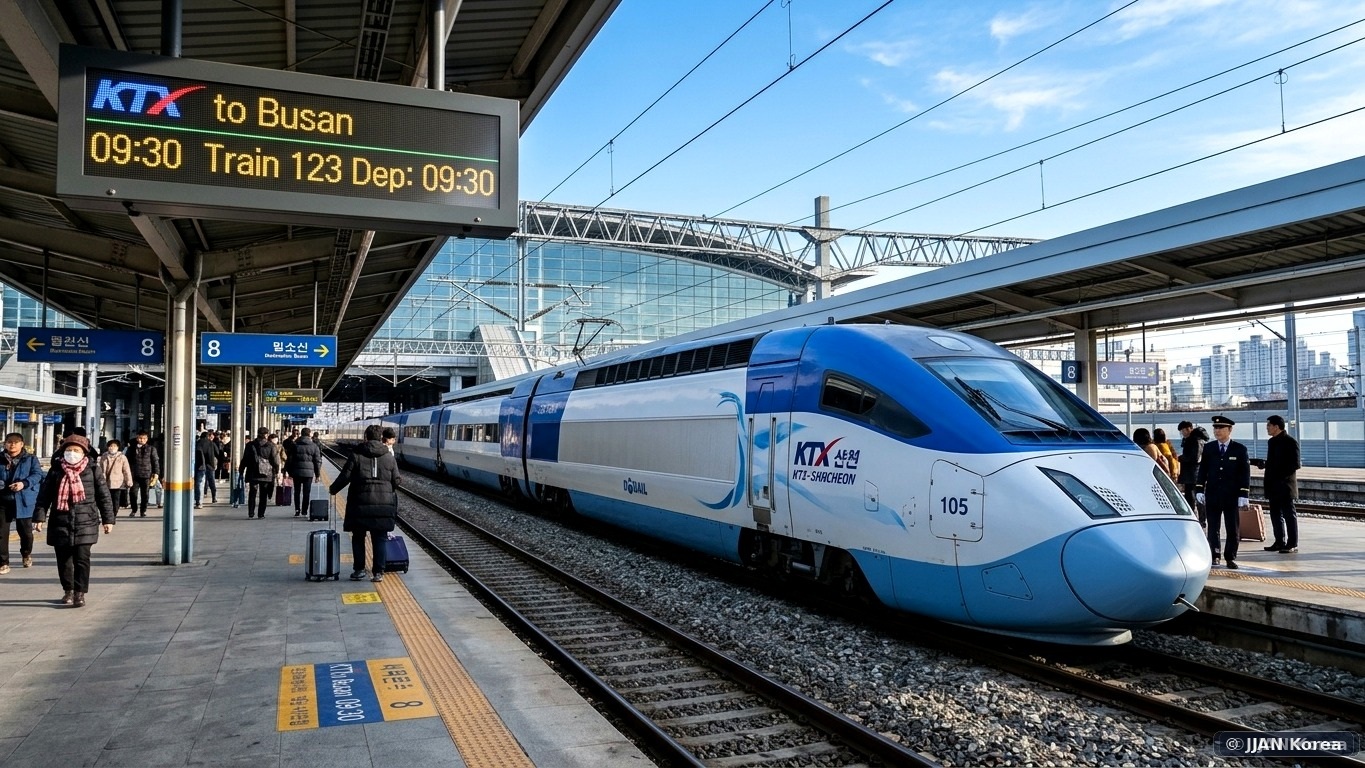
Every August and September, South Korea witnesses one of the most intense digital phenomena on the planet: the Chuseok KTX Ticketing War (추석 열차표 예매 전쟁). Organized by the national rail operator Korail and high-speed rail concessionaire SR (operator of the SRT network), this bi-annual ticketing frenzy sees millions of citizens log into specialized server queues at precisely 07:00 AM, competing furiously for seats heading to Busan, Daegu, Gwangju, Mokpo, and Gangneung. Within three minutes, hundreds of thousands of high-speed train seats evaporate completely. For foreign travelers, international exchange students, and expat professionals wishing to explore the southern coast during the harvest holiday, discovering that all standard seats are sold out weeks in advance can feel like a total travel roadblock. However, by mastering standing room allocations, automated cancellation tracking, and intercity highway alternatives, securing comfortable transport remains entirely achievable.
1. The Mechanics of the Chuseok Railway Reservation System
Korail segregates holiday travel bookings from its everyday rolling 30-day reservation window. Instead, holiday tickets are released during a dedicated two-to-three day reservation window held roughly four to five weeks prior to the holiday. The booking window divides national rail routes chronologically: Gyeongbu/Gyeongjeon lines (Busan, Jinju, Pohang) on Day One, and Honam/Jeolla lines (Gwangju, Yeosu, Mokpo) on Day Two.
| Ticket Category | Booking Channel | Release Window | Foreigner Accessibility Rating |
|---|---|---|---|
| Dedicated Senior & Disabled Pre-Booking | Korail Website / Phone Hotline | Day 1 (09:00~15:00) | Restricted (Korean ID verification required) |
| General Citizen Online Booking | Korail Special Holiday Webpage | Days 2 & 3 (07:00~13:00) | Moderate (Heavy server queues; Korean UI) |
| Unsold Seat & Standing Ticket Release | Standard KorailTalk App & Website | Day 3 from 15:00 onwards | High (English Korail website & foreign credit cards) |
| Last-Minute Cancellation Drops (Chuisopyo) | KorailTalk App (Continuous Refresh) | 48 hours to 2 hours pre-departure | Very High (Fastest method for solo travelers) |
| In-Person Station Counter Standing Tickets | Physical Station Ticket Windows | Day of travel at departure station | High (Guaranteed boarding; no reserved seat) |
For most international residents who do not possess a resident registration number or fluency in navigating high-pressure Korean reservation queues, attempting to compete during the 07:00 AM online rush is rarely successful. Instead, knowing the operational framework for mastering standard Korail seat booking systems and credit card checkouts during secondary release phases is where your true strategic advantage lies.
2. Advanced Tactics: Snagging Canceled Seats & Standing Tickets
The secret that veteran Korean commuters rely upon is that nearly 30% to 40% of all tickets purchased during the initial morning ticketing frenzy are speculative reservations made by family members booking multiple backup options. Korean rail regulations impose minimal cancellation penalties until 48 hours prior to train departure. Consequently, a massive wave of ticket cancellations—known in Korean as Chuisopyo (취소표)—floods back into the central ticketing database during the final three days before Chuseok.
- The Midnight Cancellation Sweep: Korail’s automated payment deadline for unpaid holiday reservations expires at midnight on the designated payment deadline day. Setting an alarm for 00:01 AM frequently reveals dozens of prime high-speed seats returning to the inventory pool instantly.
- The KorailTalk App Rapid Refresh Strategy: Open the official KorailTalk mobile application during off-peak commuting hours (specifically 23:00 to 01:00 or 05:30 to 06:30 AM). Select your desired origin, destination, and departure date. Repeatedly tap “Lookup” (조회하기). Solo travelers hunting for single seats have an exceptionally high success rate (over 75%) of intercepting canceled seats within a 20-minute window of focused refreshing.
- Standing + Seated Combination Tickets (Ip-seok / Jwah-seok Yeon-gyeol): If an entire journey from Seoul to Busan (2.5 hours) has no continuous seats, the KorailTalk system allows you to book a “combined ticket.” For example, you may sit in a reserved seat from Seoul to Daejeon (55 minutes), and then stand in the vestibule between train cars from Daejeon to Busan (80 minutes). This halves physical fatigue while guaranteeing legal boarding.
- Direct Station Counter Standing Tickets (Ipseok): On the actual day of travel, Korail releases standing-room-only tickets (입석 – Ipseok) exclusively at physical station ticket counters. These tickets cost 15% less than standard fare and permit you to board the designated train and stand in the vestibules between passenger cars. Arrive at Seoul Station or Yongsan Station 45 minutes prior to scheduled departure to purchase these at the customer service desk.
3. Highway Alternatives: Premium Express Buses & Dedicated Bus Lanes
If high-speed rail remains completely unavailable, South Korea’s intercity and express bus network provides an outstanding fallback. Korea operates the Gyeongbu Expressway Dedicated Bus Lane (Bus Jeonyongcharo), which runs down the center of the country’s main arterial highway from Hannam Bridge in Seoul all the way south past Daejeon.
While private passenger vehicles sit trapped in horrific multi-hour gridlock (often taking 8 to 9 hours to reach Busan), official express buses travel down unobstructed high-occupancy bus lanes, completing the trip in 4.5 to 5.5 hours. Furthermore, reserving a seat on a Premium Express Bus (프리미엄 고속버스) provides a business-class flight experience on wheels: 160-degree fully reclining leather sleeper pods, personal entertainment touchscreens with smartphone mirroring, privacy curtains, wireless charging pads, and dedicated USB power ports.
Express bus tickets can be reserved through the nationwide integrated portal (Kobus / T-Money Express Bus app). Unlike high-speed trains which operate on fixed rail capacity, express bus terminal dispatchers add dozens of temporary backup buses (Imshi-cha) on high-demand holiday routes as tickets sell out.
4. Domestic Flights and Regional Detour Routing
When overland transit is completely saturated, air travel offers a fast and surprisingly affordable bypass. While Gimpo (GMP) to Jeju (CJU) flights are heavily booked by domestic vacationers, flights connecting Seoul Gimpo with Gimhae International Airport in Busan, Daegu Airport, Ulsan Airport, or Yeosu Airport frequently have open seats. By evaluating domestic flights from Gimpo Airport as an alternative to sold-out trains, budget travelers can reach Busan in just 55 minutes flying time on carriers like Korean Air, Asiana, Jeju Air, Jin Air, or Air Busan.
Another insider method is “reverse travel” (Yeok-gwi-seong – 역귀성). Because the vast majority of holiday traffic flows outward from Seoul to the provinces before Chuseok and inward back toward Seoul after Chuseok, trains moving in the opposite direction operate half-empty! If you travel from Busan to Seoul right before Chuseok and head south right after, tickets are effortlessly available at standard discount fares.
4. Strategic Seat Selection: KTX vs. KTX-Sancheon Amenities & Quiet Cars
When booking tickets during holiday rushes, understanding the physical differences between French-designed classic KTX-I train sets and modern Korean-built KTX-Sancheon and KTX-Eum trains dramatically impacts travel comfort. Classic KTX-I consists of 20 cars where seats in Cars 1 through 8 face backward and forward toward a fixed center table, featuring narrower legroom and sparse electrical charging outlets located only along the window pillars between every two window bays.
By contrast, KTX-Sancheon (Cars 1 through 8) and high-speed KTX-Cheongryong train sets feature fully rotatable passenger seating where every seat faces forward with 55mm wider knee clearance, individual dedicated 220V power outlets and dual USB charging sockets beneath every center armrest, and high-speed onboard Korail Wi-Fi that automatically reconnects every 30 minutes. If traveling with elderly family members or needing to work remotely on a laptop, aim for Car 2 (First Class / Teuk-shil) or Car 4 (Designated Quiet Car / Jeongjeok-sil), where mobile phone voice calls, noisy multimedia games, and loud group chatter are strictly prohibited by Korail conductor enforcement.
| Train Fleet Model | Standard Legroom | Power Outlets | Seat Directionality | Luggage Rack Dimensions |
|---|---|---|---|---|
| Classic KTX-I (20 Cars) | 860 mm (Tighter) | Pillars only (Every 2nd window) | 50% Forward / 50% Reverse (Fixed) | Upper overhead racks; end-of-car bins (up to 28-inch suitcases) |
| KTX-Sancheon (8 Cars) | 960 mm (+100mm) | Every seat (Under center console) | 100% Forward-Facing (Rotatable) | Spacious end-car luggage bays with retention straps |
| KTX-Eum (EMU-260) | 960 mm (Spacious) | Every seat + Wireless phone pads | 100% Forward-Facing | Dedicated wide luggage compartments at car vestibules |
5. Frequently Asked Questions (FAQ)
Q1: Can I board a KTX without a ticket and just pay a fine to the conductor?
Strictly avoid this! Boarding a KTX without a valid ticket is classified as fraudulent boarding (Bujeong Seungcha). Train conductors carry synchronized handheld passenger seating tablets. If you board without a ticket during Chuseok, Korail rules mandate a penalty surcharge of 0.5x to 10x the full fare, and the conductor possesses the legal authority to force you off at the next immediate station stop.
Q2: Where do standing ticket passengers stay on the KTX?
Standing ticket holders must remain in the open vestibules connecting the passenger train cars. These areas feature small fold-down jump seats (two per vestibule) mounted adjacent to the exterior doors. If you board early and claim a jump seat, you can sit down for the entire journey. Vestibules also feature automated vending machines and luggage storage racks.
Q3: Does the foreign Korail English website show the same tickets as the Korean app?
Yes, the underlying reservation database is identical. However, the English website interface lacks automated push notifications and rapid one-click refresh triggers present in the Korean KorailTalk mobile application. For high-speed cancellation hunting, the Korean smartphone app is noticeably faster.
Q4: Can I use the SRT high-speed train from Suseo Station instead of Seoul Station KTX?
Yes. The SRT operates from Suseo Station in southeastern Seoul along the same high-speed tracks to Busan and Mokpo. However, the SRT ticketing system is run independently by SR Corporation via its own app (SRT – 수서고속철도). SRT holiday ticketing runs on a separate schedule and also experiences heavy demand, but it represents an additional valuable inventory pool to monitor for cancellations.
🛡️ JJAN Korea Editorial Standards & Fact-Checking Verification
This high-speed rail booking strategy guide has been written and verified by Travel Editor Do-jun Kim following operational guidelines issued by Korail (Korea Railroad Corporation) and the Ministry of Land, Infrastructure and Transport (MOLIT).
- Ticketing schedules and standing room fare rules verified directly via Korail Passenger Transport Regulations.
- Highway bus lane operating hours cross-referenced with Korean National Police Agency Holiday Traffic Plans.
- Domestic flight alternatives confirmed against Gimpo Airport domestic flight operational schedules.