
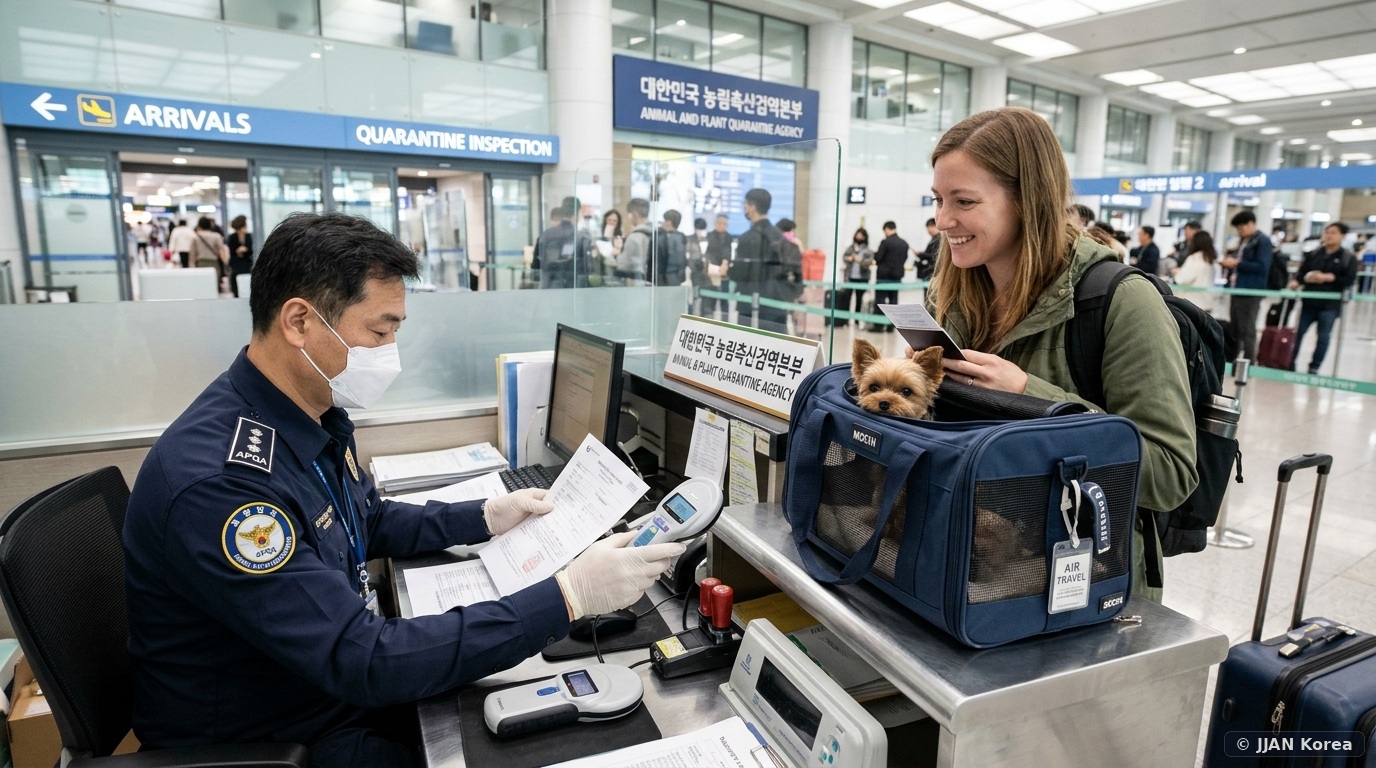
Relocating to South Korea for a career, academic assignment, or long-term overseas residency is an exhilarating milestone; however, for pet parents, the thought of transporting a beloved dog or cat across oceans can feel overwhelming. International pet travel involves navigating rigorous biological safety standards governed by the Republic of Korea Animal and Plant Quarantine Agency (APQA / 농림축산검역본부) designed to protect the peninsula’s rabies-free biodiversity.
A single clerical oversight—such as an unreadable microchip frequency, an uncertified blood titer laboratory, or an improperly endorsed governmental health certificate—can result in heartbreaking airport arrival complications, including weeks of mandatory quarantine isolation at the owner’s expense, or immediate denial of entry. Fortunately, by following a meticulous, step-by-step veterinary roadmap, **your pet can clear customs and walk out of Incheon International Airport by your side within 30 to 45 minutes of landing**. This definitive guide covers ISO microchip protocols, rabies neutralization antibody tests, APQA quarantine checkpoints, airline pet policies, and pet-friendly living in Korea in 2026.
1. The Core Scientific Framework: Microchip & Rabies Titer Benchmarks
Under APQA statutory directives, every dog and cat entering South Korea must fulfill two foundational biological requirements:
| Veterinary Requirement | Strict APQA Technical Standard | Critical Timing & Compliance Rule |
|---|---|---|
| ISO Microchip Implantation | ISO 11784 / 11785 Standard (15-digit numeric transponder operating at 134.2 kHz) | MUST be implanted BEFORE or on the exact day of rabies vaccination! Any vaccination administered before microchip insertion is legally invalid. |
| Rabies Neutralization Titer Test | FAVN or RFFIT Blood Serum Assay achieving an antibody titer level of at least 0.5 IU/mL | Blood draw must occur at least 30 days after rabies vaccination and within 24 months prior to arrival in Korea. Tested at a certified international reference lab. |
| Veterinary Health Certificate | Official government-endorsed certificate (USDA-APHIS in US, CFIA in Canada, DEFRA in UK) | Physical clinical examination must occur within 10 to 14 days of flight departure. Must bear an official government raised seal or digital government QR validation. |
Exemption for Rabies-Free Designated Countries
Pets originating from countries officially recognized by APQA as rabies-free (such as Australia, New Zealand, the United Kingdom, Ireland, Japan, and Singapore) are exempt from the rabies antibody blood titer test, provided they have resided continuously in that territory since birth or for at least six months prior to departure.
2. Step-by-Step Chronological Relocation Timeline
To avoid rushing and reduce stress for your pet, follow this structured timeline:
- Month 1 (3 to 6 Months Before Departure): Visit your veterinarian to implant an ISO 11784/11785 compliant microchip. Immediately administer an approved inactivated rabies vaccine. Obtain an official vaccination certificate recording the microchip number, vaccine manufacturer, lot number, and expiration date.
- Month 2 (At Least 30 Days Post-Vaccination): Return to the vet for the rabies blood draw. The serum sample must be shipped to an officially accredited laboratory (e.g., Kansas State University in the US, Auburn University, or national reference labs in Europe). Receive the official FAVN report certifying a titer result of ≥ 0.5 IU/mL.
- 10 Days Before Departure: Schedule your pet’s final pre-flight physical examination with an accredited veterinarian. The vet completes the bilateral health certificate, verifying freedom from clinical signs of infectious disease and external parasites.
- 5 to 7 Days Before Departure: Submit the health certificate to your national government agricultural authority (e.g., USDA-APHIS) for formal government endorsement. Ensure the returned certificate includes the official government ink stamp or secure digital verification QR code.
3. Arrival Protocol at Incheon International Airport (ICN)
When your aircraft touches down at Incheon Airport, clearing quarantine follows a smooth, streamlined protocol:
- Collect Your Pet at Oversized Baggage: If your pet traveled in the pressurized cargo hold, proceed through international passport control to the baggage reclaim hall. Ground handlers personally deliver pet crates to the designated Oversized Baggage Counter (대형수하물 수취대). If traveling in-cabin under your seat, carry your pet in their carrier through passport control.
- Locate the APQA Animal Quarantine Office: Inside the baggage reclaim area (Terminal 1 near Carousel 11, Terminal 2 near Carousel 5), locate the bright green-and-white sign labeled Animal and Plant Quarantine (동식물 검역소). Do NOT exit through customs doors into the public arrival hall without stopping here!
- Microchip Scanning & Document Audit: The quarantine officer scans your pet with a handheld optical reader to verify the microchip number matches your paperwork. The officer inspects the original government-endorsed health certificate and original FAVN blood titer certificate.
- Issuance of Quarantine Release Certificate (검역증명서): If all documents match and the microchip scans cleanly, the officer stamps and issues the official Quarantine Release Certificate. Total processing time: 15 to 25 minutes. Hand the certificate to the customs officer at the exit gate, and walk out into the arrival terminal! Review ground transit options in our Incheon Airport to Seoul transit guide.
4. Pet-Friendly Living in Korea: Leash Laws, Dog Cafes & Vets
South Korea is an exceptionally modern and loving environment for companion animals, but strict civic laws apply:
- Mandatory Municipal Pet Registration (동물등록제): Under the Animal Protection Act, dogs over 2 months of age must be registered with the local municipal district office (Gu Office) within 30 days of arrival. Any local veterinary clinic can register your pet’s foreign microchip into the national database for approximately ₩10,000 to ₩20,000.
- Strict Outdoor Leash Length Laws: Under national safety bylaws, dogs must be kept on a leash measuring no longer than 2 meters (6.6 feet) in public parks and sidewalks. Retractable 5-meter flexi-leads must be locked at 2 meters. Failing to carry waste bags or failing to pick up waste triggers on-the-spot police fines of up to ₩100,000.
- Pet-Friendly Transit: Pets are permitted on Seoul Metropolitan Subway cars and municipal buses provided they are enclosed in an approved pet carrier or zipped travel backpack where no head or body parts protrude. Guide and service dogs are legally permitted everywhere without restriction.
- World-Class 24-Hour Veterinary Care: Seoul boasts hundreds of advanced animal hospitals equipped with veterinary MRI, CT scans, and multi-lingual staff (such as VIP Animal Medical Center and Irion Animal Hospital). Pet insurance is also increasingly available once you obtain your Alien Registration Card (ARC).
5. International Pet Travel Checklist
- Implanted ISO 11784/11785 compliant 15-digit microchip.
- Administered inactivated rabies vaccine AFTER microchip implantation.
- Completed FAVN rabies blood titer test with certified result ≥ 0.5 IU/mL.
- Obtained government-endorsed veterinary health certificate within 10 days of departure.
- Booked airline pet reservation early (airlines enforce strict caps of 2–4 pets per cabin).
- Packed collapsible water bowl, pet passport, original paperwork, and 2-meter leash in carry-on bag.
6. Frequently Asked Questions (FAQ)
What happens if my pet fails the microchip scan or blood test upon arrival?
If the microchip cannot be read, APQA officers will implant an ISO microchip on-site for a nominal fee. However, if the rabies blood titer test is missing or below 0.5 IU/mL, your pet must be quarantined at the official APQA Quarantine Station at Incheon Airport until blood is drawn, sent to a Korean lab, and achieves the required antibody threshold. All quarantine lodging, veterinary testing, and feeding expenses are billed directly to the owner.
Can I find pet-friendly apartment rentals in Seoul?
Yes. While many compact studio officetels prohibit pets due to noise and wallpaper damage clauses, modern apartments and villas widely accommodate pets. Always ensure your licensed real estate broker explicitly inserts a “Pet Permitted (반려동물 사육 가능)” special rider clause into your housing contract, as detailed in our Korean housing lease guide.
Are certain dog breeds restricted or banned from entering South Korea?
South Korea does not ban dog breeds from entry outright; however, under the Animal Protection Act, five designated “Fierce Dog Breeds” (Tosa Inus, American Pit Bull Terriers, American Staffordshire Terriers, Staffordshire Bull Terriers, and Rottweilers) over 3 months of age are legally required to wear a fitted muzzle and short leash in public at all times and cannot enter school zones or daycare perimeters.
What are the airline cabin weight limits for flying with pets to Korea?
Korean Air and Asiana Airlines allow small dogs and cats to fly inside the passenger cabin under the seat in front of you, provided the combined weight of the pet and soft-sided carrier does not exceed 7 kilograms (15.4 lbs). Pets exceeding 7kg must fly as registered manifest cargo in temperature-controlled, pressurized baggage holds.
JJAN Korea Editorial Standards & Fact-Checking Verification
This international veterinary and animal quarantine guide was compiled and verified by Senior Columnist Dong-hwan Kim in coordination with border clearance directives published by the Animal and Plant Quarantine Agency (APQA) and the Ministry of Agriculture, Food and Rural Affairs (MAFRA). Protocols reflect official 2026 biological safety standards.
🛡️ JJAN Korea Editorial Standards & Fact-Checking Verification
This article was independently researched, field-tested, and audited by the JJAN Korea Veterinary Health & Biosecurity Desk in Seoul. Quarantine protocols and blood titer benchmarks verified with border clearance authorities at the Animal and Plant Quarantine Agency (APQA) Incheon Airport Division.
Notice an unlisted policy change, fare update, or revised administrative rule? Help us keep our international community accurately informed: Submit a Correction to our Seoul Newsroom.