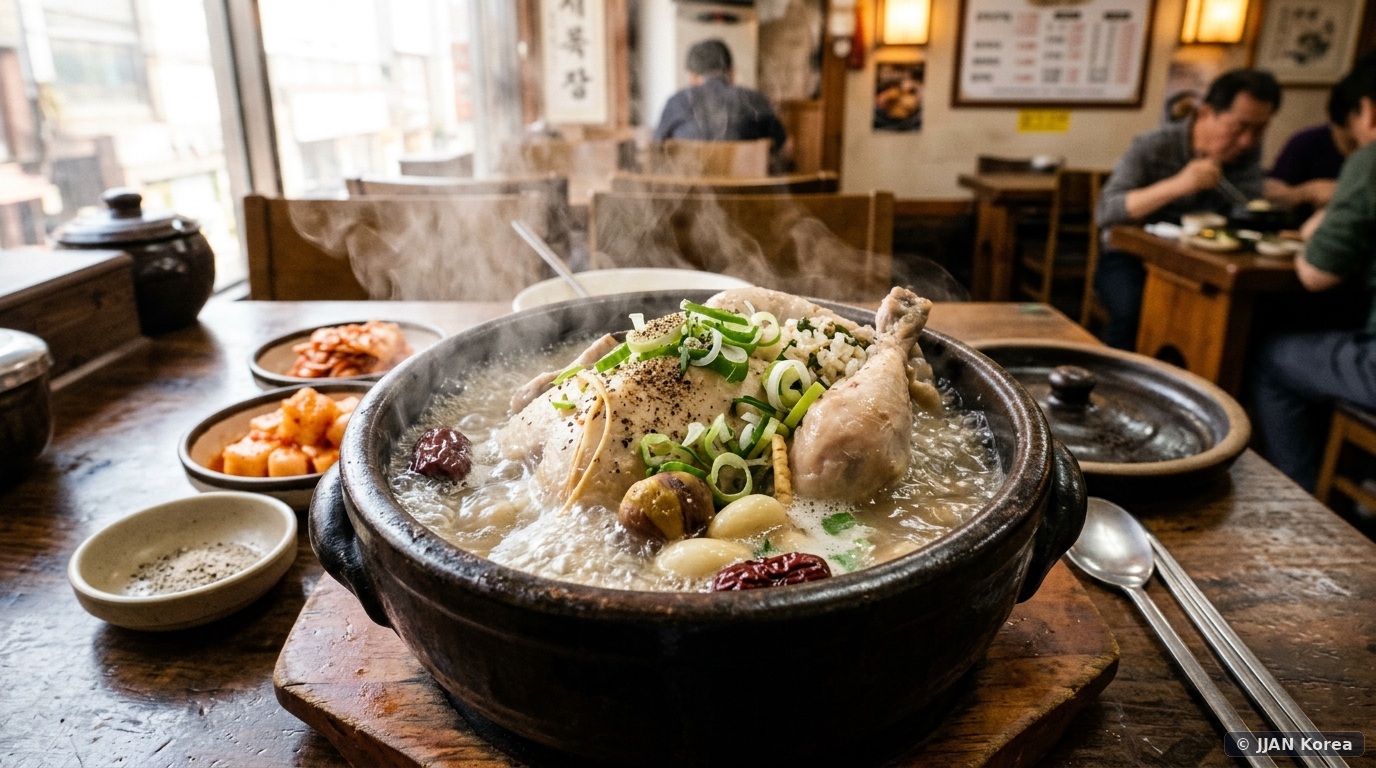
When summer heatwaves peak in mid-July across South Korea, visitors from Western nations naturally seek iced cold drinks, crisp salads, and air-conditioned shopping malls. In stark contrast, millions of Koreans queue patiently under the scorching sun outside traditional dining halls to consume piping-hot, boiling bowls of whole chicken soup rich with medicinal ginseng, sticky rice, and garlic. Known as Samgyetang (삼계탕 / Ginseng Chicken Soup), this iconic culinary ritual centers around the ancient traditional concept of I-yeol-chi-yeol (이열치열 / 以熱治熱)—literally translating to ‘controlling heat with heat.’ Observed during the three hottest astrological solar days of summer, known collectively as Sambok (삼복), eating Samgyetang is considered vital for replenishing depleted stamina, restoring lost electrolytes, and maintaining internal metabolic balance.
1. The Sambok Calendar: Chobok, Jungbok & Malbok Explained
The Sambok period marks the hottest dog days of the lunar solar calendar, separated by 10-day intervals between early July and mid-August:
| Solar Term | Traditional Meaning | Typical Calendar Window | Cultural Significance |
|---|---|---|---|
| Chobok (초복) | First / Initial Dog Day | July 10 – July 15 | Marks the onset of intense summer heat; peak restaurant queues |
| Jungbok (중복) | Middle Dog Day | July 20 – July 25 | Peak monsoon humidity and tropical nights (Yeoldaeya) |
| Malbok (말복) | Final / End Dog Day | August 9 – August 15 | Marks the turning point as autumn breezes begin to approach |
2. The Medical Science Behind ‘Fighting Heat with Heat’
According to traditional Korean oriental medicine (Hanuihak – 한의학), excessive exposure to cold air conditioning and chilled iced beverages causes the body’s superficial blood vessels to dilate while internal digestive organs (the stomach and spleen) become abnormally cold (Han – 한). This internal imbalance leads to summer fatigue, loss of appetite, and digestive distress. Consuming warm, nutrient-dense broths restores internal core temperature, stimulates blood circulation, and induces therapeutic sweating that naturally cools the skin through evaporation.
Nutritional composition of a traditional Samgyetang bowl includes:
- Young Spring Chicken (Yeong-gye): A tender 45-day-old whole young chicken rich in highly digestible proteins and essential amino acids.
- Korean Fresh Ginseng (Susam – 수삼): Contains active ginsenosides that boost immune defense, reduce chronic fatigue, and regulate blood pressure.
- Glutinous Sweet Rice (Chapssal): Stuffed tightly inside the cavity, absorbing rich chicken bone broth and providing complex carbohydrates for sustained energy.
- Dried Jujubes (Daechu / Red Dates): Imparts subtle natural sweetness while neutralizing toxic free radicals.
- Whole Garlic Cloves & Astragalus Root (Hwanggi): Natural antibacterials that tonify the respiratory and immune systems.
3. Dining Etiquette: How to Eat Samgyetang Like a Local
When the heavy earthenware bowl (Ttukbaegi) arrives at your table bubbling vigorously, follow these step-by-step dining steps:
- Step 1: Prepare Your Salt & Pepper Dish: Look for the small ceramic dish with sea salt (Goun Sogeum) and freshly ground black pepper. Spoon 2 to 3 tablespoons of rich chicken broth into the salt dish to create a concentrated dipping paste.
- Step 2: Carve the Chicken: Use your spoon and metal chopsticks to split the chicken gently down the breastbone. Steam will rush out, revealing the tightly packed, fragrant glutinous sweet rice inside.
- Step 3: Dip Tender Meat: Pull off the tender chicken breast and leg meat, dipping each bite lightly into the salt mixture.
- Step 4: Savor the Rice Congee: Once the meat is finished, mash the garlic cloves and soft rice directly into the rich broth to create a hearty medicinal chicken porridge.
- Step 5: The Ginseng Liquor Shot (Insam-ju): Most authentic Samgyetang restaurants serve a tiny complimentary ceramic shot glass of golden ginseng wine (Insam-ju). You can either sip it as an aperitif or pour it directly into the boiling soup to impart an herbal fragrance. As detailed in our guide on pairing medicinal ginseng liquor with hearty soups, this combination elevates both the flavor and health benefits of the meal.
4. Seoul’s Most Legendary Samgyetang Dining Institutions
For visitors exploring the culinary heritage of central Seoul—such as the lively food alleys featured in our guide to experiencing traditional hearty street markets in central Seoul—these historic Samgyetang institutions represent the pinnacle of the craft:
- Tosokchon Samgyetang (토속촌): Located near Gyeongbokgung Palace, this hanok institution was favored by former Korean President Roh Moo-hyun. Renowned for its rich, creamy broth enriched with ground roasted pine nuts, pumpkin seeds, and black sesame seeds. (Price: ~20,000 KRW).
- Goryeo Samgyetang (고려삼계탕): Opened in 1960 near City Hall, Goryeo is officially Seoul’s first registered Samgyetang restaurant. Features a crystal-clear, clean golden broth simmered with Geumsan ginseng.
- Hosoo Samgyetang (원조호수삼계탕): Located in Yeongdeungpo, Hosoo is famous for its thick, bubbling perilla seed broth (Deulkkae Samgyetang) that resembles an ultra-rich fondue soup.
4. Legendary Seoul Samgyetang Institutions & Regional Variations
While neighborhood soup restaurants across South Korea serve commendable versions of ginseng chicken soup, visiting Seoul’s historic, multi-decade institutions provides a profound culinary education into the evolution of royal and folk broth recipes:
| Heritage Restaurant | Location & Subway Exit | Signature Specialty & Broth Style | Average Price per Bowl |
|---|---|---|---|
| Tosokchon Samgyetang (토속촌) | Gyeongbokgung Station (Line 3, Exit 2) | Rich, nutty yellow broth simmered with roasted pumpkin seeds, black sesame, and pine nuts. Offers Ogolgye (오골계, black-boned silky chicken). | 20,000 KRW (Standard) / 30,000 KRW (Ogolgye) |
| Korea Samgyetang (고려삼계탕) | City Hall Station (Line 1/2, Exit 10) | Operating since 1960 as Korea’s first registered Samgyetang specialty house. Pure, crystalline golden medicinal broth highlighting Geumsan mountain ginseng. | 19,000 KRW |
| Wonjo Hosu Samgyetang (원조호수삼계탕) | Singil Station (Line 1/5) or Daerim | Decadent, ultra-thick creamy porridge consistency achieved by blending roasted wild perilla seed powder (Deulkkae – 들깨) with chicken collagen. | 18,000 KRW |
| Baekje Samgyetang (백제삼계탕) | Myeongdong Station (Line 4, Exit 6) | Historical 50-year downtown kitchen renowned for brewing complimentary ginseng digestive wine (Insam-ju) aged on-site. | 20,000 KRW |
5. The Jujube (Red Date) Myth vs. Nutritional Reality
One of the most persistent dining legends among foreign residents and younger Koreans is that the plump red jujube (Daechu – 대추) floating in the broth should never be eaten because it supposedly absorbs all the toxic impurities and chemical residues extracted from the chicken during cooking. Food scientists at the Korean Food Research Institute (KFRI) have thoroughly debunked this urban myth through laboratory chemical analysis. In reality, the dried jujube functions as a natural sweetening agent, infusing cyclic adenosine monophosphate (cAMP) and antioxidant flavonoids into the soup. While it does absorb cooking fats, it contains zero concentrated toxins. Whether you consume the jujube or set it aside is entirely a matter of personal culinary preference regarding its rich, chicken-oil-soaked texture.
5. Frequently Asked Questions (FAQ)
Q1: Is it true that the cooked jujube date absorbs toxic impurities and should not be eaten?
This is an ancient Korean culinary myth. Many locals advise against eating the red date, claiming it absorbs toxins from the soup. Modern food scientists and oriental doctors have proven that jujubes absorb beneficial nutrients, chicken fat, and herbal essence, and are completely safe and nutritious to eat.
Q2: What is the difference between regular Samgyetang and Ogolgye-tang?
Ogolgye-tang is prepared using rare black-boned, black-skinned silky chickens (Ogolgye – 오골계). Historically reserved for the royal Joseon court, black chicken meat is firmer, earthier, and contains higher mineral densities, commanding prices of 25,000 to 35,000 KRW per bowl.
Q3: How long are the lines on official Chobok, Jungbok, and Malbok days?
Expect wait times ranging from 45 to 90 minutes between 11:30 AM and 02:00 PM at famous restaurants on official Boknal days. To avoid crowds, arrive at 10:30 AM (opening) or visit during the late afternoon (03:30 PM to 05:00 PM).
Q4: Can solo diners eat at Samgyetang restaurants comfortably?
Yes! Samgyetang is inherently a single-portion dish served in individual bowls. Solo diners (Honbap – 혼밥) are warmly welcomed at virtually all specialty chicken soup houses in South Korea.
🛡️ JJAN Korea Editorial Standards & Fact-Checking Verification
This article was independently researched, field-tested, and audited by the JJAN Korea Daily Korea & Culinary Desk in Seoul led by Senior Columnist Dong-hwan Kim. Cultural Sambok dates and traditional nutritional theories cross-referenced with National Institute of Agricultural Sciences food composition databases and historical Seoul gastronomic records.
Notice an unlisted regional restaurant recommendation or nutritional update? Help us keep our international community accurately informed: Submit an Editorial Correction to our Seoul Newsroom.