
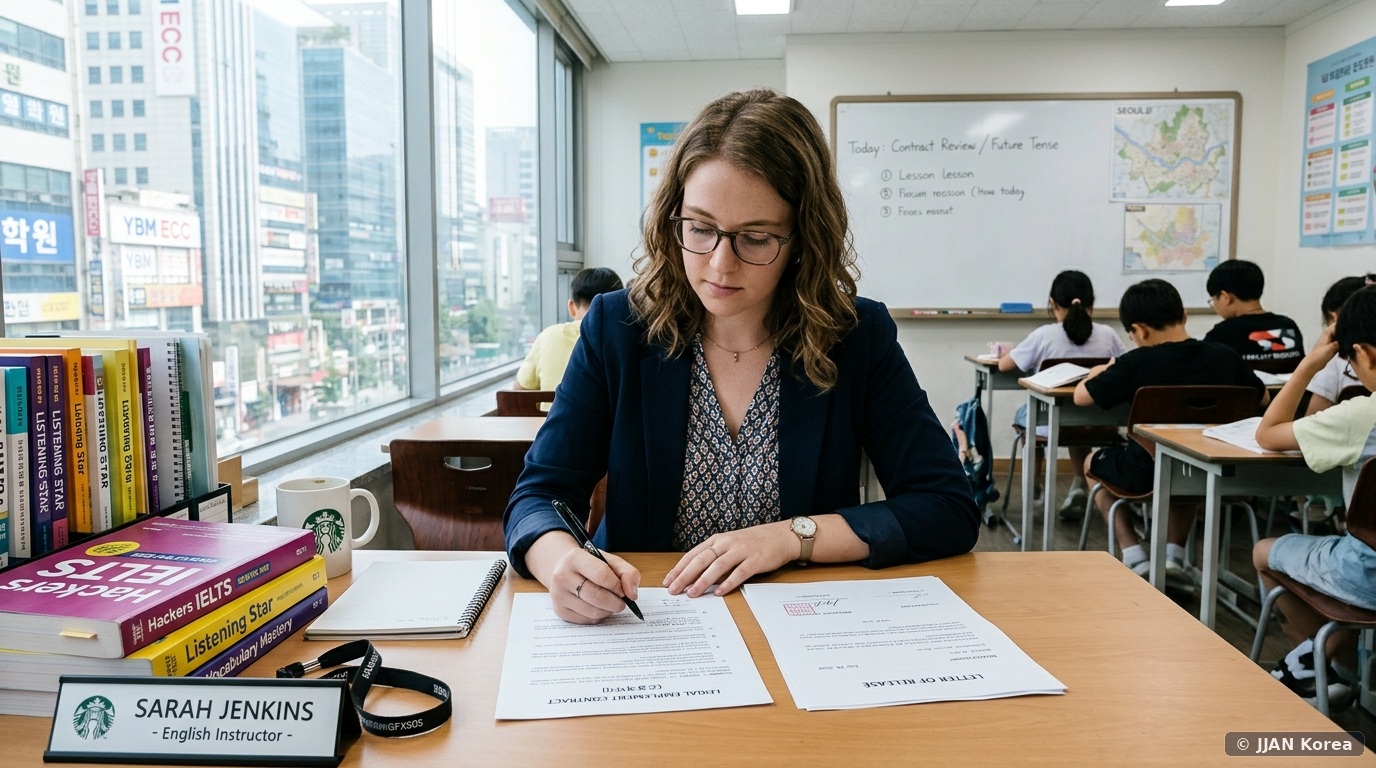
Thousands of foreign native English speakers reside in South Korea under the E-2 Conversational English Instructor Visa (회화지도 비자), teaching at private academies (hagwons), public schools (EPIK/GEPIK), and international language institutes. While many teaching experiences are professionally fulfilling, foreign instructors frequently encounter workplace disputes, unreasonable contract alterations, or toxic management that necessitate changing employers mid-contract. Unlike freelance or permanent residency visa holders, E-2 visa status is legally tied to a specific sponsoring employer registered with the Ministry of Justice. Historically, transferring to a new workplace before your contract expiration required obtaining a signed Letter of Release (LOR / 이적동의서) from your current school director. Knowing your precise statutory rights under the Immigration Control Act, Labor Standards Act, and recent judicial precedents is critical for safeguarding your residency.
1. The Legal Reality of the Letter of Release (이적동의서)
Under Article 21 of South Korea’s Immigration Control Act, an E-2 visa holder cannot work for a new employer without prior permission from the jurisdictional immigration office. If your initial 1-year contract has not yet expired, immigration regulations traditionally require a Letter of Release (LOR) signed by your current employer’s corporate representative:
- What an LOR Represents: A formal statement declaring that your current sponsoring school consents to your early contract termination and releases their sponsorship claim, permitting you to transfer to another academy.
- The Power Dynamic: Employers are not legally mandated under general contract law to sign an LOR simply because an employee requests one. Unscrupulous hagwon owners sometimes weaponize the LOR, withholding signatures to trap unhappy teachers into finishing contracts under threat of visa cancellation.
- Contract Completion vs. Mid-Contract Transfer: If you successfully complete your full 1-year contract (to the final calendar day specified on your visa record), you do NOT need a Letter of Release! Upon contract completion, you are an entirely free agent entitled to sign with any school or transfer temporarily to a D-10 Job Seeker visa.
2. Four Legal Exceptions: Transferring Employers WITHOUT an LOR
The Ministry of Justice and Korean labor courts have established clear exceptions where an E-2 instructor can transfer workplaces mid-contract even if the employer refuses to issue an LOR:
| Statutory Exception Category | Required Evidentiary Documentation | Immigration Adjudication Pathway |
|---|---|---|
| Employer Wage Arrears / Non-Payment | MOEL labor petition verdict or bank transfer statements proving wages delayed > 30 days | Direct approval for workplace transfer (Permitted by Chief of Immigration) |
| School Bankruptcy / Forced Closure | Certificate of business closure (Peeop Jeungmyeong) from district tax office | Immediate transfer to D-10 Job Seeker visa or new E-2 sponsor |
| Workplace Violence / Physical Abuse | Police report (Sagon Churi Jeonpyo), hospital medical diagnosis (Jindanseo) | Emergency transfer to G-1 dispute visa with labor change permission |
| Severe Contract Breach by Employer | Written proof of uncontracted teaching hours, missing housing, or unremitted pension | Submission of grievance petition to regional immigration review board |
Remember that instructors are fully protected by national employment statutes. As explored in our deep-dive on foreign worker rights under the Korean Labor Standards Act, illegal wage deductions or uncompensated weekend hours constitute actionable labor offenses that support your petition for mid-contract transfer.
3. Contract Renewals, Housing & Mandatory Severance Pay (퇴직금)
If you choose to complete your contract or renew for a second year, ensure the following core financial entitlements are respected:
- Mandatory Severance Pay: Under the Act on the Guarantee of Employees’ Retirement Benefits, completing 365 consecutive days of employment entitles you to at least 30 days of average salary as severance pay. Familiarize yourself with the formula for claiming full severance pay (퇴직금) upon completing teaching contracts to prevent unlawful deductions for recruitment agent fees or apartment repairs.
- Housing Deposit Deductions: If your school provides single housing (officetel or villa), the lease is typically under the director’s name. When vacating, directors can only deduct documented, verified damages beyond normal wear-and-tear. Demand receipts and photos for any cleaning or repair fee deductions.
- Contract Renewal Notice Windows: Most E-2 contracts require written notice of intent to renew or depart 60 to 90 days prior to contract expiration. Deliver written notice via email or registered mail to establish an indisputable evidentiary paper trail.
4. Transitioning to a D-10 Job Seeker Visa Between Schools
If your teaching contract concludes and you have not yet secured a new teaching position, do not panic and do not overstay your visa. You can transition smoothly to a D-10-1 Job Seeker Visa (구직 비자):
- 1. Schedule an immigration appointment on HiKorea before your E-2 visa expires.
- 2. Submit a completed D-10 application along with your university degree, proof of completed contract, current housing lease, and a 6-month Job Seeking Action Plan (Gujik Hwaldong Gyehoekseo).
- 3. The D-10 visa grants an initial 6 months of legal residency in South Korea (renewable up to 2 years under point thresholds), giving you ample time to interview, review new hagwon contracts, and inspect housing before committing to your next school.
4. Filing Petitions with the Ministry of Employment & Labor (MOEL)
If your teaching employer engages in illegal labor violations—such as withholding salary, failing to pay mandatory severance pay (퇴직금), refusing national health insurance registration, or demanding unpaid teaching hours beyond contractual weekly limits—you are not held hostage by their refusal to sign a Letter of Release. Under Ministry of Justice Administrative Directive No. 2018-442, an immigration officer has the legal discretion to waive the LOR requirement if the teacher establishes that the employer committed serious contractual breaches:
- Step 1: Document Every Infraction: Maintain meticulous physical records. Save time-stamped attendance logs, monthly paystubs, kakao messages showing employer harassment or demands for illegal off-site tutoring, and bank statements demonstrating late salary deposits.
- Step 2: File a Labor Petition (진정서 접수): Submit a formal grievance through the Ministry of Employment and Labor online e-People portal (국민신문고) or visit your regional Labor Standards Office (지방고용노동청). Labor inspectors conduct an official confrontation conference (삼자대면) with your academy director.
- Step 3: Secure the Official Violation Certificate: If the labor inspector confirms that the employer violated the Labor Standards Act (such as unpaid wages exceeding 14 days post-deadline), request an official Confirmation of Violation of Labor Conditions (근로조건 위반 확인서).
- Step 4: Present Findings to Immigration: Take this government confirmation directly to your jurisdictional immigration office. Immigration officials will recognize that the employment relationship deteriorated due to employer culpability, thereby permitting a visa transfer or transition to a job-seeker visa without an employer LOR.
5. Strategic Fallback: Transitioning to the D-10 Job Seeker Visa
If your teaching contract reaches its natural expiration date or you mutually agree to part ways but have not yet finalized your next teaching placement, do not remain in the country on an expired E-2 status. Within 14 days of contract completion, file an application at HiKorea to change your status to a D-10-1 Job Seeker Visa. The D-10 status grants you six continuous months of legal residency in South Korea to interview with public school programs (EPIK / GEPIK) or private hagwons. While on D-10, you can conduct in-person demonstration lessons and sign a new contract, smoothly converting back to E-2 status without having to exit the country to an overseas embassy.
5. Frequently Asked Questions (FAQ)
Q1: What should I do if my employer threatens to ‘cancel my visa’ immediately?
Employers cannot unilaterally cancel your Foreigner Residence Card. An employer can only notify immigration that your employment relationship has terminated. Immigration will grant you a mandatory 14- to 30-day grace period to depart the country, resolve labor disputes through MOEL, or transition your status to a D-10 or G-1 visa.
Q2: Can I teach private one-on-one English lessons (Gwa-oe) while on an E-2 visa?
No. Engaging in unauthorized private tutoring (Gwa-oe – 과외) outside your officially registered school premises is strictly illegal under the Immigration Control Act. Violations carry heavy fines up to 10,000,000 KRW, visa revocation, and immediate deportation.
Q3: Does my employer have to pay for my return flight home?
If your contract explicitly contains a return flight reimbursement clause (standard in public school EPIK contracts and established hagwons), the employer must honor that contractual term upon successful contract completion. If you resign mid-contract without mutual agreement, employers are generally not obligated to pay for your return airfare.
Q4: How do I verify if my pension and health insurance were actually paid by my school?
Download the official National Pension Service (NPS) mobile app and the National Health Insurance Service (NHIS) app. Using your Joint Certificate or simple authentication, you can review your complete real-time contribution payment history. If your employer deducted insurance fees from your monthly pay slip but failed to remit them to the government, report the violation to the NHIS and MOEL immediately.
🛡️ JJAN Korea Editorial Standards & Fact-Checking Verification
This article was independently researched, field-tested, and audited by the JJAN Korea Living & Labor Desk in Seoul led by Finance Editor Seo-jun Kim. Immigration transfer regulations, Letter of Release standards, and labor dispute remedies cross-referenced with Ministry of Justice immigration decrees and Ministry of Employment and Labor legal guidelines.
Notice an unlisted immigration transfer rule revision or teaching contract decree? Help us keep our international community accurately informed: Submit an Editorial Correction to our Seoul Newsroom.