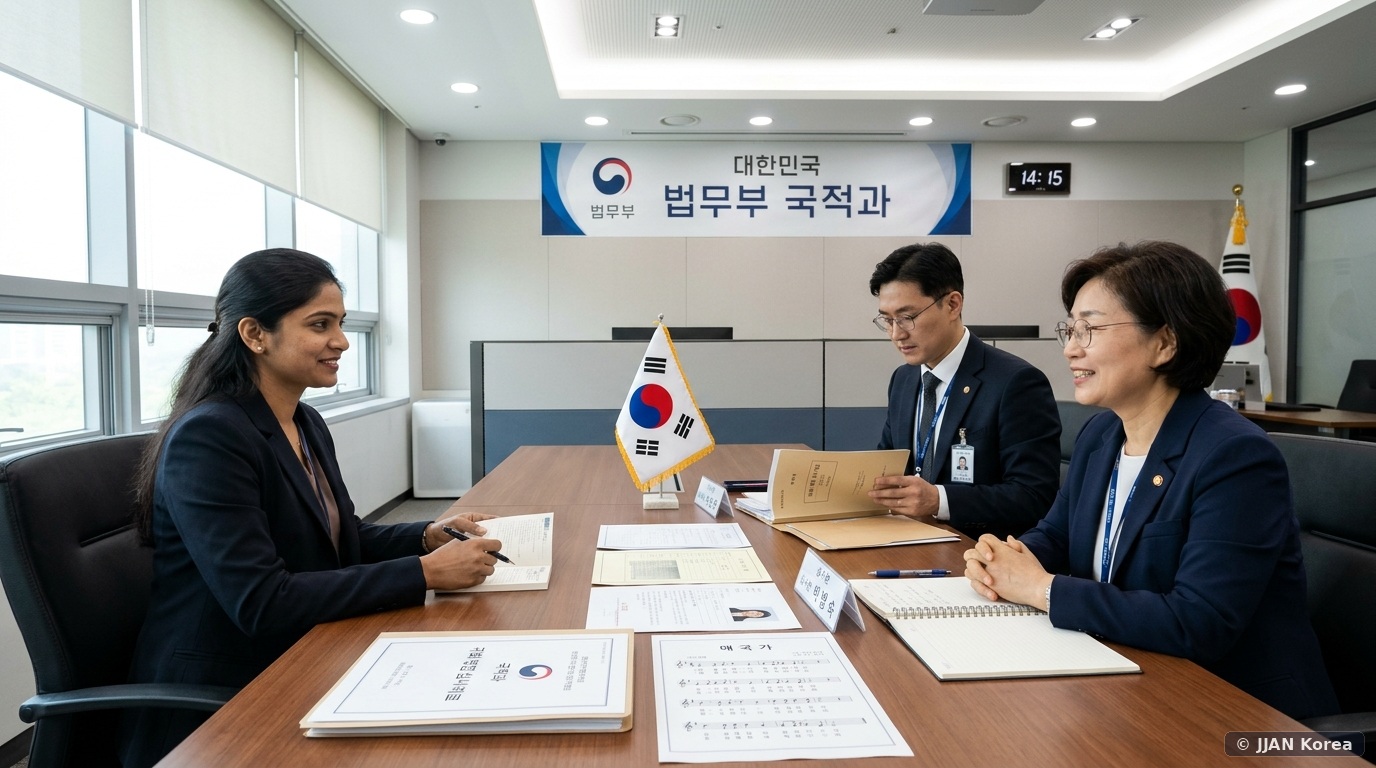
For long-term expatriates, international professionals, and foreign spouses who have built their careers, families, and lifelong homes in South Korea, the ultimate immigration milestone is acquiring South Korean Citizenship through Naturalization (Gwi-hwa – 귀화). Earning a Korean passport confers complete constitutional equality: unconditional lifetime right of abode, total exemption from visa renewals and foreign resident reporting duties, full voting rights in presidential and parliamentary elections, and visa-free travel to over 190 countries globally. However, South Korea’s Nationality Act enforces some of the most rigorous naturalization standards in the developed world. Applicants must satisfy demanding residency durations, prove substantial financial self-sufficiency, pass the grueling Comprehensive Naturalization Examination, undergo an intensive oral interview testing historical and constitutional knowledge, and navigate complex dual nationality regulations.
1. The Three Naturalization Pathways: General, Simplified & Special
Under the Korean Nationality Act, naturalization applications are divided into three distinct legal tracks depending on ancestral background and family ties to Korean citizens:
| Naturalization Track | Residency Requirement | Financial Income Threshold | Target Applicant Profile |
|---|---|---|---|
| General Naturalization (Ilban Gwihwa) | 5+ Years Continuous Domicile in South Korea | Household income exceeding GNI per capita (approx. 44M+ KRW) | Standard foreign professionals (E-7, F-2-7) with no prior Korean heritage |
| Simplified Naturalization (Gan-i Gwihwa) | 3+ Years Continuous Domicile in Korea | Moderate financial stability proof (or assets exceeding 30M KRW) | Adults whose parents were Korean citizens, or persons born in Korea |
| Marriage Naturalization (Hon-in Gwihwa) | 2+ Years Marriage & Residency in Korea (or 3 yrs married + 1 yr residency) | Shared household financial assets satisfying basic stability | Foreign spouses of Korean citizens holding active F-6 visas |
| Special Naturalization (Teukbyeol Gwihwa) | No minimum duration required | Statutory exemptions apply | Persons of outstanding extraordinary talent (science, culture, sports) or national merit |
For international spouses of Korean citizens, by understanding simplified naturalization routes available for spouses of Korean citizens, the residency requirement is slashed to just two years, providing the fastest legal track toward citizenship.
2. The Written Examination: Comprehensive Evaluation (K-CIP)
Under Ministry of Justice regulations, general naturalization applicants must demonstrate foundational civic and linguistic competence by passing the Comprehensive Evaluation for Naturalization (Gwihwa-yong Jonghap Pyeongga) administered under the Korea Immigration and Integration Program (KIIP).
The computer-based written exam consists of 40 multiple-choice questions testing Korean grammar, reading comprehension, historical milestones (the Joseon Dynasty, the March 1st Independence Movement, the Korean War), constitutional values, and contemporary social institutions. Applicants must achieve a minimum score of 60 points out of 100 to pass.
The Golden Exemption: By completing KIIP Stage 5 to earn total exemption from the written citizenship test, foreign residents who graduate from the 70-hour “Understanding Korean Society” course are 100% exempted from taking the written naturalization exam, bypassing months of high-stress standardized testing.
3. Conquering the Oral Interview: Aegukga, History & Civic Loyalty
Passing the written exam qualifies you for the high-stakes Naturalization Oral Interview (Myeonjeop Simsa – 면접심사) conducted at your jurisdictional immigration office before two senior Ministry of Justice examiners. The interview evaluates five non-negotiable criteria:
- Singing the National Anthem (Aegukga – 애국가): The interview begins with the candidate standing at attention before the Korean national flag (Taegeukgi). You must sing Verse 1 of Aegukga from memory without sheet music, maintaining proper pitch, accurate lyrics, and dignified posture. Stumbling over lyrics or refusing to sing results in an immediate failing mark.
- Korean Language Verbal Fluency: Examiners evaluate your ability to comprehend questions phrased in formal high-level Korean (Hapsyo-che) and articulate nuanced opinions regarding daily life, family values, and community responsibilities without relying on English.
- Korean History & Constitutional Knowledge: You will be grilled on foundational civic facts: identifying the Four National Holidays (Gukgyeong-il), explaining the three branches of democratic government (Executive, Legislative, Judiciary), naming the current President and Prime Minister, and explaining the historical significance of Dokdo.
- Attitude Toward the Republic of Korea: Candidates must demonstrate sincere patriotism, respect for democratic constitutional principles, and loyalty to the peace and security of the Korean Peninsula.
4. Dual Nationality Regulations: The Foreign Nationality Non-Exercise Pledge
Historically, South Korea strictly adhered to a single-nationality principle, requiring naturalized citizens to formally renounce their original birth citizenship within one year. However, landmark revisions to Article 10 of the Nationality Act have opened major legal pathways to Dual Nationality (Boksu Gukjeok) through the Foreign Nationality Non-Exercise Pledge (Oeguk Gukjeok Bul-haengsa Seoyak).
Under current law, foreign spouses who naturalize through marriage (F-6 track), foreign nationals of special national merit, and individuals possessing outstanding scientific or technological talent can legally retain their original foreign passport. To do so, you must submit a signed legal affidavit to the Minister of Justice pledging that while residing within the territory of South Korea, you will never invoke your foreign nationality or claim foreign diplomatic privileges, treating yourself exclusively as a South Korean citizen.
5. Official Oral Interview Scoring Rubric & Mandatory Aegukga Vocal Standards
The Ministry of Justice nationality adjudication panel evaluates naturalization candidates using a standardized five-criteria assessment matrix during the 15-minute oral examination. Each candidate is questioned simultaneously by two certified immigration adjudication examiners. A single failing score (under 60 points aggregate or an unresolvable deficiency in fundamental constitutional loyalty) results in immediate rejection, requiring candidates to wait several months before reapplying.
The core scoring domains comprise: (1) Ability to express basic Korean linguistic thoughts naturally in honorific speech (Jondaetmal); (2) Understanding of liberal democratic constitutional principles and civic duties (Taxation, National Defense, Education, and Labor); (3) Knowledge of pivotal historical milestones (including the March 1st Independence Movement, National Liberation Day on August 15, and the Korean War); (4) Dignified decorum, posture, and public social attitudes; and (5) Flawless memorization and vocal rendition of the national anthem (Aegukga – 애국가).
Candidates are instructed to stand erect before the national flag (Taegeukgi), maintain eye contact, place their right hand over their left chest, and sing verses 1 through 4 of Aegukga acapella without musical backing tracks or printed lyric sheets. Common elimination errors include mispronouncing classical poetic Hangul lyrics (such as confusing ‘Donghae mulgwa’ with colloquial phrasing) or trailing off in verse 3 due to lyric hesitation. Practicing vocal projection daily for six weeks prior to your exam date is strongly urged by legal advisors.
Additionally, examiners routinely test real-time situational civics by asking questions such as: “If a neighbor experiences domestic violence or a suspicious fire breaks out, which emergency hotline numbers do you dial?” (Answers: 112 and 119); or “Explain the four mandatory civic duties stipulated under Chapter II of the Constitution of the Republic of Korea.” Demonstrating fluent, confident delivery in natural formal ending forms (-kseumnida / -hamnida) signals cultural integration far more effectively than memorized verbatim recitations.
Regarding the written Comprehensive Evaluation (K-CIP): the test features 50 computer-based multiple-choice questions covering Korean history, geography, politics, and culture, followed by a short 200-character written essay. Candidates who achieve 60 points or higher receive the official Korea Immigration and Integration Program (KIIP) Stage 5 Completion Certificate, which remains permanently valid for your naturalization dossier and exempts you from future language re-testing. Once your application is officially accepted, the complete background investigation and nationality adjudication process typically takes between 12 and 18 months, culminating in a formal swearing-in ceremony where successful applicants receive their Korean identification certificate and pledge allegiance to the Republic of Korea.
5. Frequently Asked Questions (FAQ)
Q1: Are naturalized Korean male citizens subject to mandatory military conscription?
Under the Military Service Act, foreign men who acquire South Korean citizenship through naturalization as adults are legally placed on the Wartime Labor Service list (Jeonsi Geulloyeok), meaning you are 100% EXEMPTED from active peacetime military service. However, second-generation sons born to naturalized citizens inside Korea are subject to standard military draft requirements upon reaching 18 years of age.
Q2: How long does the entire naturalization adjudication process take?
The Ministry of Justice naturalization pipeline is notoriously lengthy. General naturalization currently takes approximately 18 to 24 months from the date of initial document submission to final approval. Marriage naturalization is slightly faster, averaging 12 to 16 months. During this window, you must maintain active legal residency inside Korea.
Q3: Can I create an official Korean name (Changseong Gaemyeong) upon naturalization?
Yes! Upon taking the citizenship oath, you have the legal right to apply to the Family Court to establish a Korean surname and clan origin (Changseong) and register a native Korean Hangul given name (Gaemyeong) on your new Family Relation Certificate (Gajok Gwangye Deungbon), permanently replacing your English passport name.
Q4: What happens if I fail the oral interview?
Applicants who fail the oral interview are granted one additional re-test opportunity scheduled roughly two to three months later. If you fail the second interview attempt, your naturalization application is formally rejected, requiring you to re-apply from the beginning.
🛡️ JJAN Korea Editorial Standards & Fact-Checking Verification
This legal walkthrough for South Korean citizenship and naturalization has been authored and verified by Senior Columnist Dong-hwan Kim in accordance with statutory guidelines published by the Nationality Division of the Ministry of Justice (MOJ).
- Residency duration and income benchmarks verified under Articles 4 through 7 of the Nationality Act.
- Dual nationality eligibility rules audited in compliance with the Foreign Nationality Non-Exercise Pledge Regulations.
- Military service obligations cross-checked with the Military Manpower Administration (MMA) Conscription Directives.