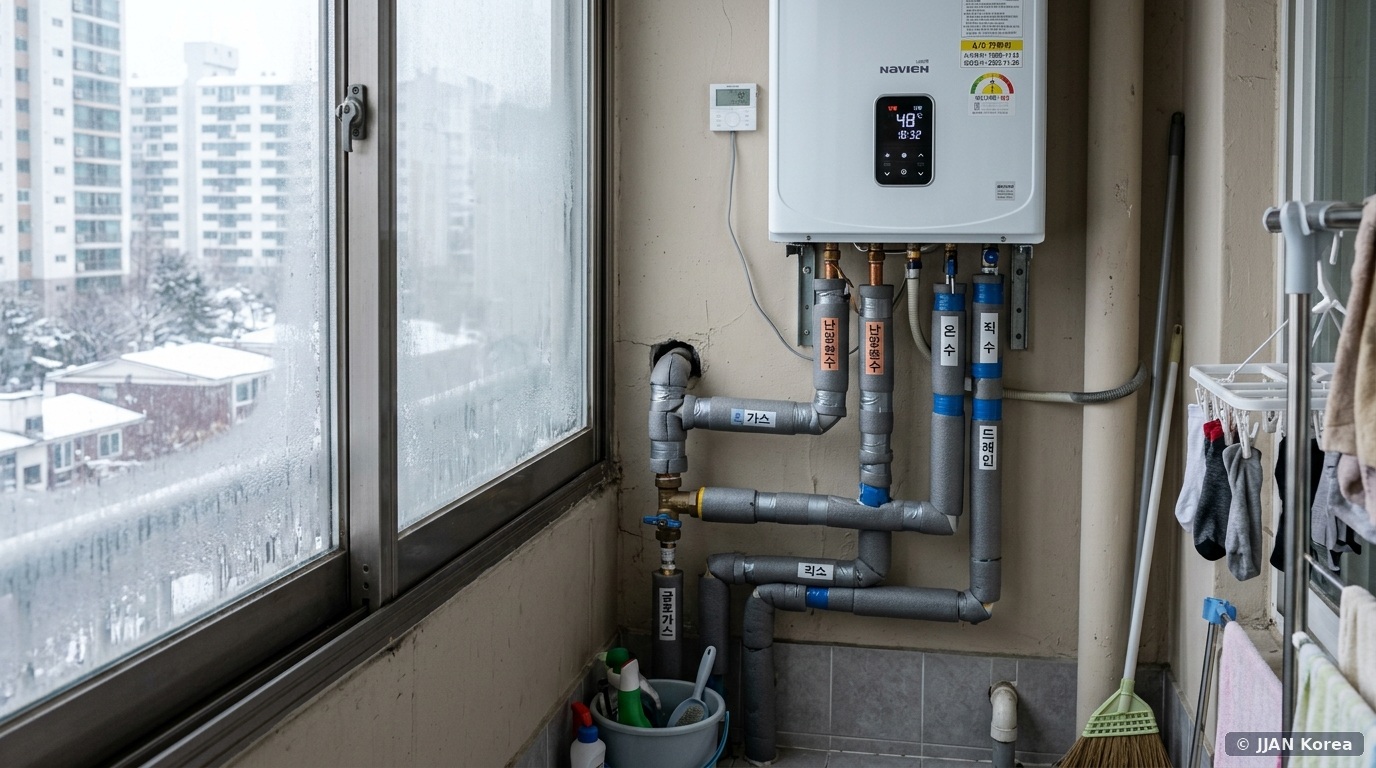
As autumn transitions into early winter across the Korean peninsula in late October and November, foreign residents living in studio apartments (One-rooms), multi-family villas (Villa – 빌라), and officetels encounter a severe domestic challenge unique to East Asian hydronic heating architecture: frozen and burst boiler pipes (Boiler Dong-pa – 보일러 동파). When arctic Siberian cold air blasts descend upon Seoul and Gyeonggi-do, plummeting nighttime temperatures below -10°C (14°F), uninsulated copper water pipes and external boiler coils freeze solid overnight, expanding rapidly and rupturing aluminum manifolds.
For unsuspecting international tenants, the consequences of a burst boiler pipe extend far beyond shivering without hot water. In South Korea’s aggressive rental market, Korean landlords (Imdaein – 임대인) routinely attempt to shift astronomical boiler replacement costs—frequently ranging between 800,000 and 2,500,000 KRW—entirely onto foreign tenants, claiming the freeze was caused by “tenant negligence and improper maintenance” (Gwan-ri So-heul). Landlords often threaten to unilaterally deduct these repair sums from your precious rental deposit (Jeonse / Wolse Bojeunggeum) when you move out.
However, under the South Korean Civil Act, Fair Trade Commission standard lease agreements, and Seoul Housing Lease Dispute Mediation Committee legal precedents, tenants possess robust statutory protections. By understanding your exact legal rights and implementing simple, zero-cost physical prevention habits before freezing temperatures arrive, you can completely insulate yourself from catastrophic winter financial liabilities.
1. Legal Liability Under Korean Law: Who Truly Pays for Boiler Freeze Damage?
The foundational statutory anchor governing residential rental repairs is Article 623 of the South Korean Civil Act (Civil Code – 민법 제623조), which explicitly stipulates: “A lessor (landlord) is obligated to deliver the leased property to the lessee and maintain the necessary condition for using and profiting from the leased property during the duration of the lease.”
To eliminate ambiguity regarding frozen winter utility pipes, the Fair Trade Commission (FTC) established standardized residential tenancy dispute guidelines that categorize liability based on two fundamental legal pillars: (1) Boiler Equipment Age and (2) Basic Fiduciary Care by the Tenant.
| Boiler / Equipment Condition | Tenant Fiduciary Action | Legal Cost Allocation | Governing Precedent / Statute |
|---|---|---|---|
| Boiler aged 7+ years (Surpassed legal durability lifecycle) | Normal residential usage | 100% Landlord Responsibility (Tenant pays 0 KRW) | Civil Act Article 623 & Consumer Dispute Resolution Standards |
| Defective exterior pipe insulation (Pre-existing deteriorated foam on balcony) | Tenant notified landlord of drafts | 100% Landlord Responsibility | Housing Lease Dispute Mediation Precedent |
| Boiler under 7 years old (Modern unit) | Maintained “Away” mode & dripping faucet | 80% to 100% Landlord Responsibility (Shared or landlord pays) | Natural Force Majeure / Unforeseeable Siberian Cold Blast |
| Boiler powered completely OFF during sub-zero trip | Tenant left apartment vacant for days with zero heat | Tenant liable for negligence (Depreciation subtracted) | Civil Act Article 374 (Fiduciary Duty of Care) |
As confirmed in our foundational legal guide on Korea apartment lease deposit protection rules, landlords are legally prohibited from arbitrarily seizing security deposits for normal building depreciation. Crucially, even in cases where a tenant left the boiler powered off, landlords CANNOT demand the cost of a brand-new modern boiler. Under Korea Consumer Agency depreciation formula standards, an older boiler’s depreciated residual book value is calculated; a 6-year-old boiler holds less than 25% of its original purchase value, drastically capping any possible tenant liability.
2. The 3-Step Zero-Cost Winterization Protocol: Surviving Sub-Zero Blasts
Preventing frozen pipes is infinitely simpler than litigating repair bills with an irate building owner. You do not need expensive specialized equipment to keep your apartment fully functional during sub-zero temperatures. Implement this 3-step winterization routine every evening before going to bed whenever the weather forecast predicts temperatures below -5°C (23°F):
Step 1: The “Away / Outing” Mode (Oechul – 외출) Golden Rule
Never, under any circumstances, press the red power button to shut your wall-mounted Ondol boiler control panel completely OFF when departing for work, university classes, or weekend travel. Turning the system off allows the water resting inside floor PEX pipes and exterior intake manifolds to stagnate, where it rapidly freezes into solid ice expansion plugs.
Instead, switch the mode to “Outing” (Oechul – 외출). In Outing mode, the boiler consumes negligible natural gas—firing for just 3 to 5 minutes every few hours—to keep warm water circulating continuously through the system, maintaining minimum circulation temperatures and making freeze-ups physically impossible. As explored in our deep-dive on managing Korean city gas bills and meter readings, keeping your boiler on Outing mode also consumes substantially less gas than reheating a completely frozen concrete slab from scratch!
Step 2: The “Dripping Tap” Water Flow Trick (Dduk-dduk – 뚝뚝)
Moving water freezes at significantly lower temperatures than stationary water. On nights when temperatures plunge below -8°C, turn your bathroom sink or kitchen faucet slightly toward the HOT water (On-su – 온수) side, and adjust the valve so that water drips in a continuous pencil-thin stream or steady drip (Dduk-dduk).
Allowing a slow trickle of water to flow overnight maintains continuous hydraulic movement through the external water supply line (Geup-su-gwan) and the boiler heating coil. The cost of running a slow water drip overnight amounts to less than 150 KRW on your municipal water utility bill, yet it completely neutralizes 99% of frozen pipe emergencies.
Step 3: Veranda Pipe Insulation Check
Inspect your external veranda or utility terrace where the wall-hung boiler unit is physically mounted. Look closely at the four pipes connecting to the base of the machine: two pipes circulate floor heating water (Nanbang-su), and two pipes supply domestic hot and cold tap water. If the gray polyethylene foam insulation (Bo-on-jae) is cracked, torn, or exposing bare copper metal, wrap old towels, bubble wrap, or 1,000-won Daiso pipe insulation tubes around the pipes, securing them tightly with vinyl packing tape.
3. Emergency Troubleshooting: What to Do When Water Stops Flowing
If you wake up in the morning, turn the hot water tap, and hear silence or sputtering air with zero water flow, your water intake pipe has frozen. Do NOT panic, and above all, DO NOT pour boiling hot kettle water directly onto frozen boiler pipes or water meters. Sudden thermal shock will instantly shatter frozen copper piping, crack brass meters, and trigger catastrophic indoor flooding!
Follow this safe, professional thawing procedure:
1. Identify Which Pipe is Frozen: Turn the cold water faucet on. If cold water flows normally but hot water does not, the main city water supply is fine; only the hot water intake pipe entering your boiler is frozen. If neither hot nor cold water flows, your building’s external water meter box (Sudo Geryanggi) outside your front door has frozen.
2. Gentle Thermal Thawing: Wrap warm, damp towels (soaked in warm water around 40°C–50°C) around the frozen pipe base. Alternatively, hold a standard household hair dryer on medium heat approximately 15 centimeters away from the frozen pipe section, sweeping the warm air back and forth continuously for 15 to 25 minutes. Keep the hot water tap open inside your bathroom so that melting water can escape as the ice plug dissolves.
3. Immediate Written Landlord Notification: If thawing efforts fail after 30 minutes, or if you spot any water spraying from hairline pipe cracks, immediately take timestamped smartphone photos and video footage of the boiler panel displaying any flashing error codes (such as Navien error ’02’ or Rinnai error ’16’). Send a formal text message or KakaoTalk to your landlord immediately:
“Annyeonghaseyo Imdaein-nim, Oneul hanpa-ro inhae bo-il-leo onsu-ga na-o-ji an-seumnida. Oechul-mo-deu-wa bo-on-jo-chi-reul haess-euna gyul-bing-i balsaenghayeoss-euni, suri gi-sa-nim bangmun-eul yocheongdeurimnida.”
(Hello Landlord, due to today’s severe cold wave, hot water is not flowing from the boiler. We maintained Outing mode and pipe insulation, but freezing occurred. We kindly request an HVAC repair technician visit.)
4. Resolving Landlord Disputes: The Housing Lease Dispute Committee
If your landlord refuses to arrange professional repairs, insults you, or demands that you immediately pay for a full replacement out of pocket, do not be intimidated. As a legally registered foreign resident holding an Alien Registration Card, you have full access to South Korea’s statutory tenant protection network.
First, obtain a formal written diagnostic assessment from the boiler manufacturer’s visiting service technician (Navien, Rinnai, Kiturami, or Daesung Celtic). The technician will issue a printed Service Inspection Receipt (Gi-sulgeom-to So-gyeon-seo) explicitly documenting the cause of the breakdown. If the technician notes that the boiler broke down due to natural mechanical wear, component aging, or improper exterior building draft insulation, this serves as legally conclusive proof of landlord liability.
Second, if the landlord continues to threaten deposit deductions, contact the Housing Lease Dispute Mediation Committee (Ju-taek Im-dae-cha Bun-jaeng Jo-jeong Wi-won-hoe – 주택임대차분쟁조정위원회) or call the Seoul Danuri Multilingual Center (1577-1366) or 120 Dasan Call Center (Extension 9 for English). The government-operated dispute committee provides free, binding administrative arbitration by licensed judges and attorneys, resolving over 90% of tenant-landlord winter repair disputes in favor of tenants without costly court lawsuits.
5. Frequently Asked Questions (FAQ)
Q1: If I travel abroad for two weeks over winter vacation, what should I do with the boiler?
Never turn the boiler off! Leave the boiler control panel switched to “Outing” (Oechul – 외출) mode or set the minimum water heating temperature to 40°C. Additionally, make sure all balcony and veranda sliding windows are closed tightly and locked to prevent freezing Siberian wind drafts from sweeping across your boiler intake pipes while you are overseas.
Q2: How much does a service technician charge to thaw frozen boiler pipes in Seoul?
During peak sub-zero cold waves, private emergency HVAC thawing technicians (Haebing Gisa) typically charge between 100,000 and 150,000 KRW for a standard hot water line steam-thawing service, and between 180,000 and 250,000 KRW for complex dual-pipe thawing. Under standard tenancy rules, if the tenant maintained basic Outing mode precautions, this thawing expense is covered by the building landlord.
Q3: How can I check how old my apartment boiler is?
Every boiler installed in South Korea features a mandatory yellow or silver metal manufacturer’s certification plate riveted to the front or side of the metal casing. Look for the label reading “Je-jo-nyeon-wol” (제조년월 – Date of Manufacture). If the date stamped on the plate indicates the boiler is 7 years old or older (e.g., manufactured in 2018 or earlier), it has officially exceeded its legal operational lifecycle, establishing 100% landlord replacement liability under FTC dispute resolution rules.
Q4: Can my landlord legally deduct boiler repair costs from my deposit without my permission?
No. Under South Korean civil law, landlords cannot unilaterally seize or deduct disputed damages from your rental deposit (Bojeunggeum) without mutual written agreement or an official judicial writ of execution from a Korean civil court. If a landlord attempts an unlawful deposit deduction, you can immediately file for a Leasehold Registration Order (Im-cha-gwon Deung-gi Myeong-ryeong) at the competent district court, legally blocking the landlord from renting the property to any future tenant until your full deposit is refunded with statutory interest.
🛡️ JJAN Korea Editorial Standards & Fact-Checking Verification
This legal tenancy and winter utility protection guide has been researched and verified by Finance Editor Seo-jun Kim following statutory leasing codes established under Article 623 of the South Korean Civil Act and official guidelines published by the Korea Fair Trade Commission (FTC) and the Housing Lease Dispute Mediation Committee.
- Equipment depreciation formulas and lifecycle thresholds verified under Korea Consumer Agency Dispute Resolution Standards.
- Landlord repair obligations cross-referenced against Supreme Court of Korea Civil Precedents on residential habitability.
- Dispute filing and administrative mediation protocols confirmed via Ministry of Land, Infrastructure and Transport (MOLIT) guidelines.