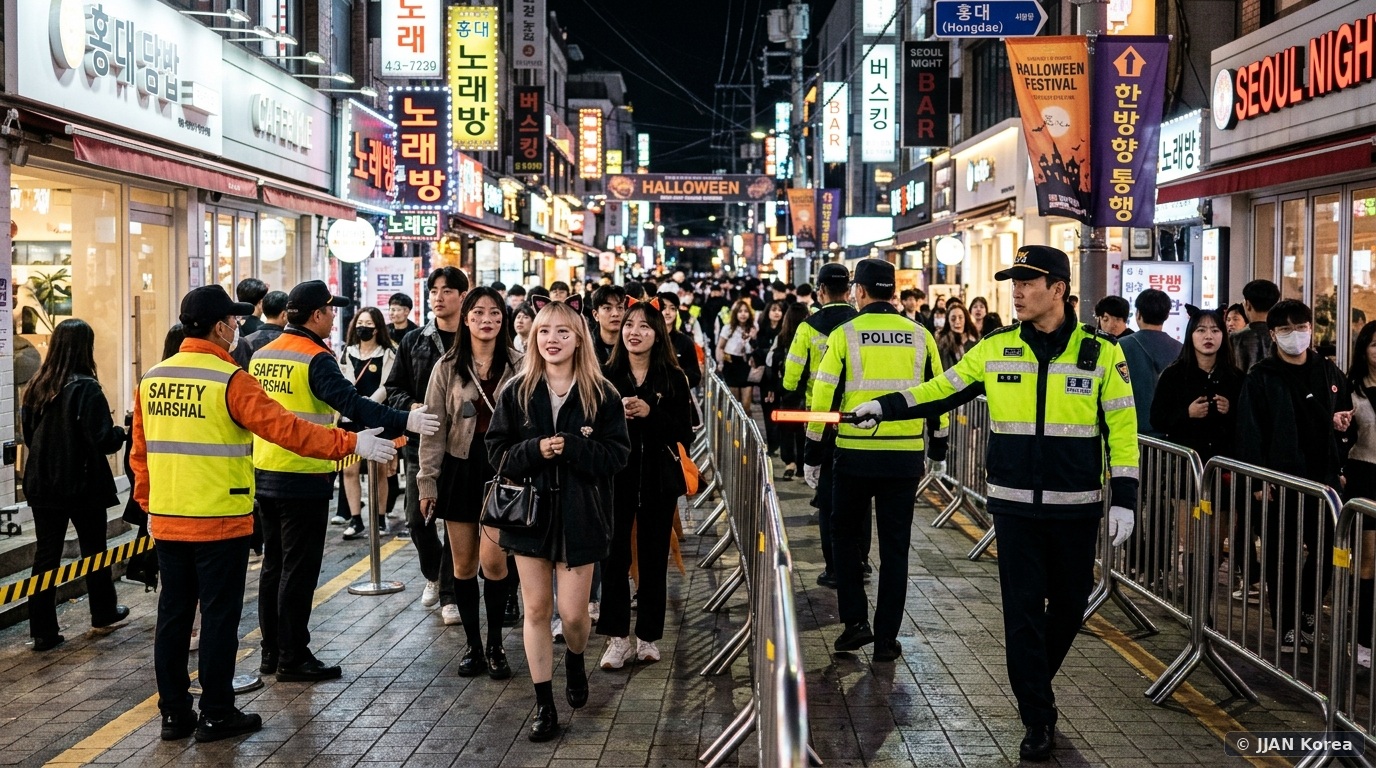
During the final weekend of October, the vibrant youth nightlife and international entertainment districts of Seoul—most notably Hongdae (Hongik University Street), Itaewon, and Gangnam Station—come alive with extraordinary creative energy as tens of thousands of revellers celebrate Halloween. From hyper-realistic movie monster prosthetics, elaborate cyberpunk combat suits, and viral K-drama cosplay to colorful fantasy ensembles, the streets transform into massive open-air costume carnivals. However, in the wake of past crowd tragedies, the Seoul Metropolitan Government, National Police Agency, and National Fire Agency have instituted some of the most comprehensive, technologically advanced Metropolitan Crowd Safety & Pedestrian Management Protocols in modern urban history. For international residents and tourists looking to enjoy Halloween nightlife, understanding these safety measures, navigating one-way pedestrian walking corridors, and following emergency protocols ensures an exhilarating, safe celebration.
1. Seoul’s AI Crowd Density Infrastructure: Sensors & Alert Levels
Throughout major nightlife corridors—including Hongdae’s Walking Street (Eoulmadang-ro) and Itaewon’s World Food Street—the municipal government operates a network of high-resolution closed-circuit surveillance cameras integrated with AI Crowd Analysis Software (In-pa Gwan-je Sis-tem). The system calculates live human crowd density per square meter in real time, automatically triggering graduated emergency responses:
| Crowd Alert Stage | Pedestrian Density Threshold | Municipal Police & Fire Action Triggered | Guidance for Foreign Revellers |
|---|---|---|---|
| Stage 1: Attention (Gwan-sim) | 3 persons per square meter | Normal foot patrol monitoring; safety broadcasts active | Normal walking; maintain awareness of crowd flows |
| Stage 2: Caution (Ju-ui) | 4 persons per square meter | Police deployment to narrow bottleneck alleyways | Avoid pausing in narrow corridors; follow police megaphone instructions |
| Stage 3: Warning (Gyeong-go) | 5 persons per square meter | Mandatory One-Way Pedestrian Circulation Enacted | You must walk strictly in the designated one-way direction; no stopping |
| Stage 4: Severe (Sim-gak) | 6+ persons per square meter | Alley Entry Blockades & Subway Station Bypass | Emergency cell broadcasts dispatched; subway trains bypass station without stopping |
Whenever crowd density reaches Stage 3, the National Emergency Management Agency dispatches real-time multilingual emergency cell broadcast text alerts (Anjeon Annae Munja) in Korean and English directly to all smartphones within the geographic cell tower zone, directing pedestrians to avoid congested alleys.
2. Navigating the One-Way Pedestrian Corridors (Il-bang Tong-haeng)
To prevent opposing streams of pedestrian traffic from colliding and creating lethal crushing pressure, Seoul Police enforce strict One-Way Pedestrian Circulation Lanes (Il-bang Tong-haeng) across narrow nightlife alleys throughout Halloween weekend.
Large illuminated LED signboards and uniformed officers equipped with high-visibility illuminated light wands guide the crowd. For example, in Itaewon, pedestrian traffic along World Food Street flows strictly from west to east; walking in reverse or attempting to push backward against the flow is strictly blocked by police cordons. Always follow the arrows marked on overhead overhead LED directional displays and move patiently with the rhythmic flow of the crowd.
3. Nightclub Entry Rules: The Physical ID Audit & Costume Weapons
Seoul’s premier clubs and lounges (such as those in Hongdae, Itaewon, and Gangnam) enforce rigorous security door policies during Halloween weekend. By ensuring proper physical passport or ARC identification at major club door queues, you must carry your original, physical passport or Alien Registration Card (ARC); digital smartphone photos or photocopies of IDs are 100% rejected at the door.
Costume Weapon Restrictions: Police and venue security enforce a strict zero-tolerance policy against realistic weapon props. Carrying realistic metal blades, imitation firearms that resemble real handguns, sharp metal spikes, or heavy wooden baseball bats will result in immediate confiscation at police checkpoints and potential questioning under the Act on the Control of Firearms, Swords, and Explosives. All costume props must be made from soft, flexible foam or plastic.
4. Emergency First-Aid Triage Tents and Safety Evacuation Hubs
Throughout Halloween weekend, the Seoul Fire Headquarters establishes mobile On-Site Emergency Medical Triage Stations (Hyunjang Eung-geub Uiryo-so) stationed at strategic points: outside Itaewon Station Exit 3, at Hongdae’s Hongik Children’s Park, and outside Gangnam Station Exit 11.
By understanding how locating on-site emergency mobile triage tents and police safety control centers operates, these stations are staffed with certified emergency doctors, paramedics, and multilingual translators equipped with defibrillators, oxygen supplies, and thermal blankets to treat acute alcohol poisoning, sprained ankles, hyperventilation, or minor cuts instantly without waiting for hospital ambulances.
5. Seoul AI Crowd Density Monitoring Cameras & Emergency Medical Triage Corridors
Following comprehensive national safety overhauls, the Seoul Metropolitan Government and the National Police Agency have deployed a state-of-the-art AI-Powered Intelligent Crowd Density Monitoring Network across high-traffic nightlife corridors, including Itaewon World Food Street, Hongdae Club Street (Eoulmadang-ro), and Gangnam Station Exit 10. High-resolution stereoscopic CCTV cameras mounted on street utility poles analyze real-time pedestrian volume per square meter.
The system operates under a four-tiered color-coded alert matrix: Green (Normal: under 3 persons per square meter), Yellow (Caution: 3 to 4 persons/m²), Orange (Warning: 4 to 5 persons/m²), and Red (Emergency: exceeding 5 persons/m²). When pedestrian density approaches the Orange threshold, automated algorithmic alerts are instantly transmitted to district disaster command centers, prompting municipal safety wardens and police squads to immediately initiate active pedestrian flow regulation.
During Halloween weekend evenings, steep and narrow alleyways (such as the narrow incline beside the Hamilton Hotel in Itaewon) are transformed into strictly enforced One-Way Pedestrian Corridors (Il-bang Tong-haeng – 일방통행). Barricades, reflective cones, and yellow light wands direct foot traffic in a single continuous circuit to prevent head-on human bottlenecks. Under the Framework Act on the Management of Disasters and Safety, ignoring police marshals or climbing over crowd safety barriers is subject to immediate detention and statutory fines.
Additionally, dedicated Emergency Medical Triage Centers (Hyunjang Eunggeup Uiryoso) staffed by certified emergency medicine physicians and paramedics are stationed at pivotal intersections—including Itaewon Station Exit 3 plaza and Hongdae Children’s Park. If you experience hyperventilation, panic attacks, or crush anxiety, step immediately toward the edge of the sidewalk and signal any officer wearing a high-visibility yellow tactical vest or call 119 for immediate evacuation to these quiet medical zones.
Prior to heading out, check the public Seoul Real-Time City Data Platform (data.seoul.go.kr/citydata) on your mobile browser. This municipal dashboard provides live crowd congestion maps across 115 major cultural zones, displaying transit congestion, bus route diversions, and real-time pedestrian density levels updated every 5 minutes. Furthermore, police strictly enforce imitation weapon bans: realistic toy firearms, metal bladed swords, and police/military uniforms are confiscated on sight at club entrances.
For late-night transit return options, remember that regular subway service ceases around midnight. Instead of battling unlicensed street taxi solicitations, utilize Seoul’s dedicated Late-Night “Owl Buses” (Sim-ya Ol-baemi Beo-seu). Routes like N16 (connecting Dobong to Onsu via Itaewon and Dongdaemun) and N26 operate every 25 to 35 minutes throughout the night at standard 2,500 KRW fares payable via T-Money.
If you find yourself separated from your friends or lose your mobile phone amidst massive crowds, pre-arrange a designated landmark meeting spot outside the main entertainment strip, such as the plaza in front of Itaewon Fire Station or the front entrance of Hongik University. Should an emergency arise and you cannot speak Korean, you can send an English SMS text message directly to 112; the national police dispatch system automatically translates foreign text messages and tracks your cellular GPS location for immediate tactical response.
5. Frequently Asked Questions (FAQ)
Q1: What time should I leave the nightlife district to avoid late-night transit jams?
The most congested hours in Hongdae and Itaewon occur between 23:30 and 02:00 AM. To avoid extreme taxi shortages and overcrowded subway exits, either depart before 23:00 to catch the final standard subways, or enjoy early morning diner breakfast and catch the first morning subways departing at 05:30 AM.
Q2: Are Seoul Late-Night “Owl Buses” (Olbaemi Bus) running during Halloween?
Yes! The Seoul Metropolitan Government deploys additional late-night Owl Buses (such as N13, N16, and N26) operating between 23:30 and 04:00 AM connecting Hongdae, Jongno, Itaewon, and Gangnam for standard transit card fares (2,500 KRW).
Q3: What should I do if I find myself caught in an uncomfortably dense crowd?
If you feel crowd pressure intensifying: (1) Keep your feet moving with the flow—never fight the current or try to bend down to pick up dropped phones, (2) Adopt the “Boxer Stance”: raise your forearms across your chest with elbows slightly pointed outward; this creates a vital 10cm protective air pocket preserving lung expansion space, and (3) Move diagonally toward the outer edges of the crowd rather than straight forward.
Q4: Is drinking alcohol outdoors on the street legal in Seoul?
While drinking beer from convenience store cans on public sidewalks is not generally prohibited by federal law, municipal districts (including Mapo-gu and Yongsan-gu) strictly prohibit glass bottles in designated crowd control zones during Halloween weekend to prevent glass breakage hazards.
🛡️ JJAN Korea Editorial Standards & Fact-Checking Verification
This metropolitan nightlife safety guide has been authored and verified by Culture Editor Min-ah Kim in coordination with public safety directives released by the Seoul Metropolitan Police Agency (SMPA) and the Seoul Fire & Disaster Headquarters.
- AI crowd density monitoring algorithms and alert thresholds audited under Seoul City Disaster Safety Management Bylaws.
- Nightclub ID inspection protocols verified in compliance with the Youth Protection Act.
- Emergency medical triage dispatch networks confirmed with National Emergency Medical Center (E-Gen) field operations.