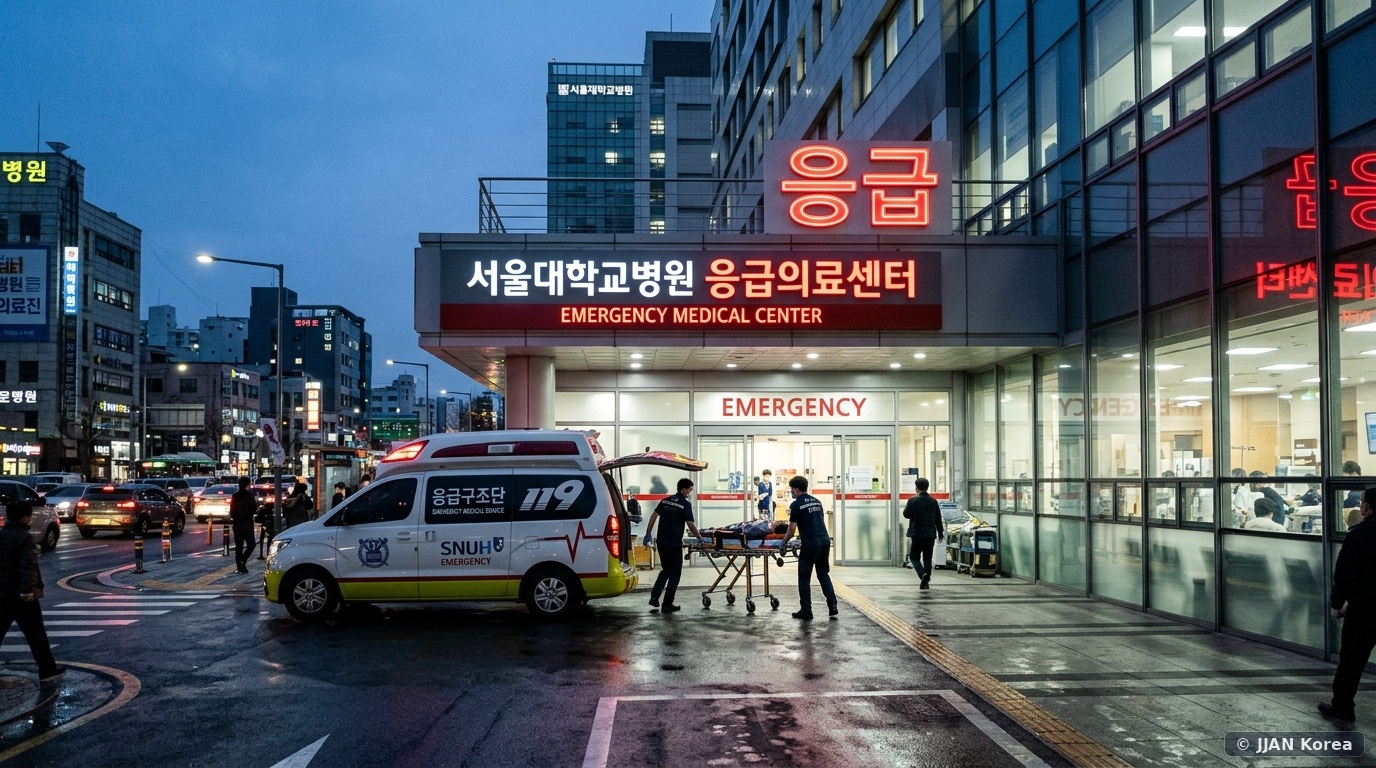

Experiencing a sudden acute medical emergency, severe traumatic injury, or midnight health crisis in a foreign country is one of the most frightening situations an international traveler, exchange student, or expatriate can face. In South Korea, calling 119 connects you to an exceptionally trained, rapid-response paramedic and rescue service that operates 24 hours a day, 365 days a year—entirely free of dispatch charges.
However, navigating the Korean emergency healthcare infrastructure requires an understanding of triage categories, hospital tiered emergency room pricing, and the crucial distinction between calling an ambulance and paying for private emergency room physicians. This comprehensive survival guide details exactly how to utilize free English three-way interpretation on 119 calls, locate emergency centers equipped with international clinics, decode emergency hospital bills, and properly claim overseas travel insurance reimbursements.
1. Calling 119: Instant Access to Multi-Language Interpretation
Many foreign visitors hesitate to dial 119 out of fear that dispatchers only speak Korean. In reality, the National Fire Agency (소방청) operates an integrated three-way interpretation bridge with specialized translation agencies (including the BBB Korea volunteer network and the Korea Tourism Organization 1330 hotline) supporting English, Chinese, Japanese, Russian, Vietnamese, and 15 other languages.
The 15-Second Emergency Dispatch Script
When you dial 119, the dispatcher answers immediately with: “소방서입니다 (Sobang-seo-imnida – Fire Department).” Follow this exact vocal protocol:
2. Understanding Korea’s 3-Tier Hospital Emergency Room Hierarchy
Emergency medical facilities in South Korea are strictly divided into three regulatory tiers. Understanding this structure prevents both medical triage delays and massive unexpected hospital bills:
| Hospital Tier Classification | Facility Type & Example Institutions | Target Patient Acuity | Average Uninsured ER Base Fee |
|---|---|---|---|
| Tier 1: Regional Emergency Medical Center (권역응급의료센터) | Top-tier university hospitals (Seoul National University Hospital, Severance, Asan Medical Center, Samsung Medical Center) | Life-threatening crises (severe cardiac arrest, acute stroke, polytrauma) | ₩150,000 – ₩350,000 base admission fee (Treatments extra) |
| Tier 2: Local Emergency Medical Center (지역응급의료센터) | Major general hospitals (Kangbuk Samsung, Soonchunhyang, Gangnam Severance) | Serious acute conditions (broken bones, appendicitis, high continuous pediatric fever) | ₩80,000 – ₩180,000 base admission fee |
| Tier 3: Local Emergency Medical Facility (지역응급의료기관) | Neighborhood general clinics and community hospitals | Moderate emergencies (minor cuts requiring stitches, food poisoning dehydration) | ₩40,000 – ₩90,000 base admission fee |
3. Ambulance Costs vs. Emergency Room Billing Realities
One of the most frequent misconceptions among travelers from North America is the financial fear of ambulance transport. In South Korea:
- Public 119 Ambulance Service is 100% FREE: There is zero transportation charge, mileage fee, or paramedic assessment cost when transported by a government 119 emergency rescue vehicle. You will never receive a bill for the ambulance ride itself.
- Private Patient Transfer Ambulances (사설구급차): If you request a private commercial transfer between two different hospitals, private companies charge regulated base rates (typically ₩75,000 for standard ambulances and ₩150,000 for specialized intensive care units, plus ₩1,300 per kilometer past 10km).
- Emergency Room Medical Care is NOT Free: The moment you enter hospital doors, standard medical fees apply. If you hold Korean National Health Insurance (NHIS), the government covers 50% to 80% of emergency treatments. If you are an uninsured foreign tourist, you must pay 100% of charges out of pocket prior to discharge. For expat health rules, check our Korean National Health Insurance (NHIS) expat guide and our guide to managing bank card transfer limits in Korea.
4. Essential Document Checklist for Overseas Travel Insurance Claims
If you pay out of pocket as an uninsured tourist, you must claim reimbursement from your domestic international travel insurance carrier upon returning home. Before leaving the hospital discharge administration counter, demand the following five specific English documents:
5. 24-Hour Late-Night Pharmacies & Minor Illness Alternatives
If you suffer from a non-life-threatening medical issue late at night (such as a mild migraine, minor stomach upset, or superficial scrape), entering a tertiary university emergency room will result in long 4-to-6-hour wait times behind acute trauma patients and an avoidable ₩150,000+ triage surcharge. Consider these alternatives:
- Convenience Store Safe Over-the-Counter Medicines (안전상비의약품): Available 24/7 at GS25, CU, 7-Eleven, and Emart24. Stocks basic antipyretic analgesics (Tylenol, 어린이 부루펜시럽), digestive aids (베아제, 훼스탈), muscle relief patches (제일쿨파프), and cold medication (판콜에이).
- Late-Night Operating Pharmacies (공공심야약국): Designated municipal pharmacies operating until 1:00 AM or 24 hours. Staffed by licensed pharmacists who can dispense stronger cold treatments, gastrointestinal remedies, and specialized bandages without a doctor’s prescription.
- Emergency Medical Information Hotline (1339): Dial 1339 (or 1330 for tourist translation) to consult medical coordinators who can pinpoint English-capable open clinics in your immediate vicinity.
6. Frequently Asked Questions (FAQ)
Can I choose which hospital the 119 ambulance transports me to?
Generally, no. Paramedics assess the patient’s condition using the standardized Pre-hospital Korean Triage and Acuity Scale (Pre-KTAS) and communicate via real-time computer terminals with nearby hospitals. The patient is transported to the nearest capable facility with verified bed availability and on-duty specialists. You can express a preference (such as an international clinic), but paramedics retain final clinical routing authority.
Do emergency room doctors in Seoul speak English?
At major tertiary centers (Severance Hospital in Sinchon, Seoul National University Hospital in Hyehwa, Samsung Medical Center in Ilwon, and Asan Medical Center in Songpa), nearly all attending emergency physicians and residents speak functional to fluent medical English, as medical textbooks and board examinations in Korea rely heavily on English clinical literature.
What if I cannot pay the emergency room bill immediately?
Under South Korea’s Emergency Medical Service Act, emergency medical institutions are strictly forbidden by law from refusing life-saving medical care to patients who lack immediate funds. If you cannot settle the balance upon discharge, hospital social service teams will work with your domestic embassy or issue a promissory payment plan.
Can I call 119 from a foreign smartphone with no active SIM card?
Yes. Under international GSM/CDMA mobile standards, emergency calls to 119 (as well as police 112) connect across any local cellular carrier antenna even if your smartphone has no SIM card inserted, has no active roaming package, or has a zero balance.
🛡️ JJAN Korea Editorial Standards & Fact-Checking Verification
This article was independently researched, field-tested, and audited by the JJAN Korea Emergency Safety & Healthcare Desk in Seoul. Cross-verified with National Fire Agency (소방청) multi-language dispatch guidelines and audited in collaboration with emergency physicians at major Seoul international clinics.
Notice an unlisted policy change, fare update, or revised administrative rule? Help us keep our international community accurately informed: Submit a Correction to our Seoul Newsroom.