
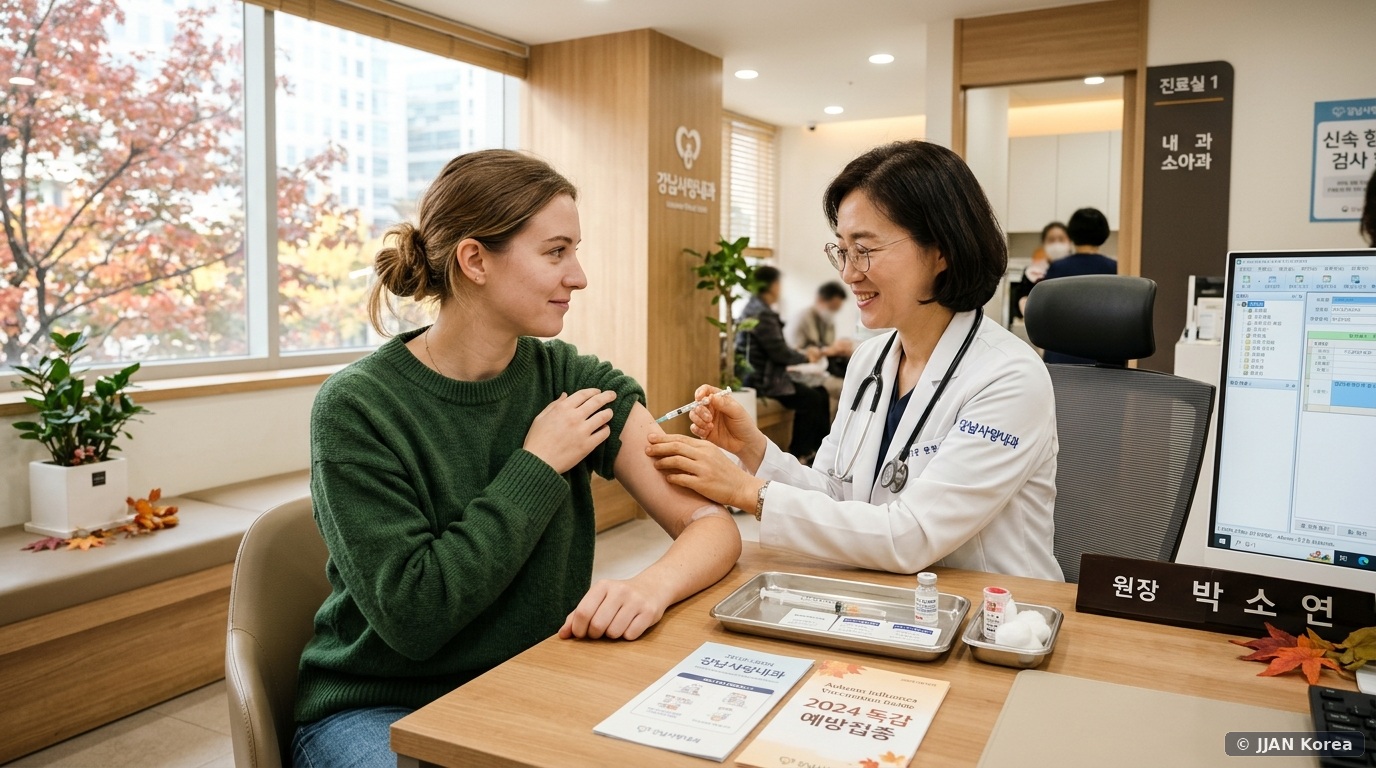
As late October arrives and morning temperatures across South Korea drop into single digits, public health banners appear outside neighborhood medical clinics and pharmacies bearing an urgent annual reminder: Dokgam Yebangjeopjong (독감 예방접종 – Seasonal Influenza Vaccination). In a dense, transit-heavy society where millions of commuters pack into subway cars and office elevators daily, seasonal influenza viruses (Types A and B) circulate rapidly from late November through March. For international foreign residents, exchange students, and expatriate families living in South Korea, receiving your annual quadrivalent flu vaccine is fast, inexpensive, and completely walk-in friendly. However, understanding how National Health Insurance (NHIS) subsidies apply, knowing standard out-of-pocket clinic costs, and choosing the optimal medical setting ensures you stay healthy all winter long.
1. Quadrivalent Vaccines and National Immunization Subsidies (NIP)
South Korea administers state-certified Quadrivalent (4-Ga / 4가) Influenza Vaccines formulated according to World Health Organization (WHO) East Asian winter strains, protecting against two Influenza A strains (H1N1 and H3N2) and two Influenza B lineages (Victoria and Yamagata). The Korea Disease Control and Prevention Agency (KDCA – 질병관리청) operates the National Immunization Program (NIP – 국가예방접종), providing 100% Free Flu Vaccinations to designated vulnerable resident groups—including eligible foreign nationals holding an Alien Registration Card (ARC):
| Patient Population | Age / Medical Criteria | National Insurance (NHIS) Subsidy Level | Required Document at Clinic |
|---|---|---|---|
| Infants and Young Children | Ages 6 Months to 13 Years Old | 100% FREE (Fully Covered by KDCA) | Alien Registration Card / Child Health Handbook |
| Pregnant Women | All stages of pregnancy (Foreigners included) | 100% FREE (Fully Covered) | ARC + Maternal Health Handbook (Sanchon-sucheop) |
| Seniors | Ages 65 Years and Older | 100% FREE (Fully Covered) | Physical Alien Registration Card |
| General Adults (Ages 14 to 64) | Standard foreign residents, workers, students | Non-Covered Self-Pay (Bi-geub-yeo) | Typical clinic fee: 30,000 ~ 40,000 KRW |
By understanding which preventive treatments are covered under Korean National Health Insurance, general working adults must recognize that routine preventive flu shots are legally categorized as “Non-Covered” (Bi-geub-yeo), meaning standard insurance does not subsidize the fee for healthy adults, requiring an out-of-pocket payment.
2. Where to Get Vaccinated: Private Clinics vs. Public Health Centers (Bogeonso)
You do not need a hospital appointment to get vaccinated. South Korea’s primary healthcare density allows patients to walk into neighborhood medical facilities without reservations:
- Internal Medicine (Naegwa) & ENT (Ibihu-in-gwa) Clinics: Located in commercial building hubs beside every subway station. Walk in, register your ARC at reception, receive a brief 2-minute physician pre-injection consultation, and receive the injection from a certified nurse. Cost: typically 35,000 to 40,000 KRW.
- Korea Association of Health Promotion (Geon-hyeop / Medicheck Centers): Large specialized non-profit medical screening centers located in major districts (e.g., Gangseo, Dongdaemun). Because they purchase vaccines in massive bulk volumes, they charge only 26,000 to 30,000 KRW per shot.
- Public Health Centers (Bogeonso – 보건소): Municipal public health clinics provide free shots to seniors, disabled residents, and welfare recipients, but generally do not dispense commercial self-pay vaccines to general adults.
If you cannot find an English-speaking clinic in your neighborhood, remember that by locating English-speaking local neighborhood clinics via the 1339 hotline, medical operators will guide you to nearby clinics with English-fluent doctors within two minutes.
3. Step-by-Step Clinic Protocol: Registration, Screening & Phrasing
The entire walk-in vaccination process takes less than 15 minutes from entrance to exit:
- Step 1: Front Desk Registration: Hand your physical ARC to the receptionist and say: “Dokgam yebangjeopjong ha-reo wasseoyo” (I am here for a flu shot).
- Step 2: Medical Questionnaire (Ye-jin-pyo): You will be handed a one-page health screening questionnaire (available in English upon request). Check “No” or “Yes” regarding current fever, severe egg allergies (anaphylaxis), Guillain-Barré syndrome history, or adverse reactions to prior vaccinations.
- Step 3: Physician Examination: A doctor listens to your lungs, checks your throat with a tongue depressor, and takes your temperature to confirm you do not have an active viral fever.
- Step 4: Deltoid Injection: A nurse administers the intramuscular injection into your upper arm deltoid muscle. Staff apply a small round protective adhesive bandage.
- Step 5: 15-Minute Observation: Sit quietly in the clinic waiting lounge for 15 minutes to monitor for rare acute allergic reactions before settling your bill at the front desk.
4. Optimal Timing and Post-Vaccination Care
The Korea Disease Control and Prevention Agency recommends receiving the flu shot between mid-October and mid-November. Because the human immune system requires approximately two weeks (14 days) to develop full neutralizing antibody titers, getting vaccinated before November ensures robust immune protection before peak December influenza transmission begins.
Post-Vaccination Guidelines: Avoid vigorous weightlifting, heavy cardiovascular exercise, sauna bathhouses (Jjimjilbang), and excessive alcohol consumption on the day of injection. Mild tenderness at the injection site or low-grade fatigue is normal and resolves within 24 to 48 hours.
5. Quadrivalent Vaccine Formulations (Egg-Based vs. Cell-Cultured) & Clinic Consent Phrasing
When presenting yourself at a local internal medicine clinic (Nae-gwa) or ENT clinic (I-bi-in-hu-gwa) for your autumn influenza immunization, Korean physicians typically offer a selection of internationally recognized quadrivalent (4-strain) vaccines. These modern formulations protect against two influenza A subtypes (H1N1 and H3N2) and two influenza B lineages (Victoria and Yamagata). Knowing the distinct pharmaceutical formulations available helps ensure you select the vaccine best suited to your medical history.
The standard vaccines distributed across Korean medical centers are traditional egg-based quadrivalent vaccines produced by reputable domestic and international pharmaceutical manufacturers, including GC Biopharma GC Flu, Boryung BoryungFlu, and Sanofi Pasteur Vaxigrip Tetra, generally priced between 30,000 and 40,000 KRW. However, for individuals who suffer from severe egg allergies (anaphylaxis) or prefer cell-culture technology, Korean clinics also stock SK Bioscience SKYCellflu Quadrivalent. Cultured inside sterile canine kidney cell bioreactors rather than chicken eggs, SKYCellflu is completely egg-protein-free and antibiotic-free, minimizing allergic hypersensitivity reactions.
Before the physician administers the intramuscular injection into your non-dominant deltoid muscle, the clinic receptionist will hand you an official Pre-Vaccination Screening Questionnaire (Ye-bang Jeop-jong Ye-jin-pyo – 예방접종 예진표). While larger university clinics provide English forms, neighborhood clinics often have only Korean forms. Key questions you must answer include:
• “Have you experienced any fever or acute illness in the past 48 hours?” (Oneul yeori nago apun gos-i isseumnikka?)
• “Have you had severe allergic reactions (such as hives or breathing difficulty) following previous vaccinations?” (Ijeon ye-bang jeop-jong hu bu-jak-yong-i isseumnikka?)
• “Are you currently pregnant or undergoing immunosuppressive therapy?” (Im-sin jung-i-geona myeon-yeok eok-je-je-reul bogyong jung-imnikka?)
After answering “No” (Anio) to these screening criteria and signing your legal signature, the nurse will check your body temperature with an infrared temporal thermometer. Following the injection, remain seated in the clinic waiting lounge for 15 to 20 minutes to verify the absence of acute anaphylactic responses before departing for home.
If you are employed full-time at a Korean corporation or educational institution, check with your human resources department before paying out of pocket. Many Korean employers provide comprehensive annual group medical checkup benefits that include 100% reimbursed quadrivalent influenza immunizations through partnered occupational health clinics throughout October and November.
Should you develop localized soreness or mild fever after returning home, apply a cold gel compress over the injection site and take acetaminophen (Tylenol 500mg). In the extremely rare event of persistent high fever (exceeding 39°C) or severe dizziness, contact the Korea Disease Control and Prevention Agency (KDCA) consultation center at 1339 for immediate medical direction.
5. Frequently Asked Questions (FAQ)
Q1: Can foreign tourists without an Alien Registration Card get a flu shot in Korea?
Yes! Any foreign visitor—including short-term tourists holding a standard foreign passport—can walk into any private Korean medical clinic (Naegwa or Ibihuingwa) and receive a flu vaccine. You simply present your passport and pay the standard self-pay clinic fee (35,000 to 45,000 KRW) using cash or international credit card.
Q2: Can I get the COVID-19 booster and the flu shot at the same time?
Yes! Korean public health guidelines officially permit simultaneous co-administration of updated seasonal COVID-19 booster vaccines and the quadrivalent flu vaccine during the same clinic visit, typically administered into opposite arms for patient comfort.
Q3: How long does the flu vaccine provide immunity?
The quadrivalent influenza vaccine provides strong antibody protection lasting approximately six months, perfectly covering South Korea’s entire winter influenza season from November through April.
Q4: What should I do if I develop a high fever after the shot?
Mild soreness is common. If you develop a mild post-vaccine fever or headache, taking standard over-the-counter acetaminophen (Tylenol 500mg) easily manages symptoms. If severe breathing difficulty, facial swelling, or high fevers exceeding 39°C occur, seek immediate medical attention at a hospital emergency room.
🛡️ JJAN Korea Editorial Standards & Fact-Checking Verification
This seasonal healthcare guide to Korean influenza vaccinations has been authored and verified by Senior Columnist Dong-hwan Kim in accordance with official clinical directives published by the Korea Disease Control and Prevention Agency (KDCA) and the National Health Insurance Service (NHIS).
- National Immunization Program (NIP) subsidy criteria verified under the Infectious Disease Control and Prevention Act.
- Quadrivalent vaccine strain compositions cross-checked against WHO Global Influenza Surveillance Network recommendations.
- Clinic fee transparency and non-covered healthcare pricing monitored via Health Insurance Review and Assessment Service (HIRA) datasets.