
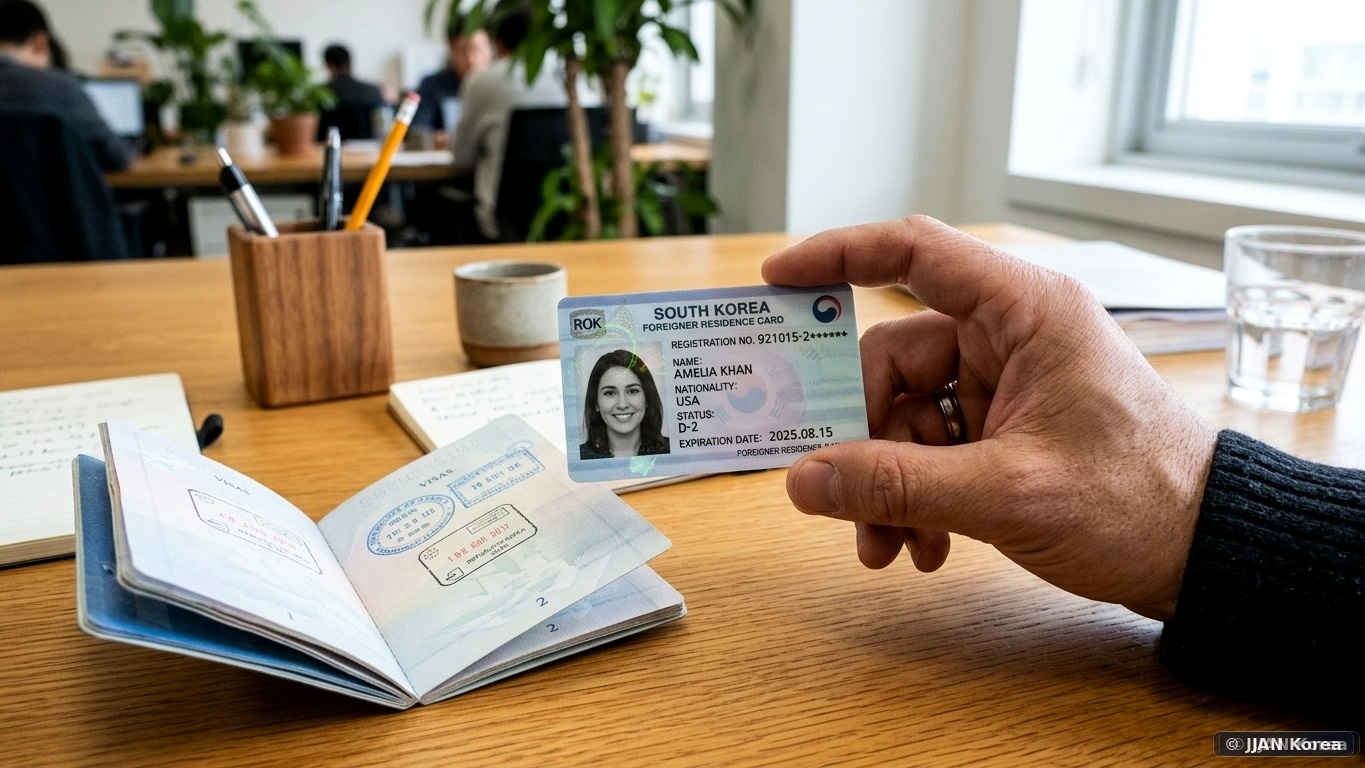
For ambitious foreign professionals, engineers, researchers, and university graduates living in South Korea, breaking free from the restrictive confines of employer-sponsored work visas (such as E-7, E-2, or D-8) represents the holy grail of immigration status. Under employer-tied visas, losing your job means losing your legal right to reside in Korea within 30 days. The ultimate solution is the coveted F-2-7 Points-Based Long-Term Residency Visa (우수인재 점수제 거주비자). Granting residency periods of up to 3 to 5 years, the F-2-7 visa awards complete employment freedom: holders can change jobs without immigration permission, work across multiple corporate sectors, freelance, establish businesses, and sponsor their spouse and children with full work rights. To qualify, applicants must score at least 80 points out of a possible 170 points across a rigorously scrutinized Ministry of Justice point evaluation matrix.
1. Comprehensive Point Matrix Breakdown (Total: 170 Points)
The Ministry of Justice evaluates applicants across five primary statutory criteria, supplemented by bonus points and deduction penalties:
| Evaluation Category | Maximum Points Possible | Optimal Scoring Profile | Critical Verification Document |
|---|---|---|---|
| 1. Age (연령) | 25 Points | Age 25–34 (25 pts); Age 35–39 (23 pts) | Original Passport / Foreigner Residence Card |
| 2. Annual Income (연간 소득) | 60 Points | Tiered from 1x GNI (10 pts) up to ≥ 2x GNI (60 pts) | NTS Certificate of Income (소득금액증명원) |
| 3. Academic Education (학력) | 25 Points | Doctorate (25 pts); Master’s (20 pts); Bachelor’s (15 pts) | Apostilled degree / Domestic diploma |
| 4. Korean Language (한국어능력) | 30 Points | KIIP Level 5 (30 pts); TOPIK Level 6 (20 pts) | Official KIIP Certificate / TOPIK Scorecard |
| 5. Bonus Points (가점) | 30 Points | Domestic STEM degree, employment at listed firm, social work | Certificates of employment, patent registrations |
| Pass Threshold | ≥ 80 Points | Must score ≥ 80 total points to receive approval | Combined administrative dossier |
2. The Income Point Tier Table: Why GNI Determines Your Fate
Income represents the single largest point category (up to 60 points). Points are determined by comparing your previous calendar year’s gross taxable income against the Bank of Korea’s official Gross National Income (GNI) per capita:
- ≥ 100 Million KRW: 60 Points (Maximum).
- ≥ 2x GNI (~93.6 Million KRW): 50 Points.
- ≥ 1.5x GNI (~70.2 Million KRW): 40 Points.
- ≥ 1x GNI (~46.8 Million KRW): 30 Points.
- 30 Million to 40 Million KRW: 15 to 20 Points.
- Under 30 Million KRW: 10 Points.
To claim income points, you must present an official National Tax Service Certificate of Income Amount (Sodeuk Geumaek Jeungmyeongwon – 소득금액증명원). As emphasized in our guide to obtaining National Tax Service income certificates, ensuring that all freelance earnings, year-end bonuses, and wages are properly reported during your annual tax settlement is essential for maximizing your F-2-7 point score.
3. KIIP: The Undisputed 30-Point Golden Ticket
Notice the massive discrepancy in the Korean language category: holding a TOPIK Level 6 (the highest possible score on the Test of Proficiency in Korean) awards only 20 points. However, completing the Ministry of Justice’s official Korea Immigration and Integration Program (KIIP – 사회통합프로그램) Level 5 awards a staggering 30 full points!
Furthermore, graduating from KIIP Level 5 grants an additional 5 to 10 bonus points under the social contribution criteria. In practical terms, completing KIIP provides up to 40 total points—literally half of the entire 80-point threshold required to secure permanent residency freedom! If transitioning away from corporate sponsorship, review our roadmap on transitioning from an employer-sponsored E-7 visa to F-2-7 independence.
4. F-2-7 Application Submission Checklist
Prepare the following paperwork before scheduling your HiKorea immigration appointment:
- Unified Application Form (통합신청서): Accompanied by standard passport photo.
- F-2-7 Point Calculation Worksheet (점수제 평가표): Completed and self-scored by the applicant.
- Official Tax Certificates: NTS Certificate of Income Amount (소득금액증명원) and Employer Withholding Receipt (근로소득원천징수영수증).
- Certificates of Graduation & Degrees: Domestic Korean university degrees or apostilled foreign diplomas.
- Language Certificates: Official KIIP Korean Immigration Integration Program Completion Certificate (KIPRIS portal printout).
- Housing Lease Contract: Proving registered domicile matching ARC records.
- Apostilled Federal Criminal History Record: Issued within the last 6 months (Exempt for certain domestic graduates who previously submitted clean checks).
4. Annual Income Scoring: The GNI Multiplier Benchmark
In South Korea’s points matrix, annual earned income represents the single most powerful scoring component, offering up to 60 total points. Income points are evaluated directly against South Korea’s official Gross National Income (GNI per capita / 1인당 국민총소득) announced annually by the Bank of Korea:
| Income Tier Benchmark | Annual Earned Income Threshold (2026 Reference) | Awarded F-2-7 Points | Required Documentary Proof |
|---|---|---|---|
| Under 1.0x GNI | Below ~45,000,000 KRW | 10 – 30 Points (tiered based on base salary brackets) | NTS Certificate of Income Amount (소득금액증명원) |
| 1.0x to 1.5x GNI | 45,000,000 to 67,500,000 KRW | 40 Points | Official NTS Tax Withholding Receipt (근로소득원천징수영수증) |
| 1.5x to 2.0x GNI | 67,500,000 to 90,000,000 KRW | 50 Points | NTS Verified Electronic Record |
| 2.0x GNI or Higher | 90,000,000 KRW and above | 60 Points (Maximum Allocation) | Direct immigration fast-track eligibility |
5. Actionable Roadmap: How to Reach 80 Points Within 12 Months
To illustrate how accessible the 80-point threshold is with strategic preparation, consider this realistic profile of a typical 29-year-old corporate professional working in Seoul:
- Age (25–29 years old): 25 Points (Peak demographic tier)
- Academic Degree (Overseas 4-Year Bachelor’s Degree): 10 Points
- Annual Salary (38,000,000 KRW in IT or Marketing): 20 Points
- Korean Language (TOPIK Level 4 / KIIP Level 4): 16 Points
- KIIP Level 5 Completion Bonus: +10 Bonus Points
- Domestic Tax Compliance Record (No back taxes for 2 years): +5 Bonus Points
- Total Accumulated Score: 86 Points (Target Breached!)
By investing 6 to 12 months into completing weekend KIIP courses while maintaining clean tax records, virtually any dedicated foreign worker can transition away from restrictive company visa sponsorship and achieve complete professional independence.
5. Frequently Asked Questions (FAQ)
Q1: What happens if my income drops after I obtain the F-2-7 visa?
During visa extension renewals (typically every 1 to 3 years), immigration reassesses your point total. If your score drops below 80 points due to a salary reduction or job transition, immigration will not grant a full multi-year extension. Instead, you may receive a conditional 6-month or 1-year extension to restore your income.
Q2: Can my spouse work full-time on an accompanying F-2-71 visa?
Yes! Spouses of F-2-7 visa holders receive an F-2-71 residency visa that grants broad employment rights, allowing them to work legally across most Korean commercial industries without needing separate work visa sponsorship.
Q3: How many points are deducted for minor traffic fines or administrative infractions?
Traffic camera speeding fines do not deduct points. However, any criminal summary fine (Beol-geum – 벌금) resulting from DUI, physical scuffles, or immigration law violations deducts between 5 and 30 points, and fines exceeding 5,000,000 KRW trigger automatic visa denial and non-renewal.
Q4: Can I apply for F-2-7 directly from outside South Korea?
While technical regulations permit certain high-income foreign corporate executives to apply overseas, 99% of F-2-7 visas are awarded as domestic changes of status (Jageuk Byeongyeong) for professionals already residing in Korea on E-1, E-2, E-7, or D-10 visas.
🛡️ JJAN Korea Editorial Standards & Fact-Checking Verification
This article was independently researched, field-tested, and audited by the JJAN Korea Living & Visa Desk in Seoul led by Senior Columnist Dong-hwan Kim. Point scoring rubrics, GNI threshold multipliers, and KIIP bonus scoring schedules cross-referenced with Ministry of Justice Korea Immigration Service official F-2-7 operational manuals.
Notice an unlisted point rubric change or new scoring category? Help us keep our international community accurately informed: Submit an Editorial Correction to our Seoul Newsroom.