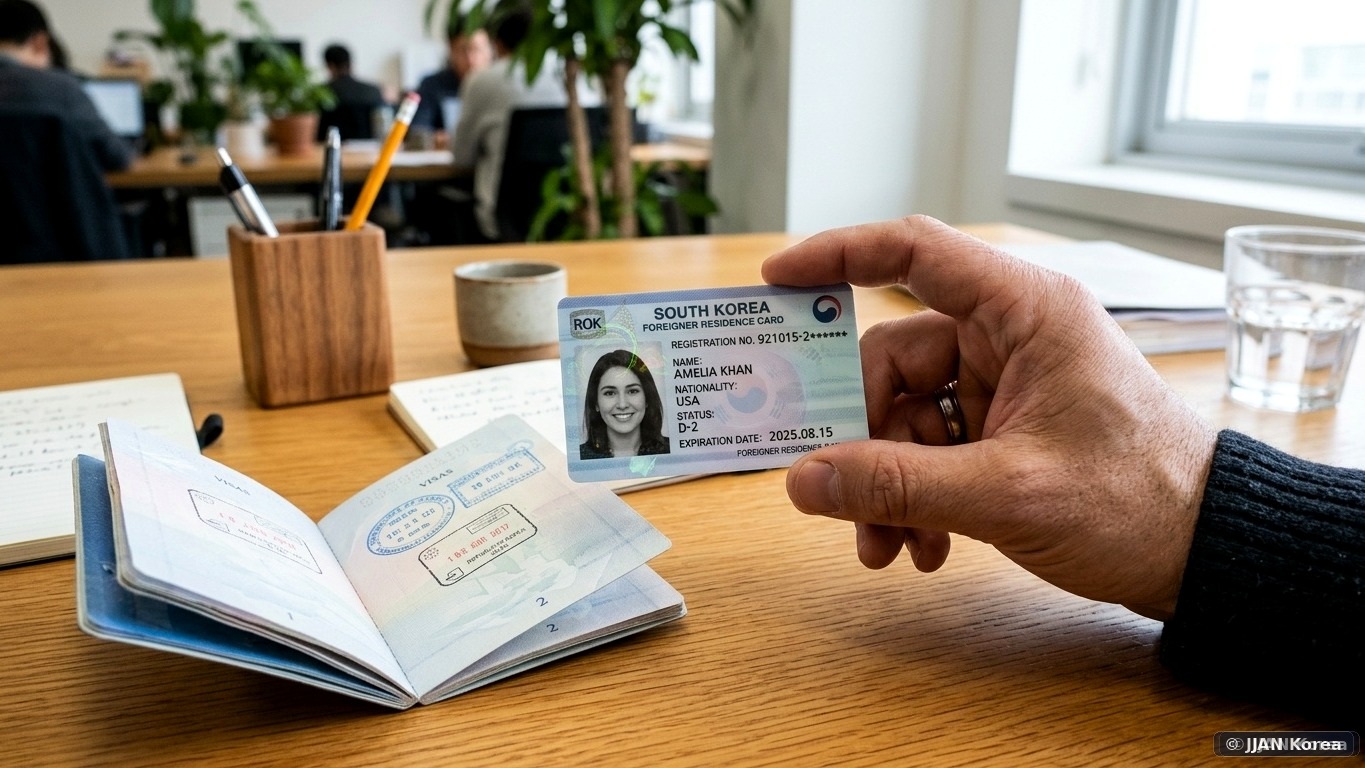
For millions of ethnic Koreans born abroad or holding foreign citizenship—commonly referred to in contemporary society as Gyopo (동포 / Overseas Koreans)—relocating to their ancestral homeland is facilitated by one of the most generous and privileged residence statuses in South Korean immigration law: the F-4 Overseas Korean Visa (재외동포 비자). Established under the Act on the Immigration and Legal Status of Overseas Koreans, the F-4 visa functions virtually as quasi-permanent residency. It permits multi-year stays, unlimited renewals, the freedom to purchase real estate, full access to the National Health Insurance service, and broad employment rights. However, navigating the intricate documentary proofs of blood lineage, verifying the official renunciation of Korean nationality (Gukjeok Sangsil), and understanding legal restrictions against unskilled manual labor requires thorough legal navigation.
1. Legal Eligibility: Who Qualifies as an Overseas Korean?
Under South Korean immigration statutes, an applicant qualifies for F-4 status through one of two legal ancestral lineages:
| Applicant Category | Legal Definition | Core Evidentiary Documents Required |
|---|---|---|
| 1st Generation Overseas Korean (본인 국적상실) | A person who once possessed Korean nationality and subsequently acquired foreign citizenship by naturalization | Family Relations Certificate (가족관계증명서) showing Loss of Nationality (국적상실신고 완료), foreign naturalization certificate, valid foreign passport |
| 2nd / 3rd Generation Lineage (직계비속) | A person whose parent or grandparent possessed Korean nationality and acquired foreign citizenship | Grandparent/Parent Korean Family Register (제적등본), applicant’s certified birth certificate proving direct parental bloodline, apostilled background check |
Crucially, as explained in our consular legal manual on submitting apostilled foreign birth and criminal record certificates, all foreign-issued vital statistics records must carry a certified Hague Apostille and official notarized Korean translations prior to submission at immigration desks.
Upon visa grant and entry into the country, applicants must formally complete administrative residency registration as detailed in our guide on registering your Korean residency and obtaining your overseas citizen card, receiving a domestic residence card (국내거소신고증) equivalent to an ARC.
2. Military Service Rules & The Crucial Age 38 Threshold
For male applicants of Korean descent, the single greatest hurdle to acquiring an F-4 visa involves compliance with South Korea’s Military Service Act (병역법). Following major statutory amendments enacted in May 2018:
- The Age 38 Rule: Male descendants of Korean ancestry who renounced or lost Korean nationality without fulfilling mandatory military service cannot be granted an F-4 visa until January 1st of the year they turn 38 years old.
- The Pre-2018 Grandfather Exception: If the loss or renunciation of Korean nationality was officially completed and registered on your Family Census Register prior to May 1, 2018, the old statutory regulations apply, permitting F-4 issuance prior to age 38.
- Female Applicants & Non-Lineage Exemption: Female Gyopo applicants and male applicants whose lineage never held dual Korean citizenship at birth are completely exempt from military service restrictions.
3. Permitted Job Sectors vs. The “Simple Labor” Prohibition
While F-4 visa holders enjoy immense freedom to work in corporate white-collar roles, open businesses, teach English, or work in creative media without employer sponsorship, the Ministry of Justice strictly prohibits F-4 holders from engaging in designated Simple Physical Labor (단순노무 행위):
| Permitted Employment Sectors (100% Legal) | Restricted / Prohibited Employment Sectors (Simple Labor) |
|---|---|
| Software engineering, IT development, data science | Construction site manual laborer (건설 단순노무직) |
| Corporate management, international marketing, finance | Restaurant kitchen dishwashing & table clearing (단순 주방보조) |
| Foreign language instruction (Hagwons, public schools, corporate) | Door-to-door courier delivery and parcel parcel sorting (택배 상하차) |
| Starting an independent registered business / startup (사업자등록) | Commercial accommodation room housekeeping and janitorial cleaning |
| Professional entertainment, modeling, arts, writing | Adult entertainment venues, gambling parlors, and host bars |
4. Transition Pathways: Upgrading from C-3-8 or H-2 Visas
Many ethnic Koreans from China, CIS nations, and Southeast Asia initially enter South Korea on short-term C-3-8 visitor visas or H-2 work-and-visit permits. Upgrading to the superior F-4 status is achievable through several recognized administrative pathways:
- National Technical Qualification (국가기술자격증 취득): Passing a certified South Korean national technical examination (such as Craftsman certification in baking, information processing, culinary arts, or hair design / 기능사 자격증) entitles the holder to convert immediately to F-4 status.
- University Graduation in Korea: Graduating with an Associate Degree (전문학사) or Bachelor’s Degree from an accredited South Korean university grants automatic eligibility to transition to F-4 regardless of past nationality.
- Top Corporate Taxpayers: Maintaining continuous employment in high-demand manufacturing, agricultural, or maritime sectors for over two years without labor violations unlocks fast-track conversion privileges.
5. The Overseas Koreans Agency (재외동포청 / OKA) Support Centers
In June 2023, the South Korean government formally inaugurated the dedicated cabinet-level Overseas Koreans Agency (재외동포청) headquartered in Songdo, Incheon, alongside the integrated OKA Services Center (재외동포서비스지원센터) located in Gwanghwamun, Seoul (Twin Tree Tower A, 16th Floor). This centralized one-stop administrative hub was established specifically to assist Gyopo with complex residency and legal transitions:
- Family Census Record Tracing (제적등본 발급): If you do not know your Korean ancestors’ official civil registration numbers or ancestral village domicile (Bon-jeok / 본적), OKA legal specialists assist in tracing archived colonial-era Family Registers and hand-written lineage ledgers.
- Dual Citizenship Restoration for Seniors: Under Korean Nationality Act revisions, overseas ethnic Koreans aged 65 or older who permanently return to South Korea can legally restore their South Korean citizenship while retaining their foreign passport by signing the “Agreement Not to Exercise Foreign Nationality Within the Republic of Korea” (외국국적 불행사 서약).
- Real Estate & Domestic Tax Consultation: Bilingual tax accountants and legal counselors provide free advisory sessions on purchasing residential real estate, registering foreign capital inward remittances with the Bank of Korea, and navigating inheritance taxes on ancestral lands.
5. Frequently Asked Questions (FAQ)
Q1: What is the maximum duration of stay granted on an F-4 visa?
A: Initial F-4 visas are typically granted for two to three years. Extensions (연장) can be completed continuously inside South Korea via HiKorea or local immigration offices indefinitely, provided you maintain a clean criminal record.
Q2: Can my non-Korean spouse and children live with me in Korea?
A: Yes. Legal spouses and minor children of F-4 holders are granted an F-1-9 Dependent Visa. While the F-1 dependent visa allows legal residence and study, the spouse cannot work in South Korea unless they independently qualify for a work permit.
Q3: Do F-4 visa holders need to pass the Korean Language (TOPIK) test?
A: If you are applying as a 1st or 2nd generation Gyopo who previously held Korean citizenship or graduated from a Korean educational institution, language testing is waived. However, certain 3rd and 4th generation applicants from non-English speaking jurisdictions must present TOPIK Level 1 or KIIP pre-test scores.
Q4: Can an F-4 visa holder eventually apply for Korean Permanent Residency (F-5)?
A: Yes! After maintaining continuous F-4 residence in South Korea for at least two years and meeting the annual GNI income threshold (or real estate asset requirements), F-4 holders can transition smoothly to F-5-6 Permanent Residency status.
6. Long-Term Horizons: Transitioning to Citizenship (Naturalization)
While the F-4 visa provides stable multi-year residency, many diaspora Koreans eventually seek full restoration of political voting rights and South Korean passports through Special Naturalization (특별귀화):
- Ancestral Restoration Track: Ethnic Koreans whose parents or grandparents were Korean nationals can apply for simplified nationality restoration (국적회복) under the Nationality Act. Applicants must demonstrate basic Korean linguistic competence (satisfied via KIIP Level 5 completion) and clear criminal background checks.
- Retaining Foreign Passports: While general naturalization requires forfeiting foreign citizenship within one year, overseas Koreans naturalizing under designated national talent programs or seniors aged 65+ can maintain dual passports legally by filing the Foreign Nationality Non-Exercise Pledge at the Ministry of Justice.
7. Administrative Appeals & Resolving Lineage Ambiguities
If an immigration officer issues an administrative notice of deficiency (Bo-wan Yocheong – 보완요청) regarding foreign birth records or discrepancy in family name spellings:
- Name Discrepancy Affidavits (동일인 증명서): If your foreign passport displays an English legal name that differs slightly from the Chinese characters (Hanja) or Hangul registered on your ancestral family register, you can submit an official Affidavit of One and the Same Person sworn before a licensed notary public or your home country’s embassy.
- Immigration Administrative Review (이의신청): If your F-4 application is arbitrarily denied, applicants have the statutory right under the Administrative Appeals Act to file a formal Objection (이의신청) within 90 days at the Ministry of Justice Administrative Appeals Commission, demonstrating that ancestral lineage was unlawfully rejected.
8. Banking, Credit Card Issuance & Telecommunications on F-4 Status
Unlike foreign workers on E-7 or E-2 visas whose banking services are frequently restricted by contract durations, F-4 Domestic Residence Card holders enjoy parity with South Korean citizens across financial institutions. F-4 holders can register for postpaid smartphone financing plans, open stock brokerage investment accounts, apply for high-limit domestic credit cards (Shinhan, Hyundai, Samsung Card) without special employer guarantees, and qualify for government-backed commercial loan programs designed for small business entrepreneurs.
Government Administrative Helplines & Multilingual Legal Desks: For personalized consultations regarding ancestral lineage verification or criminal background check exemptions, foreign diaspora members can dial the Ministry of Justice 1345 Immigration Contact Center (press 2 for English) or visit the Seoul Global Center’s dedicated legal clinic for overseas ethnic Koreans.
JJAN Korea Editorial Standards & Fact-Checking Verification
Lead Author: Dong-hwan Kim, Senior Columnist (Immigration, Nationality & Legal Desk)
Legal frameworks and employment eligibility restrictions reviewed in strict compliance with the Act on the Immigration and Legal Status of Overseas Koreans (재외동포법) and Ministry of Justice Immigration Enforcement Guidelines. Military exemption ages apply by calendar year.