
Stretching 250 kilometers (160 miles) across the Korean Peninsula along the 38th parallel, the Demilitarized Zone (DMZ / 비무장지대) is the most heavily fortified border on Earth. Established during the 1953 Korean War Armistice Agreement, this 4-kilometer-wide buffer zone separating North and South Korea stands as a poignant, living relic of the Cold War—brimming with razor-wire fencing, subterranean invasion tunnels, observation posts, and anti-tank barricades, all juxtaposed against an untouched temperate biodiversity wildlife sanctuary.
For international visitors, traveling to the DMZ is an unforgettable geopolitical and historical journey. However, due to rigorous United Nations Command (UNC) and Republic of Korea (ROK) military security protocols, independent travel to the DMZ is strictly illegal. Visitors must book authorized group tours with accredited military-licensed operators. Furthermore, ongoing geopolitical shifts between the Joint Security Area (JSA / Panmunjom) and the Civilian Control Line require meticulous advance planning. This comprehensive 2026 booking guide covers tour types, military dress codes, passport clearance, and booking platforms.
1. Tour Options: Half-Day DMZ vs. Full-Day vs. JSA Panmunjom
Understanding the geographic and administrative distinction between general DMZ tours and the Joint Security Area (JSA) is critical before reserving your tickets:
| Tour Category | Primary Highlights Included | Duration & Timing | Booking Window & Availability |
|---|---|---|---|
| Standard Half-Day DMZ Tour | Imjingak Peace Park, 3rd Infiltration Tunnel, Dora Observatory, Dorasan Station | 6 – 7 Hours (07:30 departure, return to Seoul by 14:30) | Book 1 to 2 weeks in advance. Operates Tuesday through Sunday (Mondays closed). |
| Full-Day DMZ + Suspension Bridge | Standard DMZ highlights + Gamaksan or Majang Lake Red Suspension Bridge + War Memorial | 8 – 9 Hours (Full day excursion with Korean lunch) | Book 2 to 3 weeks in advance. Excellent for photography and outdoor nature lovers. |
| Joint Security Area (JSA / Panmunjom) | Blue UN Military Armistice Conference T-Buildings, Freedom House, Military Demarcation Line | Full Day (Highly restricted military escort) | Subject to UNC military operational status. Requires 1 to 2 months advance security vetting. |
Crucial JSA (Panmunjom) Operational Notice
Public civilian tours to the Joint Security Area (JSA / the famous blue conference buildings straddling the North-South border line) are subject to sudden military suspension by the United Nations Command during periods of heightened diplomatic tension or joint military exercises. If JSA tours are suspended during your travel dates, the Standard DMZ Tour to Paju remains fully operational and provides an extraordinary, immersive look directly into North Korean territory through high-powered observation binoculars.
2. Core Highlights of the Paju DMZ Tour
A standard licensed military tour to the Paju Civilian Control Zone includes four fundamental historical monuments:
1. Imjingak Peace Park (임진각)
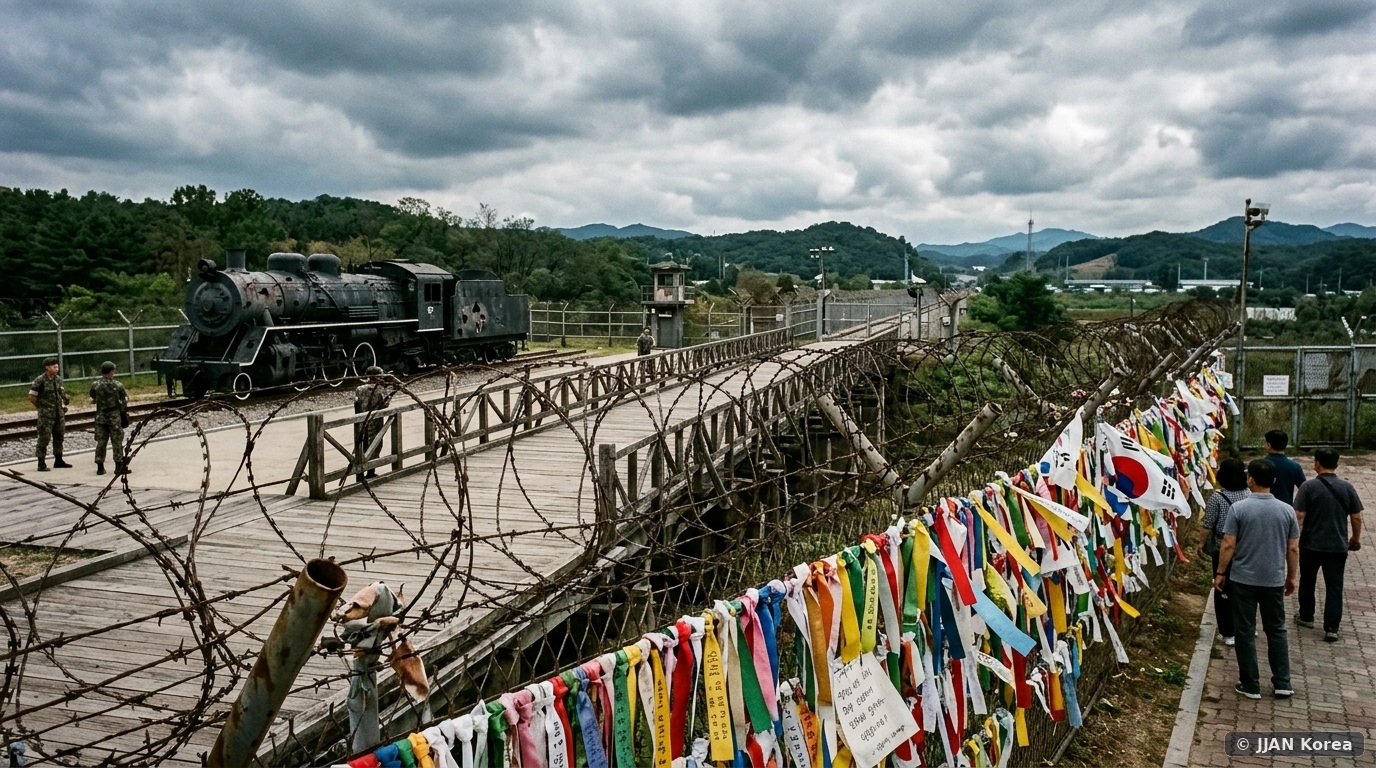
The furthest northern point accessible to the general public without passing through military passport checkpoints. Features the Bridge of Freedom (where 12,773 ROK/UN prisoners of war were repatriated in 1953), the bullet-riddled steam locomotive that derailed during the Battle of Jangdan, and the Mangbaedan memorial altar where separated families pay respects toward their ancestral hometowns in the North during Chuseok and Lunar New Year.
2. The Third Infiltration Tunnel (제3땅굴)
Discovered in October 1978 based on intelligence provided by a North Korean defector, this clandestine tunnel was blasted through solid granite rock 73 meters underground. Measuring 1.95 kilometers in length and 2 meters in diameter, it was engineered by the North Korean military to secretly infiltrate 30,000 armed troops per hour directly into Seoul, located just 52 kilometers away. Visitors put on safety hardhats and walk down a steep 350-meter interception ramp to view the concrete interception barrier wall directly facing the North.
3. Dora Observatory (도라전망대)
Perched atop Mount Dora, this military observation complex offers unobstructed panoramic vistas across the DMZ into North Korea. Through high-powered digital optical binoculars, visitors can clearly see Kijong-dong (the North Korean Propaganda Village) featuring a 160-meter-tall flagpole flying a 270-kilogram North Korean flag, the shuttered Kaesong Industrial Complex, and local farmers tending collective agricultural fields.
4. Dorasan Station (도라산역)
A modern, gleaming trans-continental railway station built on the Gyeongui Line with signs pointing to “Pyongyang 205km” and “Seoul 56km”. Originally intended to connect South Korea to the Trans-Siberian Railway (TSR) and Europe, the empty passenger customs hall stands as a poignant symbol of hopes for eventual Korean reunification. Travel connections back to Seoul connect seamlessly through rail networks detailed in our Seoul KTX and intercity transit guide.
3. Strict Military Regulations & Dress Code
Entering the Civilian Control Zone (민간인통제선 / CCZ) places visitors under direct United Nations Command and Republic of Korea Army operational jurisdiction. Violation of these mandatory rules results in immediate tour expulsion or military detention:
- Physical Passport Requirement (CRITICAL): Every single passenger must carry their physical, original passport. Photocopies, phone screenshots, or driver’s licenses are strictly rejected by armed military sentries at the Unification Bridge (Tongil-daegyo) checkpoint. If you forget your physical passport at your hotel, you cannot board the bus.
- Dress Code Guidelines: While general DMZ tours have relaxed dress codes compared to the formal JSA, visitors must avoid torn or ripped jeans, athletic tank tops, clothing displaying provocative political slogans or military camouflage patterns, and flip-flops. Wear comfortable athletic walking shoes, as walking through the steep 3rd Tunnel requires sturdy footwear.
- Strict Photography Zones: Photography is strictly prohibited at all military checkpoints, troop fortifications, razor-wire barricades, and camera-facing sentry towers. At Dora Observatory, photos may only be taken from designated outdoor observation decks. Inside the 3rd Tunnel, all cameras, smartphones, and bags must be locked in free storage lockers before entering.
- No Alcohol Consumption: Consuming alcohol before or during the tour is strictly prohibited; military sentries reserve the right to conduct breathalyzer tests at the border crossing.
4. How to Book: Accredited Platforms & Logistics
Reserve your tour through licensed travel operators that hold pre-cleared military time slots:
- Select a Government-Accredited Operator: Reputable platforms include VIP Travel, Koridoor Tours, Klook, GetYourGuide, and Trazy. Ensure the tour operator guarantees confirmed departure tickets rather than “on-request waitlists.”
- Departure Points: Most group tour coaches depart early in the morning (between 07:00 and 08:00 AM) from convenient central Seoul subway hubs: Myeongdong Station Exit 1, Hongik University Station Exit 4, or Dongdaemun History & Culture Park Station. Connect easily using the tips in our Incheon Airport and Seoul transit guide.
- Early Morning “Ticket Lottery”: Due to strict daily military civilian caps (typically 2,000 to 3,000 visitors per day at the 3rd Tunnel), tour buses line up at the Imjingak ticket office before 07:30 AM to secure physical admission time slots. Choose tours with early departures to avoid long standby delays.
5. DMZ Tour Preparation Checklist
- Packed physical, original passport in daypack (NO photocopies or phone photos).
- Dressed in respectful clothing (closed-toe walking sneakers, no ripped clothing, no military camo).
- Booked tour tickets at least 2 to 3 weeks in advance through an accredited licensed provider.
- Arrived at Seoul morning meeting point 15 minutes before scheduled bus departure.
- Brought a light jacket (the 3rd Infiltration Tunnel maintains a brisk 11°C–14°C temperature year-round).
- Stored ₩100 and ₩500 coins for high-powered observation binoculars at Dora Observatory.
6. Frequently Asked Questions (FAQ)
Is the DMZ tour safe for foreign tourists?
Yes. The DMZ is visited by hundreds of thousands of international tourists and dignitaries each year. The region is heavily monitored by United Nations Command peacekeepers and the Republic of Korea armed forces under strict armistice protocols. In the rare event of heightened military readiness, tours are preemptively cancelled with full ticket refunds.
Can I visit the DMZ on a Monday?
No. All military tourist facilities in the Paju Civilian Control Zone—including the 3rd Infiltration Tunnel, Dora Observatory, and Dorasan Station—are strictly closed every Monday and on major national holidays for mandatory military security inspections. Plan your excursion for Tuesday through Sunday.
Is the walk inside the Third Infiltration Tunnel physically demanding?
Yes. Walking down the access interception ramp involves a steep 11-degree incline descending 73 meters underground over 350 meters (equivalent to walking down and up a 25-story building). The tunnel ceiling is low (approximately 1.6 meters in sections), requiring adults to hunch while wearing safety helmets. Visitors with severe cardiovascular conditions, asthma, or limited mobility should consider booking the monorail option or relaxing at the tunnel visitor center.
Can citizens of all nationalities book a DMZ tour?
For standard Paju DMZ tours (3rd Tunnel & Dora Observatory), citizens of virtually all sovereign nations holding valid entry visas or K-ETA entry permits to South Korea can participate. However, if booking specialized JSA (Panmunjom) tours, United Nations Command requires special background screening for passport holders of certain designated countries (including China, Russia, Iran, and North Korea).
JJAN Korea Editorial Standards & Fact-Checking Verification
This military and geopolitical travel dossier was compiled and cross-checked by Travel Editor Do-jun Kim in coordination with operational notices from the United Nations Command (UNC) Military Armistice Commission, ROK Ministry of National Defense, and Paju Municipal City Tourism Bureau. Operational access rules reflect 2026 standards.
🛡️ JJAN Korea Editorial Standards & Fact-Checking Verification
This article was independently researched, field-tested, and audited by the JJAN Korea Geopolitical Travel & Heritage Desk in Seoul. Audited in accordance with United Nations Command (UNC) Military Armistice Commission notices and Paju Municipal City Civilian Control Zone regulations.
Notice an unlisted policy change, fare update, or revised administrative rule? Help us keep our international community accurately informed: Submit a Correction to our Seoul Newsroom.