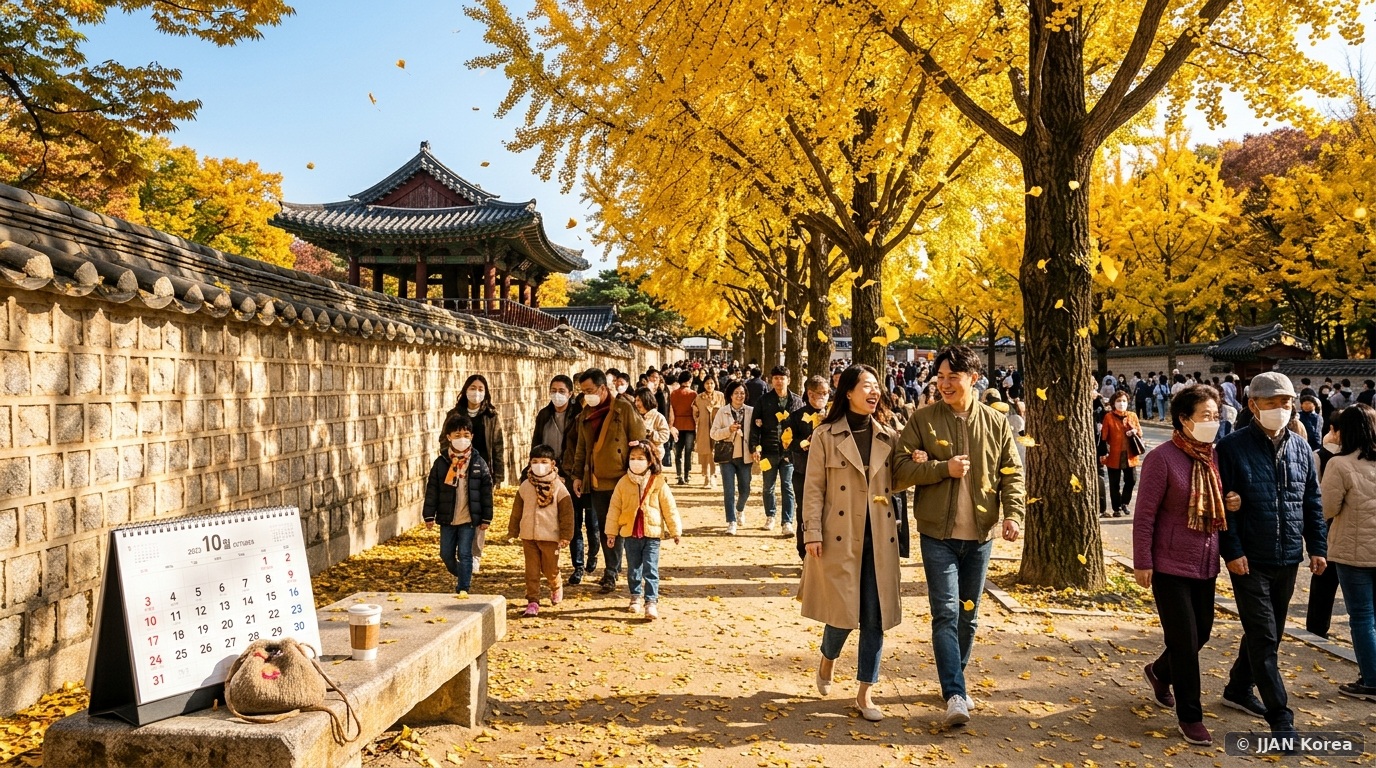
Every October, the South Korean calendar experiences an extraordinary concentration of statutory national holidays and cultural commemorations, creating what locals and expatriates affectionately celebrate as the Autumn Golden Holiday Window (Ga-eul Hwang-geum Yeonhyu). Within a span of less than ten days, the nation observes Armed Forces Day (Gunguk-ui Nal – October 1), National Foundation Day (Gaecheonjeol – October 3), and Hangul Day (Hangul-nal – October 9). When these dates align adjacent to weekends or follow immediately after Chuseok, millions of office workers take advantage of substitute public holidays (Daeche Gonghyuil), triggering massive domestic tourism rushes, highway congestions, and sporadic public administrative office closures. For foreign residents and travelers, navigating this festive period requires understanding what government offices shutter, how commercial retail operates, and where to experience the season’s grandest cultural ceremonies.
1. The October Holiday Triad: Origins, History & Civic Significance
Each October holiday commemorates a fundamentally distinct epoch of the Korean nation’s historical, spiritual, and linguistic evolution. Understanding their legal designations clarifies which services remain active:
| Holiday Name | Statutory Date | Historical Origin & Meaning | Public Office & Bank Status |
|---|---|---|---|
| Armed Forces Day (국군의 날) | October 1 | Honors military service; commemorates crossing of 38th parallel in 1950 | Statutory public holiday (Government & banks closed) |
| National Foundation Day (개천절 / Gaecheonjeol) | October 3 | “Opening of Heaven”; commemorates legendary founding of Gojoseon by Dangun in 2333 BCE | National flag-raising holiday (Full statutory closure) |
| Hangul Day (한글날) | October 9 | Commemorates King Sejong’s proclamation of the Hunminjeongeum alphabet in 1446 | Statutory holiday; extensive free cultural museum admissions |
| Substitute Holiday (대체공휴일) | Next immediate Monday | Mandatory under the Public Holidays Act if Oct 3 or 9 falls on a weekend | Full administrative holiday extension nationwide |
While the multi-day harvest festival of Chuseok causes complete metropolitan shutdowns, by comparing October single-day holidays with Chuseok multi-day national closures, travelers will find that October holidays represent leisure celebrations where commercial restaurants, department stores, and entertainment complexes remain 100% open and thriving.
2. What Closes and What Stays Open: Banking, Healthcare & Immigration
While consumer retail thrives during October, essential civic and public services observe strict statutory closures:
- Immigration Offices & Community Service Centers (Jumin Center): 100% closed on October 1, 3, and 9 (as well as any designated substitute Mondays). You cannot register residence address changes, pick up Alien Registration Cards, or file in-person visa petitions. Automated document issuance kiosks (Muin Balgeupgi) in subway stations remain operational for printing resident certificates.
- Commercial Bank Branches & Post Offices: Physical retail bank branches are closed. While convenience store ATMs and mobile banking apps function normally, wire transfers requiring compliance officer reviews (such as large overseas remittances exceeding 50,000 USD) pause until standard banking hours resume.
- Primary Care Medical Clinics & Pharmacies: Neighborhood private doctors and dental clinics are generally closed. However, by accessing on-duty emergency pharmacies during statutory public holidays, you can locate certified Holiday Guardian Pharmacies (Hyuil Jikimi Yakguk) and hospital emergency rooms for urgent medical needs.
- Hypermarkets & Shopping Centers: Major hypermarkets (E-Mart, Lotte Mart, Homeplus) and department stores operate standard weekend hours, making October holidays ideal for leisure shopping and family dining.
3. Major Civic Ceremonies: Armed Forces Parades & Gwanghwamun Festivals
October holidays bring magnificent public spectacles to central Seoul. On Armed Forces Day, the Ministry of National Defense stages monumental military parades down Sejong-daero boulevard between Sungnyemun Gate and Gwanghwamun Square, featuring supersonic fighter jet flyovers (the ROKAF Black Eagles aerobatic team) and mechanized armor columns.
On National Foundation Day (October 3), traditional ancestral ceremonies are held atop Mount Manisan on Ganghwa Island at Chamseongdan Altar—where Dangun is said to have offered sacrifices to the heavens—while central Seoul hosts cultural street pageants and traditional drumming performances. On Hangul Day (October 9), the entire Gwanghwamun Square plaza transforms into an open-air linguistic festival celebrating the Korean script.
4. Holiday Travel Logistics: Expressways, KTX & Substitute Days
When an October holiday falls on a Friday or Monday, creating a three-day weekend, millions of metropolitan residents depart for autumn foliage road trips toward Gangwon Province and the southern national parks. Expressways (particularly the Yeongdong and Gyeongbu expressways) experience heavy congestion starting from 07:00 AM on the first day of the holiday weekend.
If you plan to travel intercity via KTX high-speed rail, reserve train seats at least 3 to 4 weeks in advance via KorailTalk. Alternatively, taking regional subway lines (such as Line 1 or the Gyeongui-Jungang Line) allows you to reach scenic hiking trails and royal Joseon tomb complexes on the outskirts of Seoul without getting caught in highway traffic jams.
5. Emergency Healthcare, Pharmacy Networks & Municipal Service Protocols
When multiple national holidays align within a single fortnight, the most pressing dilemma confronting foreign residents is navigating closed outpatient medical clinics, neighborhood pharmacies (Yakguk), and public administrative offices. Under South Korean municipal emergency preparedness ordinances, local governments designate rotating on-duty clinics (Dang-jik Byeong-won) and late-night holiday pharmacies (Hyu-il Jikkim Yakguk) across every administrative ward (Gu).
If you experience acute dental pain, sudden fever, or unexpected food allergies when standard clinics are shuttered, avoid rushing straight to tertiary university hospital emergency rooms (ERs) unless the situation is life-threatening. Tertiary ERs triage non-emergent patients to the lowest priority tiers, resulting in 4- to 6-hour waiting times and emergency admission surcharges often exceeding 70,000 to 120,000 KRW before treatment even begins.
Instead, leverage Korea’s nationwide 119 Emergency Medical Consultation Service. By dialing 119 and pressing 7 (or requesting English translation through the BBB Korea volunteer hotline), a licensed nurse or paramedic will immediately search the real-time National Emergency Medical Information Center (E-Gen – www.e-gen.or.kr) database. They will pinpoint open pediatric clinics, orthopedic urgent-care facilities, and 24-hour pharmacies operating within walking distance of your current GPS location.
For basic over-the-counter pharmaceuticals—such as acetaminophen antipyretics (Tylenol), ibuprofen analgesics, digestive enzymes (Whalmyungsu or Festal), antacid chewables, and thermal pain patches—major convenience store chains (CU, GS25, 7-Eleven, and Emart24) stock registered “Safety-Net Household Medicines” (Anjeon Sangbi Uiyakpum). These items are legally authorized for retail sale 24 hours a day, 365 days a year, providing an immediate first line of relief during extended autumn holiday shutdowns.
Regarding public utilities and banking: automated teller machines (ATMs) and mobile banking applications operate uninterrupted throughout National Foundation Day and Hangul Day, but physical bank branches, post offices (Ucheguk), and district immigration branch offices remain strictly closed. If your legal stay period or Alien Registration Card (ARC) is scheduled to expire on an official public holiday, Article 31 of the Immigration Control Act automatically extends your statutory filing deadline to the very next working business day, completely exempting you from late-filing administrative penalties.
For prescription refills during extended holidays, keep your National Health Insurance Service (NHIS) card or digital ARC handy on your smartphone. Consultations at designated holiday emergency clinics incur a modest 30% statutory holiday surcharge (Hyu-il Ga-san-geum) on primary care physician fees, typically raising an ordinary 5,000 KRW co-pay to approximately 6,800 to 7,500 KRW—still remarkably affordable compared to international emergency room rates.
5. Frequently Asked Questions (FAQ)
Q1: Are national museums and royal palaces open on October statutory holidays?
Yes! The National Museum of Korea, National Folk Museum, and the Four Grand Palaces (Gyeongbokgung, Changdeokgung, Changgyeonggung, Deoksugung) remain fully open during all October holidays. In fact, if a holiday falls on a Monday (when palaces are normally closed for weekly maintenance), palaces remain open on Monday and observe their closure day on the subsequent Tuesday instead.
Q2: Do workers in Korea receive mandatory holiday pay on October holidays?
Under Article 55 of the Labor Standards Act, all businesses employing five or more full-time staff must grant statutory public holidays as paid rest days (Yugeup Hyuil). If an employee is required to work on October 1, 3, or 9, the employer must pay a holiday overtime premium equal to 150% of the standard hourly wage (or 200% for work exceeding 8 hours).
Q3: How do substitute public holidays work if an October holiday falls on a Saturday?
Under the revised Public Holidays Act, National Foundation Day (Oct 3) and Hangul Day (Oct 9) are fully covered by the substitute holiday mandate. If either holiday falls on a Saturday or Sunday, the very next regular business day (typically the following Monday) is automatically designated as an official paid substitute public holiday nationwide.
Q4: Why do Koreans fly the national flag (Taegeukgi) in October?
Both National Foundation Day and Hangul Day are designated as “National Flag-Raising Days” (Gukgyeong-il). Korean citizens proudly hang the Taegeukgi flag from apartment balcony railings, while municipal buses and streetlamp posts throughout Seoul fly twin flags along every major boulevard.
🛡️ JJAN Korea Editorial Standards & Fact-Checking Verification
This October national holiday guide has been authored and fact-checked by Senior Columnist Dong-hwan Kim in accordance with official public notices released by the Ministry of the Interior and Safety (MOIS) and the Ministry of Employment and Labor (MOEL).
- Statutory holiday dates and substitute holiday mechanisms verified under the Regulations on Holidays of Public Agencies.
- Holiday overtime wage compensation rates audited under Article 55 of the Korean Labor Standards Act.
- Civic parade operating routes confirmed with Seoul Metropolitan Police Agency Traffic Management Operations.