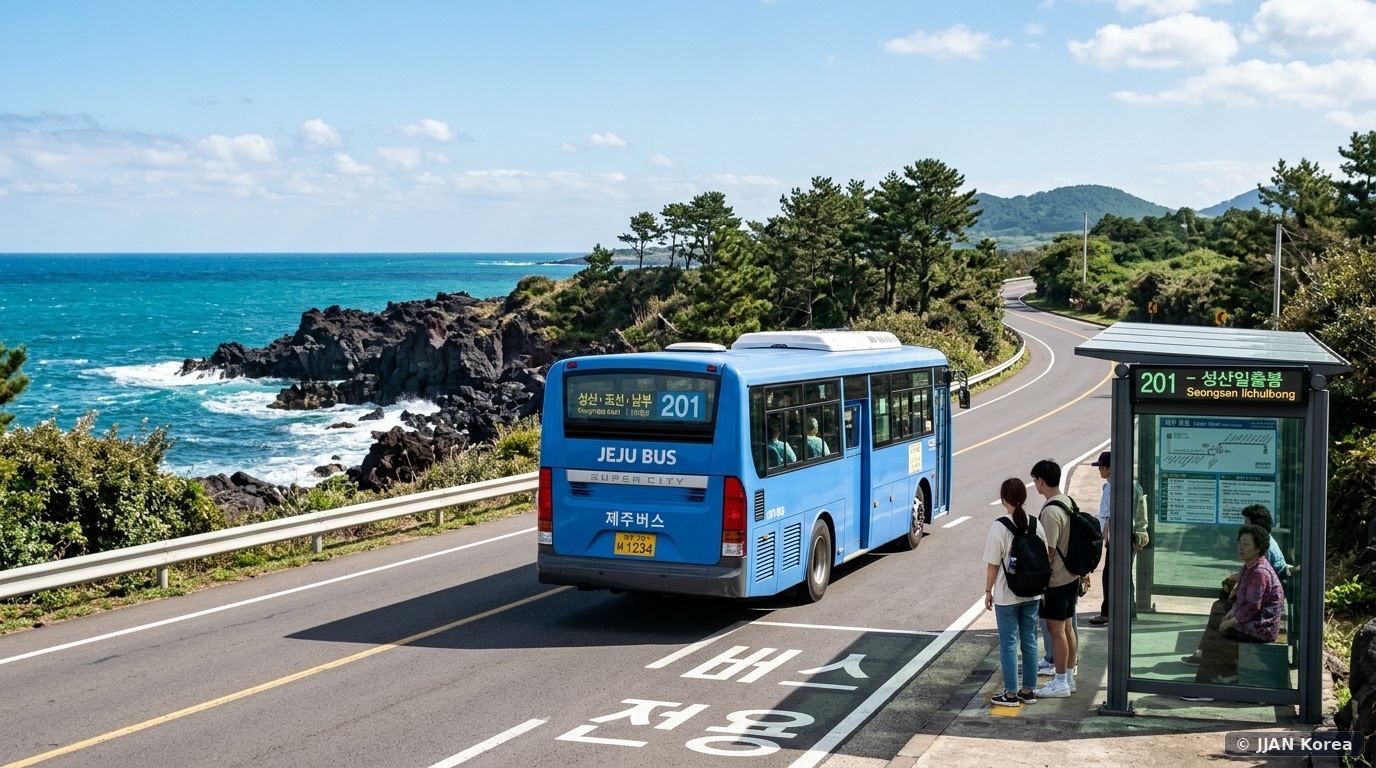

With its dramatic volcanic crags, emerald ocean coastlines, fragrant tangerine orchards, and the towering caldera peak of Hallasan, Jeju Island (제주도) is South Korea’s premier island getaway. For decades, conventional travel advice proclaimed that renting a private vehicle was non-negotiable for exploring Jeju’s expansive 1,849-square-kilometer terrain. International tourists who lacked an International Driving Permit (IDP) or felt uncomfortable navigating right-hand traffic often felt shut out of the island’s best natural treasures.
However, following a comprehensive multi-billion-won overhaul of Jeju’s municipal bus network, **exploring Jeju Island completely without a car is now faster, cheaper, and more scenic than ever**. Anchored by high-speed Express Red Buses fanning out directly from Jeju International Airport, dedicated East and West Tourist Shuttle loop lines with multilingual GPS audio commentary, and seamless T-Money transit card integration, car-free travelers can navigate beaches, UNESCO volcanic lava tubes, and coastal cafes with complete freedom. This definitive transit guide breaks down route numbers, airport bus depots, luggage logistics, and smart transit strategies for 2026.
1. Jeju Island’s Color-Coded Bus Hierarchy Explained
Jeju’s bus network operates under a color-coded classification system that makes navigation straightforward, even without reading Korean:
| Bus Class & Color | Route Number Range | Speed & Stop Frequency | Standard Fare (T-Money) |
|---|---|---|---|
| Express Bus (급행버스 / Bright Red) | 100-Series (101, 102, 111, 112, 121, etc.) | Fastest transit across island. Departs directly from Jeju Airport, stops only at major transfer transit centers. | ₩2,000 – ₩3,000 (Distance-based tariff) |
| Main Trunk Bus (간선버스 / Vibrant Blue) | 200 & 300-Series (201 Coastal East, 202 Coastal West) | Connects cities, towns, and scenic coastal villages. Stops at all coastal beaches and cafe streets. | Flat ₩1,150 (Adult card) |
| Tourist Shuttle Bus (관광지순환 / Bright Yellow) | 810-Series (East) & 820-Series (West) | Circular loop lines dedicated to major attractions (Manjanggul, Snoopy Garden, O’sulloc Tea). Multilingual audio guides on board! | ₩1,150 per ride (or ₩3,000 all-day pass) |
| Local Feeder Bus (지선버스 / Light Green) | 400 to 700-Series | Short neighborhood hops connecting rural villages to main trunk lines. | Flat ₩1,150 |
2. The Essential Routes Every Tourist Must Know
By memorizing just four core routes, you can reach virtually 90% of Jeju’s most famous destinations:
1. Route 101 & Route 201: The East Coast Arterials (동일주)
Fanning eastward from Jeju Airport and Jeju Intercity Terminal, these buses trace the stunning eastern coastline through Hamdeok Beach, Woljeongri Beach, and Seongsan Ilchulbong (Sunrise Peak). Take **Express 101** to reach Seongsan in just 75 minutes, or take **Blue Bus 201** to hop between turquoise beachside cafes and seaside Olle trails at your own pace.
2. Route 102 & Route 202: The West Coast Arterials (서일주)
Tracing the dramatic sunsets of the western shoreline, these routes connect Jeju City to Aewol Cafe Street, Gwakji Beach, Hyeopjae Beach, Hallim Park, and continue down to the southern city of Seogwipo. Express 102 provides rapid transit, while Blue 202 offers the ultimate scenic ocean-view bus ride in Korea.
3. Route 181 & Route 182: The Hallasan Mountain Express Loops
These two express circular loops cut directly through the pristine central highland pine forests of Hallasan National Park via the 5.16 Highway and Pyeonghwa-ro. Route 181 loops clockwise (Jeju City > Seongpanak Trailhead > Seogwipo > Jungmun > Airport), while Route 182 loops counter-clockwise. This is the official public transit route for hikers climbing to Hallasan’s Baekrokdam crater summit!
4. The 810 (East) and 820 (West) Tourist Loop Shuttles
Operating out of the Daecheon Transit Hub (East) and Donggwang Transit Hub (West), these yellow buses are specifically designed for car-free sightseers. A bilingual tourist concierge is stationed at each transfer hub, and buses feature GPS-triggered automated English, Japanese, and Chinese audio commentary explaining local folklore as you approach attractions.
3. Luggage Logistics: The “Luggage Delivery Service” Secret
The single greatest burden of car-free travel is dragging heavy wheeled suitcases between scenic stops. Fortunately, Jeju features an ingenious solution: island-wide Same-Day Luggage Delivery Services (짐옮김이 서비스):
- How It Works: Companies like Zim-Carry, Gabang-eul Butak-hae, and Jeju Zim Delivery pick up your heavy luggage directly from Jeju Airport Arrival Hall or your hotel lobby at 09:00 AM, and securely transport it to your next hotel or guesthouse by 16:00 PM.
- Affordable Pricing: Rates typically range from ₩10,000 to ₩15,000 per standard 24–28 inch suitcase.
- Travel Completely Unburdened: Hand your bags to the service counter at Jeju Airport, hop directly onto Express Bus 101 with only a light daypack, explore beaches and volcanic craters all day, and find your luggage waiting in your room in Seogwipo upon check-in!
4. Smart Digital Navigation: Naver Map vs. KakaoMap
Due to national security data protection laws, Google Maps does not support real-time public transit GPS tracking or walking directions in South Korea. Car-free travelers in Jeju must install KakaoMap (카카오맵) or Naver Map (네이버 지도):
- Real-Time Bus Arrival Counters: KakaoMap displays the exact live GPS location of every bus on Jeju Island, counting down arrival times in minutes and seconds (e.g., “Bus 101: 3 stops away, 4 mins”).
- Bus Fullness Indicators: The app displays seat availability before the bus arrives—indicating whether the bus is “Smooth / 여유” (empty seats available), “Normal / 보통”, or “Crowded / 혼잡”.
- Alight Alarms (하차 알림): Activate the in-app GPS alarm; your phone vibrates and chimes two stops before your destination, ensuring you never miss your stop while admiring scenic ocean views. Pair this with seamless connections explored in our T-Money and Climate Card transit guide.
5. Car-Free Jeju Travel Checklist
- Loaded physical T-Money or Cashbee transit card with at least ₩30,000 cash before boarding.
- Installed KakaoMap or Naver Map and tested real-time bus route tracking.
- Arranged same-day luggage delivery service (짐옮김이) to move heavy bags between hotels.
- Tagged transit card upon boarding AND exiting bus to secure free transfer discounts.
- Identified Express Bus platform at Jeju Airport Gate 2 (Platform 1 for West, Platform 2 for East).
- Packed portable power bank (GPS navigation uses substantial smartphone battery).
6. Frequently Asked Questions (FAQ)
Can I use the Seoul Climate Card (기후동행카드) in Jeju?
No. The Seoul Climate Card is strictly valid within the Seoul Metropolitan municipal transit boundary and cannot be used in Jeju. However, standard rechargeable T-Money, Cashbee, and Rail+ transit cards, as well as foreign-issued Namane cards, work seamlessly across all Jeju buses and taxis.
How do transfer discounts work on Jeju buses?
Jeju provides up to two free transit transfers within 40 minutes of tagging off your initial bus. You must tap your card against the sensor when exiting your first bus to validate the transfer window. When transferring between regular Blue buses, the second ride is completely free (₩0)!
Can I hail taxis easily in rural areas of Jeju?
Empty street taxis are rare in remote volcanic countryside areas. However, you can hail licensed local taxis to virtually any rural spot using the Kakao T smartphone app. Drivers arrive within 5 to 10 minutes. Alternatively, ask cafe staff or tourist center attendants to call a local “Call Taxi” (콜택시) on your behalf.
What time do buses stop running on Jeju Island?
Express Red Buses run until approximately 22:00 to 22:30 PM. However, rural feeder lines and tourist shuttle loop lines wrap up service earlier, often by 18:00 to 19:00 PM. Always check the final departure time (막차 시간) for your return route on KakaoMap before embarking on late-afternoon hikes or sunset cafe visits.
JJAN Korea Editorial Standards & Fact-Checking Verification
This public transit field report was independently tested across 300km of Jeju bus corridors by Travel Editor Do-jun Kim in coordination with the Jeju Special Self-Governing Provincial Bus Transit Authority and Jeju Tourism Organization (JTO). Tariff schedules and transfer algorithms reflect official 2026 standards.
🛡️ JJAN Korea Editorial Standards & Fact-Checking Verification
This article was independently researched, field-tested, and audited by the JJAN Korea Regional Transit & Island Logistics Desk in Seoul. Bus routes and timetables physically audited across 300km of Jeju corridors by our travel desk in coordination with the Jeju Bus Transit Authority.
Notice an unlisted policy change, fare update, or revised administrative rule? Help us keep our international community accurately informed: Submit a Correction to our Seoul Newsroom.