
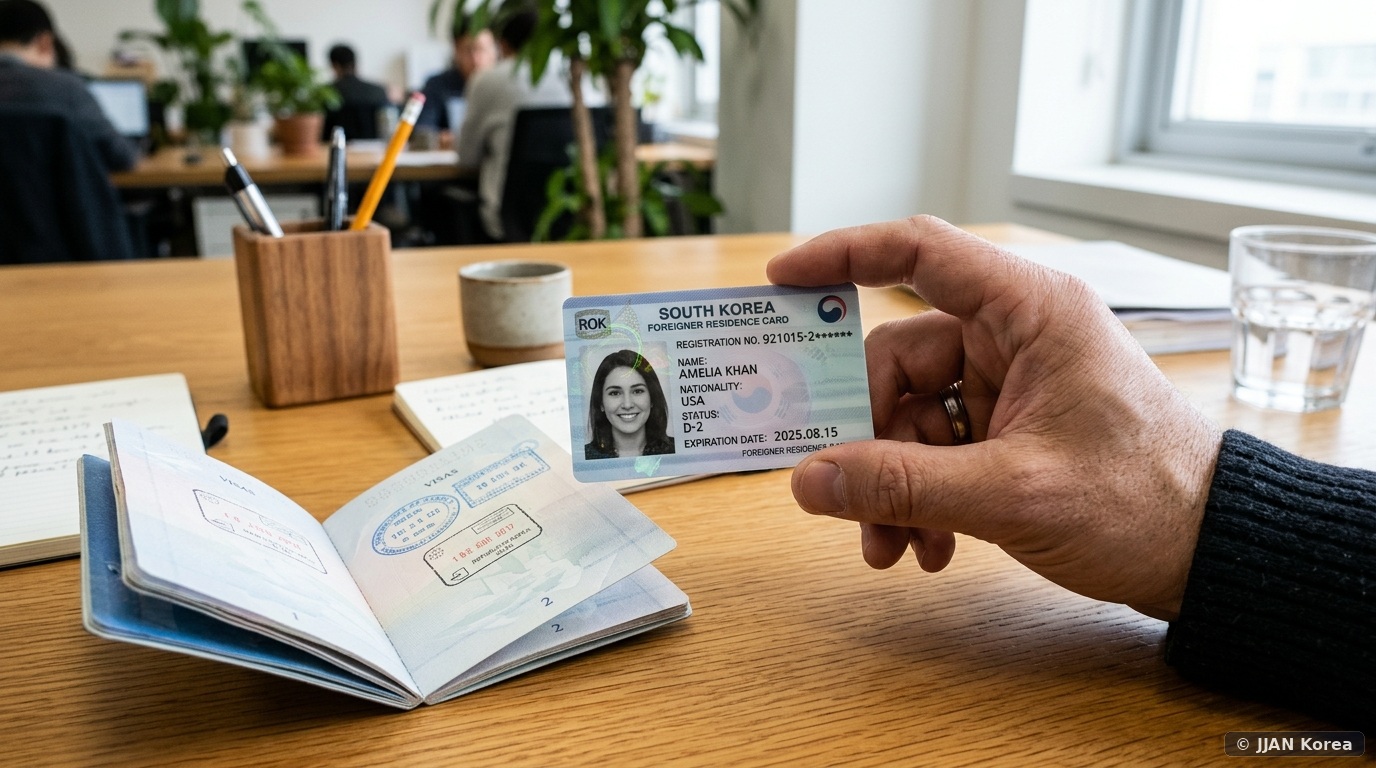
For any foreign national residing in South Korea for more than 90 days, the Alien Registration Card (ARC / 외국인등록증)—officially rebranded by the Ministry of Justice as the Foreign Resident Registration Card (외국인국적증 / Residence Card)—is far more than a simple photo ID. It is your foundational legal master key to Korean society. Without it, you cannot open a Korean bank account, sign a residential lease contract, acquire a postpaid smartphone plan, register for National Health Insurance, or complete online identity verifications (본인인증).
However, examining the physical plastic card reveals dense alphanumeric codes, issuance stamps, holographic watermarks, and reverse-side residential history tables that dictate your legal rights and limitations under the Immigration Control Act. Understanding how to decode every data field on your card—alongside mastering the newly launched 2023+ design standard and digital Mobile ARC protocols—is essential for maintaining legal residency and preventing costly administrative penalties in 2026.
1. Anatomical Breakdown of the Front Face: Key Identity Fields
The front side of your residence card displays your core biographical and immigration parameters:
| Field Label (Korean / English) | Exact Location on Card | Legal Significance & Format | Common Expat Pitfall |
|---|---|---|---|
| 성명 (Full Legal Name) | Top Center | Printed in Latin capital letters (SURNAME GIVEN NAME MIDDLE NAME). Must match passport machine-readable zone (MRZ) exactly. | Spacing or hyphen mismatches during online identity authentication (본인인증) will cause verification failures. |
| 외국인등록번호 (Resident Reg. Number) | Below Name | 13-Digit code formatted as: YYMMDD-5XXXXXX or YYMMDD-6XXXXXX. |
First 6 digits represent birthdate. The 7th digit indicates century and gender (5/7 for males, 6/8 for females born after 1900/2000). |
| 국적 (Country / Nationality) | Middle Left | Sovereign state of passport issuance (e.g., USA, CANADA, VIETNAM, JAPAN). | Dual nationals must use the single nationality through which their visa entry clearance was granted. |
| 체류자격 (Visa Status of Stay) | Middle Center | Your alphanumeric visa classification (e.g., E-7 Professional, D-2 Student, F-4 Overseas Korean, F-6 Marriage Migrant). | Working outside your designated visa scope constitutes illegal labor punishable by deportation. |
| 발급일자 (Date of Issue) | Bottom Left | The calendar date this specific physical card was manufactured and issued. | This is NOT your visa expiration date! Expiration dates are tracked on the back of the card. |
2. Anatomical Breakdown of the Back Face: Expiration & Address Grid
Flip the card over to examine the reverse side. The back is divided into two vital administrative tables that determine your ongoing legal compliance:
1. 체류기간 만료일 (Period of Stay Expiration Date Table)
Located on the upper half of the card back, this table contains four horizontal rows with three columns: 허가일자 (Date of Approval), 체류기간 (Period Granted), and 만료일자 (Expiration Date). When immigration approves your initial visa or grants a visa extension, an officer prints a thermal ink entry in this table. The final date in this column is your legal deadline to depart South Korea or submit an extension! Overstaying even by one single day violates Article 17 of the Immigration Control Act.
2. 체류지 (Residential Address History Grid)
The lower half of the card contains rows for your residential address history. Every time you move apartments and submit a change of residence at your local Dong community center under our Change of Residence reporting guide, the municipal clerk runs the card through a specialized thermal ribbon printer that indelibly stamps your new Korean road-name address and registration date. If all blank rows fill up over the years, the Dong office will apply an official thermal plastic overlay sticker or issue a free replacement card.
3. The 2023+ Redesigned Foreign Resident Card Standards
In April 2023, the Ministry of Justice implemented the first major physical overhaul of the Foreign Resident Card in two decades. Key enhancements you will notice on modern cards include:
- Removal of “Alien” Terminology: The archaic, stigmatizing English word “Alien” was officially replaced with “Residence Card” or “Foreign Resident Card” to match international human rights recommendations.
- High-Resolution Full-Color Portrait: Older monochrome laser-etched photos were replaced with vibrant, high-security full-color portraits equipped with anti-tamper optical variable ink.
- Integrated QR Code: A secure two-dimensional QR code was embedded on the reverse face. When scanned by government agencies, police officers, or domestic financial institutions using accredited readers, it instantly displays the cardholder’s real-time legal status, preventing fraudulent alteration of printed expiration dates.
4. Carrying Requirements & Penalties (Article 27)
Under Article 27 of the Immigration Control Act, foreign residents are legally required to carry their physical Alien Registration Card with them at all times while residing in South Korea:
- Police & Immigration Stops: If an authorized immigration inspector or police officer requests identification, you must produce your physical ARC. Failing or refusing to carry your card is an administrative offense punishable by a fine of up to ₩100,000.
- Can I show a photo on my phone? While showing a clear smartphone photo of your card or a Mobile Identification profile will often satisfy officers for minor civic inquiries, it does not strictly fulfill the statutory legal obligation of Article 27. When traveling between cities, taking domestic flights to Jeju, or entering nightlife districts covered in our Hongdae nightlife ID guide, always carry the original physical plastic card.
5. Residence Card Maintenance Checklist
- Memorized the 13-digit Foreign Resident Registration Number (외국인등록번호).
- Noted the exact visa expiration date printed on the reverse side table.
- Set smartphone calendar reminders 4 months and 2 months prior to visa expiration.
- Ensured spelling of full English legal name matches bank and telecom account contracts.
- Carried physical plastic card in wallet at all times (avoid leaving in hotel safes).
- Stored secure digital PDF color scans of front and back in cloud storage.
6. Frequently Asked Questions (FAQ)
What should I do if I lose my Alien Registration Card?
Under Article 35 of the Immigration Control Act, you must report a lost ARC and apply for a reissuance within 14 calendar days of discovering the loss. You can apply in person at your jurisdictional immigration office or submit an application online via hikorea.go.kr. The statutory reissuance fee is ₩30,000, and processing typically takes 2 to 3 weeks.
What does the 7th digit of the registration number mean?
In the Korean national identification schema, the 7th digit (the first digit following the hyphen) indicates gender and century of birth for foreign nationals: 5 indicates a male born between 1900 and 1999; 6 indicates a female born between 1900 and 1999; 7 indicates a male born in 2000 or later; and 8 indicates a female born in 2000 or later.
Can I open a Korean bank account before my ARC arrives?
While a few foreigner-friendly bank branches (such as select Hana Bank locations) can open limited-withdrawal accounts using your passport and visa grant notice, you cannot access online mobile banking, establish debit card auto-debits, or complete identity verifications until your physical ARC is issued and registered with the bank. Review full details in our foreigner bank account opening guide.
Do I need to surrender my ARC when departing Korea permanently?
Yes. If your period of stay is concluding and you do not plan to renew or re-enter on the same visa, you must physically surrender your ARC to the immigration officer at the airport departure passport control gate. Failing to surrender your card can result in administrative delays or penalties when applying for future Korean entry visas.
JJAN Korea Editorial Standards & Fact-Checking Verification
This legal documentation guide was compiled and audited by Senior Columnist Dong-hwan Kim in coordination with the Korea Immigration Service (KIS) and the Ministry of Justice Division of Immigration Integration. Card security specifications and registration statutes reflect official 2026 standards.
🛡️ JJAN Korea Editorial Standards & Fact-Checking Verification
This article was independently researched, field-tested, and audited by the JJAN Korea Immigration Policy & Civil Rights Desk in Seoul. Audited in direct consultation with the Korea Immigration Service (KIS) and Ministry of Justice Residence Card Design Taskforce.
Notice an unlisted policy change, fare update, or revised administrative rule? Help us keep our international community accurately informed: Submit a Correction to our Seoul Newsroom.