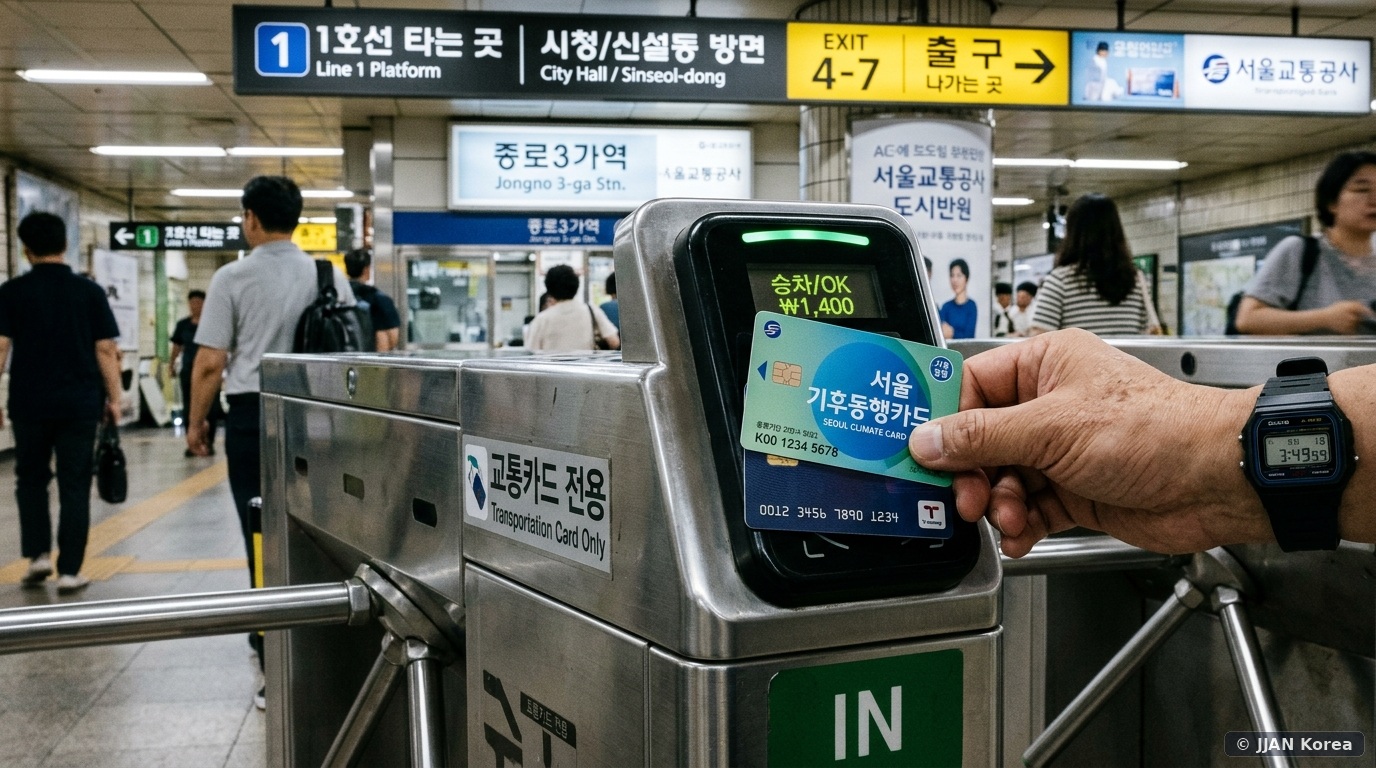

Navigating the ultra-modern, subterranean labyrinth of the Seoul Metropolitan Subway and its vast interconnected bus grid is an exhilarating highlight for any foreign visitor or newly arriving expatriate. However, South Korea’s recent overhaul of its fare architectures—highlighted by the rapid rollout of the Seoul Climate Card (기후동행카드) alongside the venerable rechargeable T-Money card and the tourist-oriented Korea Tour Card—has introduced genuine mathematical dilemmas: Which payment method actually saves money, matches your travel itinerary, and prevents unexpected penalty fares?
While marketing brochures tout the Climate Card as an all-inclusive transit pass offering unlimited subway and bus rides for a flat fee, the reality is defined by rigid municipal borders, strictly enforced cash-only recharge kiosks, and regional exclusions such as the privately operated Shinbundang Line or out-of-boundary excursions toward Incheon and Gyeonggi Province. This definitive, field-tested guide breaks down the precise mathematical formulas, hidden zoning boundaries, physical card purchasing spots, and practical travel simulations to ensure you never overspend on South Korean public transport in 2026.
1. Core Architectural Differences: Climate Card vs. T-Money vs. Korea Tour Card
To make the optimal financial decision, international travelers must understand how these three payment mechanisms function behind the turnstiles. The fundamental difference lies in stored-value deduction versus time-delimited unlimited passes:
| Feature / Parameter | Seoul Climate Card (기후동행카드) | Standard T-Money Card (티머니) | Korea Tour Card (코리아투어카드) |
|---|---|---|---|
| Pass Type | Unlimited rides pass (1, 2, 3, 5, 7, or 30 days) | Pay-as-you-go stored-value card | Stored-value card with tourist retail discounts |
| Card Issuance Cost | ₩3,000 (Non-refundable physical plastic) | ₩3,000 – ₩5,000 (Non-refundable plastic) | ₩4,000 (Non-refundable physical card) |
| Pass Pricing (Short-Term) | 1-Day: ₩5,000 | 2-Day: ₩8,000 | 3-Day: ₩10,000 | 5-Day: ₩15,000 | 7-Day: ₩20,000 | N/A (Deducts ₩1,400 per base subway/bus trip) | N/A (Standard subway deduction of ₩1,400) |
| 30-Day Monthly Pass | ₩62,000 (Transit only) / ₩65,000 (with Ddareungi bike) | Pay per ride (Typically ₩70,000 – ₩95,000/mo) | Pay per ride (Standard transit rates) |
| Geographic Validity | Seoul Municipal boundaries only (Strict exclusions) | Nationwide (Seoul, Busan, Jeju, Daegu, taxis, convenience stores) | Nationwide transit + select cultural attractions |
| Airport Transit (AREX) | Valid between Seoul Stn & Gimpo. Excludes Incheon T1/T2! | Fully valid on All-Stop AREX trains to Incheon Airport | Fully valid on All-Stop AREX trains to Incheon Airport |
2. The Exact Financial Breakeven Formula: When Does the Climate Card Win?
To avoid spending money on a pass that yields no financial return, consider the basic base fare of the Seoul transportation system in 2026. A standard single adult journey tapped with a stored-value T-Money card costs exactly ₩1,400 (cash single-use tickets cost ₩1,500). Furthermore, the Seoul transit network grants up to four free transfers between buses and subways within a 30-minute window (extended to 60 minutes between 9:00 PM and 7:00 AM).
This transfer policy significantly alters the financial math. If you take a subway from Hongdae to Gangnam, exit the gate, and do not ride another vehicle for four hours, that constitutes one separate ride (₩1,400). Here is the required daily ride volume needed to turn a profit on each Climate Card option:
- 1-Day Pass (₩5,000): You must complete at least 4 separate transit journeys per day (4 × ₩1,400 = ₩5,600). Ideal for intensive sightseeing marathons spanning Bukchon, Gangnam, Yeouido, and Dongdaemun.
- 3-Day Pass (₩10,000): Requires an average of 2.4 rides per day (8 rides total across 72 hours). This is the absolute sweet spot for weekend leisure tourists.
- 5-Day Pass (₩15,000): Requires 2.2 rides per day (11 rides total). Perfect for first-time tourists exploring multi-neighborhood itineraries.
- 30-Day Commuter Pass (₩62,000): Requires 45 one-way trips per month. If you commute to work or university five days a week (approx. 40 trips) and venture out on weekends (8 trips), the 30-day card yields substantial, guaranteed monthly savings of ₩15,000 to ₩30,000.
Verdict: If your planned daily schedule involves only traveling from your hotel to an office or university and back (2 trips = ₩2,800/day), purchasing a short-term 1-Day Climate Card (₩5,000) causes a net loss of ₩2,200 per day. In that case, sticking to a traditional rechargeable T-Money card is far more economical. When planning travel outside Seoul, check out our companion guides on Incheon Airport transit options like the AREX express train and booking intercity high-speed KTX train tickets.
3. Crucial Geographic Exclusions & The “Red Zone” Trap
The single greatest operational hazard for foreign travelers using the Climate Card is confusing the Seoul metropolitan municipal borders with the broader Capital Urban Area (Sudogwon). Because the Climate Card is subsidized exclusively by the Seoul Metropolitan Government, neighboring municipalities in Gyeonggi Province and Incheon operate under distinct public finance agreements.
Subway Lines With Restricted Operating Zones
Pay close attention to these common destination anomalies:
- The Shinbundang Line (신분당선): Completely excluded from all Climate Card passes due to its private operator fare concessions. If you board at Sinsa, Nonhyeon, or Gangnam Station to travel toward Pangyo or Bundang, the turnstiles will deny entry or levy full distance surcharges upon exit.
- Incheon International Airport (AREX Line): While the Climate Card is fully valid between Seoul Station and Gimpo International Airport (Line 5, Line 9, and AREX), you cannot use it to disembark at Incheon Airport Terminal 1 or Terminal 2. If you tap into Seoul Station with a Climate Card and exit at Incheon Airport, the automated gates will lock, and station agents will charge you the entire cash fare from Seoul Station (approx. ₩4,750 to ₩5,000) on the spot.
- Gyeonggi-do Suburbs (Everland, Suwon, Nami Island): Boarding within Seoul is permitted, but if you disembark outside Seoul boundaries at an unapproved suburban station, the gate will trigger an error, requiring station master intervention.
Bus Network Rules: What You Can and Cannot Ride
Seoul city buses are distinguished by clear exterior vehicle coloring:
- Blue Buses (Main Trunk Lines) & Green Buses (Branch Feeders): Fully valid within the Climate Card system, provided the bus operator holds a Seoul city municipal license.
- Yellow Circular Buses & Local Village Buses (Maeul Bus): Fully valid and included.
- Red Express Buses (Gwangyeok Bus / 광역버스): Strictly excluded. Red commuter buses connecting satellite commuter towns (Suwon, Seongnam, Ilsan, Incheon) to downtown Seoul require standard T-Money payment (typical fares: ₩3,000 – ₩4,100).
- Night Buses (Late-Night ‘Owl’ All-Night Buses / 올빼미 버스): Included in the Climate Card! A huge cost-saving advantage for travelers enjoying Hongdae, Itaewon, or Gangnam nightlife past midnight.
4. Step-by-Step Purchase & Cash-Only Recharge Walkthrough
Unlike Korean citizens who can activate a digital Mobile Climate Card inside Samsung Wallet or the Mobile T-Money app using Korean resident identification and domestic credit cards, foreign travelers and tourists must purchase a physical plastic card.
Physical cards (₩3,000 non-refundable cash) can be purchased at Station Customer Service Offices (고객안전실) across Seoul Metro Lines 1 through 8, the Seoul Tourism Plaza Information Center in Jongno, the Myeongdong Tourist Information Center, or designated convenience stores (GS25, CU, 7-Eleven, Emart24) displaying the official Climate Card window decal.
Subway ticket vending machines and physical sales desks inside Seoul Metro stations do not accept international credit cards (Visa, Mastercard, Amex) for transit card recharges. You must withdraw physical banknotes at an ATM beforehand.
Approach the automated ticketing machine inside any Seoul subway station. Tap the English (or Japanese/Chinese) language button at the top right of the touchscreen.
Place the physical plastic card onto the designated sensor cradle. Select “Climate Card”, choose your desired short-term duration (1, 2, 3, 5, or 7 days) or 30-day pass, and specify your exact start date (you can select today or up to 5 days in advance).
Feed KRW paper currency into the bill slot. Wait until the progress bar reaches 100% and the screen confirms the active expiration timestamp before lifting the card from the sensor.
5. Expats vs. Tourists: Strategic Decision Matrix
Depending on the length and nature of your stay in South Korea, align your wallet with the following strategic recommendations:
- Short-Term Tourists (3 to 7 Days, Seoul Focus): Buy a 3-Day or 5-Day Climate Card. It eliminates the friction of monitoring stored balances and provides unlimited rides across high-density sightseeing corridors. Supplement it with a spare T-Money card containing ₩10,000 for your return AREX train ride to Incheon Airport.
- Regional Explorers (Seoul + Busan + Jeju + Gyeongju): Stick strictly to a standard T-Money Card or Korea Tour Card. A Climate Card cannot be used on the Busan Metro, Jeju public buses, or intercity express trains, rendering regional balances completely dead outside Seoul.
- Long-Term Foreign Residents (Students, E-7 Expats, Digital Nomads): Purchase the 30-Day Climate Card (₩62,000 transit only or ₩65,000 with public bicycle access). If you register your card number on the official T-Money website, you can also claim cash receipts for annual tax deductions during the local municipal rules and neighborhood conveniences review.
6. Frequently Asked Questions (FAQ)
Can two people share a single Climate Card by tapping consecutively at the turnstile?
No. The Climate Card enforces a strict one-card-per-passenger rule. If you tap the card at an entrance barrier, the system enters an active ride state and will reject any immediate secondary tap with a “Card Already in Use” error. Every individual passenger must hold their own registered plastic card.
Can I get a refund on the remaining days of a short-term Climate Card?
Short-term passes (1, 2, 3, 5, 7 days) are non-refundable once the selected activation date begins, even if you did not utilize the card. For 30-day commuter cards, refunds are permitted before the expiration date at station customer service offices, calculated by subtracting the actual standard transit fares used (₩1,400 per trip) plus a ₩500 administrative cancellation fee.
Can I pay for taxis or convenience store snacks using a Climate Card?
No. Unlike standard T-Money cards that carry an electronic cash purse usable at convenience stores, bakeries, and inside metered taxis, the Climate Card is purely a municipal public transit pass. It cannot be used to pay for retail goods or taxi fares.
What should I do if my Climate Card triggers an error at an exit turnstile?
Do not jump or force open the emergency gate. Press the red “Help / Station Call” button located directly beside the turnstile barrier. A Seoul Metro staff member will speak to you via the intercom, open the swing gate, inspect your card, and help you clear any out-of-boundary zone penalties using cash.
🛡️ JJAN Korea Editorial Standards & Fact-Checking Verification
This article was independently researched, field-tested, and audited by the JJAN Korea Global Transit & Climate Desk in Seoul. Our editorial team physically tested card compatibility across 24 Seoul Metro stations, verified cash-only kiosk recharges, and cross-referenced 2026 tariff notices published by the Seoul Metropolitan Government.
Notice an unlisted policy change, fare update, or revised administrative rule? Help us keep our international community accurately informed: Submit a Correction to our Seoul Newsroom.