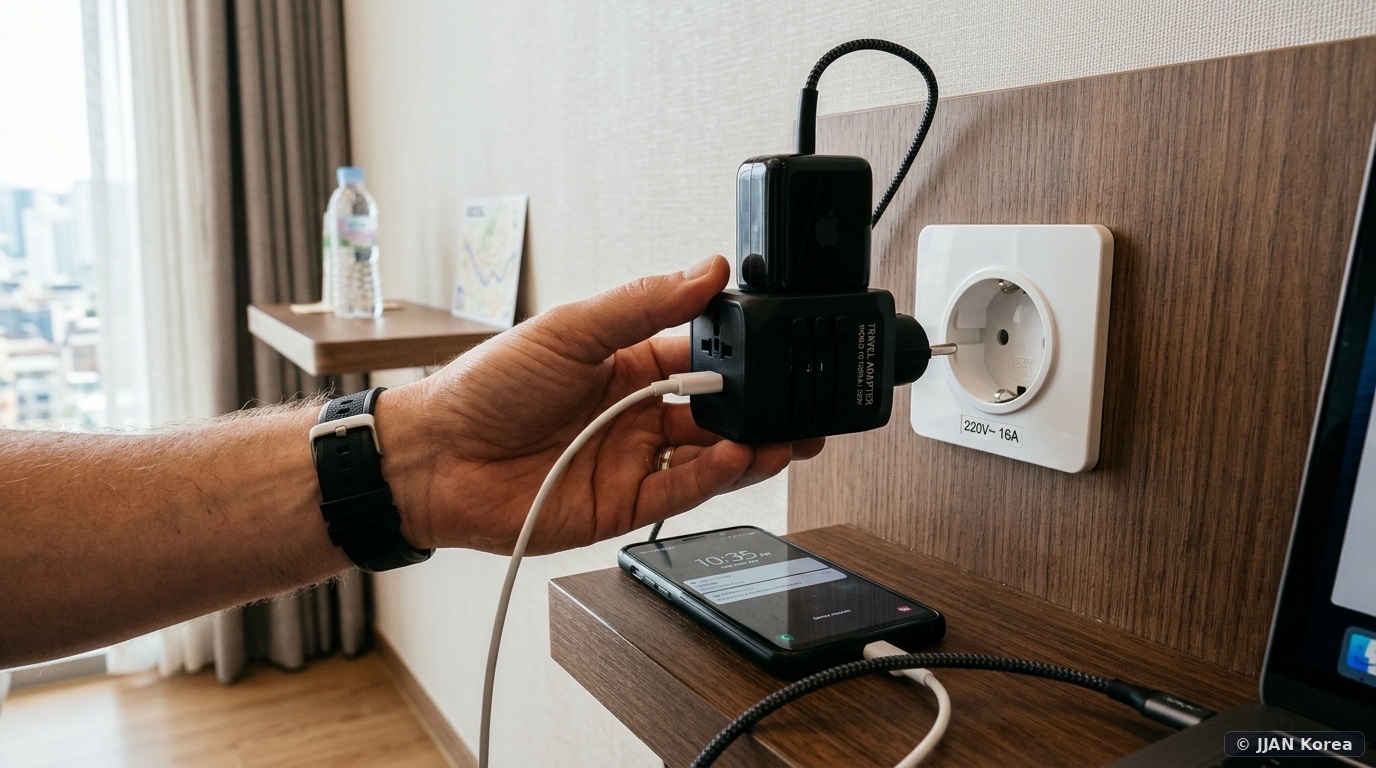
Few travel blunders are as instantly disruptive as arriving at your boutique hotel or Airbnb in Seoul after a grueling 14-hour transpacific flight, reaching into your carry-on bag to charge your depleted smartphone or power your high-wattage travel hairdryer, and discovering that your home country power prongs cannot physically fit into the recessed circular wall sockets. Worse yet, plugging an incompatible single-voltage American appliance into a Korean wall outlet can trigger a terrifying shower of electrical sparks, trip your floor’s circuit breakers, or permanently fry your expensive electronic circuitry.
South Korea operates on a standardized, high-voltage electrical grid with specific plug types, grounding configurations, and safety tolerances. Understanding the critical difference between a simple mechanical plug adapter and an active electrical voltage converter, identifying the exact pin millimeter tolerances between Europlugs and Korean Schuko sockets, and knowing where to purchase emergency adapters for ₩1,000 to ₩5,000 at local convenience stores and Daiso outlets ensures you stay powered safely throughout your stay in 2026.
1. South Korea Electrical Grid Specifications & Plug Anatomy
South Korea utilizes one of the most reliable and high-capacity electrical grids in the world, governed by the following technical parameters:
| Electrical Parameter | Official Standard Specification | Compatibility Assessment for International Travelers |
|---|---|---|
| Standard Voltage | 220 Volts (V) | Identical to Europe, UK, Australia, and China (220V–240V). Double the standard 110V/120V used in the US, Canada, Japan, and Taiwan. |
| Grid Frequency | 60 Hertz (Hz) | Matches North America (60Hz), but differs from Europe/UK/Australia (50Hz). Most modern dual-voltage digital devices handle 50/60Hz automatically. |
| Standard Wall Plug Types | Type C & Type F (Schuko) | Two round metal prongs. Standard Korean sockets are deeply recessed circular basins featuring two top and bottom grounding clips. |
2. The “4.0mm vs. 4.8mm” Pin Trap: Why Loose Adapters Spark
One of the most dangerous and poorly understood electrical hazards foreign travelers experience in Korea is the subtle difference between European Type C (Europlug) and Korean Type C/F plugs:
1. European Standard Type C (Europlug)
Standard European two-prong Europlugs feature pins measuring 4.0 mm in diameter. These are designed for low-power consumer gadgets across mainland Europe.
2. Korean Standard Type C & F (Schuko / KS C 8305)
South Korean wall sockets are engineered to fit prongs measuring exactly 4.8 mm in diameter. The socket contacts are built with heavy internal spring retention clips designed to grip 4.8mm pins firmly.
The Dangerous Hazard:
If you push a cheap 4.0mm Europlug adapter into a Korean wall socket, the pins will feel extremely loose and wobbly. The adapter will sag under its own weight, frequently disconnecting. More dangerously, the loose metal contact creates electrical micro-arcing (visible sparks, buzzing sounds, and heat buildup) that can melt your adapter plastic or trip the room’s residual current circuit breaker (RCD). Always ensure your travel adapter specifically advertises “Korean Standard 4.8mm Pins” or fits snugly into the circular recessed socket without wobbling.
3. Adapter vs. Voltage Converter: The Hairdryer Warning
Never confuse a mechanical plug adapter with an electrical voltage transformer:
- Plug Adapter (돼지코 / Adapter): A simple mechanical plastic casing that physically reshapes your foreign flat prongs (US/Japan Type A) or three-pronged plugs (UK Type G) into two round pins. It does NOT alter the electrical voltage entering your device. If you plug a 110V device into a 220V wall socket via a simple adapter, you are feeding 220V directly into a 110V circuit!
- Voltage Converter / Step-Down Transformer: A heavy, active magnetic transformer that steps down incoming 220V electricity to 110V. These are heavy, expensive, and rarely carried by modern travelers.
How to Check Your Device Power Label
Pick up your charger, laptop brick, or curling iron and read the fine, tiny printed specifications on the back or bottom:
- Dual-Voltage Safe:
INPUT: 100-240V ~ 50/60Hz: Virtually 100% of modern Apple iPhones, iPads, MacBooks, Samsung Galaxy phones, laptops, digital cameras, and Nintendo Switch chargers are dual-voltage. These devices ONLY require a cheap mechanical adapter to reshape the prongs. They adjust to Korea’s 220V current automatically. - Single-Voltage Danger:
INPUT: 120V 60Hz only: High-wattage heating appliances brought from North America (hair straighteners, curling wands, hair dryers, clothing steamers, electric toothbrushes) are almost always single-voltage 120V. DO NOT plug these into Korean outlets! They will overheat within seconds, melt internal heating coils, emit acrid smoke, and destroy the unit. Leave single-voltage heating tools at home; all Korean accommodations provide complimentary high-powered 220V hair dryers.
4. Where to Buy Adapters in Seoul: Daiso, Convenience Stores & Marts
If you landed in Korea without an adapter, do not panic. Emergency adapters are ubiquitous across the city:
| Retail Location | Available Adapter Options | Average Price (KRW) | Availability & Convenience |
|---|---|---|---|
| Daiso (다이소) | Universal multi-adapters, travel USB-C GaN fast chargers, 2-pin convert plugs | ₩1,000 – ₩5,000 (Unbeatable value!) | Massive branches in every neighborhood. Explore more travel essentials in our Daiso Korea haul and travel guide. |
| 24-Hour Convenience Stores (GS25, CU, 7-Eleven) | Basic travel conversion plugs and emergency USB charging cables | ₩3,500 – ₩8,000 | Located on every street corner; open 24/7 for late-night arrivals. |
| Incheon Airport Kiosks & Telecom Booths | All-in-one world travel adapters with dual USB-C ports | ₩15,000 – ₩25,000 | Available immediately upon arrival near transit hubs detailed in our Incheon Airport transit guide. |
| Hotel Front Desks | Complimentary loaner adapters (대여 어댑터) | Free (May require ₩5,000–₩10,000 cash deposit) | Ask the front desk: “Byeon-hwan-gi bil-ryeo jusi-gess-eoyo? (변환기 빌려주시겠어요? / May I borrow an adapter?)” |
5. Power Adapter & Electrical Safety Checklist
- Checked device labels to verify dual-voltage rating (
100-240V). - Left single-voltage 120V hair straighteners and curlers at home.
- Acquired an adapter with snug-fitting 4.8mm Korean diameter pins (not loose 4.0mm Europlugs).
- Packed a multi-port USB-C fast charger (GaN 65W+) to charge laptop, phone, and power bank from a single wall plug.
- Verified portable power bank capacity does not exceed 100Wh (airline carry-on safety limit).
- Saved nearest 24-hour Daiso or convenience store location on Naver Map.
6. Frequently Asked Questions (FAQ)
Can I plug European two-pin plugs directly into Korean sockets?
While European Type C plugs will technically enter the socket holes, they measure 4.0mm in diameter, whereas Korean sockets are built for 4.8mm pins. The fit will be noticeably loose, causing intermittent power cuts, sagging, and potentially dangerous electrical sparking. European Type F (Schuko) plugs with 4.8mm pins from Germany, Austria, and Scandinavia fit perfectly with complete grounding safety.
Can I charge my Apple iPhone or MacBook using a simple adapter?
Yes, 100%. All genuine Apple power bricks (5W, 20W, 30W, 67W, 140W) are universal dual-voltage units rated for 100V–240V at 50/60Hz. They only require a mechanical plug adapter to fit Korean wall sockets. Alternatively, you can slide off the detachable duckhead prong from your MacBook charger and snap on a Korean/European duckhead!
Do KTX high-speed trains have power outlets at passenger seats?
Yes. KTX-Sancheon and KTX-Cheongryong high-speed trains feature standard 220V Korean sockets and USB-A charging ports located beneath the center of every passenger seat pair. Older original KTX-1 trains feature 220V wall sockets mounted between the windows. Review seat amenities in our Seoul to Busan KTX travel guide.
What is the Korean word for a plug adapter?
Koreans colloquially refer to small plug adapters as Dwae-ji-ko (돼지코 / Pig Nose) because the two round holes resemble a pig’s snout! If asking store clerks, you can say: “Dwae-ji-ko isseoyo? (돼지코 있어요? / Do you have a pig-nose adapter?)” or use the formal term Byeon-hwan-plug (변환 플러그 / Conversion plug).
JJAN Korea Editorial Standards & Fact-Checking Verification
This technical hardware and consumer electronics report was compiled and verified by Tech Editor Min-jun Kim in coordination with electrical safety standards published by the Korea Electrical Safety Corporation (KESCO) and Korean Agency for Technology and Standards (KATS). Technical specifications reflect 2026 KS C 8305 compliance rules.
🛡️ JJAN Korea Editorial Standards & Fact-Checking Verification
This article was independently researched, field-tested, and audited by the JJAN Korea Electrical Standards & Consumer Safety Desk in Seoul. Technical specifications cross-verified with the Korea Electrical Safety Corporation (KESCO) and Korean Agency for Technology and Standards (KATS) KS C 8305 standards.
Notice an unlisted policy change, fare update, or revised administrative rule? Help us keep our international community accurately informed: Submit a Correction to our Seoul Newsroom.