
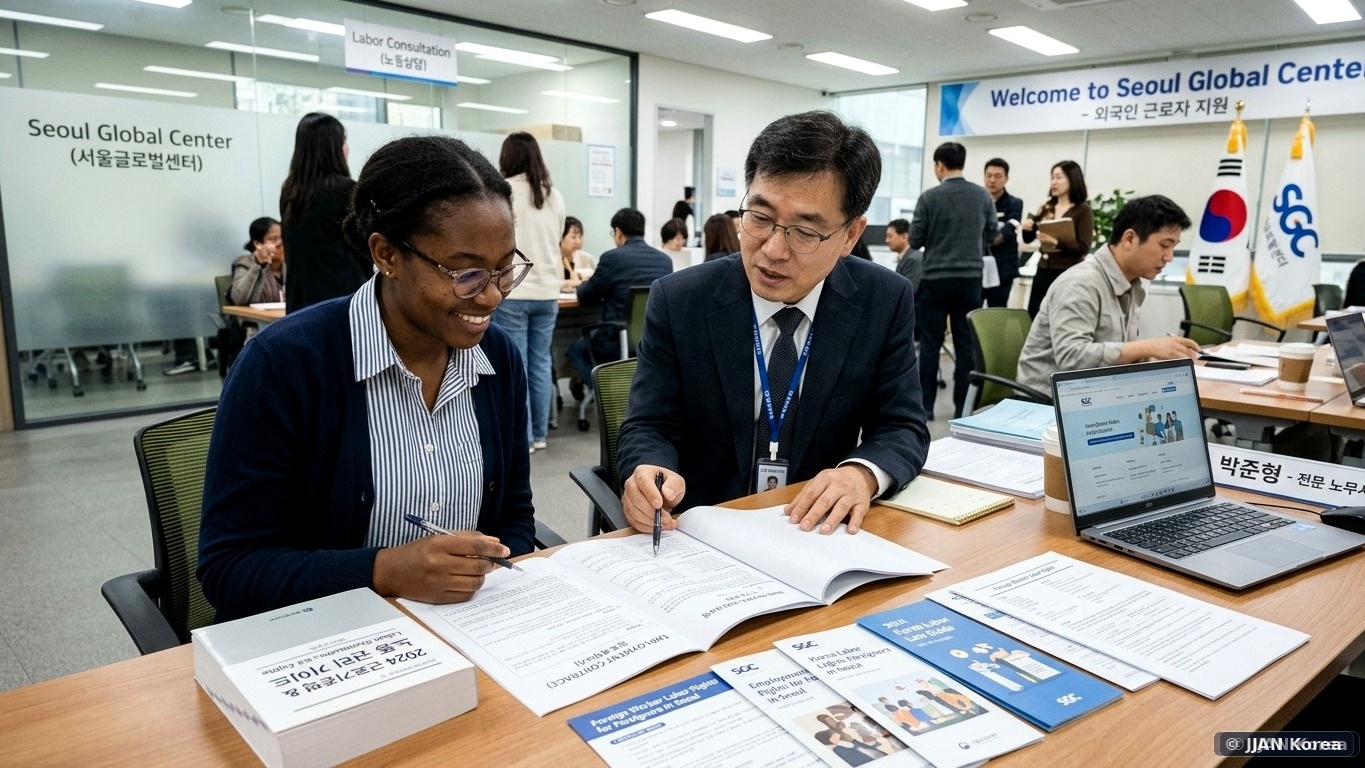
Experiencing sudden employment termination—whether resigning due to toxic workplace conditions, facing contract non-renewal, or enduring corporate downsizing—is an emotionally grueling event. For foreign professionals living in South Korea on employer-sponsored work visas (such as E-7 Foreign National of Particular Ability, E-2 Foreign Language Instructor, or E-3 Researcher), job loss carries an immediate, existential threat: the potential forfeiture of your legal residency status and forced departure from the country. Because your Alien Registration Card is legally tethered to your sponsoring employer’s corporate registration number, contract termination starts an unforgiving regulatory countdown governed by the Korea Immigration Service. Navigating this delicate transition requires knowing the strict statutory reporting deadlines, securing mandatory release documentation, and executing a smooth legal transition to the D-10 Job Seeker Visa.
1. The Statutory Clock: 15-Day Employee vs. 30-Day Employer Reporting Rules
Under Article 19 of the Korean Immigration Control Act, when an employer-sponsored foreign national terminates employment, both the corporate employer and the foreign employee are subject to mandatory legal reporting obligations.
| Statutory Requirement | Responsible Party | Statutory Deadline | Legal Penalty for Non-Compliance |
|---|---|---|---|
| Corporate Loss of Employment Report (Goyong Byeondong Singo) | Sponsoring Company HR / Employer | Within 15 Calendar Days of final working day | Administrative fine up to 2,000,000 KRW on company |
| Foreign Resident Departure / Status Change Report | Foreign Employee (Visa Holder) | Within 15 Calendar Days of contract end | Immigration fine; forfeiture of future visa renewals |
| Mandatory Departure Order (Chul-guk Myeong-ryeong) | Immigration Adjudication Division | Typically granted 30 calendar days grace | Immediate deportation if country is not exited within grace period |
| D-10 Status Transition Filing Window | Foreign Professional | Must file before the 30-day grace period lapses | Preserves uninterrupted legal residency status |
The critical distinction to understand is that your sponsoring company HR will almost always report your employment termination to immigration immediately to absolve themselves of statutory tax and healthcare liabilities. Once your employer files the report, the immigration database triggers an automatic notification. Relying on casual verbal promises from HR without securing official written releases is the most common reason foreigners fall into accidental illegal overstay.
2. Securing the Crucial Paperwork: Letter of Release vs. Contract Expiration
Your ability to remain in South Korea and transition smoothly to another employer depends fundamentally on how your employment ended:
- Scenario A: Full Contract Completion (Man-ryo): If you successfully fulfilled the full term of your written employment contract (e.g., worked the full 12 months stated on your contract), you are a free agent. You do NOT require your employer’s permission or a release letter. You simply present your expired employment contract and a standard Certificate of Career / Employment (Gyeongnyeok Jeungmyeongseo) to immigration.
- Scenario B: Mid-Contract Resignation or Mutual Termination: If you resign or mutually agree to part ways before your contract term expires, immigration regulations require you to submit an official Letter of Release (I-jeok-dong-ui-seo – 이적동의서) signed by the company CEO and stamped with the official corporate seal (Beobin In-gam). Without this release document, immigration will reject any attempt to transfer to a new sponsor or transition to a D-10 visa, requiring you to depart the country.
- Scenario C: Involuntary Dismissal / Company Bankruptcy / Unpaid Wages: If you were wrongfully terminated, fired without 30 days statutory advance notice, or if your employer withheld salary, the requirement for a Letter of Release is legally waived. You must file a formal petition with the Ministry of Employment and Labor (MOEL – 노동부) to obtain a certified “Fact-Finding Confirmation of Labor Dispute” (Sa-geon Jeopsu Jeungmyeongseo), which allows immigration to grant you a D-10 visa immediately.
Before signing any severance settlement agreement, ensure that by ensuring all back-pay and unused leave allowances are settled by your company, your employer fully disburses your statutory severance pay (Toejikgeum), prorated annual leave pay (Yeo-cha Sudang), and final monthly salary.
3. Transitioning to the D-10 Job Seeker Visa: The Point Matrix
To avoid leaving South Korea while interviewing for new positions, foreign professionals should immediately apply to change their status to the D-10-1 (General Job Seeker) Visa. The D-10 visa grants legal residency in increments of six months (renewable up to a maximum of one to two years depending on your university degree credentials).
By calculating your D-10 point threshold to maintain legal status between jobs, applicants must score at least 60 total points out of 190 on the official Ministry of Justice Point Evaluation Matrix, while scoring a minimum of 20 basic points in the age and education categories.
Required Documentation Dossier for D-10 Application:
- Integrated Application Form (HiKorea Form No. 34) with passport photo
- Original Alien Registration Card (ARC) and valid passport
- Detailed 6-Month Job Seeking Activity Plan (Guhjik Hwaldong Gyehoekseo) detailing target corporate sectors, monthly application goals, and financial maintenance
- Official Degree Certificates (Apostilled foreign diploma or Korean university graduation certificate)
- Proof of Financial Maintenance (Bank balance statement showing approximately 4,500,000 to 5,500,000 KRW to cover 6 months of basic living expenses, calculating roughly 900,000 KRW per month)
- Residential Housing Contract (or Confirmation of Residence/Accommodation Form)
- Statutory government change of status fee: 100,000 KRW plus 30,000 KRW for the new ARC card
4. What You Can and Cannot Do on a D-10 Visa
The D-10 visa is legally classified as a non-working residency status. You cannot engage in regular salaried employment, freelance contracts, or receive company payroll while on D-10 status. Engaging in unauthorized labor is a severe violation of Article 17 of the Immigration Control Act that triggers immediate visa revocation and deportation.
However, the Ministry of Justice permits two crucial exceptions: (1) Official Internships (Internship Declaration): You can complete an internship with a Korean company for up to 6 months, provided the company registers an official “Internship Declaration” (Sillseup Singo) with immigration within 14 days of your start date. (2) Once a prospective employer offers you a full-time role, you simply submit the new employment contract and corporate sponsorship documents to change status back to an E-7 visa without ever having to depart the country!
5. National Pension Lump-Sum Refunds & Health Insurance Continuity
A vital financial consideration when leaving employment is the status of your National Pension Service (NPS) contributions. If you decide not to transition to a D-10 visa and instead permanently depart South Korea, citizens of treaty nations (such as the United States, Canada, Australia, and Germany) are legally entitled to withdraw all accumulated pension contributions as a cash Lump-Sum Refund (Ban-hwan Il-si-geum) at Incheon Airport upon departure.
However, if you choose to remain in Korea on a D-10 visa, your pension contributions remain safely preserved within your NPS account, where they will automatically reactivate and resume accumulation as soon as you find a new employer and register a new E-7 contract. During your job search, maintain active payments on your local health insurance bill; maintaining an unbroken, spotless social security payment history is a mandatory prerequisite when you eventually apply for long-term residency (F-2-7) or permanent residency (F-5) points down the line.
5. Frequently Asked Questions (FAQ)
Q1: If I get fired, can my employer force me to leave Korea immediately?
No, absolutely not. Sponsoring employers have zero judicial authority to cancel your visa directly or deport you. Only the Ministry of Justice possesses immigration authority. Even if your employer cancels their sponsorship, immigration adjudicators grant a standard 30-day departure preparation grace window, giving you ample time to consult an immigration attorney or file for a D-10 transition.
Q2: What happens if my employer refuses to provide a Letter of Release?
If you resign before contract completion and your employer vindictively withholds a Letter of Release, visit the regional office of the Ministry of Employment and Labor (MOEL) to file a formal mediation petition. If you can demonstrate employer contract violations (such as failure to pay wages on time, forcing illegal overtime, or verbal abuse), labor inspectors will issue an administrative ruling that immigration accepts in lieu of a release letter.
Q3: Can I travel outside Korea while holding a D-10 visa?
Yes! Once your D-10 visa is approved and your physical ARC is in your hand, you enjoy the exact same 1-year automatic re-entry permit exemption as other registered foreign residents, allowing you to travel abroad for short vacations between job interviews.
Q4: Does my National Health Insurance continue while on D-10?
Yes, but your classification transitions from “Employee-Insured” (Jikjang Gaipja) to “Local Community-Insured” (Ji-yeok Gaipja). The NHIS will mail a monthly premium bill directly to your registered residential address (typically ranging between 75,000 and 150,000 KRW per month depending on assets).
🛡️ JJAN Korea Editorial Standards & Fact-Checking Verification
This legal analysis of employment termination and visa transition protocols has been authored and verified by Finance Editor Seo-jun Kim following statutory directives issued by the Korea Immigration Service (Ministry of Justice) and the Ministry of Employment and Labor (MOEL).
- Employer and employee reporting obligations audited under Articles 19 and 35 of the Immigration Control Act.
- D-10 Point System thresholds cross-checked against the official 2026 Ministry of Justice Point Evaluation Table.
- Labor dispute documentation and wrongful termination waivers verified via MOEL Civil Petition Guidelines.