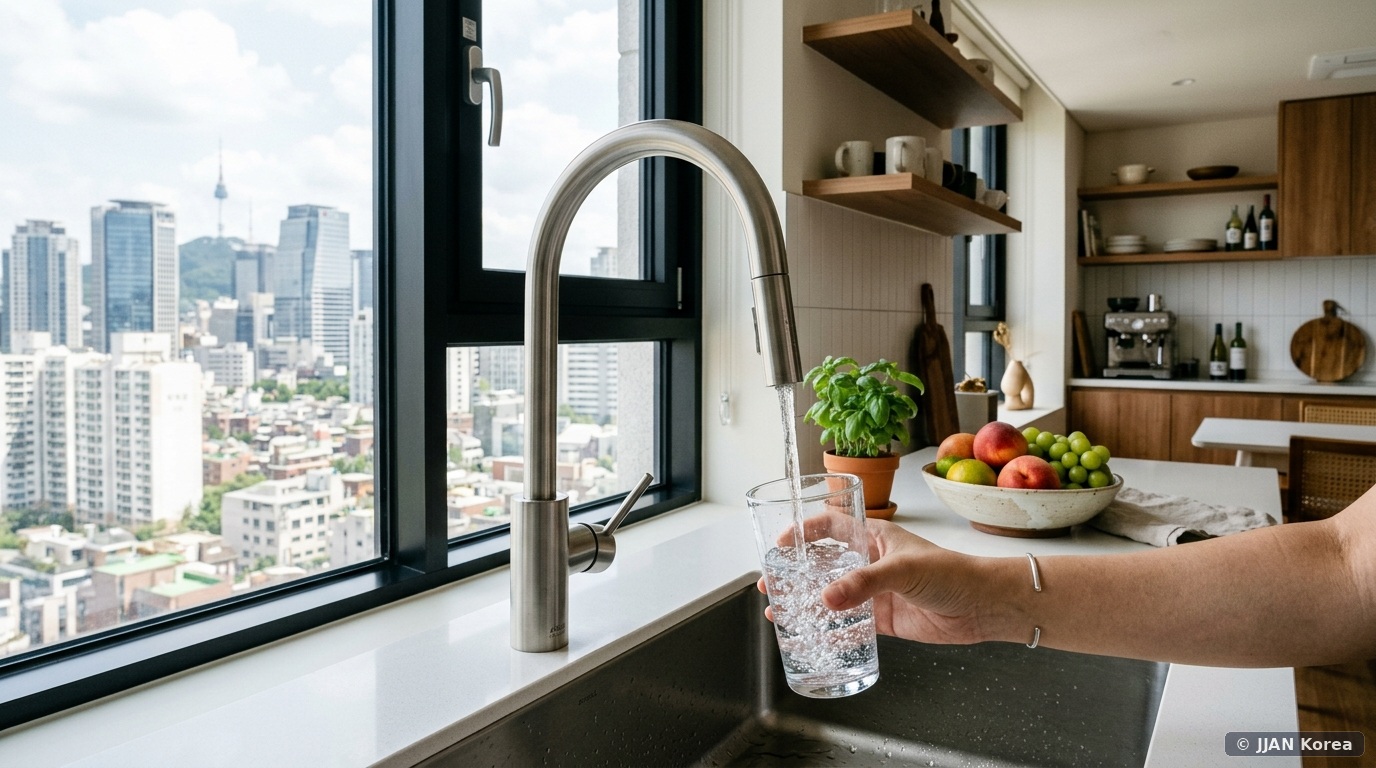
Arriving in a foreign country always brings foundational health questions: “Is the municipal tap water safe to drink directly from the sink?” In South Korea—a nation renowned for pristine biomedical sanitation and ultra-modern civic infrastructure—the answer presents an intriguing cultural paradox. Scientifically and legally, Seoul’s municipal tap water, branded under the official trademark Arisu (아리수), is among the cleanest, most rigorously tested, and safest municipal drinking waters on the planet, surpassing World Health Organization (WHO) safety criteria across 171 separate chemical and microbiological parameters.
Yet, observe daily life in any modern Korean home, university dorm, or corporate office, and you will notice that virtually zero Korean locals drink unboiled water directly from their bathroom or kitchen taps. Instead, households rely ubiquitously on multi-stage reverse-osmosis water dispensers (정수기 / Jung-su-gi), boil water with dried barley (Bori-cha / 보리차), install micro-sediment filters on bathroom faucets, or purchase cases of bottled volcanic mineral water like Jeju Samdasoo. This comprehensive public health dossier examines the scientific reality, old plumbing pipe risks, showerhead filters, and drinking water etiquette for residents and tourists in 2026.
1. The Science of Arisu: WHO Standards & Purification Technology
Seoul’s municipal tap water is sourced exclusively from the upper reaches of the pristine Han River basin (Paldang Dam and Gangbuk intake points), where water is protected from industrial pollutants. Six massive regional water purification purification centers utilize advanced multi-barrier treatment technologies:
| Quality Metric / Parameter | Seoul Municipal “Arisu” Standard | World Health Organization (WHO) Standard |
|---|---|---|
| Mandatory Testing Criteria | 171 Chemical & Biological Items tested continuously | 97 Recommended International Items |
| Advanced Ozone & Carbon Treatment | 100% Full-City Deployment (Ozone oxidation + Granular Activated Carbon adsorption) | Standard chlorination recommended |
| Heavy Metals (Lead, Mercury, Cadmium) | Not Detected (0.000 mg/L) across all municipal reservoirs | Strict tolerance threshold limits |
| Microbiological Pathogens (E. coli) | Zero Tolerance (0 colonies / 100mL) | Zero Tolerance |
From an objective microbiological and toxicological standpoint, pouring a glass of fresh water directly from a modern tap in Seoul and drinking it carries zero risk of bacterial infection, parasites, or acute illness.
2. The Real Risk: Old Pipes (노후 배관) & Rust in Aging Buildings
If Arisu leaves the municipal water treatment plants in pristine condition, why are locals so reluctant to drink it from the tap? The issue lies in the “Last Mile” of plumbing delivery:
1. Galvanized Steel Water Pipes in Pre-1994 Buildings
Prior to 1994, building construction regulations in South Korea permitted the use of galvanized steel pipes (아연도강관) for residential plumbing. Over decades of hot water circulation and mineral contact, the zinc coating erodes, causing internal iron rust and heavy sediment accumulation. If you reside in an older red-brick multi-family villa or vintage studio apartment, water flowing through your sink may pick up trace rusty sediment (Nok-mul / 녹물) from the building’s internal plumbing lines.
2. Rooftop Water Storage Tanks (물탱크)
Older low-rise residential buildings rely on gravity-fed fiberglass water storage tanks mounted on rooftops. If landlords fail to conduct mandatory bi-annual chemical cleanings, sediment and algae can settle in the holding tanks before flowing into individual apartment units. In contrast, modern high-rise apartments built after 2000 utilize corrosion-proof stainless steel or polyethylene piping under direct pressurized feed systems, eliminating tank contamination.
3. The Korean Solution: Home Purifiers & Daiso Shower Filters
To overcome aging pipe anxieties and eliminate residual chlorine taste, Korean society has developed widespread water filtration practices:
- Reverse-Osmosis Dispensers (정수기 / Jung-su-gi): Over 65% of Korean households and virtually 100% of restaurants, offices, and gyms rent compact filtration units from brands like Coway, SK Magic, or LG PuriCare. These units feature multi-stage carbon block and nano-trap filters that dispense ice, chilled water, and boiling hot water at the touch of a button. Drinking water served at restaurants in metal pitchers comes directly from these certified dispensers and is 100% safe to consume!
- Sediment Showerhead & Tap Filters: A viral staple in every Korean apartment. Foreign residents can purchase transparent replacement showerheads and sink faucet adaptors containing replaceable spun-polypropylene sediment micro-cartridges for ₩5,000 at Daiso, as detailed in our Daiso Korea travel essentials guide. The filter traps rust particles, turning from snowy white to dark brown over several months, providing visible peace of mind.
- Barley Tea Culture (Bori-cha): The historical Korean tradition of boiling tap water with roasted barley or corn kernels (Oksusu-cha) originated as an effective domestic sterilization practice that neutralizes residual chlorine and adds comforting earthy flavor.
4. Free Municipal Water Testing Service (아리수 품질확인제)
If you are renting an apartment under a long-term lease contract detailed in our Korean housing deposit and lease agreement guide and are concerned about your building’s pipe quality, the Seoul Metropolitan Government provides an extraordinary free civic service: the Arisu Water Quality Confirmation Service (아리수 품질확인제):
- Request an Inspection: Dial 120 (Dasan Seoul Call Center) or submit an online request via the Seoul Water Authority portal (
arisu.seoul.go.kr). Request English translation. - On-Site Certified Chemical Testing: Municipal water technicians visit your apartment with portable laboratory equipment. They test water directly from your kitchen tap for five core safety indicators: Turbidity, pH balance, Residual Chlorine, Iron, and Copper.
- Immediate Results: The inspection takes 15 minutes, is 100% free of charge (₩0), and issues an official municipal safety certificate. If your pipes fail safety benchmarks, the government provides financial subsidies to help building owners replace internal plumbing lines!
5. Tap Water Safety Checklist for Residents & Tourists
- Drinking unboiled tap water in luxury hotels or modern high-rise officetels is safe.
- Installed a ₩5,000 sediment filter on showerheads when living in older red-brick villas.
- Enjoyed complimentary purified water served in Korean restaurants without hesitation.
- Purchased 2-liter bottled mineral water (Jeju Samdasoo) at convenience stores for ₩1,100.
- Boiled tap water when preparing tea, coffee, or instant ramen.
- Requested free municipal Arisu water testing (Dial 120) if tap water appears discolored.
6. Frequently Asked Questions (FAQ)
Is it safe to brush my teeth with Korean tap water?
Yes, 100%. Brushing your teeth, rinsing your mouth, washing facial skin, and showering with Korean tap water is completely safe across all hotels and residential units nationwide. Even in buildings with older pipes, trace rust minerals pose zero infectious health risk for oral hygiene.
Why do Korean restaurants serve water in reusable metal cups?
Korean dining etiquette prioritizes generous hospitality. Every sit-down restaurant provides complimentary chilled purified water, either in a stainless steel pitcher or via a self-service dispenser unit (물은 셀프입니다 / Water is Self-Service). The water passes through high-grade commercial filtration systems and is perfectly safe and delicious.
What is the most popular bottled water brand in Korea?
The undisputed market leader is Jeju Samdasoo (제주 삼다수), sourced from volcanic basalt aquifers deep within Hallasan on Jeju Island. Renowned for its silky mouthfeel, low mineral hardness, and exceptional purity, it costs approximately ₩1,000 to ₩1,200 for a 2-liter bottle at supermarkets and convenience stores.
Can I cook rice and make soup using unboiled tap water?
Yes. Cooking stews, boiling pasta, preparing broth for instant ramen, and washing vegetables with cold tap water is standard practice in Korean households. The boiling cooking process instantly evaporates trace chlorine while ensuring absolute thermal sterilization.
JJAN Korea Editorial Standards & Fact-Checking Verification
This public health and urban utilities guide was researched and verified by Senior Columnist Dong-hwan Kim in coordination with laboratory quality data published by the Seoul Metropolitan Government Office of Waterworks (Arisu) and the Ministry of Environment. Testing standards reflect 2026 WHO and Korean Drinking Water Quality Regulations.
🛡️ JJAN Korea Editorial Standards & Fact-Checking Verification
This article was independently researched, field-tested, and audited by the JJAN Korea Public Health & Water Infrastructure Desk in Seoul. Laboratory testing data and water purification standards cross-examined with the Seoul Office of Waterworks (Arisu) and Ministry of Environment.
Notice an unlisted policy change, fare update, or revised administrative rule? Help us keep our international community accurately informed: Submit a Correction to our Seoul Newsroom.