
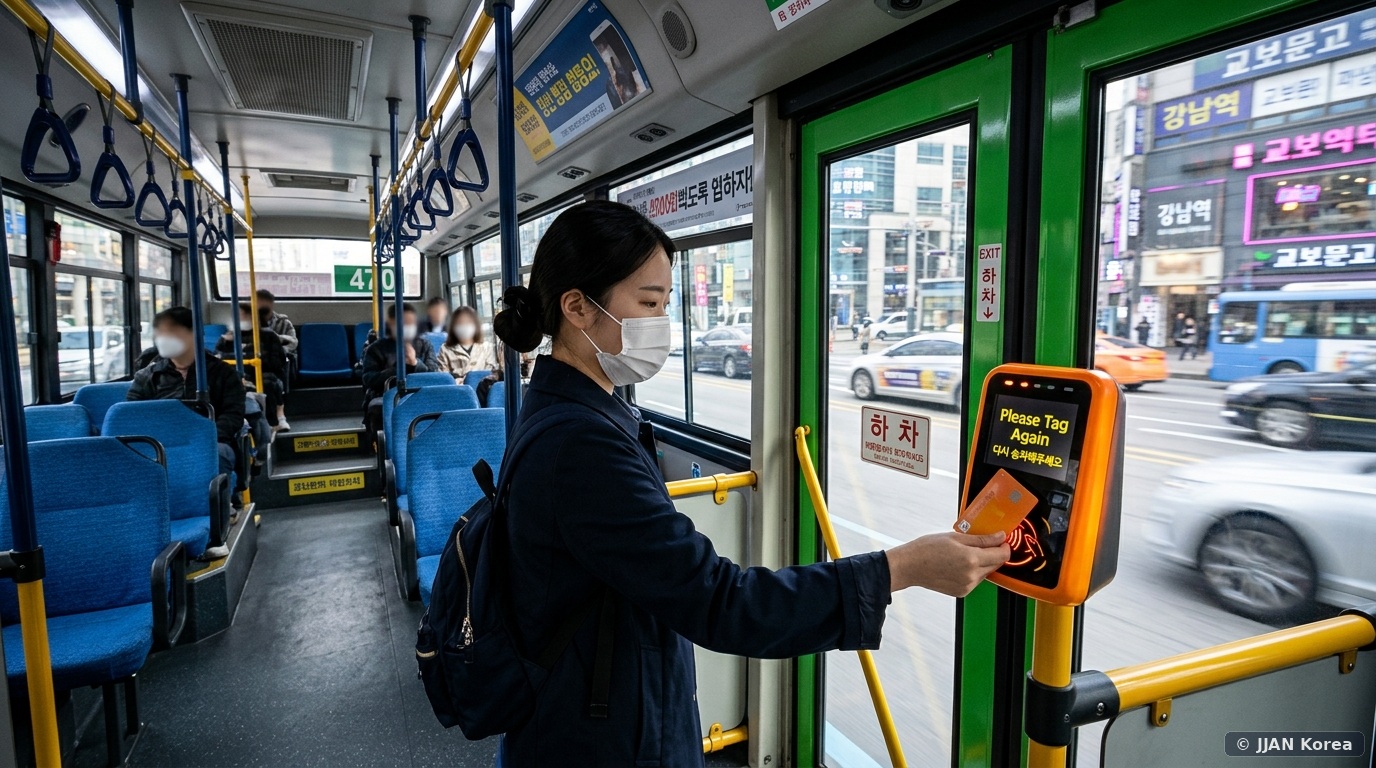

While Seoul’s sparkling, climate-controlled subway system receives global acclaim, the true circulatory lifeblood connecting every hilltop neighborhood, university alley, and cultural landmark is the city’s formidable municipal bus network. Comprising over 7,400 buses operating across 370 routes, Seoul’s buses reach deep into pedestrian corners where subway rails cannot penetrate, offering panoramic streetscapes and rapid direct transit.
However, for international travelers, boarding a Seoul bus can present unique hurdles. Stringent municipal regulations—such as a total ban on carrying open takeaway coffee cups, mandatory card-tagging upon exiting to avoid double-charging penalties, and an intricate color-coded route hierarchy—require practical orientation. This comprehensive transit guide explains color categories, bus-stop wave protocols, contactless transit card transfers, and passenger safety rules in 2026.
1. Seoul Bus Color Hierarchy: Blue, Green, Red, Yellow & Owl Buses
Every bus in Seoul is painted in a distinct primary color that signifies its operational function and route distance:
| Bus Class & Color | Korean Name | Operational Route Purpose | Standard Adult Card Fare (KRW) |
|---|---|---|---|
| Blue Bus (간선버스) | Ganseon Bus | Long-distance arterial trunk lines connecting major suburban districts to downtown Seoul. 3-digit route numbers. | ₩1,500 |
| Green Bus (지선버스) | Jiseon Bus | Feeder branch lines connecting residential neighborhoods to nearby subway stations and Blue bus corridors. 4-digit numbers. | ₩1,500 |
| Town Village Bus (마을버스) | Maeul Bus | Small green minibuses navigating steep, winding residential hill streets (e.g., “Mapo 09”). | ₩1,200 |
| Red Bus (광역버스) | Gwang-yeok Bus | Rapid express commuter coaches connecting Gyeonggi satellite cities (Bundang, Suwon, Ilsan) via expressways. 4-digit numbers starting with 9. | ₩3,000 |
| Owl Night Bus (올빼미버스) | N-Bus | Late-night routes running from 23:30 to 06:00 AM while subways are shut down. Prefix “N” (e.g., N16, N26, N62). | ₩2,500 |
2. The Cardinal Rule: Mandatory Tag-Off (하차 태그) & Free Transfer Algorithms
In Seoul’s integrated public transit schema, buses and subways form a unified distance-based fare network. Understanding how transfer algorithms work will save you hundreds of thousands of won over a prolonged stay:
1. The 30-Minute Free Transfer Window
When you transfer between buses, or from a subway line to a bus, your second, third, and fourth rides are completely free (or only charge nominal ₩100 distance increments if traveling beyond 10 kilometers). You are allowed up to 4 transfers (5 total transit legs) on a single journey, provided you tag into your next transit leg within 30 minutes of tapping out of the previous one (extended to 60 minutes between 21:00 PM and 07:00 AM).
2. Why You MUST Tap Your Card Upon Exiting
Always tag your transit card against the card reader beside the rear exit door right before stepping off! If you forget to tap off (하차 미태그):
- The automated fare system cannot calculate your actual travel distance.
- The system assumes you traveled to the maximum terminal terminus of the bus route, deducting an automatic maximum penalty surcharge (₩700 to ₩1,400) upon your next card tap!
- Your 30-minute free transfer discount is completely forfeited, forcing you to pay full base fare on your next bus or subway connection.
For unlimited rides without worrying about per-ride balances, consider switching to the Seoul Climate Card for unlimited bus and metro transit.
3. The Strict “No Takeout Drinks” Municipal Law (음료 반입 금지)
Under the Seoul Metropolitan Government Ordinance on Passenger Safety, bus drivers are legally empowered and mandated to refuse boarding to any passenger carrying unsealed takeout food or drink. This law is strictly enforced by drivers:
- Strictly PROHIBITED Items (Refusal of Boarding): Disposable plastic or paper coffee cups containing hot or iced coffee, boba milk tea with plastic film lids pierced with a straw, open ice cream cones, and unboxed fried street snacks. Drivers will point to the cup and firmly state: “Eum-nyo ban-ip an-doe-yo (음료 반입 안 돼요 / No drinks permitted).”
- PERMITTED Items: Sealed screw-top thermos bottles, sealed beverage cans, plastic water bottles with a tightly closed cap, and food groceries packed securely in closed plastic carrier bags. Finish your iced Americano or discard it in street recycling bins before boarding!
4. Boarding, Riding & Ringing the Bell
Seoul bus drivers operate under tight schedules. Master these physical boarding mechanics:
- Boarding via Front Door Only: Always board through the front doors beside the driver, and alight through the rear middle doors. Boarding through the rear door is prohibited unless specifically invited by the driver during severe peak-hour crowding.
- Step Toward the Curb: At busy bus stops servicing 10+ routes, buses stop only if a waiting passenger steps toward the curb or makes eye contact with the driver. If you stand back looking down at your phone, the driver may assume no one is waiting for that specific route and bypass the stop.
- Press the Stop Bell Early (하차벨): As soon as the automated bilingual voice announcement broadcasts your stop (e.g., “This stop is Anguk Station. Next stop is Changdeokgung”), locate a red circular STOP button (하차벨) on the wall or ceiling poles and press it. A chime sounds and the driver prepares to pull over. If no one presses the bell and no passengers are waiting at the curb, the driver will not stop!
- Stand Up Only When the Bus Stops: In recent years, Seoul buses actively discourage passengers from rushing down the aisle while the bus is decelerating. Tap your card when the bus slows down, hold onto handrails firmly, and alight smoothly once the vehicle comes to a complete halt.
5. Bus Transit Rider Checklist
- Loaded physical T-Money card or activated unlimited Seoul Climate Card.
- Discarded all open takeaway coffee cups and drinks before stepping toward the curb.
- Boarded strictly through front doors and tapped card against the front sensor.
- Monitored bilingual bus stop audio announcements or live route tracking on KakaoMap.
- Pressed the red STOP bell immediately upon hearing destination stop announcement.
- Tapped card against the rear exit reader before stepping off to secure free transfer.
6. Frequently Asked Questions (FAQ)
Can I pay bus fares with physical cash?
Seoul has largely transitioned to “Cashless Buses” (현금 없는 버스) across over 80% of municipal routes. While a few older buses retain emergency cash drop boxes, drivers strongly discourage cash, cannot provide electronic transfer discounts, and often carry no change for ₩10,000 bills. Always use a rechargeable transit card or bank check card.
Can I take a Seoul bus directly to Incheon Airport?
Standard municipal Blue and Green buses do not travel to Incheon Airport. You must take an official Airport Limousine Bus (공항리무진 / 6000-series buses), which cost ₩17,000 to ₩18,000, or ride the high-speed AREX railway detailed in our Incheon Airport to Seoul transit guide.
Are Seoul buses wheelchair and stroller accessible?
Yes. Over 70% of Seoul’s Blue and Green bus fleet consists of modern Low-Floor Electric Buses (저상버스) featuring hydraulic kneeling systems and retractable boarding ramps. When a passenger in a wheelchair or with an unfolded baby stroller signals the driver, the driver deploys the ramp and assists with securing the passenger in the designated priority bay.
How do late-night Owl Buses (N-Buses) work?
Seoul operates 14 designated late-night Owl Bus routes marked with an “N” prefix (such as N26 connecting Hongdae to Jongno and Dongdaemun) between 23:30 and 06:00 AM. Fares are ₩2,500. They run every 25 to 35 minutes and are heavily utilized by revelers returning from nightlife districts explored in our Hongdae nightlife guide.
JJAN Korea Editorial Standards & Fact-Checking Verification
This municipal transit operations report was compiled and field-verified across all bus networks by Travel Editor Do-jun Kim in coordination with the Seoul Metropolitan City Transportation Headquarters and the Seoul Bus Transportation Business Association. Tariff rates and transit transfer algorithms reflect official 2026 standards.
🛡️ JJAN Korea Editorial Standards & Fact-Checking Verification
This article was independently researched, field-tested, and audited by the JJAN Korea Municipal Transit & Traffic Operations Desk in Seoul. Seoul bus routes, stop announcements, and contactless transfer algorithms field-tested across all four color bus networks by our transit team in coordination with the Seoul Metropolitan Government.
Notice an unlisted policy change, fare update, or revised administrative rule? Help us keep our international community accurately informed: Submit a Correction to our Seoul Newsroom.