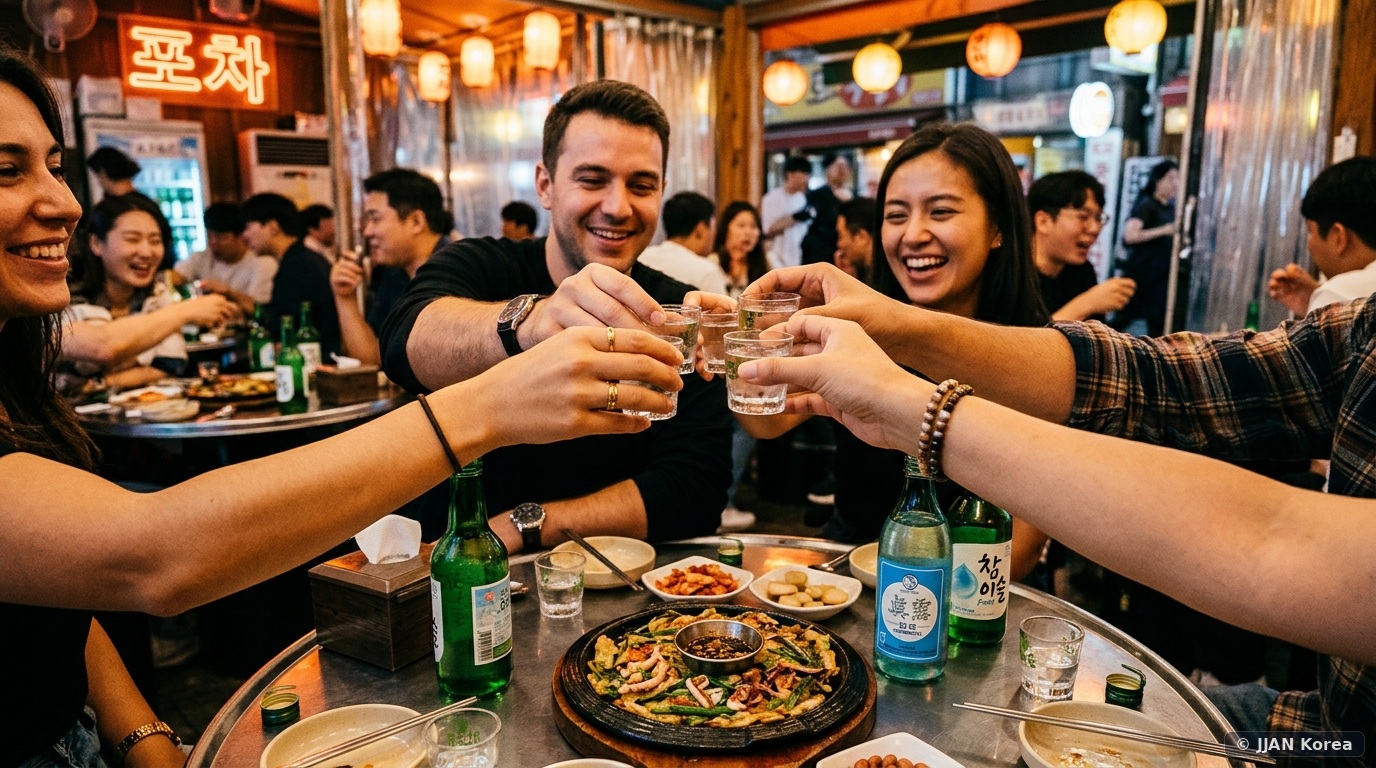

In South Korea’s high-octane social fabric, few cultural rituals are as foundational, emotionally unifying, and intensely celebrated as gathering around a low wooden table at a neighborhood pub or tavern: the Sulzip (술집). From late-night corporate team dinners (Hoesik / 회식) that dissolve workplace hierarchies to boisterous university gatherings fueled by ice-cold beer and green bottles of Soju, drinking in Korea is not an isolated indulgence—it is a cherished medium of communal bonding, empathy, and friendship.
However, entering a Korean drinking session involves observing an intricate, centuries-old social choreography rooted in Confucian respect and mutual hospitality. Rules governing who pours, how to receive a glass with two hands, the subtle 45-degree head-turn when drinking before elders, the culinary mandatory role of food snacks (Anju / 안주), and the exhilarating art of mixing Soju and beer into golden Somaek (소맥) can bewilder newcomers. This comprehensive cultural guide deconstructs Korean drinking etiquette, iconic drinking rounds, hangover survival, and the joyful toast that gives our publication its name: JJAN! (짠!).
1. The Cardinal Commandments of Korean Drinking Etiquette
Observing these five fundamental rules will instantly earn you the deep respect and affection of your Korean drinking companions:
1. Never Pour Your Own Glass (No “Ja-jak” / 자작 금지)
The single most important rule in Korean drinking culture is that you must never pour your own drink (known as Ja-jak / 자작). Pouring your own alcohol is traditionally viewed as lonely, and folklore humorously warns that pouring your own drink causes your companion to sit across from you for three years of bad luck! Instead, constantly monitor the glasses of your friends or colleagues. When a companion’s glass is empty, pick up the bottle and offer a refill. In turn, they will eagerly pour yours!
2. Two Hands for Pouring & Receiving (두 손 예절)
When pouring alcohol for someone older, senior in status, or someone you have just met, hold the bottle with your right hand while supporting your right wrist or forearm with your left hand (or placing your left hand over your chest). When receiving alcohol poured by an elder or colleague, hold your glass with **both hands** (cupping the bottom with one hand while holding the side with the other) as a gesture of deep Confucian respect.
3. The 45-Degree Head Turn (고개 돌려 마시기)
When taking a sip or shooting a glass in the presence of an older person, boss, or senior colleague, turn your head and torso 45 degrees away from them, shielding your mouth slightly with your free hand as you swallow. Drinking directly facing a senior’s eyes is traditionally viewed as a sign of confrontation or disrespect.
4. The Universal Clinking Toast: “JJAN!” (짠!)
Before taking the first sip of any round, everyone raises their glass together to the center of the table and shouts in unison: “JJAN! (짠!)” (onomatopoeia mimicking the musical clinking sound of crystal glasses) or the formal toast “Geon-bae! (건배! / Dry the glass!)”. When clinking glasses with someone senior, position the rim of your glass slightly lower than theirs to demonstrate humble politeness.
5. Empty Your Glass Before Refilling
Unlike Western wine etiquette where glasses are continually topped off, in Korea you should wait until a companion’s glass is **completely empty** (or down to the final drop) before offering a fresh refill. Topping off a half-full glass (Chambae / 첨배) is traditionally avoided except in ancestral memorial rites.
2. The Holy Trinity of Korean Alcohol: Soju, Beer & Makgeolli
Understanding what is in your glass elevates the tasting experience:
| Beverage Type | Alcohol by Volume (ABV) | Iconic Brands | Flavor Profile & Pairing Snacks |
|---|---|---|---|
| Soju (소주) | 16.0% – 16.5% | Chamisul (참이슬), Chum-Churum (처음처럼), Saero (새로 – Zero Sugar) | Crisp, clean, distilled neutral spirit. Pairs flawlessly with rich grilled pork belly (Samgyeopsal) and spicy stews. |
| Korean Lager (맥주) | 4.5% – 5.0% | Cass Fresh, Terra, Kelly, Kloud | Ultra-crisp, highly carbonated light lagers engineered specifically for refreshing palate-cleansing and mixing Somaek. |
| Makgeolli (막걸리) | 6.0% – 8.0% | Seoul Jangsu, Kooksoondang, Boksoondoga (Champagne Makgeolli) | Unfiltered, milky fermented rice wine with naturally sweet, tangy effervescence. Traditionally drunk from shallow brass bowls paired with savory scallion pancakes (Pajeon) on rainy days! |
3. The Art of “Somaek” (소맥) & Table Games
The undisputed king of Korean party drinks is Somaek (소맥)—a portmanteau of Soju and Maekju (Beer):
- The Golden Ratio (3:7): Fill a standard beer glass with approximately 30% Soju and 70% cold beer. (Standard beer glasses often feature subtle etched cartoon markings indicating the golden ratio line!).
- The “Spoon Cavitation” Tap (수저 탕!): To blend the mixture into creamy, velvety foam without stirring, insert a metal soup spoon upright into the glass and strike the bowl of the spoon sharply with the flat back of another chopstick. The sonic acoustic shockwave (cavitation) causes the carbonation to erupt into dense, micro-fine creamy bubbles! Drink it immediately in one smooth gulp.
- The Soju Bottle Cap Flick Game: Twist the wire neck of a green soju bottle cap until it forms a stiff tail. Take turns flicking the tail with your index finger; whoever snaps the tail off forces the players on their left and right to take a shot!
4. The Marathon: Navigating 1-Cha, 2-Cha & 3-Cha (차수 문화)
Korean nights out are structured around progressive geographic rounds known as Cha (차), where groups migrate between distinct venues every 90 minutes:
- 1-Cha (일차 – The Dinner Anchor): A hearty barbecue or sit-down restaurant (Korean pork belly, Galbi, or Galbi-jjim) to establish a solid stomach foundation with food and initial drinks.
- 2-Cha (이차 – The Traditional Pub or Izakaya): A transition to a livelier pub (Pocha / 포차 or craft beer taproom) for lighter snacks, fried chicken, or dried pollock (Meoktae).
- 3-Cha (삼차 – Entertainment & Singing): Moving to a private karaoke singing room (Noraebang / 노래방) to belt out pop anthems with cold beers and tambourines.
- 4-Cha (사차 – Late-Night Hangover Soup): A 24-hour diner at 04:00 AM for steaming bowls of spicy Hangover Soup (Haejang-guk) before catching the first morning subway! Connect late-night safe hailing with our Kakao T taxi booking guide and cure morning symptoms with our Korean pharmacy OTC guide.
5. Korean Drinking Etiquette Checklist
- Never poured your own alcohol (always waited for a companion to pour).
- Poured and received drinks with two hands when interacting with elders or seniors.
- Turned head 45 degrees away and shielded mouth when drinking in front of senior colleagues.
- Waited for glasses to be completely empty before pouring refills.
- Clinked glasses together with a vibrant shout of “JJAN!” before taking the first sip.
- Drank condition anti-hangover drinks before bedtime to prepare for the morning.
6. Frequently Asked Questions (FAQ)
What should I do if I cannot drink alcohol for medical or religious reasons?
Korean drinking culture has become far more progressive and accommodating. If you do not drink alcohol, simply state warmly: “Jeoneun geon-gang sang sul-eul mot masyeoyo (저는 건강상 술을 못 마셔요 / I cannot drink due to health reasons).” Accept the pour into your glass with two hands, keep the glass full on the table, and toast “JJAN!” with soda, tea, or water. Participating in the clinking toast and conversation is what matters, not consuming alcohol!
What is “Anju” (안주) and is it mandatory to order food?
In South Korea, drinking alcohol without food is culturally unthinkable. Anju (안주) refers to specialized savory culinary dishes engineered specifically to complement alcohol (such as spicy seafood stews, crispy pancakes, or dried squid). At virtually all Korean pubs and bars, tables are legally or commercially required to order at least one food dish alongside alcohol orders.
Who pays the bill at the end of the night?
Historically, the most senior person or the host who extended the invitation paid the entire bill for 1-Cha, while another person paid for 2-Cha. Among younger generations and international friends, splitting the bill evenly (Dutch Pay / 더치페이) is increasingly standard. Ask the cashier: “Ttaro gyeol-je hal-geyo (따로 결제할게요 / We will pay separately).”
Why do Koreans drink Makgeolli when it rains?
It is an iconic national tradition! Koreans say that the rhythmic patter of falling raindrops resembles the sizzling sound of savory scallion pancakes (Pajeon) frying in oil. On rainy days, traditional Makgeolli houses across Seoul are packed with locals enjoying cold bowls of rice wine and hot golden pancakes.
JJAN Korea Editorial Standards & Fact-Checking Verification
This cultural anthropological dossier was researched and documented across diverse entertainment districts by Culture Editor Min-ah Kim in consultation with sociological researchers from the National Institute of Korean Language. Etiquette norms and social customs reflect contemporary 2026 Korean practices.
🛡️ JJAN Korea Editorial Standards & Fact-Checking Verification
This article was independently researched, field-tested, and audited by the JJAN Korea Sociological Traditions & Dining Culture Desk in Seoul. Documented across diverse nightlife clusters by Culture Editor Min-ah Kim in consultation with researchers from the National Institute of Korean Language.
Notice an unlisted policy change, fare update, or revised administrative rule? Help us keep our international community accurately informed: Submit a Correction to our Seoul Newsroom.