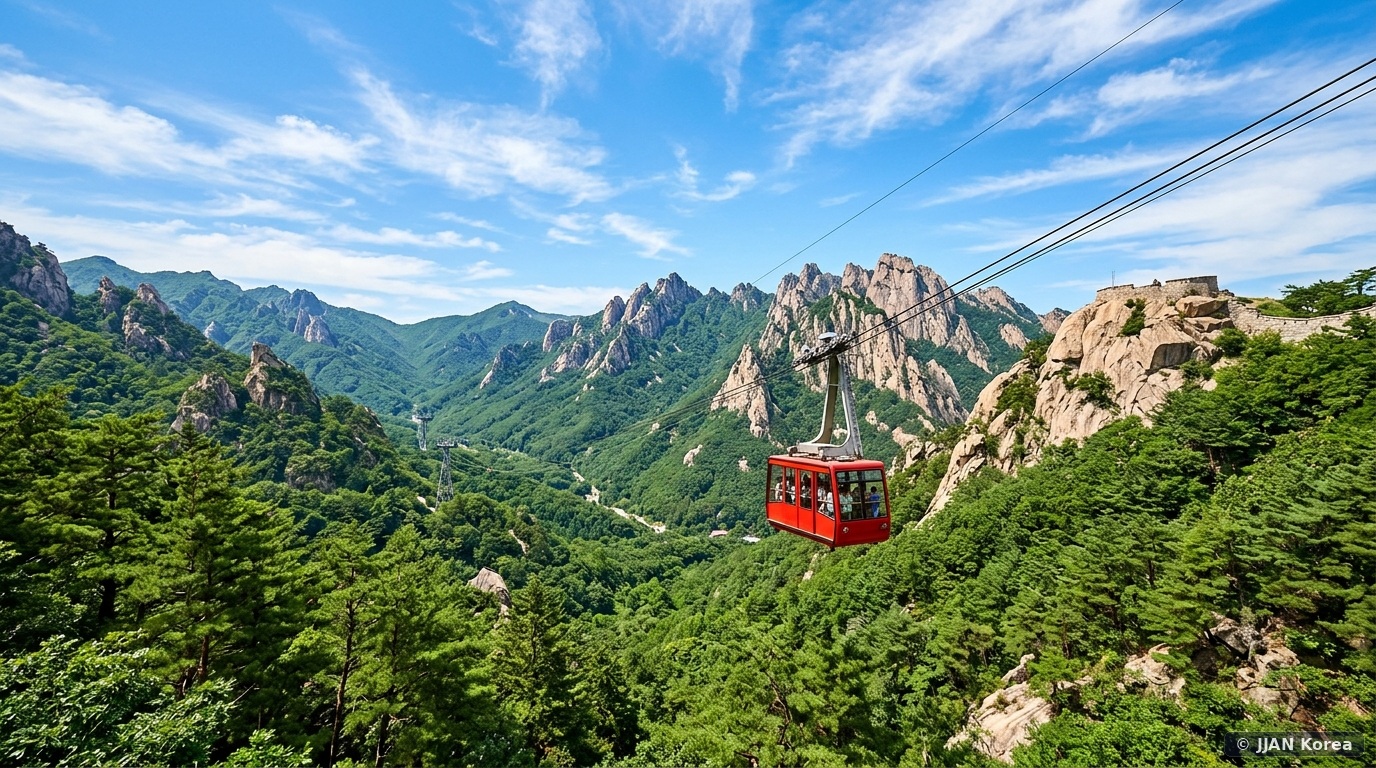
Rising majestically above South Korea’s northeastern Gangwon-do province, Seoraksan National Park (설악산국립공원) is celebrated as the crown jewel of Korea’s national park system and a designated UNESCO Biosphere Reserve. While autumn draws massive crowds eager to witness the fiery red foliage of its ancient maples, visiting Seoraksan during the early summer season offers an enchanting, crowd-free alpine sanctuary. Towering granite monoliths, misty valleys blanketed in lush emerald pine forests, crystal-clear glacial streams cascading into deep turquoise mountain pools, and crisp mountain breezes provide the ultimate escape from Seoul’s summer heat. For travelers who prefer scenic vistas without grueling 12-hour technical ascents up Daecheongbong Peak, the park’s modern Sogongwon Cable Car (설악 케이블카) glides effortlessly up to the sheer rock promontory of Gwongeumseong Fortress in just 5 minutes.
1. Transit Logistics: Traveling from Seoul to Seoraksan & Coastal Sokcho
Reaching Seoraksan from the capital requires a combined express bus and local transit itinerary. As explored in our primer on navigating intercity and regional bus routes outside Seoul, South Korea’s express bus network is reliable, punctual, and comfortable:
| Leg Segment | Departure Terminal | Arrival Destination | Travel Duration | One-Way Transit Fare |
|---|---|---|---|---|
| Leg 1 (Express Bus) | Seoul Express Bus Terminal (Gyeongbu/Honam) | Sokcho Express Bus Terminal (속초고속버스터미널) | 2 Hours 10 Minutes | 18,900 – 24,600 KRW (Premium) |
| Leg 1 Alternative | Dong Seoul Bus Terminal (Gangbyeon) | Sokcho Intercity Bus Terminal (속초시외버스터미널) | 2 Hours 15 Minutes | 17,200 KRW |
| Leg 2 (Local Bus No. 7 / 7-1) | Sokcho Bus Terminal Stop | Seoraksan Sogongwon Park Entrance (종점) | 30 – 35 Minutes | 1,700 KRW (T-Money card) |
| Leg 2 Alternative (Taxi) | Sokcho Bus Terminal | Seoraksan Sogongwon Visitor Center | 20 Minutes | 16,000 – 19,000 KRW |
Board the 06:30 AM or 07:00 AM express bus from Seoul Express Bus Terminal (Express Bus Line 3, 7, 9). You will arrive at Sokcho terminal before 09:15 AM, allowing you to reach the park entrance and secure early cable car tickets before tour groups arrive from the coast.
2. The Sogongwon Cable Car: Booking Windows & Gwongeumseong Peaks
The Seoraksan Cable Car departs from the Sogongwon entrance plaza, carrying 50 passengers per cabin along a 1.2km aerial cable up to the rocky summit station at an altitude of 700 meters. Important operational rules apply:
- Same-Day On-Site Ticketing Only: The cable car authority does not accept online advance reservations due to unpredictable alpine winds. Tickets must be purchased in person at the ground station ticket window on a first-come, first-served basis.
- Round-Trip Ticket Rates: Adults (age 14+) pay 15,000 KRW; children pay 11,000 KRW. Operating hours commence daily at 08:30 AM (earlier during peak weekends).
- High-Wind Grounding: Cable cars operate under strict meteorological safety standards. If mountain ridge winds exceed 15 meters per second, operations are temporarily paused and ticket refunds are issued immediately.
Upon exiting the upper cable car terminal, follow the stepped wooden trail for 10 to 15 minutes to reach the bare granite precipice of Gwongeumseong Fortress (권금성). According to legend, two generals named Gwon and Kim built a fortress wall here in a single night to defend against invading Mongol forces. Today, standing on the sheer granite summit rewards you with breathtaking panoramic vistas of the Ulsanbawi Rock formation, the East Sea coastline of Sokcho, and the mist-shrouded valleys of Outer Seorak.
3. Accessible Summer Hiking: Biryong Falls & Towangseong Falls Observatory
While hiking in the capital at places like Inwangsan offers wonderful city views—as detailed in our guide to beginner city fortress hiking trails at Inwangsan in Seoul—Seoraksan provides pure alpine wilderness. After descending on the cable car, embark on the park’s most rewarding half-day trail: the Biryong Falls Course (비룡폭포 코스).
- Trail Distance & Difficulty: 2.8km one-way (approx. 1.5 to 2 hours return). Mostly gentle, flat gravel path shaded by centuries-old oak and pine trees, tracking alongside the boulder-strewn Shuangcheon stream.
- Yukdam Falls (육담폭포): Cross the thrilling steel suspension footbridge hanging dramatically over a deep mountain canyon featuring six emerald natural pool basins carved out by glacial runoff.
- Biryong Falls (비룡폭포): Legend holds that a dragon residing beneath this 16-meter roaring waterfall was appeased by local villagers to bring an end to a devastating drought.
- Towangseong Falls Observatory (토왕성폭포 전망대): For ambitious hikers, tackle the final grueling section: a continuous 900-step vertical wooden staircase ascending to the high ridge observatory. The panoramic view reveals Towangseong Falls—a 320-meter three-tiered mountain cataract plunging down a vertical rock face, designated one of Korea’s Top 10 Scenic Views.
4. Cultural Treasures: Sinheungsa Temple & The Great Bronze Buddha
Located just 10 minutes walking distance from the cable car base sits Sinheungsa (신흥사), a head temple of the Jogye Order of Korean Buddhism first founded by monk Jajang in 652 AD. Guarding the temple entrance is the magnificent Tongil Daebul (통일대불 / Great Unification Buddha), a colossal 14.6-meter (48-foot), 108-ton gilded bronze statue of seated Sakyamuni Buddha erected to symbolize the Korean people’s heartfelt prayers for peaceful national reunification.
Walk past the stone bridge and enter the historic temple courtyard surrounded by towering mountain peaks. Admire the intricately carved wooden Four Heavenly Kings (Sacheonwang) guarding the main gate and the vibrant Dancheong mineral paint decorating the main prayer hall (Geukrakbojeon).
5. Afternoon in Coastal Sokcho: Abai Village & Squid Sundae
Conclude your day trip by taking Bus No. 7 back to central Sokcho. Visit Abai Village (아바이마을), a historic fishing enclave settled by North Korean refugees from Hamgyong Province during the Korean War. Board the iconic manual hand-pulled ferry (Gaetbae – 갯배), where passengers use hooked iron rods to pull the flat ferryboat across the harbor channel for just 500 KRW.
At local seaside restaurants, order Sokcho’s iconic culinary specialty: Ojingeo Sundae (오징어순대 / Squid Sausage). Fresh squid tubes are stuffed with a savory filling of minced squid tentacles, glutinous rice, tofu, glass noodles, and fresh vegetables, sliced into rounds, dipped in egg wash, and pan-fried golden on the griddle, served alongside spicy seasoned raw pollock (Myeongtae Sikhae).
6. Frequently Asked Questions (FAQ)
Q1: Is there an entrance fee to enter Seoraksan National Park?
In May 2023, the South Korean government abolished cultural heritage admission fees for all national parks. Entrance to Seoraksan National Park and Sinheungsa Temple grounds is completely free of charge. You only pay for parking (if driving) and cable car tickets.
Q2: Can I climb Ulsanbawi Rock on the same day?
Yes, but only if you start early. The Ulsanbawi trail is a steep 3.8km hike featuring over 800 technical metal stairs ascending to the 873-meter rocky summit ridge (taking 3.5 to 4.5 hours round-trip). Attempting both the cable car and Ulsanbawi on the same afternoon requires excellent cardiovascular fitness and an early 08:00 AM park arrival.
Q3: What should I pack for a summer day trip to Seoraksan?
Pack a lightweight breathable daypack, at least 1.5 liters of bottled water, electrolyte hydration powders, hiking boots with high-traction rubber outsoles (granite rock gets slippery when wet), sunscreen, a wide-brim hat, and an ultralight windbreaker jacket (the upper cable car ridge is significantly cooler than the coast).
Q4: How late do buses run back to Seoul from Sokcho?
Express buses depart Sokcho Express Bus Terminal for Seoul Express Bus Terminal until 10:30 PM on Sunday evenings. However, Sunday evening departures from Gangwon province frequently book out hours in advance. Always book your return express bus ticket via the Kobus website or app as soon as you arrive in Sokcho in the morning.
🛡️ JJAN Korea Editorial Standards & Fact-Checking Verification
This article was independently researched, field-tested, and audited by the JJAN Korea Travel & Transit Desk in Seoul led by Travel Editor Do-jun Kim. Park admission policies, trail safety advisories, and cable car ticketing systems verified directly through Korea National Park Service (KNPS) and Seorak Cable Car management.
Notice an unlisted hiking trail restriction or cable car operational change? Help us keep our international community accurately informed: Submit an Editorial Correction to our Seoul Newsroom.