
For expatriates, foreign corporate employees, and English language instructors residing in South Korea, monthly housing rent—known locally as Wolse (월세)—represents the single largest recurring living expense. In high-demand metropolitan hubs like Gangnam, Mapo, and Yongsan, monthly rent for a standard studio apartment (officetel) or two-room villa easily ranges from 700,000 to 1,500,000 KRW, totaling over 8 to 18 million won annually. Fortunately, South Korea’s National Tax Service (NTS – 국세청) provides powerful tax relief frameworks for residential renters. Under the Restriction of Special Taxation Act, eligible foreign wage earners can claim a direct Tax Credit of up to 15% to 17% of their annual rent payments, potentially delivering tax refunds exceeding 1,200,000 KRW. Furthermore, even if your specific visa or income tier disqualifies you from direct tax credits, you can still register your rent payments as an official Cash Receipt (Hyeon-geum Yeongsusueng) to substantially slash your taxable income.
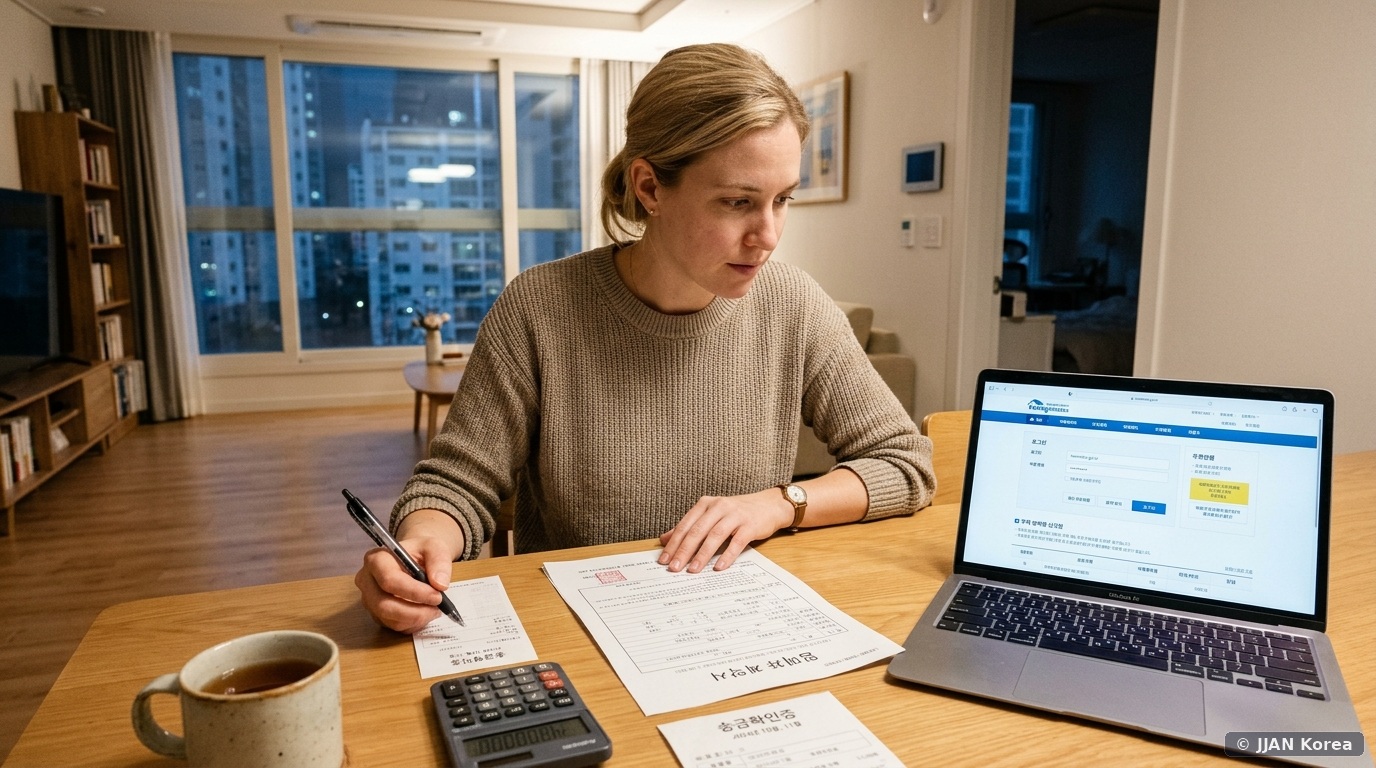
1. Two Distinct Avenues: Tax Credit (Se-aek Gongje) vs. Cash Receipt (Sodeuk Gongje)
Understanding the fundamental distinction between the two relief mechanisms on the NTS Hometax portal is vital for maximizing your annual refund:
| Tax Relief Category | Eligibility Requirements | Maximum Annual Claim Cap | Actual Refund Impact | Landlord Consent Requirement |
|---|---|---|---|---|
| Monthly Rent Tax Credit (월세액 세액공제) | Total annual gross salary ≤ 80M KRW; Head of household; No owned real estate in Korea | Up to 10,000,000 KRW in rent payments | 15% to 17% direct credit (Up to 1,700,000 KRW cash refund) | Zero (No landlord consent required by law) |
| Rent Cash Receipt Deduction (월세 현금영수증 소득공제) | All taxpayers (no salary limit, no household restriction) | Up to 30% of total taxable income threshold | Reduces gross taxable income base by 30% of rent | Zero (Can be registered unilaterally via Hometax) |
The Monthly Rent Tax Credit is infinitely more lucrative because it reduces your actual tax bill won-for-won (a direct 17% rebate on rent paid). By integrating this credit into your broader financial planning as outlined in our walkthrough on Foreigner Year-End Tax Settlement (연말정산) filing procedures, you can ensure that substantial excess withholding tax is returned directly to your Korean bank account every February.
2. Mandatory Eligibility Criteria for the 15%–17% Tax Credit
To qualify for the premier Monthly Rent Tax Credit, a foreign resident must satisfy four strict statutory conditions under Korean tax law:
- Wage Earner Status: You must be an employed wage earner (Geunroja) holding an employment contract in South Korea. Self-employed freelancers and business operators cannot claim the tax credit (though they can deduct rent as a business expense).
- Annual Gross Salary Threshold:
- Annual Gross Salary ≤ 55,000,000 KRW: Entitled to a 17% Tax Credit on annual rent paid.
- Annual Gross Salary between 55,000,000 and 80,000,000 KRW: Entitled to a 15% Tax Credit on annual rent paid.
- Annual Gross Salary > 80,000,000 KRW: Ineligible for the tax credit; must utilize the Cash Receipt deduction instead.
- Housing Size & Valuation Standard: The rented property must have an exclusive living area of 85 square meters or less (국민주택규모 이하), OR have an official government-assessed baseline value (Gongsi Gagyuk) of 400,000,000 KRW or less. Standard officetels, studios, villas, and medium apartments readily qualify.
- Address Registration Match (Jeon-ip Singo): The residential address stated on your official lease agreement must match 100% identically with the residential address registered on the back of your Foreigner Residence Card (ARC).
This fourth condition emphasizes why following legal housing protocols is critical. As detailed in our guide on protecting your rental lease and registering fixed dates (확정일자), notifying immigration of your new domicile within 14 days is not merely an immigration rule—it is the prerequisite for proving your tax residency domicile.
3. How to Register Your Lease Unilaterally on NTS Hometax (홈택스)
Many foreign renters hesitate to claim rent deductions out of fear that their Korean landlord will become angry or retaliate by raising rent upon renewal. Under South Korean law, your landlord has no legal right to forbid you from claiming tax deductions! You do not need the landlord’s signature, corporate stamp, or permission. You can register your lease unilaterally through the official NTS Hometax portal:
- Step 1: Access Hometax Portal: Log in to the official National Tax Service portal (hometax.go.kr) using your Joint Certificate (Gongdong Injeungseo), Financial Certificate, or Simple Authentication (Kakao/Naver PASS).
- Step 2: Navigate to Cash Receipt Civil Petitions: In the top navigation menu, click on 상담·불복·고충·제보 (Consultation / Petitions) ➔ 주택임차료(월세) 현금영수증 발급신청 (Residential Rent Cash Receipt Application).
- Step 3: Enter Lease Details: Fill in the landlord’s resident registration number (or corporate business number), property address, lease duration, contract deposit amount, and exact monthly rent due date.
- Step 4: Upload Required Digital Attachments: Scan and attach clear PDF copies of:
- Your signed Korean Standard Residential Lease Agreement (Imdaecha Gyeyakseo).
- A certified copy of your Foreigner Residence Card (both front and back).
- Bank account transfer statements (Iche Hwag-inseo) proving monthly wire payments from your personal account to the landlord’s account for the preceding 12 months.
- Step 5: Automated Monthly Issuance: Once the local tax district officer approves your submission (usually within 3 to 5 business days), Hometax will automatically generate an official Cash Receipt for your rent payment on the designated due date each month. These records flow directly into your year-end simplified tax document.
4. The 5-Year Retroactive Claim Rule (Gyeongjeong Cheong-gu)
If you were unaware of this tax credit and failed to claim rent deductions during previous tax years, you have not lost your money. Under Korean tax law, taxpayers are entitled to file a Petition for Rectification (Gyeongjeong Cheong-gu – 경정청구), allowing you to retroactively claim unclaimed rent tax credits for up to five (5) previous calendar years!
If you have lived in rented apartments in Seoul since 2021 without claiming rent credits, you can submit past leases and historical bank transfer statements to the tax office, frequently resulting in lump-sum cash refunds of 3,000,000 to 5,000,000 KRW wired directly into your bank account within 60 days of filing.
5. Frequently Asked Questions (FAQ)
Q1: What if my monthly rent is paid in cash without bank transfer records?
The National Tax Service will reject rent deduction claims without verifiable third-party financial records. Always pay monthly rent via electronic bank wire transfer (Gyejwa Iche) with the sender name matching your legal name, or request a physical signed paper receipt from the landlord for every payment.
Q2: Does my lease require a ‘Fixed Date’ (Hakjeong Ilja) to claim the tax credit?
For leases executed after 2014, the National Tax Service no longer requires a Fixed Date stamp (확정일자) to qualify for the Monthly Rent Tax Credit. However, obtaining a Fixed Date at your local Community Center (Jumin Center) is still vital to protect your deposit from mortgage foreclosure under the Housing Lease Protection Act.
Q3: My landlord included a lease clause stating ‘Tenant agrees not to report rent to tax authorities.’ Is this enforceable?
No. Clauses in private contracts that violate mandatory statutory laws (Ganghaeng Gyujeong) are deemed legally null and void under South Korean civil law. Your landlord cannot evict you, penalize you, or withhold your deposit because you claimed a lawful government tax deduction.
Q4: Do maintenance fees (Gwallibi) qualify for the rent tax credit?
No. Only pure residential rent (Wolse) qualifies for the tax credit. Variable utility charges, building management fees, elevator maintenance, and cleaning costs listed as separate items on your monthly invoice cannot be included in the calculation.
🛡️ JJAN Korea Editorial Standards & Fact-Checking Verification
This article was independently researched, field-tested, and audited by the JJAN Korea Finance & Tax Desk in Seoul led by Finance Editor Seo-jun Kim. Tax credit percentage tables and Hometax civil filing procedures cross-referenced directly with the National Tax Service (NTS) Restriction of Special Taxation Act decrees and Year-End Tax Settlement guides.
Notice an unlisted tax credit threshold adjustment or civil filing portal update? Help us keep our international community accurately informed: Submit an Editorial Correction to our Seoul Newsroom.