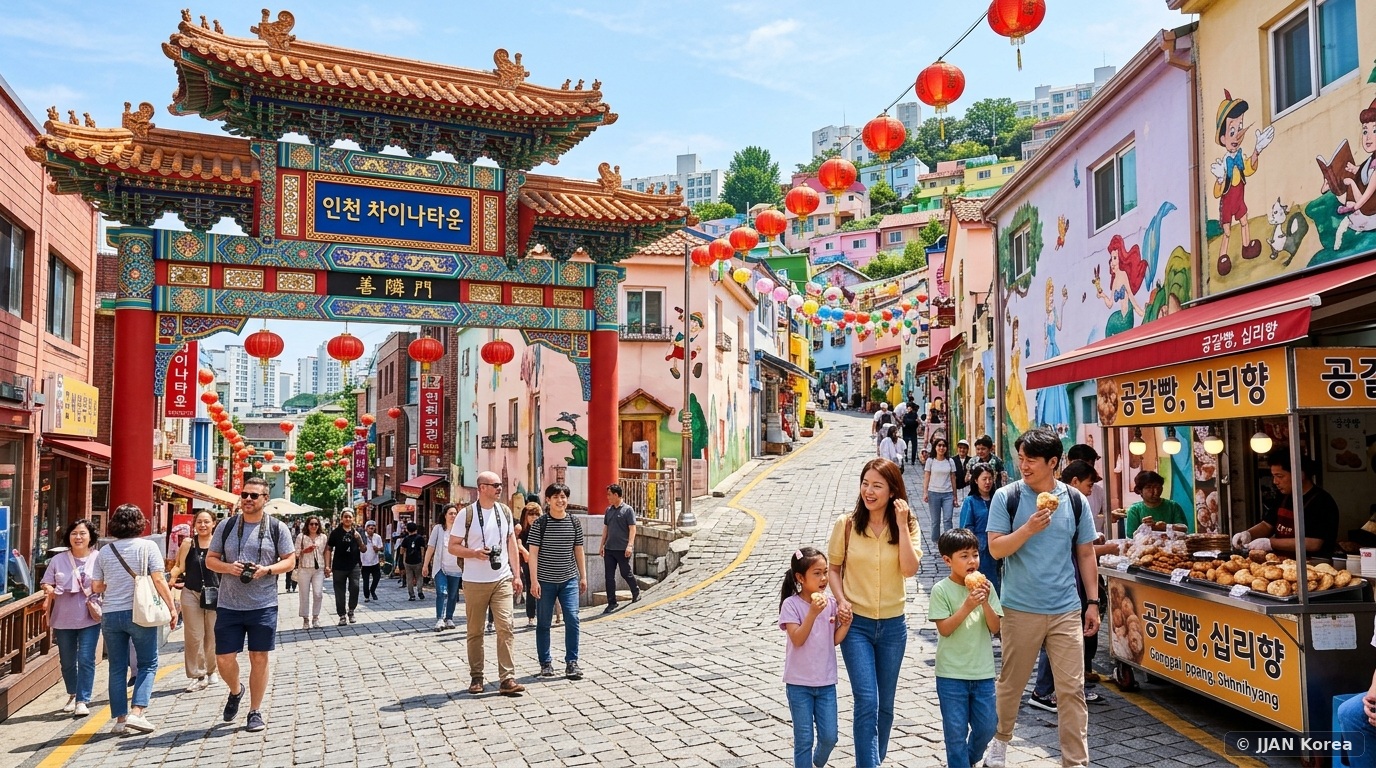
Located at the western terminus of Seoul Subway Line 1, where the metropolitan railway meets the Yellow Sea, the port city of Incheon holds a profound historical significance in modern Korean history. Following the formal opening of Incheon Port (Jemulpo) to international maritime trade in 1883, foreign settlements flourished along the harbor hillsides, establishing South Korea’s first and only official Chinatown (인천 차이나타운). Today, this vibrant neighborhood is globally celebrated as the birthplace of South Korea’s most beloved comfort food: Jajangmyeon (짜장면 / Black Bean Noodles). Blending monumental Qing dynasty paifang gates, century-old red-brick consular architecture, historic black-bean noodle dining halls, and the whimsical, colorful painted alleyways of adjacent Songwol-dong Fairy Tale Village (송월동 동화마을), an Incheon day trip offers an enchanting cultural retreat less than an hour from central Seoul.
1. Getting to Incheon Station: Subway Line 1 & Suin-Bundang Line
Unlike distant regional destinations that require intercity bus transfers, Incheon Chinatown is uniquely accessible directly via the standard Seoul metropolitan subway network:
| Subway Route | Boarding Station in Seoul | Travel Duration | One-Way Transit Fare (KRW) |
|---|---|---|---|
| Seoul Subway Line 1 (Gyeongin Express – 급행) | Yongsan, Noryangjin, or Sindorim Station | 48 to 58 Minutes (Terminates at Incheon Station) | 2,150 – 2,350 KRW (T-Money) |
| Suin-Bundang Line (수인분당선) | Suwon, Pangyo, or Gangnam transfers | 1 Hour 10 Minutes | Standard metered transit fare |
When riding Line 1 out to Incheon, note the boundary fare rules detailed in our commuter manual on checking subway boundary fare rules when taking Line 1 into Incheon, as certain unlimited Seoul commuter passes require standard T-Money top-ups when exiting stations outside municipal Seoul.
If you plan to connect your Chinatown excursion with flights departing from the international airport, consult our transit timetable on exploring Incheon metropolitan transit connections from central Seoul.
2. The Birthplace of Jajangmyeon: Gonghwachun & The Jajangmyeon Museum
In the late 19th century, Chinese dockworkers from Shandong province sought an inexpensive, energizing meal along the bustling wharves. They tossed wheat noodles with salty fermented black soybean paste (Chunjang – 춘장), julienned cucumbers, and pork fat. In 1905, a luxury banquet restaurant named Gonghwachun (공화춘) became the first registered dining establishment to commercially sell this dish, giving birth to modern Korean Jajangmyeon:
- The Jajangmyeon Museum (짜장면박물관): Located inside the preserved, registered cultural heritage brick building of the original 1905 Gonghwachun. Admission is just 1,000 KRW. Exhibits showcase life-sized wax dioramas depicting early Chinese kitchen operations, the evolution of delivery metal boxes (Cheolgabang – 철가방), and vintage noodle-making machinery.
- White Jajangmyeon (Baek-Jajang / 백짜장): While traditional black Jajangmyeon utilizes caramelized chunjang, modern culinary masters in Incheon Chinatown (such as Yeon-gyeong / 연경 and Mandabok / 만다복) invented White Jajangmyeon. Made from fermented white soybeans, minced pork, and sweet corn, this clear savory sauce highlights pure umami flavors without artificial caramel food coloring.
3. Songwol-dong Fairy Tale Village: 3D Street Murals & Whimsical Art
Directly bordering the northern gate of Chinatown lies Songwol-dong Fairy Tale Village (송월동 동화마을). Originally an aging residential district suffering from urban decline, the Incheon municipal government launched a comprehensive revitalization initiative in 2013, painting entire residential houses, garden fences, and stairways with vivid three-dimensional storybook murals:
- Iconic Storybook Trails: Stroll through themed alleys depicting classical world folk tales: Cinderella’s pumpkin carriage, Jack and the Beanstalk (with green vines wrapping around apartment drainage pipes), Peter Pan’s Neverland, Alice in Wonderland, and Dorothy’s Yellow Brick Road.
- Street Pastries & Treats: Sample iconic Chinatown street snacks along the route: hollow crunchy Gonggalppang (공갈빵) glazed with brown sugar, oven-baked Taiwanese mooncakes (Wolbyeong – 월병), and freshly torched clay-oven white lamb skewers (Yanggkkochi).
4. Incheon Open Port Modern Architecture Street (개항장 거리)
Directly south of Chinatown sits the historic Incheon Open Port Modern Architecture Street (개항장 근대건축지구). Following the 1883 treaty opening, this district was partitioned into sovereign Japanese, Russian, British, and American concessions, leaving a remarkable preserved architectural heritage:
- The Historic Japanese Bank Quarters: Tour the former Bank of Chosen Incheon Branch (now the Incheon Open Port Modern Architecture Museum) and the former First National Bank of Japan (now the Open Port Museum), showcasing imposing neoclassical granite facades, iron vaults, and vintage colonial currency.
- Jemulpo Club (제물포구락부): Perched on Jayu Park hill, this Russian-designed wooden mansion built in 1901 served as the exclusive social club for Western and Asian diplomats, featuring billiard rooms, ballroom dance halls, and panoramic views of Incheon harbor.
- Retro Café Culture: Relax inside repurposed 120-year-old wooden Japanese merchant warehouses (Machiya), such as Café Pot R (팟알), serving handmade sweet red bean porridge (Danpatjuk) and delicate castella sponge cake.
4. Frequently Asked Questions (FAQ)
Q1: What are the peak queue times at famous Chinatown restaurants?
A: Weekend lunch queues at premier institutions like Yeongyeong and Mandabok peak between 12:00 and 14:00 PM, with wait times reaching 30 to 45 minutes. Arrive early around 11:15 AM or visit after 14:30 PM for prompt table seating.
Q2: Can I combine Incheon Chinatown with Wolmido Island?
A: Yes! From Incheon Station, the historic oceanfront theme park island of Wolmido (월미도) is located just 2 kilometers west. Board the elevated Wolmi Sea Train (월미바다열차) monorail or take City Bus No. 45 (10 minutes) to enjoy ocean boardwalks, thrilling Disco Pang Pang rides, and fresh seafood clam boils.
Q3: Is the area stroller and wheelchair friendly?
A: The main thoroughfares of Chinatown and Songwol-dong are paved, but the terrain sits on a moderately steep hillside incline with occasional cobblestone stairs. Ramps are available along main avenues.
Q4: Are vegetarian options available at Incheon Chinatown restaurants?
A: Yes. Many heritage restaurants feature vegetarian menus (Chaeshik – 채식), preparing Jajangmyeon sauces made exclusively with wild mushrooms, tofu, and diced zucchini rather than pork fat.
5. Historic Jayu Park & The General MacArthur Monument
Ascending the stone staircases behind Chinatown brings visitors to Jayu Park (자유공원 / Freedom Park), South Korea’s first Western-style municipal public park, established in 1888. At the park’s scenic summit crest stands the monumental bronze statue of General Douglas MacArthur, commemorating the daring September 15, 1950 Incheon Landing Operation (Operation Chromite) during the Korean War, which dramatically altered the course of modern East Asian history. The park’s panoramic lookout pavilion offers sweeping 180-degree vistas across Incheon’s industrial container ship terminals, the Wolmido shoreline, and the distant arch of the Incheon Grand Bridge.
6. Sinpo International Market: Sweet-Spicy Dakgangjeong & Cheolmyeon
Conclude your Incheon walking excursion at Sinpo International Market (신포국제시장), located a 10-minute stroll southeast of Chinatown. Operating since the late Joseon era, Sinpo Market is famous across Korea for two culinary milestones:
- Sinpo Dakgangjeong (신포닭강정): The undisputed pioneer of sweet-spicy glazed fried chicken. Watch master chefs toss double-fried bone-in chicken in giant bubbling cauldrons of thick red syrup infused with whole dried red chilis, raw garlic, and peanuts. Queues line the market alleyway all afternoon.
- Original Cheolmyeon (쫄면 / Chewy Spicy Cold Noodles): Invented accidentally in Incheon during the 1970s when a noodle factory extruded wheat dough through the wrong fine-bore die, creating ultra-chewy, elastic noodles. Tossed with shredded cabbage, boiled egg, and fiery sweet-vinegar gochujang sauce.
7. The Wolmi Sea Train: Scenic Coastal Monorail Experience
Directly departing from the elevated platform adjacent to Incheon Station Exit 2, the Wolmi Sea Train (월미바다열차) is South Korea’s longest urban tourist monorail, tracing a 6.1-kilometer loop around Wolmido Island. Gliding 18 meters above sea level, passengers look down at the monumental Incheon Port Grain Silo mural—recognized by Guinness World Records as the world’s largest outdoor mural painting—and enjoy panoramic sunset views across the Yellow Sea shipping channels.
8. The Perfect 1-Day Incheon Heritage Itinerary & Travel Budget
Make the most of your day trip with this optimized timeline departing from central Seoul:
- 10:00 AM – Line 1 Express Arrival: Arrive at Incheon Station Exit 1. Pass beneath the towering Chinese gateway (Zhonghwamun) into Chinatown.
- 10:30 AM to 12:00 PM – Heritage Museums: Tour the Jajangmyeon Museum (1,000 KRW) to discover the culinary birth of black-bean noodles, followed by the Incheon Open Port Museum showcasing early diplomatic trade treaties.
- 12:15 PM – Iconic Jajangmyeon Lunch: Enjoy a celebratory lunch of White Jajangmyeon or classic black noodles paired with sweet-and-sour crispy pork (Tangsuyuk) at Yeon-gyeong or Mandabok (approx. 14,000 to 22,000 KRW).
- 13:45 PM – Songwol-dong Fairy Tale Village: Stroll through the colorful 3D fairytale street murals, photographing storybook scenes and tasting warm Gonggalppang pastry.
- 15:30 PM – Jayu Park & MacArthur Lookout: Ascend through the pine park to the General MacArthur monument for panoramic harbor views.
- 17:00 PM – Sinpo International Market: Conclude your day trip sampling famous sweet-spicy Sinpo Dakgangjeong and chewy Cheolmyeon cold noodles before taking Subway Line 1 back to Seoul. Total estimated daily budget: 35,000 to 45,000 KRW.
Incheon Smart Tourism App & Audio Walking Tours: Visitors can download the ‘Incheon e-Ji’ smart tourism mobile app, which provides free GPS-triggered English audio walking tours of the Open Port historical district, AR photo zones with historical figures, and luggage locker availability at Incheon Station.
Seasonal Spring Cherry Blossom Festivals in Jayu Park: Every April, Jayu Park hosts Incheon’s premier cherry blossom festival. Thousands of mature King Cherry trees form a delicate pink canopy over the pedestrian walking paths, creating an enchanting visual contrast with the historic brick architecture of the Open Port district and the colorful fairytale character statues of Songwol-dong.
JJAN Korea Editorial Standards & Fact-Checking Verification
Lead Author: Do-jun Kim, Senior Travel Editor (Heritage & Regional Tourism Desk)
Historical timelines, municipal museum opening hours, and subway railway fare matrices verified in consultation with Incheon Metropolitan City Tourism Corporation (인천관광공사) and Seoul Metro Line 1 transit authorities.