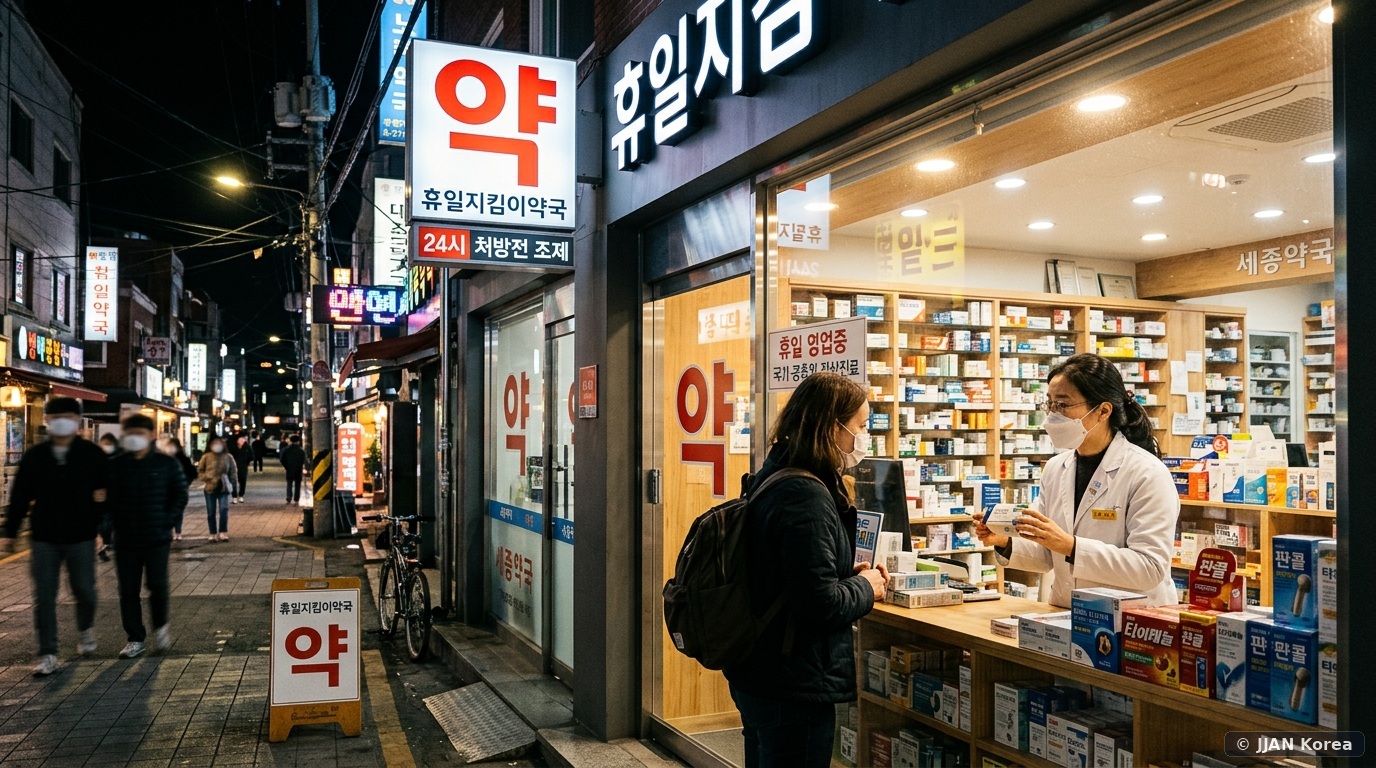
Experiencing a sudden throbbing migraine, high fever, acute pediatric stomach flu, or painful dental infection late at night or during a major national holiday (such as Chuseok, Lunar New Year, or Christmas) is an unnerving ordeal for international residents in South Korea. Walking down dark residential neighborhood streets only to discover that every commercial pharmacy (Yakguk – 약국) is closed with its lights switched off can feel terrifying. However, South Korea operates one of the world’s most sophisticated statutory emergency healthcare safety nets: the Public Holiday Guardian Pharmacy System (휴일지킴이약국 / Hyuil Jikimi Yakguk) and the Public Late-Night Pharmacy Network (공공심야약국). Coordinated by the Korean Pharmaceutical Association and local municipal governments, this statutory rotation mandates that certified licensed pharmacies remain open until midnight or throughout national holidays to dispense both over-the-counter and prescription emergency medications.
1. The Pharm114 Search System: Real-Time Open Pharmacy Locator
When you need medication outside standard retail hours, your primary tool is the official national portal operated by the Korean Pharmaceutical Association: Pharm114 (www.pharm114.or.kr). This real-time database tracks every licensed pharmacy across South Korea that is legally operating on Sundays, statutory public holidays, and during late-night hours.
| Healthcare Tier | Standard Operating Hours | Types of Medication Available | Access Method & Requirements |
|---|---|---|---|
| Public Late-Night Pharmacies (공공심야약국) | 22:00 ~ 06:00 (Overnight) | Full OTC and certified doctor prescription medications | Search Pharm114; in-person consultation with licensed pharmacist |
| Holiday Guardian Pharmacies (휴일지킴이약국) | Sundays & Holidays (09:00~18:00+) | Full range of pharmaceutical medicines and pediatric syrups | Rotational schedule; call pharmacy telephone before departing |
| 24-Hour Convenience Stores (Safety Medicine) | 24 Hours Continuous | 13 certified basic OTC items (Tylenol, cold, digestive, pain patches) | Walk into any CU, GS25, 7-Eleven; cash/card payment at register |
| Hospital Emergency Rooms (Eung-geub-sil) | 24 Hours Continuous | Trauma, IV hydration, prescription injections, emergency surgery | Call 119 for ambulance dispatch or walk into emergency reception |
While online portals are effective, if you lack Korean reading proficiency or need immediate verbal triage, remember that by calling 1339 to have operators locate the closest open emergency pharmacy, professional English-speaking operators will look up your GPS coordinates and text you the exact name, address, and telephone number of the nearest open late-night pharmacy within two minutes.
2. Step-by-Step Guide: Searching Pharm114 on Your Smartphone
Even if the Pharm114 website interface is primarily in Korean, navigating the search tool is straightforward when you know the core geographic keywords:
- Step 1: Access the Portal: Open your smartphone web browser and navigate to
www.pharm114.or.kr. On the main landing screen, tap the prominent search tab labeled “휴일지킴이약국 검색” (Holiday Guardian Pharmacy Search). - Step 2: Select Your Province / City (Si/Do – 시/도): In the first drop-down menu, select your metropolitan area (e.g., 서울특별시 for Seoul, 경기도 for Gyeonggi, 부산광역시 for Busan).
- Step 3: Select Your Municipal District (Gu/Gun – 구/군): In the secondary drop-down menu, choose your specific autonomous district (e.g., 마포구 for Mapo-gu, 강남구 for Gangnam-gu, 용산구 for Yongsan-gu).
- Step 4: Check Operating Status & Time: The search results display a table listing pharmacy names, physical addresses, current operating hours, and telephone numbers. A green icon labeled “운영중” (Operating Now) confirms active hours.
- Step 5: The Golden Rule – Always Telephone First: Pharmacists may occasionally experience personal emergencies or step out briefly for dinner during 14-hour holiday shifts. Always dial the listed telephone number (e.g., “Yeo-bo-se-yo, jigeum mun yeol-eo iss-na-yo?” – Hello, are you currently open?) before getting into a taxi.
3. Convenience Store Safety Medicine: What You Can and Cannot Buy
Under the Korean Pharmaceutical Affairs Act, designated 24-hour convenience stores (GS25, CU, 7-Eleven, Emart24) are legally licensed to sell a designated portfolio of 13 Safety-Net Over-the-Counter Medicines (안전상비의약품). These are displayed directly behind the cash register counter or on a small dedicated rack near the front cashier.
By understanding identifying common Korean over-the-counter packaging and active ingredients, you can quickly locate what you need:
- Antipyretics and Analgesics (Pain & Fever): Tylenol 500mg tablets (acetaminophen), Children’s Tylenol 80mg, Children’s Tylenol suspension syrup, and Children’s Brufen syrup (ibuprofen).
- Cold and Flu Relief: Panpyrin-T tablets (판피린티정) and Pancold-A (판콜에이 내복액)—widely used combination remedies combating runny nose, body aches, and fever.
- Digestive Enzymes & Stomach Relief: Festal Gold and Festal Plus digestive enzyme tablets (helping break down heavy fats and carbohydrates), along with traditional Whalmyungsu (활명수) herbal carbonated digestive tonics.
- External Pain Relief: Sinyang Pas and Jeil Cool Pas (menthol and anti-inflammatory transdermal medicated patches for acute muscular sprains and lumbar pain).
Crucial Purchasing Restriction: To prevent dangerous pharmaceutical stockpiling or accidental overdose, convenience store point-of-sale registers automatically enforce a strict statutory limit: only one individual package of each medication can be sold per customer transaction.
4. What If You Need a Doctor’s Prescription Late at Night?
If your condition requires strong prescription-only medications—such as oral antibiotics, high-potency asthma inhalers, prescription antiemetics, or narcotic painkillers—neither a holiday pharmacy nor a convenience store can dispense them without a certified doctor’s prescription. In these acute scenarios, you must visit a hospital emergency room (Eung-geub-sil).
Major university medical centers (such as Severance Hospital in Sinchon, Seoul National University Hospital in Hyehwa, Asan Medical Center, and Samsung Medical Center) maintain 24-hour international healthcare centers and emergency triage rooms. Emergency room consultation fees are covered under the National Health Insurance Service (NHIS) at subsidized rates, while hospital pharmacies located inside the emergency ward dispense prescribed medications directly to patients before discharge.
4. Pediatric Syrups, Dosage Syringes & Emergency Dental First-Aid
When young children experience sudden nighttime fevers or acute dental emergencies during holidays, foreign parents face heightened stress due to language and measurement barriers. In South Korea, pediatric fever management relies on the alternating administration of two distinct pharmaceutical classes: Acetaminophen (Champ Red / Children’s Tylenol) and Dexibuprofen / Ibuprofen (Champ Blue / Brufen).
Korean pediatricians recommend alternating between acetaminophen and ibuprofen every 2 to 3 hours if high fevers exceed 38.5°C and refuse to drop after a single dose. When purchasing pediatric syrups at holiday pharmacies, pharmacists provide plastic graduated oral dosage syringes (Tu-yak-byeong – 투약병) marked in milliliters. The proper dosage is calculated strictly by child body weight (approximately 0.3ml to 0.4ml per kilogram of body weight) rather than chronological age.
For traumatic dental injuries—such as a tooth knocked out during holiday sports—speed is critical: do NOT scrub the root of the tooth with water. Place the tooth immediately into a clean cup of cold cow’s milk or hold it inside your cheek saliva, and rush directly to a designated university dental hospital emergency center (such as Seoul National University Dental Hospital in Jongno) within 60 minutes for successful reimplantation.
5. Animal Bites, Burns, Tetanus Protocols & Foreign Language Pharmacy Scripts
Holiday outdoor barbecues, autumn hiking, and unfamiliar kitchen tasks frequently trigger unexpected minor trauma, including hot cooking oil burns, stray cat scratches, or rusty metal cuts. If you sustain a deep puncture wound or animal scratch during a public holiday, visit an on-duty clinic immediately to receive a prophylactic Tetanus Toxoid Vaccine (Pasanpung Baeksin – 파상풍 백신), which is fully stocked at designated regional emergency health centers and costs approximately 15,000 to 25,000 KRW under standard insurance.
For minor burns and abrasions, holiday pharmacies carry medical-grade hydrocolloid healing dressings (such as Duoderm or Medifoam) and antibiotic ointments (Fucidin / Madecassol). To make your communication effortless at the pharmacy counter, save these essential Korean phrasing scripts to your smartphone notepad:
- “Hwasang-e ba-reuneun yeongo-rang deuresing bbaen-deu juseyo.” (Please give me burn ointment and hydrocolloid dressings.)
- “Bae-ga simhage apeugo seolsa-reul hae-yo.” (I have severe stomach pain and diarrhea.)
- “Yeol-i nago meori-ga neomu kkaejil deut-i apayo.” (I have a high fever and a splitting headache.)
- “Eorin-i haeyeolje-rang tuyak-byeong juseyo.” (Please provide pediatric fever syrup with an oral dosage syringe.)
5. Frequently Asked Questions (FAQ)
Q1: Are medication prices higher at holiday and late-night pharmacies?
Yes, but only marginally. Under Korean statutory health regulations, medications dispensed between 18:00 and 09:00 on weekdays, as well as all day on Sundays and public holidays, incur a modest Night and Holiday Surcharge (야간·공휴일 가산금) of roughly 30% added to the base dispensing service fee. For standard over-the-counter medicine, this translates to an extra 1,000 to 2,000 KRW.
Q2: Can I buy emergency morning-after contraceptive pills at a late-night pharmacy?
In South Korea, emergency morning-after contraceptive pills (e.g., NorLevo, EllaOne) are legally classified as prescription-only drugs (Cheo-bang-yak). A licensed pharmacist cannot legally sell emergency contraception over the counter without a physician’s prescription. You must visit a hospital emergency room or a late-night OB/GYN clinic (San-bu-in-gwa) to obtain an immediate prescription first.
Q3: Can I pay with foreign credit cards at holiday pharmacies?
Yes! Virtually all Korean pharmacies accept international credit cards (Visa, MasterCard, American Express) through standard chip-and-PIN and contactless payment terminals. Cash and local payment apps (Kakao Pay, Naver Pay, T-Money) are also universally accepted.
Q4: Do pharmacists in Korea speak English?
Pharmacists in major metropolitan hubs (such as Seoul Station, Myeongdong, Gangnam, and Itaewon) frequently speak functional English. In residential neighborhoods, pharmacists are accustomed to assisting foreign residents. Showing the clear English or Korean name of the active ingredient (e.g., “Ibuprofen” / “Doxylamine”) on your smartphone screen allows pharmacists to provide exact domestic bio-equivalents instantly.
🛡️ JJAN Korea Editorial Standards & Fact-Checking Verification
This emergency and holiday pharmacy access guide has been compiled and fact-checked by Senior Columnist Dong-hwan Kim in accordance with statutory directives issued by the Ministry of Health and Welfare (MOHW) and the Korean Pharmaceutical Association (KPA).
- Public Holiday Guardian Pharmacy regulations verified under Article 21 of the Pharmaceutical Affairs Act.
- Convenience store safety medicine sales quotas cross-checked against Ministry of Health and Welfare safety lists.
- Night and holiday dispensing fee surcharges confirmed via National Health Insurance Corporation (NHIS) tariffs.