For international residents living, studying, or working in South Korea, paying mandatory monthly National Health Insurance Service (NHIS – 국민건강보험) premiums—often exceeding 150,000 KRW per month for regional subscribers and corporate employees alike—can feel like a substantial financial obligation. Yet, an overwhelming majority of foreign nationals fail to utilize one of the most generous statutory preventive healthcare benefits built directly into South Korea’s National Health Insurance Act: the subsidized annual dental scaling benefit (건강보험 치과 스케일링).
Under Article 41 of the National Health Insurance Act, every insured individual aged 19 and older—including all legally registered foreign nationals holding an Alien Registration Card (ARC)—is legally entitled to receive one full-mouth ultrasonic dental scaling procedure per calendar year at a government-subsidized co-pay rate of approximately 15,000 to 17,000 KRW (roughly $11 to $13 USD). In sharp contrast, undergoing the identical deep ultrasonic scaling without health insurance coverage costs between 60,000 and 85,000 KRW at private Korean dental clinics (Chik-gwa – 치과).
Crucially, this subsidized benefit operates strictly on a calendar-year cycle (January 1 through December 31). Unused annual scaling quotas do NOT roll over into the following year; if you do not complete your dental cleaning before midnight on December 31, your annual entitlement vanishes permanently. Because neighborhood dental clinics across Seoul and metropolitan areas become completely booked throughout late November and December as locals scramble to use expiring medical benefits, late October represents the absolute golden window for international residents to secure their appointment without stressful delays.
1. What NHIS Covers vs. Non-Covered (Bi-geup-yeo) Dental Services
One of the primary anxieties foreign patients experience when entering a Korean dental clinic is the fear of unexpected out-of-pocket medical bills or high-pressure cosmetic upselling. In the South Korean medical billing architecture, dental procedures are strictly bifurcated into two regulatory tiers: Covered National Benefits (Geup-yeo – 급여) and Non-Covered Elective Services (Bi-geup-yeo – 비급여). Understanding this distinction empowers you to decline unwanted elective treatments with complete confidence.
As detailed in our comprehensive analysis of the Korea National Health Insurance (NHIS) expat system, preventive scaling and medically necessary dental treatments receive substantial state co-payment subsidies, whereas aesthetic restorations, ceramic prosthetics, and orthodontic treatments are billed at 100% market rates established independently by each clinic.
| Dental Treatment / Procedure | NHIS Status | Typical Patient Co-Pay (With NHIS) | Uninsured Market Price (Bi-geup-yeo) |
|---|---|---|---|
| Annual Ultrasonic Dental Scaling | Covered (1x / calendar year) | 15,000 – 17,000 KRW | 60,000 – 85,000 KRW |
| Panoramic Dental X-Ray (Full Jaw) | Covered (Diagnostic) | 7,000 – 10,000 KRW | 25,000 – 40,000 KRW |
| Wisdom Tooth Extraction (Sarang-ni) | Covered (Surgical & Simple) | 18,000 – 35,000 KRW | 100,000 – 200,000 KRW |
| Root Canal Therapy (Sin-gyeong Chiryo) | Covered (All stages) | 12,000 – 18,000 KRW / visit | 80,000 – 120,000 KRW / visit |
| Silver Amalgam / GI Cavity Filling | Covered | 10,000 – 15,000 KRW / tooth | 30,000 – 50,000 KRW |
| Composite Resin Cavity Filling (Tooth-colored) | Non-Covered (Age 13+) | 70,000 – 120,000 KRW (100% out of pocket) | 70,000 – 120,000 KRW |
| Ceramic / Gold Inlay | Non-Covered (Elective) | 250,000 – 380,000 KRW | 250,000 – 380,000 KRW |
| Dental Crown (Zirconia / Gold) | Non-Covered (Under 65) | 450,000 – 650,000 KRW | 450,000 – 650,000 KRW |
As the comparison table illustrates, your primary objective during an annual checkup is utilizing your subsidized scaling and diagnostic panoramic X-ray. If the dentist discovers small incipient enamel cavities, you are under zero legal or clinical obligation to commit to expensive composite resin or zirconia inlay treatments on the spot. You can politely request the diagnostic X-ray prints, pay your ~25,000 KRW total bill (scaling + X-ray), and take time to seek a second medical opinion.
2. Step-by-Step Clinic Protocol: Booking, Registration & Useful Korean Phrasing
You do not need to visit a massive university tertiary hospital (Daehak Byeongwon) for routine scaling; in fact, doing so will incur substantial administrative referral surcharges. Instead, look for local neighborhood dental clinics—easily identified by street signs reading 치과의원 (Chik-gwa Ui-won). Nearly every commercial building adjacent to Seoul subway stations houses two to four competing dental practices.
Booking an appointment is remarkably straightforward. Most modern Korean dental clinics accept online reservations through Naver Booking (Naver Yeyak) or telephone reservations. If booking by phone, or walking in directly at the clinic reception desk, utilize these essential Korean phrases:
• “Health insurance scaling ha-reo wasseoyo.” (건강보험 스케일링 하러 왔어요.)
➔ “I came for my National Health Insurance subsidized scaling.”
• “Geon-gang-bo-heom jeok-yong doe-na-yo?” (건강보험 적용 되나요?)
➔ “Does this qualify for health insurance coverage?”
• “Oneul-eun seu-ke-il-ling-man ba-deul-ge-yo.” (오늘은 스케일링만 받을게요.)
➔ “Today I only want to receive the scaling treatment.”
• “Chung-chi chiryo-neun da-eum-e hal-ge-yo.” (충치 치료는 다음에 할게요.)
➔ “I will consider cavity treatment at a later date.”
Upon arriving at the reception desk, hand the receptionist your physical Alien Registration Card (ARC) or provide your 13-digit Foreigner Registration Number (Jumin/Oegukin Deungnok Beonho). The receptionist enters your registration number into the centralized Health Insurance Review and Assessment Service (HIRA – 건강보험심사평가원) electronic portal. The system instantly verifies your active insurance status and confirms whether your annual scaling quota for the current calendar year remains available.
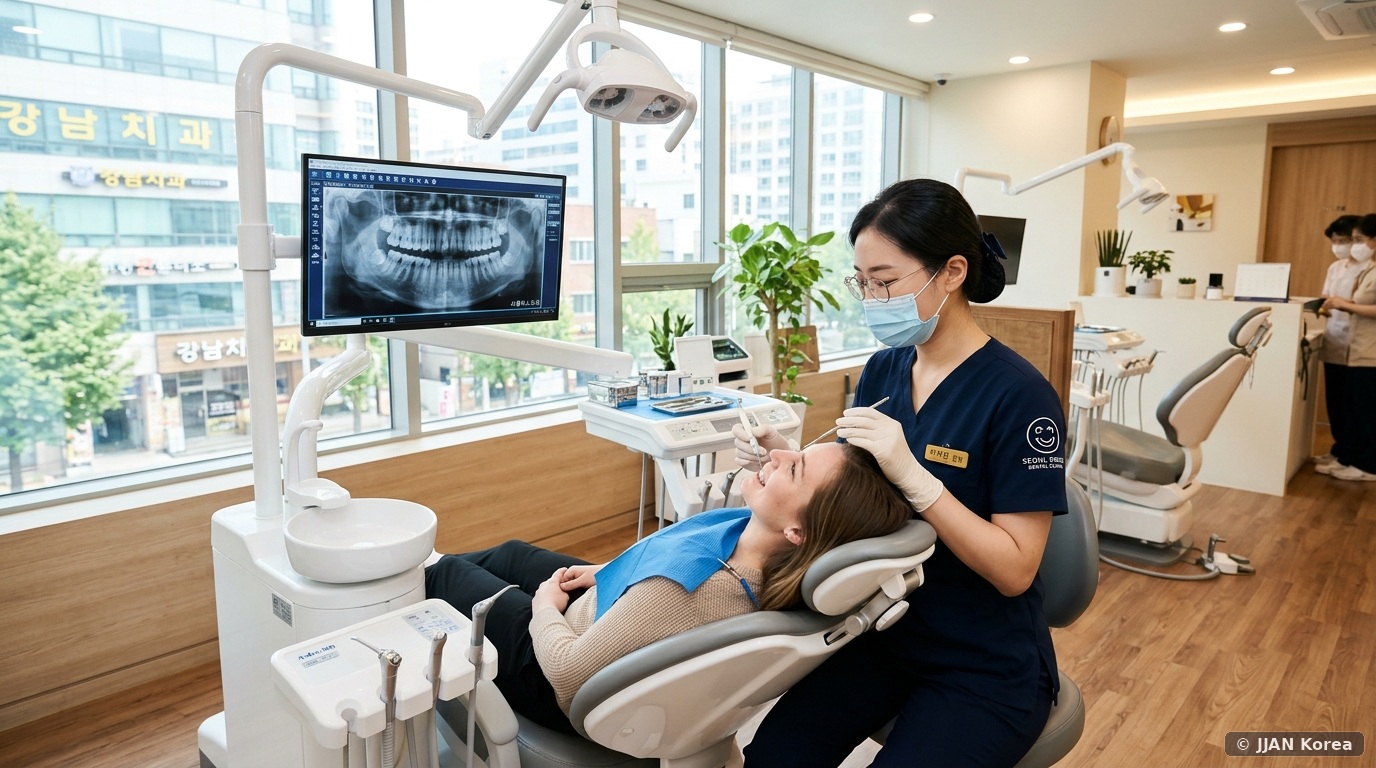
The dental hygienist or dentist will guide you to a motorized dental chair, drape a sterile paper bib over your chest, and conduct a brief visual inspection. An ultrasonic scaler—which uses high-frequency microscopic vibrations combined with a cool cooling water spray—gently pulverizes hardened calcified tartar (dental calculus) and bacterial biofilm accumulated along your gumline and between lower incisors. The procedure takes between 20 and 30 minutes, is virtually painless (though individuals with mild gum inflammation may feel momentary cold sensitivity), and concludes with an antiseptic mouthwash rinse.
3. Defending Against Dental Overtreatment: The 3 Red Flags to Watch
While South Korea boasts world-class dental technology and rigorous medical standards, private dental clinics operate as commercial enterprises. A minority of aggressive commercial dental chains (often located in hyper-competitive retail districts like Gangnam or Sinchon) engage in “over-diagnosis” (Gwa-ing Jin-ryo – 과잉진료), diagnosing microscopic surface stains as severe decay requiring immediate porcelain inlays costing hundreds of thousands of won.
To protect your wallet and dental health, always enforce these three defensive consumer rules:
1. Beware the “Same-Day Treatment Discount”: If a clinic coordinator (Counseling Director – Sangdam Siljang) insists that you must drill five cavities today to receive an exclusive 20% discount on resin, decline immediately. Honest dentists encourage patients to observe early-stage enamel decay (C1 level decay) through regular remineralizing brushing rather than aggressive drill-and-fill procedures.
2. Inspect Your Own X-Rays on the Monitor: Legitimate dentists will display your digital panoramic and intraoral camera photos directly on the monitor positioned in front of your dental chair, methodically pointing out dark shadows penetrating into the dentin layer before recommending restorative fillings.
3. Seek Care at “Natural Tooth Preservation” Clinics: Look for clinics whose signage or Naver profile explicitly emphasizes “Jayeon Chi-a Sal-li-gi” (자연치아 살리기 – Preserving Natural Teeth). These ethical practitioners prioritize conservative remineralization and periodontal therapy over premature tooth extraction and costly titanium implants.
4. Post-Scaling Clinical Care & Gum Inflammation Management
Following ultrasonic scaling, your gums may feel slight tingling or mild soreness, and teeth may exhibit temporary thermal sensitivity to icy water or hot broth for 24 to 48 hours. This is an entirely physiological response: removing thick calcified tartar blocks exposes sensitive tooth root surfaces that were previously insulated by bacterial calculus.
To ensure rapid gingival healing and maximize your cleaning benefits, adhere to this clinical checklist:
• Avoid scalding-hot Korean soups (such as Kimchi-jjigae or Samgyetang) and ice-cold drinks for the first 24 hours.
• Refrain from smoking cigarettes and drinking alcohol for at least 48 hours, as nicotine and alcohol irritate healing gum capillaries and elevate bleeding risks.
• Do not aggressively probe your newly cleaned interdental gaps with wooden toothpicks; use soft dental floss or waxed interdental brushes (Chi-gan Chit-sol) purchased from Daiso or Olive Young.
• If gums bleed slightly during evening brushing, do NOT stop brushing. Continue gentle circular brushing with a soft-bristle toothbrush to remove soft plaque before it re-calcifies into tartar.
For emergencies occurring late at night or during holiday weekends, remember that you can always utilize Korea’s 119 emergency medical telephone consultation service to locate designated holiday dental emergency triage rooms operating in your district.
5. Frequently Asked Questions (FAQ)
Q1: Does the annual dental scaling benefit apply to international students on D-2 visas?
Yes, absolutely. Under Ministry of Health and Welfare regulations, all international students residing in South Korea are automatically enrolled in the National Health Insurance Service (NHIS) as local subscribers. Your student insurance policy grants 100% identical preventive dental benefits as Korean citizens, allowing you to receive annual scaling for ~15,000 KRW at any licensed dental clinic nationwide.
Q2: What happens if I miss the December 31 deadline? Can I get two scalings next year?
No. The NHIS scaling quota resets automatically at 00:00 on January 1 every calendar year. If you fail to use your 2026 quota by December 31, 2026, it lapses permanently. You cannot “accumulate” or rollover unused cleanings; you will simply receive your standard single quota for the 2027 calendar year.
Q3: Does dental scaling damage or thin out my tooth enamel?
No, this is a pervasive dental myth. Modern ultrasonic dental scalers operate using microscopic mechanical vibrations and water cavitation. They do not cut, scrape, or grind away tooth enamel. The sensation that your teeth feel “thinner” or have “gaps” is simply the natural contour of your clean teeth once swollen, inflamed tartar deposits have been cleared away.
Q4: Can I get my wisdom teeth (Sarang-ni) extracted under National Health Insurance?
Yes. In South Korea, surgical and non-surgical extraction of problematic, impacted, or decaying wisdom teeth is fully covered under NHIS as a medically necessary therapeutic procedure. A routine wisdom tooth extraction typically costs between 18,000 and 35,000 KRW per tooth (including diagnostic panoramic X-rays and local anesthesia), representing a tiny fraction of Western dental extraction costs.
🛡️ JJAN Korea Editorial Standards & Fact-Checking Verification
This preventive healthcare guide has been compiled and verified by Senior Columnist Dong-hwan Kim in accordance with official clinical co-pay statutes published by the National Health Insurance Service (NHIS) and the Health Insurance Review and Assessment Service (HIRA).
- Annual scaling co-pay rates verified under Article 41 of the National Health Insurance Act Enforcement Rules.
- Covered vs. non-covered dental procedure categorizations cross-referenced against HIRA Medical Fee Schedules.
- Foreign resident health insurance eligibility criteria confirmed via Ministry of Health and Welfare public welfare directives.