For international foreign residents holding long-term South Korean visas (such as E-7, D-2, D-10, E-2, F-2, or F-6), international travel—whether embarking on a summer holiday across Southeast Asia, returning home for winter family holidays, or departing on foreign corporate business trips—is a routine part of expat life. However, nothing induces greater panic at the airport departure gate than uncertainty surrounding South Korea’s Re-Entry Permit (Jae-ip-guk Heo-ga – 재입국허가) regulations. Historically, departing Korea without securing advance permission resulted in the immediate, irreversible cancellation of your Alien Registration Card (ARC) and the forfeiture of your hard-earned residency status. While immigration reforms have introduced generous automatic exemptions, strict statutory time limits, multiple re-entry rules, and online filing procedures still govern who can leave and return legally.
1. The General 1-Year Re-Entry Exemption Rule (Jae-ip-guk Myeon-je)
Under Article 30 of the Korean Immigration Control Act and its updated Enforcement Rules, the fundamental statutory baseline for registered foreign residents is the Automatic Re-Entry Permit Exemption. If you are a legally registered foreigner who holds an active, unexpired Alien Registration Card (ARC), you are automatically exempted from applying for a separate re-entry permit provided your trip adheres to standard duration limits.
| Visa Category Held | Permitted Period of Absence from Korea | Advance Re-Entry Permit Required? | Standard Statutory Fee |
|---|---|---|---|
| Standard Long-Term Visas (D-2, D-10, E-7, E-2, etc.) | Up to 1 Full Calendar Year (Within ARC validity) | AUTOMATICALLY EXEMPTED (No filing needed) | 0 KRW (Free) |
| F-5 Permanent Residency (Yeong-ju-gwon) | Up to 2 Full Calendar Years | AUTOMATICALLY EXEMPTED | 0 KRW (Free) |
| F-4 Overseas Korean Visa | Entire Duration of Authorized Stay (Up to 3 Years) | AUTOMATICALLY EXEMPTED | 0 KRW (Free) |
| Absences Exceeding 1 Year (Standard Visas) | Between 1 Year and 2 Years Maximum | MANDATORY: Must Apply via HiKorea Before Departure | Single: 30,000 KRW / Multiple: 50,000 KRW |
| Pending Initial ARC Issuance (First-Time Entrants) | Departing before physical ARC is manufactured | CRITICAL WARNING: CANNOT LEAVE without Certificate | Requires Certificate of Alien Registration |
The single most dangerous misconception among expats is confusing the 1-year exemption with the expiration date printed on the back of their card. By keeping your Alien Registration Card valid and presenting it at airport immigration, you must ensure that your authorized Period of Stay (Che-ryu Gi-gan) does not expire while you are abroad. If your ARC expires on November 15, you cannot return to Korea on November 16, even if your international absence was only three weeks long!
2. When You MUST File for a Re-Entry Permit: Absences Exceeding 1 Year
If your employment, overseas academic sabbatical, overseas military service, or prolonged medical treatment requires you to remain outside South Korea for longer than 1 continuous year (12 months), the automatic exemption expires. In this scenario, you must file a formal application for a Multiple Re-Entry Permit (Boksu Jae-ip-guk Heo-ga) before boarding your departure flight.
Under the law, Multiple Re-Entry Permits can be granted for an absence of up to two full years (capped by your underlying visa expiration date). Failing to secure this permit before leaving will cause your residency status to be permanently extinguished on day 366 of your absence, forcing you to begin the entire visa application process from scratch abroad.
3. Step-by-Step Guide: Filing Online via the HiKorea Portal
You do not need to take time off work to visit an immigration office in person to request a re-entry permit. By processing immigration civil petitions via the official HiKorea web portal, you can complete the application entirely from your laptop:
- Step 1: Log Into HiKorea (www.hikorea.go.kr): Log in using your registered foreign resident account. If you do not have an account, register using your active ARC number.
- Step 2: Select Electronic Applications (Jeonja Minwon): Navigate to the “Application for Re-entry Permit” (재입국허가 신청) service portal.
- Step 3: Specify Reason and Period of Travel: Enter your departure date, expected return date, destination countries, and detailed justification for the extended absence (e.g., overseas company assignment contract, overseas university enrollment letter, or medical certificates).
- Step 4: Pay Statutory Fee Electronically: The statutory fee is 30,000 KRW for a Single Re-Entry Permit (valid for 1 journey) or 50,000 KRW for a Multiple Re-Entry Permit. Payments can be completed using Korean domestic debit cards, Kakao Pay, or international credit cards.
- Step 5: Print the Electronic Confirmation Slip: Adjudication typically takes 1 to 3 business days. Once approved, download and print the official Re-Entry Permit Confirmation Certificate (재입국허가 확인서). Keep a physical copy folded inside your passport alongside your ARC during airport check-in.
4. Airport Departure Protocols: Incheon SmartPass & Automated Gates
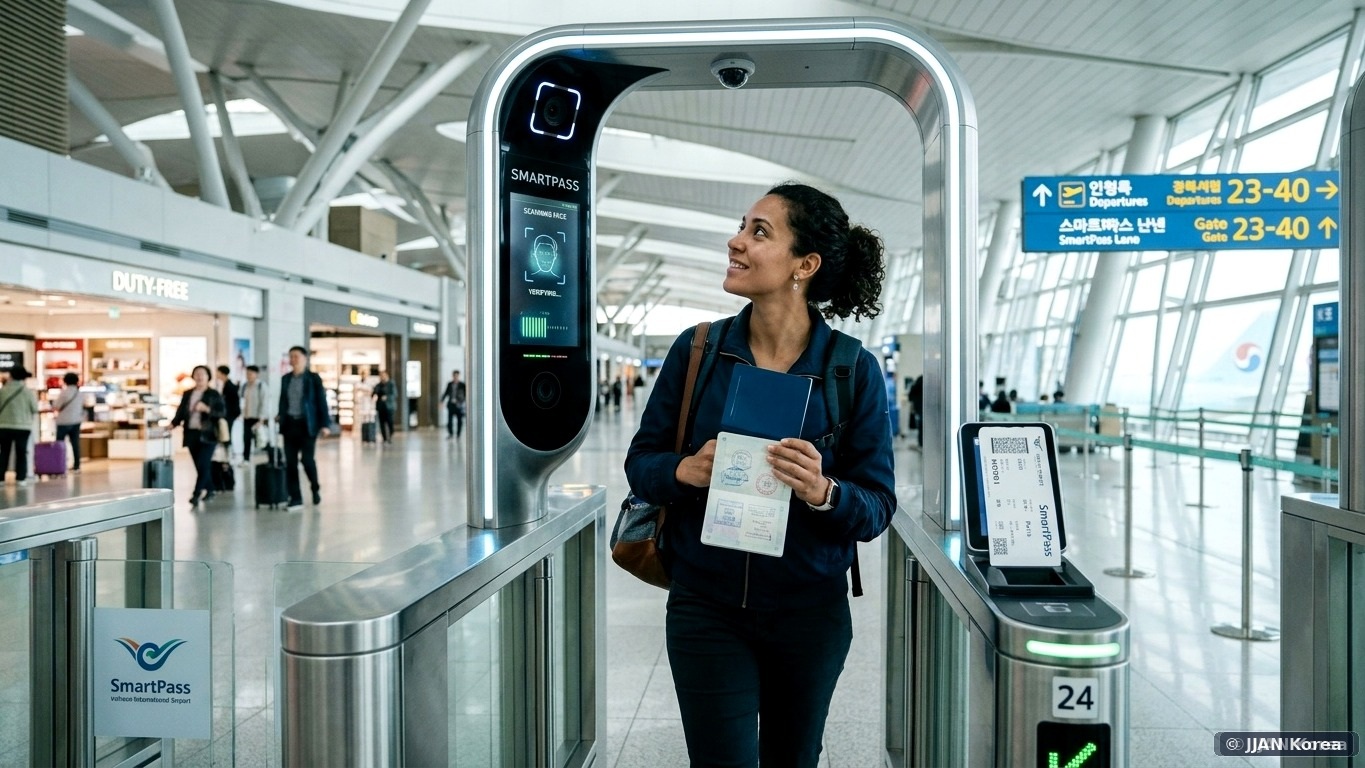
When departing South Korea through Incheon International Airport (Terminal 1 or Terminal 2), registered foreigners who have registered their biometric facial data and fingerprints can utilize the Automated Immigration Clearance Gates (Seu-ma-teu Pae-seu / SmartPass). Simply scan your passport photo page, look into the facial recognition camera, and press your index fingers onto the glass scanner; the automated gate opens in under 10 seconds.
Crucial Departure Card Protocol: Foreign residents holding valid ARCs do NOT need to fill out paper departure or arrival cards (Chul-ip-guk Singo-seo) when flying through Korean airports. Your physical card and passport are electronically synchronized with the National Police Agency and Ministry of Justice border control systems.
5. Special Bilateral Exemption Treaties & Overseas Emergency Protocols
While the general baseline exempts registered foreigners for up to 1 year, citizens of specific countries enjoy enhanced protections under reciprocal bilateral treaties signed with the Republic of Korea. For example, passport holders from countries such as Suriname, the Netherlands, Germany, and Chile enjoy extended re-entry exemptions or fee waivers under longstanding bilateral diplomatic accords.
If your physical passport is lost or stolen while traveling abroad, do not panic about your Korean visa status. Report the loss to local foreign police to obtain a certified police incident report, and visit your national embassy to obtain an emergency passport. Once issued, email a copy of the emergency passport and your original ARC card to the Korea Immigration Contact Center ([email protected]). Upon flying back to Incheon Airport, proceed to the primary immigration inspection desk with your police report; immigration officers will look up your biometric record and stamp your emergency passport with an authorized re-entry permit without penalty.
Managing Automatic Bank & Utility Direct Debits While Abroad: When departing South Korea for an extended multi-month sabbatical, foreign residents must ensure that their Korean bank accounts maintain sufficient balances to cover automated monthly direct debits (Ja-dong Iche) for utility bills (electricity, gas, water) and mobile phone minimal suspension plans (Ilsi Jeongji). If your phone line is terminated due to unpaid bills while you are overseas, you will lose the ability to receive SMS verification codes, creating extreme difficulty when logging into Korean banking portals from abroad.
Maintaining Active Emergency Contacts on HiKorea: Whenever you depart South Korea on international journeys, ensure your emergency contact telephone number and foreign travel email address are kept up-to-date in your HiKorea member profile. If unforeseen immigration policy revisions or health quarantine declarations occur while you are overseas, the Ministry of Justice dispatches official consular guidance to your registered email address.
5. Frequently Asked Questions (FAQ)
Q1: What happens if I recently applied for an ARC but haven’t received the plastic card yet?
This is the most dangerous trap for new arrivals. If you entered Korea on a long-term visa and applied for your ARC at immigration, but leave Korea before the physical card is manufactured or before your registration number is finalized in the database, your visa will be automatically CANCELLED upon departure. If you must travel abroad urgently, visit your local community service center (Jumin Center) or immigration office to obtain a Certificate of Alien Registration (Oegugin Deungnok Sasil Jeungmyeong) before heading to the airport.
Q2: Can I extend my re-entry permit from outside South Korea if an emergency arises?
Yes, but only under exceptional extenuating circumstances (such as severe hospitalization, unavoidable natural disaster, or sudden flight cancellations). You must contact and visit the nearest Republic of Korea Embassy or Consulate in the country where you are staying prior to the expiration of your approved re-entry period to apply for a Re-Entry Period Extension (Jae-ip-guk Heo-ga Gi-gan Yeon-jang).
Q3: Does leaving Korea pause my National Health Insurance (NHIS) payments?
Under Korean National Health Insurance Corporation (NHIS) rules, if an enrolled foreign resident remains outside South Korea for one continuous calendar month or longer, your monthly health insurance premium obligation is automatically suspended from the first day of the subsequent month. When you fly back into Korea, insurance coverage and billing resume automatically upon clearing border immigration.
Q4: Do B-1/B-2 tourists or C-3 short-term visa holders need re-entry permits?
No. Re-entry permit regulations apply exclusively to registered foreign residents holding long-term visas. Short-term visa-exempt travelers and tourist visa holders cannot obtain re-entry permits; their status terminates automatically upon departure.
🛡️ JJAN Korea Editorial Standards & Fact-Checking Verification
This legal border departure and re-entry guide has been compiled and fact-checked by Senior Columnist Dong-hwan Kim in accordance with official statutory directives issued by the Korea Immigration Service (Ministry of Justice).
- Re-entry exemption periods verified under Article 30 of the Immigration Control Act and Enforcement Regulations.
- Online civil petition workflows audited via the HiKorea electronic administration system.
- Automated border clearance protocols confirmed with Incheon Airport Immigration Office (SmartPass operations).