
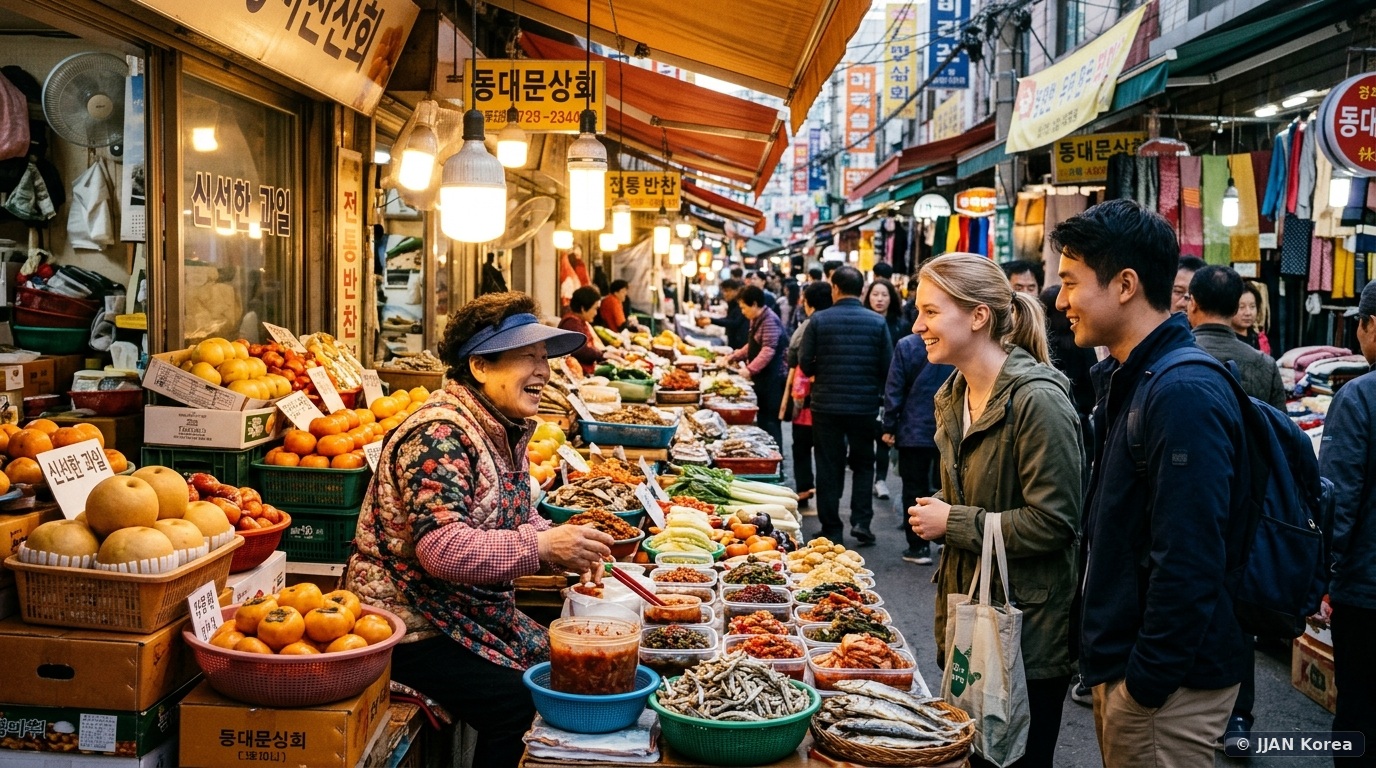
Step beneath the arched steel canopies of South Korea’s historic traditional markets (Jeontong Sijang – 전통시장) and you step into the beating, sensory heart of Korean community life. The sizzling hiss of mung bean pancakes frying in cast-iron skillets, towering mountains of vibrant ruby kimchi, wooden crates spilling over with sun-dried red chili peppers, and lively grandmothers (Imo / Halmeoni) calling out warm greetings create an atmosphere impossible to replicate in sterile hypermarket supermarkets. However, foreign visitors frequently bring Western or Southeast Asian retail assumptions—either attempting aggressive, confrontational price bargaining or feeling shy about communal seating etiquette. Mastering Korean market culture requires understanding the ancient emotional bond known as Jeong (정), the delightful tradition of Deom (덤 / Free Bonus Portions), and navigating modern payment systems including subsidized Onnuri Gift Certificates.
1. Why Aggressive Haggling Fails: The Cultural Philosophy of Jeong
Unlike markets in some developing tourist hubs where marked prices are inflated by 300% to invite grueling haggling battles, prices in modern Korean traditional markets are already operating at slim, highly competitive agrarian margins. Attempting to cut prices in half or arguing aggressively with an elderly produce vendor is considered socially abrasive and disrespectful.
Instead, Koreans interact through the unspoken cultural currency of Jeong (정)—a deep, empathetic bond of mutual warmth and affection. When you engage a vendor politely with a warm smile, exchange courteous pleasantries in Korean, and express authentic delight in their fresh seasonal produce, Korean market vendors will spontaneously grant you Deom (덤). Deom is the beloved Korean tradition of tossing extra bonus items into your shopping bag at no extra charge: an extra handful of crisp garlic scapes, two extra ripe persimmons, or a complimentary ladle of spicy fishcake broth.
| Interaction Style | Verbal Phrasing / Action | Cultural Perception | Likely Vendor Outcome |
|---|---|---|---|
| Aggressive Demanding (Avoid) | “Neomu bissayo! Kkakka juseyo!” (Too expensive! Discount it!) | Rude, entitled, dismissive of vendor’s manual labor | Firm refusal; cold interaction |
| Charming & Polite (Recommended) | “Sajangnim, i-geo neomu singsinghaeyo! Jogeumman deo juseyo~” | Affectionate, warm, showing appreciation for quality | Vendor laughs and adds generous “Deom” bonus items |
| Bulk Purchasing Strategy | Buying multiple kilograms of fruit, dried seafood, or side dishes | Valued commercial patron | Automatic 1,000~3,000 KRW rounding discount or free side dish |
While exploring Seoul’s culinary markets, by navigating street stall vendors and communal benches at Gwangjang Market, you will observe local patrons sharing tight benches with strangers, sliding over to make room for newcomers, and offering paper cups of makgeolli across the counter.
2. The Insider Secret: Saving 10% with Onnuri Gift Certificates (온누리상품권)
While major department stores and luxury boutiques do not accept them, South Korea’s Small and Medium Business Administration issues special vouchers known as Onnuri Gift Certificates (온누리상품권) designed specifically to invigorate traditional neighborhood markets. The best part? The Korean government offers an automatic 10% instant discount when you purchase them!
- Paper Onnuri Vouchers (10% Discount): Any resident holding an Alien Registration Card (ARC) can walk into any commercial bank branch (Shinhan, KB, Hana, Woori, Post Office Bank) and purchase physical Onnuri paper vouchers in denominations of 5,000, 10,000, and 30,000 KRW at a flat 5% to 10% discount off face value.
- Digital Mobile Onnuri (10% Discount via App): Download the official “Onnuri Pay” or mobile banking apps. Link your Korean bank debit account to charge digital Onnuri vouchers directly onto your smartphone. When paying at traditional market stalls, simply scan the vendor’s ZeroPay QR code to pay instantly with discounted funds.
- Cash and Bank Transfer Customs: While credit card terminals are increasingly common at established storefronts, smaller elderly vendors selling raw seasonal herbs or seasonal street food operate without card machines. Carrying physical 1,000, 5,000, and 10,000 KRW paper banknotes—or knowing how to execute instant mobile wire transfers (Gyejwa Iche) via your Korean banking app—is essential. By using cash and digital transfer cards at historic wholesale markets, transactions remain smooth and rapid.
3. Communal Street Food Stall Etiquette: Benches, Broth & Waste
Eating at traditional market street food stalls (Bunsik / Pojangmacha) follows distinct unwritten social conventions that ensure harmony in compact spaces:
- The Sacred Free Fishcake Broth (Eomuk-gukmul): When standing at a food cart ordering spicy rice cakes (Tteokbokki) or blood sausage (Sundae), you are entitled to enjoy unlimited free paper cups of hot fishcake broth. Use the wooden ladle provided to pour broth directly into a clean paper cup; NEVER drink directly from the shared metal soup vat.
- Never Double-Dip Sauce Brushes: If dipping skewered fried snacks or grilled blood sausages into shared communal soy sauce or chili pots, dip your food only once. If you need additional sauce after biting, use the individual basting brush provided to paint sauce onto your snack over your plate.
- Slide Together on Benches: When eating seated at market counters, never place your backpack, purse, or shopping bags onto open seats. Place personal belongings onto your lap or hang them beneath the counter hooks. When new patrons approach, automatically slide your body over to open up bench space.
- Clean Up Your Counter Space: After finishing your meal, stack your empty plates and bowls neatly onto the elevated top shelf of the food stall. Hand used wooden toothpicks and paper napkins directly into the waste bucket located at the corner of the cart.
4. Essential Korean Phrasing Scripts for Foreign Shoppers
Speaking even a few basic Korean phrases earns immense warmth and generous service from traditional vendors. Keep these phrases handy:
| English Meaning | Korean Hangul Script | Phonetic Pronunciation |
|---|---|---|
| “Hello, how much is this?” | 안녕하세요, 이거 얼마예요? | An-nyeong-ha-se-yo, i-geo eol-ma-ye-yo? |
| “Please give me one kilogram of this.” | 이거 일 킬로만 주세요. | I-geo il-kil-lo-man ju-se-yo. |
| “Can I pay with Onnuri vouchers?” | 온누리상품권 받으시나요? | On-nu-ri sang-pum-gwon bad-eu-si-na-yo? |
| “Can I make a bank wire transfer?” | 계좌이체 해도 될까요? | Gye-jwa i-che hae-do doel-kka-yo? |
| “Thank you! It was delicious!” | 감사합니다! 정말 맛있었어요! | Gam-sa-ham-ni-da! Jeong-mal mas-iss-eoss-eo-yo! |
5. Autumn Market Delicacies: Gizzard Shad (Jeoneo) & Blue Crabs (Kkotge)
Visiting traditional Korean seafood and agricultural markets during autumn introduces travelers to seasonal culinary treasures that capture the national imagination. Two delicacies in particular define Korean autumn: Autumn Blue Crabs (Ga-eul Kkotge – 가을 꽃게) and Gizzard Shad (Jeoneo – 전어).
According to historic Korean folklore, the aroma of roasting autumn gizzard shad is so intoxicating that “a runaway daughter-in-law returns home when she smells Jeoneo grilling.” In autumn, these small fish accumulate thick layers of heart-healthy omega-3 fats. Market fishmongers grill them whole over open charcoal braziers with coarse sea salt, allowing patrons to eat them whole from head to tail. Meanwhile, male blue crabs caught off the West Coast during September and October are bursting with sweet, firm meat, ideal for bubbling spicy crab stews (Kkotge-tang) or marinated raw in spicy chili sauce (Yangnyeom Gejang).
Navigating Traditional Market Delivery Services (Jangbogi Baesong): For long-term expatriates doing weekly grocery hauls at traditional markets, many modernized municipal markets (such as Mangwon Market and Gyeongdong Market) now feature dedicated “Market Delivery Centers” (Jangbogi Baesong Service). If you purchase heavy fresh produce, watermelons, or glass jars of fermented pastes totaling over 30,000 KRW, vendors will consolidate your shopping bags into a single crate and deliver it directly to your neighborhood front door via eco-friendly electric scooters within two hours for a nominal fee of 2,000 KRW.
5. Frequently Asked Questions (FAQ)
Q1: Are traditional market restrooms clean?
Yes! Under the government’s Traditional Market Modernization Project, almost all certified municipal traditional markets maintain clean, heated, modern public restrooms equipped with toilet paper, soap dispensers, and baby-changing stations, usually situated near the central market administration customer center (Gogaek Jiwon Center).
Q2: Can I take photos of market vendors and street food?
Photographing the colorful mounds of fresh fruit, bubbling vats of tteokbokki, and overall market architecture is warmly welcomed. However, out of respect for personal privacy, always ask before taking close-up portraits of individual vendors’ faces (e.g., “Sajin han-jang jjig-eo-do doel-kka-yo?” – May I take a photograph?).
Q3: What are the best hours to visit Korean traditional markets?
For fresh agricultural produce, meat, and seafood, visit during the morning hours between 09:00 and 11:30 AM when goods have just arrived. For lively street food, buzzing night stall crowds, and drinking culture, visit between 17:00 and 21:00.
Q4: Can foreign tourists buy Onnuri Gift Certificates?
Foreign tourists without an Alien Registration Card can spend physical Onnuri paper vouchers if gifted or purchased at full face value, but the subsidized 10% government discount requires verifying an ARC or domestic tax residency registration at commercial bank tellers.
🛡️ JJAN Korea Editorial Standards & Fact-Checking Verification
This cultural and financial guide to traditional Korean market etiquette has been compiled and verified by Senior Columnist Dong-hwan Kim in accordance with operating standards issued by the Ministry of SMEs and Startups (MSS) and the Korea Merchant Association (KMA).
- Onnuri Gift Certificate discount rates and purchasing ceilings verified under Special Act on Traditional Market Development.
- Consumer price transparency standards confirmed with the Seoul Metropolitan Traditional Market Modernization Bureau.
- Food safety and stall sanitation regulations audited in compliance with the Ministry of Food and Drug Safety (MFDS).