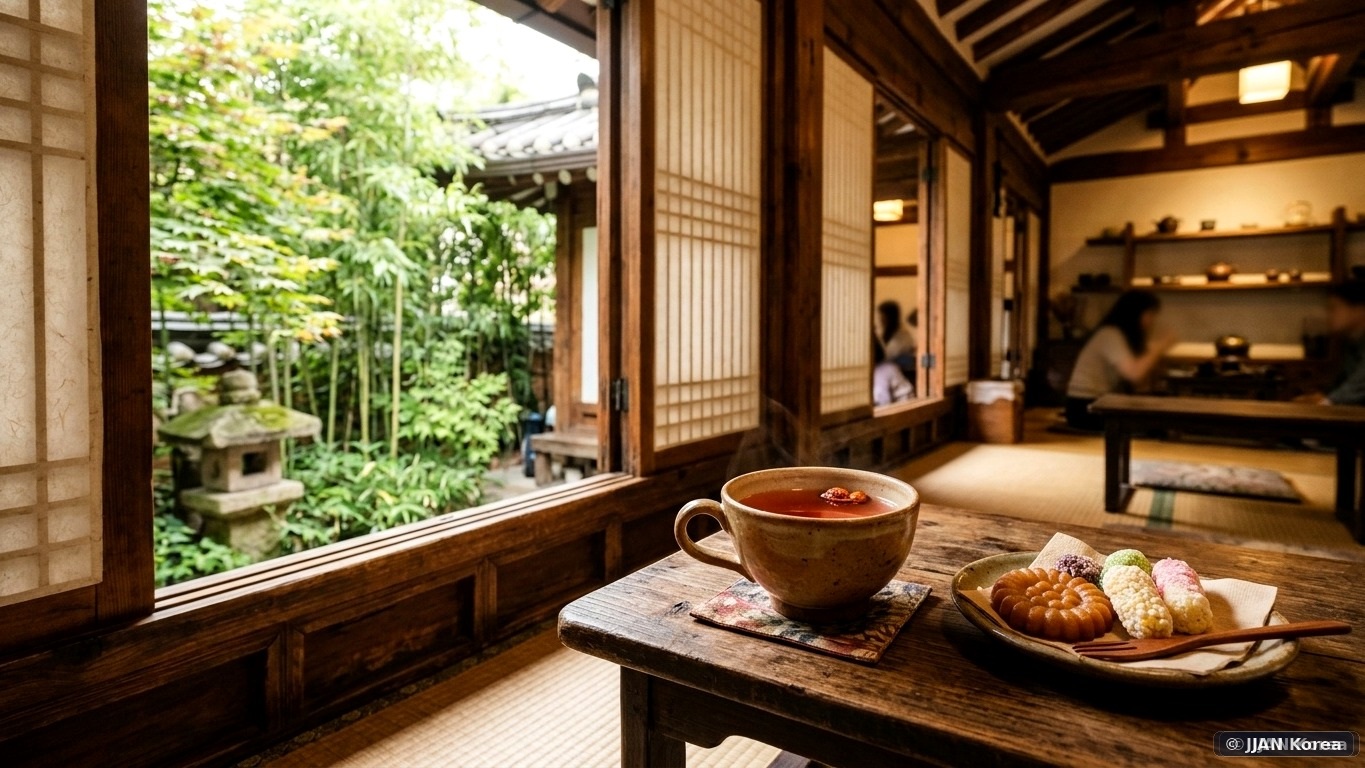
Located approximately 200 kilometers south of Seoul in North Jeolla Province, Jeonju (전주) holds an exalted status in the cultural consciousness of the Korean people. Renowned as the historic seat of the Joseon Dynasty’s royal Yi clan and designated in 2012 as an official UNESCO City of Gastronomy, Jeonju is where Korea’s most celebrated artistic, architectural, and culinary traditions converge. At the very heart of the city lies Jeonju Hanok Village (전주한옥마일), an extraordinary living heritage precinct encompassing more than 800 preserved traditional timber-frame, slate-roofed houses (Hanok). For international travelers seeking an escape from Seoul’s high-rise glass skyscrapers, wandering Jeonju’s stone-walled alleyways, savoring gold-standard bibimbap served in sizzling brass bowls, and sleeping on heated ondol wooden floors provides an enchanting deep-dive into authentic Korean heritage.
1. Fast Transit: Reaching Jeonju via KTX-Sancheon High-Speed Rail
Reaching Jeonju from downtown Seoul is exceptionally fast, comfortable, and straightforward thanks to the national high-speed rail network. By booking high-speed KTX-Sancheon train journeys straight to Jeonju Station from Seoul’s Yongsan Station (용산역), travelers cover the 240-kilometer distance in just 1 hour and 35 minutes. KTX trains depart roughly once every 45 to 60 minutes throughout the day.
| Transit Option | Departure Terminal (Seoul) | Travel Duration | One-Way Adult Fare | Pros & Strategic Advice |
|---|---|---|---|---|
| KTX-Sancheon Express | Yongsan Station / Seoul Station | 1 hour 35 minutes | 34,600 KRW | Fastest, smoothest; book 2 weeks early for weekends |
| ITX-Saemaeul Rail | Yongsan Station | 2 hours 45 minutes | 23,400 KRW | Scenic rural rail views; cheaper fallback when KTX sells out |
| Honam Express Bus | Seoul Central City (Express Bus Terminal) | 2 hours 40 minutes | 20,100 KRW (Honam Express) | Buses depart every 10~15 minutes; drops at Jeonju Express Terminal |
| Jeonju Station to Village Taxi | Jeonju KTX Station Taxi Rank | 12~15 minutes | approx. 7,000~8,500 KRW | Direct drop-off at Hanok Village entrance (Pungnammun Gate) |
Upon arriving at Jeonju Station—celebrated as one of the most beautiful train stations in Asia due to its traditional tiled Hanok pavilion architecture—proceed straight to the taxi stand outside the main exit. A short 15-minute taxi ride deposits you directly at the northern gate of the Hanok Village.
2. Key Heritage Landmarks: Gyeonggijeon, Omokdae & Jeondong Cathedral
While wandering the labyrinth of pedestrian-only stone alleys is the primary joy of Jeonju, several core historical monuments anchor the village’s rich Joseon Dynasty history:
- Gyeonggijeon Shrine (경기전): Erected in 1410, this majestic royal shrine enshrines the sole surviving authentic portrait of King Taejo (Yi Seong-gye), the founding monarch of the Joseon Dynasty. Strolling through Gyeonggijeon’s ancient bamboo groves and historic archives (Jeonju Sago) feels like stepping onto the set of a historical K-drama. Admission is 3,000 KRW.
- Jeondong Catholic Cathedral (전동성당): Located directly opposite Gyeonggijeon, this striking Byzantine-Romanesque red-brick cathedral was completed in 1914 on the site where early Korean Catholic martyrs were executed. Its soaring stone arches and stained-glass windows create an extraordinary architectural contrast against the surrounding wooden Hanok rooftops.
- Omokdae Historic Pavilion (오목대): Perched atop a forested hill on the eastern perimeter of the village, Omokdae is the historic site where King Taejo celebrated his victory over Japanese invaders in 1380. Climbing the wooden pavilion stairs takes just 10 minutes and rewards visitors with the most iconic panoramic rooftop view overlooking the sea of 800 Hanok tiled roofs.
- Hyanggyo Confucian School (전주향교): A serene 14th-century regional academy featuring giant 400-year-old ginkgo trees that carpet the courtyard in brilliant golden leaves every autumn. It is far less crowded than Gyeonggijeon, making it ideal for peaceful contemplation.
3. The UNESCO Culinary Capital: Authentic Bibimbap, Bean Sprout Soup & PNB
Jeonju is universally recognized across South Korea as the gastronomic birthplace of Bibimbap (비빔밥). What elevates authentic Jeonju Bibimbap above ordinary versions found in Seoul is the meticulous preparation: rice cooked in rich beef bone broth (Sagol-guk) to impart individual grain savory depth, topped symmetrically with up to 30 seasonal mountain vegetables, fresh raw beef tartar (Yukhoe), golden mung bean jelly (Hwangpo-muk), and artisan red pepper paste (Gochujang) aged with fermented plum extract.
Renowned historic heritage restaurants such as Hanguk Jip (한국집)—operating continuously since 1952—and Gajok Hoegwan (가족회관) serve their bibimbap in scorching heavy brass bowls (Bangjja Yugi) accompanied by a royal banquet table of over 12 complimentary side dishes (Banchan).
Beyond bibimbap, you must experience these three culinary icons:
- Kongnamul Gukbap (Jeonju Bean Sprout Soup): Served piping hot at legendary 24-hour institutions like Hyundai-ok, this restorative soup features crisp local bean sprouts, diced squid, and a fiery garlic-chili broth, served alongside a soft-poached egg (Sudan) and crushed toasted seaweed sheets. It is Korea’s supreme hangover cure.
- PNB Poongnyeon Bakery Handmade Choco Pies: Founded in 1951, PNB’s original flagship bakery crafts dense, crumbly chocolate-coated pastry cakes filled with strawberry jam, rich buttercream, and roasted walnuts. Tourists routinely carry boxes of 10 back to Seoul on the KTX.
- Jeonju Makgeolli Night Alleys (Samcheon-dong): In Jeonju’s famed Makgeolli neighborhoods, ordering a traditional yellow brass kettle of unfiltered rice wine triggers an endless banquet of savory seafood pancakes, grilled fish, braised pork tofu, and seasonal stews delivered to your table at no additional charge.
4. Hanok Stay Etiquette and Dressing in Traditional Hanbok
To fully absorb the spirit of Jeonju, reserve an overnight stay in a restored Hanok guest lodge. Sleeping on thick cotton silk futons (Yo – 요) placed atop radiant floor-heated wooden planks (Ondol – 온돌) provides deep physical relaxation. Traditional paper lattice sliding doors (Hanji) allow the gentle sound of autumn wind and courtyard bamboo to filter through. Remember to always remove your outdoor footwear at the stone threshold (Maru) before stepping onto the polished wooden floors.
Over 80% of young travelers in Jeonju explore the village wearing traditional clothing. By understanding traditional hanbok rental etiquette, accessories, and hair styling, renting an elegant silk Hanbok from neighborhood rental boutiques (typically 15,000 to 25,000 KRW for 4 hours) grants you free admission to Gyeonggijeon Shrine and provides extraordinary, timeless photo memories against historic stone walls.
4. Traditional Hanji Paper Crafting and Cultural Living Workshops
Beyond its culinary fame, Jeonju was historic Joseon Korea’s premier publishing capital, celebrated for producing Hanji (한지)—traditional Korean paper painstakingly crafted from the inner fibrous bark of indigenous paper mulberry trees (Daknamu). Treasured for its extraordinary durability, Hanji is said to last for over one thousand years, earning the historic Korean idiom: “Silk lasts five hundred years, but Hanji endures for a millennium.”
At the Jeonju Korean Traditional Hanji Center (전주전통한지원) located within the Hanok Village, visitors can participate in hands-on papermaking workshops. Guided by master paper artisans (Inmul), you will dip wide bamboo screens (Bal) into vats of mulberry pulp water, sift the fibers symmetrically using rhythmic flowing motions, press dried autumn maple leaves onto the wet paper mesh, and watch your custom sheet dry over heated copper plates. Taking home a sheet of handmade calligraphy stationery or crafting a delicate mulberry lantern provides an intimate connection to centuries of scholarly Joseon craftsmanship.
In the evening, cross the southern bridge to explore the Nambu Traditional Market (남부시장). On Friday and Saturday evenings, the second floor transforms into the vibrant Cheongnyeon Mall (Youth Market), where young Korean artisans, indie cocktail brewers, and retro vinyl listening bars operate alongside legendary street food stalls serving spicy blood sausage stew (Sundae-gukbap) and crispy pan-fried beef patties (Tteokgalbi).
5. Frequently Asked Questions (FAQ)
Q1: Is Jeonju doable as a single-day trip from Seoul?
Yes, perfectly doable! By catching an 08:00 AM KTX from Yongsan, you arrive in Jeonju by 09:35 AM. You have roughly 9 full hours to explore Gyeonggijeon, hike Omokdae, enjoy a relaxed bibimbap lunch, visit PNB Bakery, and browse craft artisan shops before catching a 19:30 KTX back to Seoul, arriving in time for late drinks.
Q2: Is the Hanok Village walkable for luggage?
The main arterial streets of the Hanok Village are paved with flat granite flagstones and easily navigated with rolling suitcases. However, inner residential alleys feature narrower gravel or stone paths. Most Hanok guesthouses offer free luggage storage before check-in, or you can utilize the coin luggage lockers inside Jeonju KTX Station and the Jeonju Hanok Village Tourist Information Center.
Q3: Can vegetarian or halal travelers find food in Jeonju?
Traditional Jeonju bibimbap often includes beef bone broth in the rice and minced beef tartar (Yukhoe). However, major restaurants (such as Hanguk Jip and Gajok Hoegwan) readily accommodate dietary requests: simply request “Gogi ppae-ju-se-yo” (Please omit the meat) and specify vegetable bibimbap (Chaeshik Bibimbap) prepared without seafood broth.
Q4: What is the best season to visit Jeonju Hanok Village?
Autumn (late September through mid-November) is widely considered the absolute pinnacle season. The summer humidity dissipates, temperatures hover between a pleasant 18°C and 22°C, and the giant ancient ginkgo trees at Jeonju Hyanggyo burst into a magnificent canopy of brilliant gold against the slate-gray Hanok roof tiles.
🛡️ JJAN Korea Editorial Standards & Fact-Checking Verification
This Jeonju Hanok Village travel and heritage guide has been researched and fact-checked by Travel Editor Do-jun Kim in coordination with materials provided by the Jeonju City Tourism Division and the Korea Tourism Organization (KTO).
- High-speed rail schedules and ticketing fares verified via Korail passenger tariffs.
- Historic site admission policies and opening hours confirmed with Gyeonggijeon Management Office.
- Culinary heritage classifications verified through UNESCO Creative Cities Network Gastronomy archives.