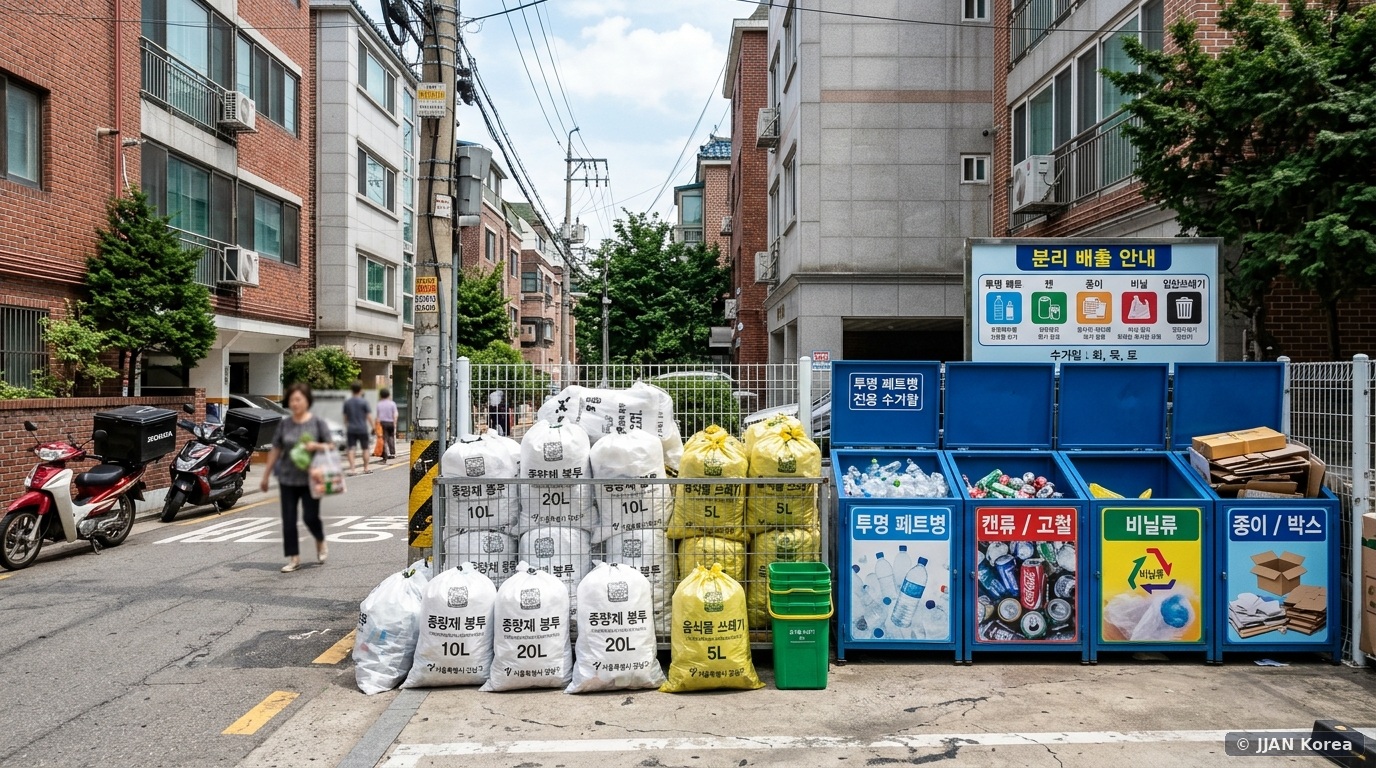

For newly arrived expatriates, international university students, and long-term foreign residents in South Korea, domestic waste disposal is often the very first cultural and administrative shock encountered. Unlike many Western nations where household trash is casually consolidated into a single municipal dumpster, South Korea enforces one of the most sophisticated, technologically audited, and strictly regulated waste management architectures on the planet: the Volume-Rate Garbage Disposal System (종량제 / Jongnyangje).
Administered under the Waste Management Act (폐기물관리법), every neighborhood strictly monitors garbage bags using color-coded plastic sacks, CCTV surveillance cameras, and rigorous door-to-door inspections. Disposing of trash in an unapproved bag, mixing recyclable paper with food scraps, or missing designated weekly collection hours can trigger municipal fines ranging from ₩100,000 to over ₩1,000,000. This comprehensive, practical manual breaks down the four core waste streams, color codes by district, food waste definitions, and large appliance disposal protocols in 2026.
1. The Four Distinct Waste Streams in Korea
To avoid compliance violations, domestic waste must be rigorously separated into four non-overlapping categories before leaving your apartment:
| Waste Stream | Required Bag / Receptacle | What Belongs Inside | Common Foreigner Mistakes |
|---|---|---|---|
| General Waste (일반쓰레기) | District-specific Standard Volume Bag (종량제 봉투) – Usually White | Non-recyclable trash: dirty tissues, pet pads, hygiene products, rubber, ceramics, plastic wraps | Throwing recyclables or wet food scraps into general bags triggers automated fines |
| Food Waste (음식물쓰레기) | Yellow/Orange Volume Bag OR Electronic RFID Bin Chute | Pure organic food residues consumable by farm animals (soft fruit peels, cooked rice, vegetables) | Bones, eggshells, onion skins, and fruit pits are GENERAL waste, NOT food waste! |
| Recyclables (재활용품) | Clear transparent plastic bag or designated apartment sorting bins | Clean plastics (PET), washed beverage cans, cardboard boxes, clear glass bottles | Failing to rinse sauce residues or leaving vinyl labels on PET water bottles |
| Bulky Items (대형폐기물) | Online QR Sticker or Local Community Center Permit | Furniture, mattresses, luggage, office chairs, large electronic appliances | Abandoning furniture on street corners without paying the municipal disposal fee |
2. Purchasing Standard Garbage Bags: Color Codes & District Rules
You cannot use ordinary grocery shopping bags or generic black plastic sacks for household garbage. You must purchase authorized government Jongnyangje bags (종량제 봉투) at local convenience stores (GS25, CU, 7-Eleven) or neighborhood supermarkets (Lotte Mart, Homeplus Express):
- Strict District Jurisdiction (구 단위 판매): Garbage bags are strictly managed by local autonomous municipal districts (Gu / 구). A bag purchased in Mapo-gu cannot be collected if disposed of in Gangnam-gu or Seodaemun-gu. Always purchase bags inside your immediate residential neighborhood.
- Common Sizes & Prices:
- 5 Liters: Approx. ₩130 (Ideal for single studio apartments)
- 10 Liters: Approx. ₩250 (Most popular weekly size)
- 20 Liters: Approx. ₩490 (Standard for couples or weekly consolidations)
- 50 Liters: Approx. ₩1,250 (Larger households or post-move cleanups)
- How to Ask at the Convenience Store Counter: Say clearly: “일반쓰레기 봉투 10리터 10장 주세요 (Il-ban sseu-re-gi bong-tu ship-ri-teo yeol-jang ju-se-yo – Ten 10-liter general waste bags, please).” If you also need food waste bags, request: “음식물 쓰레기 봉투도 주세요 (Eum-shik-mul sseu-re-gi bong-tu-do ju-se-yo).” For apartment settlement rules, consult our comprehensive Korean housing and deposit protection guide.
3. The Golden Food Waste Rule: “Can a Farm Animal Eat This?”
In South Korea, recycled food waste is sanitized, dehydrated, and converted into agricultural fertilizer or livestock feed. Therefore, the Ministry of Environment applies this Definitive Litmus Test: If a farm pig or cow could digest it, it is Food Waste. If not, it is General Waste.
Items That Must Go into GENERAL Waste (NOT Food Waste)
- Animal Bones & Shells: Chicken bones, pork rib bones, beef bones, clam shells, oyster shells, and crab/shrimp carapaces. (These damage processing machinery).
- Eggshells: Chicken and quail eggshells.
- Hard Fruit Pits & Tough Peels: Peach seeds, avocado pits, mango stones, walnut shells, and tough fibrous rinds like whole coconut shells or durian husks. (Banana peels, apple skins, and orange rinds ARE food waste).
- Fibrous Vegetable Skins & Roots: Onion skins, garlic peels, corn husks, hot pepper seeds, and scallion roots.
- Tea Bags & Coffee Grounds: Used tea bags containing synthetic mesh or paper filters, and spent espresso grounds.
4. High-Precision Recycling: The 4-Step Wash & Strip Protocol
South Korea’s recycling compliance standards are rigorous. Simply dumping unwashed takeout boxes into a recycling bin will result in building management leaving a warning sticker on your door. Master this 4-step protocol:
5. Modern Apartment RFID Food Chutes & Bulky Waste Permits
Depending on your housing type, the operational mechanisms vary dramatically:
RFID Food Waste Systems (Large Apartments / Danji)
Modern high-rise apartment complexes use automated cylindrical RFID bins. Tap your building keycard or digital pass against the sensor; the lid opens automatically. Empty your raw food scraps directly into the chamber (do not drop plastic bags inside!). The machine weighs your deposit in kilograms, displays the precise surcharge on an LED screen (typically ₩50 to ₩150 per dump), and automatically bills the balance to your monthly apartment maintenance invoice (관리비).
Disposing of Furniture & Large Electronics
To discard a mattress, desk, suitcase, or microwave:
6. Frequently Asked Questions (FAQ)
What are the legal collection days and hours in Seoul?
In standalone villas and multi-family residential streets, waste collection is permitted only on specific evenings—typically Sunday, Tuesday, and Thursday between 7:00 PM and midnight. Setting garbage out on Saturday morning or broad daylight triggers neighborhood nuisance reports and municipal fines. High-rise apartment complexes typically provide 24/7 access to dedicated basement or ground-floor disposal stations.
How do municipal authorities identify who threw out unapproved garbage bags?
District environmental enforcement teams physically open unapproved or improperly sorted garbage bags. They search for delivery order receipts, addressed envelopes, bank statements, or prescription drug bags displaying names and apartment unit numbers. Violators receive formal certified penalty notices through the postal mail.
Where can I dispose of small household batteries and burnt lightbulbs?
Do not throw batteries or fluorescent tubes into general trash. Every neighborhood Community Service Center, apartment waste station, and major subway station concourse operates specialized collection mailboxes labeled 폐건전지 (Spent Batteries) and 폐형광등 (Fluorescent Tubes) to prevent heavy metal fires.
Can I take garbage bags with me if I move to a new district in Seoul?
If you move from one autonomous district to another (e.g., Yongsan-gu to Gangnam-gu), take your unused bags to the Community Service Center in your new neighborhood. They will issue official authorization stickers (전입자용 인증스티커) allowing you to use up to 20 old bags in your new district.
🛡️ JJAN Korea Editorial Standards & Fact-Checking Verification
This article was independently researched, field-tested, and audited by the JJAN Korea Urban Governance & Daily Life Desk in Seoul. Audited against municipal waste sorting bylaws across Seoul’s 25 autonomous district offices (Gu Offices) and Ministry of Environment statutory guidelines.
Notice an unlisted policy change, fare update, or revised administrative rule? Help us keep our international community accurately informed: Submit a Correction to our Seoul Newsroom.