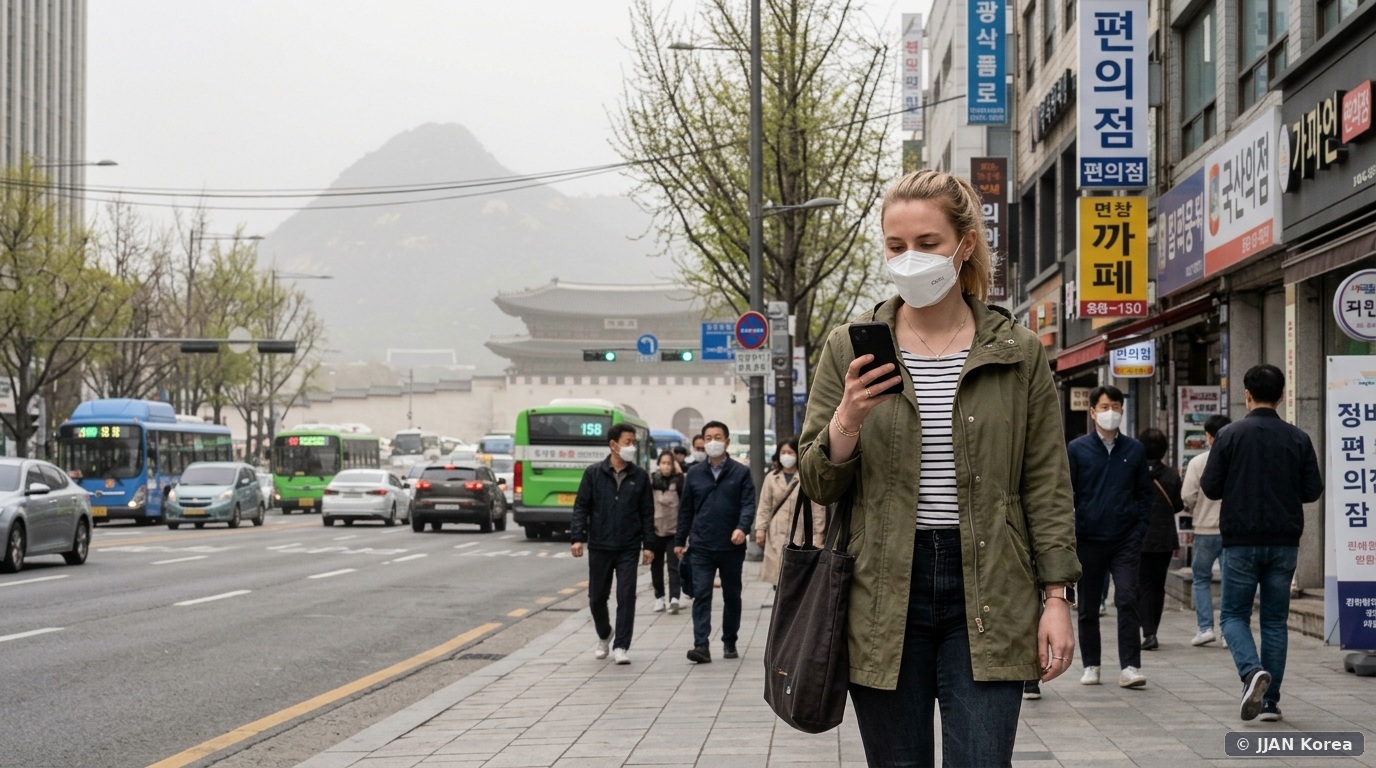
As spring breezes arrive across the Korean Peninsula, bringing blooming cherry blossoms and vibrant outdoor festivals, international residents and travelers frequently encounter an unwelcome seasonal atmospheric guest: Hwangsa (황사 / Asian Yellow Dust) accompanied by elevated spikes of Chomi-se-meonji (초미세먼지 / Ultrafine Particulate Matter PM2.5). Originating from the arid desert steppes of Mongolia and northern China and swept eastward by high-altitude prevailing westerlies, these dust storms can transform blue skies into eerie sepia haze.
Beyond reducing visibility, ultrafine dust particles carry industrial heavy metals and respiratory allergens that can cause itchy eyes, sore throats, and persistent coughing if proper precautions are ignored. Fortunately, South Korea maintains one of the world’s most advanced public environmental monitoring infrastructures. Understanding official Air Korea real-time air quality indices (AQI), deciphering emergency government disaster SMS alerts (긴급재난문자), and selecting certified KF94 protective masks ensures you stay healthy and active throughout the spring in 2026.
1. Decoding the Threat: Yellow Dust (PM10) vs. Ultrafine Dust (PM2.5)
Environmental health authorities distinguish between two distinct particulate threats:
| Pollutant Category | Particle Size & Origin | Health Impact Mechanism | Peak Seasonal Timing |
|---|---|---|---|
| Yellow Dust (황사 / PM10) | Coarse particulate matter under 10 micrometers. Originates from Gobi and Taklamakan desert sands. | Trapped in upper respiratory tract; causes eye stinging, allergic rhinitis, sinusitis, and throat irritation. | March through May (Spring seasonal winds). |
| Ultrafine Dust (초미세먼지 / PM2.5) | Microscopic combustion particles under 2.5 micrometers (1/30th diameter of human hair). Heavy industrial byproduct. | Bypasses nasal filters completely, penetrating deep into lung alveoli and entering the bloodstream. Increases cardiovascular strain. | Winter temperature inversions (Nov–Feb) and stagnant spring air masses. |
2. The KF Mask Grading System: KF80 vs. KF94 vs. KF99
Standard cloth masks, surgical paper masks, or fashion foam masks provide virtually zero filtration against microscopic PM2.5 particles. South Korea’s Ministry of Food and Drug Safety (MFDS) certifies medical respiratory masks under the standardized Korean Filter (KF) benchmark:
| Mask Rating | Filtration Efficiency | Breathability & Comfort | Best Use Case |
|---|---|---|---|
| KF80 Mask | Blocks at least 80% of fine particles averaging 0.6 micrometers | High breathability; very low breathing resistance | Moderate yellow dust days, outdoor jogging, light sports. |
| KF94 Mask (Gold Standard) | Blocks at least 94% of ultrafine particles averaging 0.4 micrometers | Excellent balance of airtight face seal and 3D boat-shaped breathing chamber | #1 Universal Choice. Equivalent to US N95 or European FFP2 standards. Essential for heavy smog days. |
| KF99 Mask | Blocks at least 99% of particles | High inhalation resistance; can feel suffocating during physical exertion | Clinical surgical environments or individuals with severe acute asthma. |
Why KF94 Masks Are Ergonomically Superior:
Unlike Western cup-shaped N95 masks that smash against the lips, Korean KF94 masks feature a patented 3D tri-fold “boat” design. When unfolded, the center panel creates an expansive airspace away from your lips, preventing lipstick smudging and allowing effortless speaking without fabric suction during breathing. Pick up a 5-pack for ₩3,000 at any convenience store or Daiso, as detailed in our Daiso Korea shopping guide.
3. How to Monitor Air Quality: Air Korea & Mobile Apps
Never rely on subjective window glances to assess air quality; heavy industrial smog can sometimes look like romantic morning fog. Track official data through these trusted channels:
- Air Korea (에어코리아 / airkorea.or.kr): Operated by the Korea Environment Corporation, this government portal aggregates live telemetry from over 500 monitoring stations across the nation. Levels are categorized into four intuitive color tiers: Blue (Good / 좋음, 0–15 µg/m³), Green (Moderate / 보통, 16–35 µg/m³), Yellow (Bad / 나쁨, 36–75 µg/m³), and Red (Very Bad / 매우나쁨, 76+ µg/m³).
- MiseMise Mobile App (미세미세): The most popular local smartphone app. Features friendly, expressive character face icons (smiling, frowning, gas mask) that alert you instantly to changing neighborhood air quality without requiring Korean reading skills.
- Emergency Disaster SMS Alerts (긴급재난문자): When PM2.5 levels exceed 75 µg/m³ for over two hours, the Ministry of Interior and Safety broadcasts loud emergency cell broadcast alerts to all smartphones in the affected district. These sirens simply advise elderly residents and children to minimize prolonged outdoor activities and remind citizens to wear protective masks.
4. Health Defense: The Samgyeopsal Myth vs. Proven Remedies
Korean folklore famously claims that eating sizzling grilled pork belly (Samgyeopsal / 삼겹살) cleanses dust from your throat because the rendered pork fat “washes away toxins.” While enjoying Korean barbecue is always a culinary delight, pulmonary physicians confirm that pork fat enters the esophagus, whereas fine dust lodges deep inside the bronchial windpipe!
For proven medical defense against dust irritation, follow these protocols:
- Drink Warm Water Continuously: Keep your oral and laryngeal mucous membranes hydrated. Drinking 2 liters of water daily stimulates cilia motility in your windpipe, rapidly expelling trapped particles.
- Saline Nasal Irrigation (코 세척): If you experience sinus congestion after walking outdoors, purchase a sterile saline nasal spray or rinse bottle (₩5,000–₩8,000) at any community pharmacy covered in our Korean pharmacy OTC guide. Flushing nasal passages provides instant relief.
- Artificial Tear Eye Drops (인공눈물): Dust causes acute conjunctivitis and dry eye syndrome. Pharmacists dispense single-use carboxymethylcellulose lubricating eye drops over the counter without a prescription.
5. Yellow Dust Defense Checklist
- Installed MiseMise or Air Korea app to check daily PM2.5 forecast before leaving hotel.
- Stocked certified KF94 masks from Daiso or 24-hour convenience stores.
- Pinched aluminum nose bridge strip firmly against face to prevent air leakage around eyes.
- Kept residential apartment windows closed and ran indoor air purifiers on “High” mode.
- Rinsed eyes, washed hands, and showered immediately upon returning home from outdoors.
- Carried preservative-free artificial tear drops in daypack for dry eye relief.
6. Frequently Asked Questions (FAQ)
Can I reuse a KF94 mask for multiple days?
Under heavy yellow dust and pollution conditions, KF94 masks are designed for single-day use (approximately 8 to 10 hours of continuous wear). The electrostatic melt-blown filtration layer degrades when exposed to moisture from exhalation, sweat, and trapped facial oils. Discard used masks daily for maximum respiratory protection.
Are indoor spaces in Seoul safe on high-pollution days?
Yes. Modern commercial spaces in Seoul—including mega-malls like COEX and The Hyundai Seoul, subway trains, underground arcades, and cafes—are equipped with hospital-grade commercial HEPA filtration systems that continuously scrub indoor air. On days when AQI reaches “Bad” or “Very Bad,” transition outdoor sightseeing to indoor cultural museums and shopping centers.
Why did my phone scream with a loud siren alert about dust?
South Korea operates an automated Cell Broadcast emergency notification system. When particulate pollution spikes dramatically, regional municipal governments broadcast an alert labeled 미세먼지 비상저감조치 (Emergency Fine Dust Reduction Measure). You do not need to panic; the alert simply notifies citizens that heavy diesel vehicles face driving restrictions and suggests wearing protective masks outdoors.
Does yellow dust affect flights at Incheon Airport?
Only in exceedingly rare, catastrophic dust storms where ground visibility drops below 200 meters do airports implement minor departure spacing delays. Modern instrument landing systems (ILS Category IIIb) at Incheon Airport permit commercial airliners to land smoothly even through dense spring dust haze.
JJAN Korea Editorial Standards & Fact-Checking Verification
This environmental public health report was compiled and cross-verified by Senior Columnist Dong-hwan Kim in coordination with air quality monitoring data from the Korea Environment Corporation (Air Korea), the Ministry of Environment, and the Ministry of Food and Drug Safety (MFDS). Standards reflect 2026 public health guidelines.
🛡️ JJAN Korea Editorial Standards & Fact-Checking Verification
This article was independently researched, field-tested, and audited by the JJAN Korea Environmental Health & Air Quality Desk in Seoul. Air quality indexing algorithms and KF mask filtration benchmarks verified with the Korea Environment Corporation (Air Korea) and Ministry of Food and Drug Safety.
Notice an unlisted policy change, fare update, or revised administrative rule? Help us keep our international community accurately informed: Submit a Correction to our Seoul Newsroom.