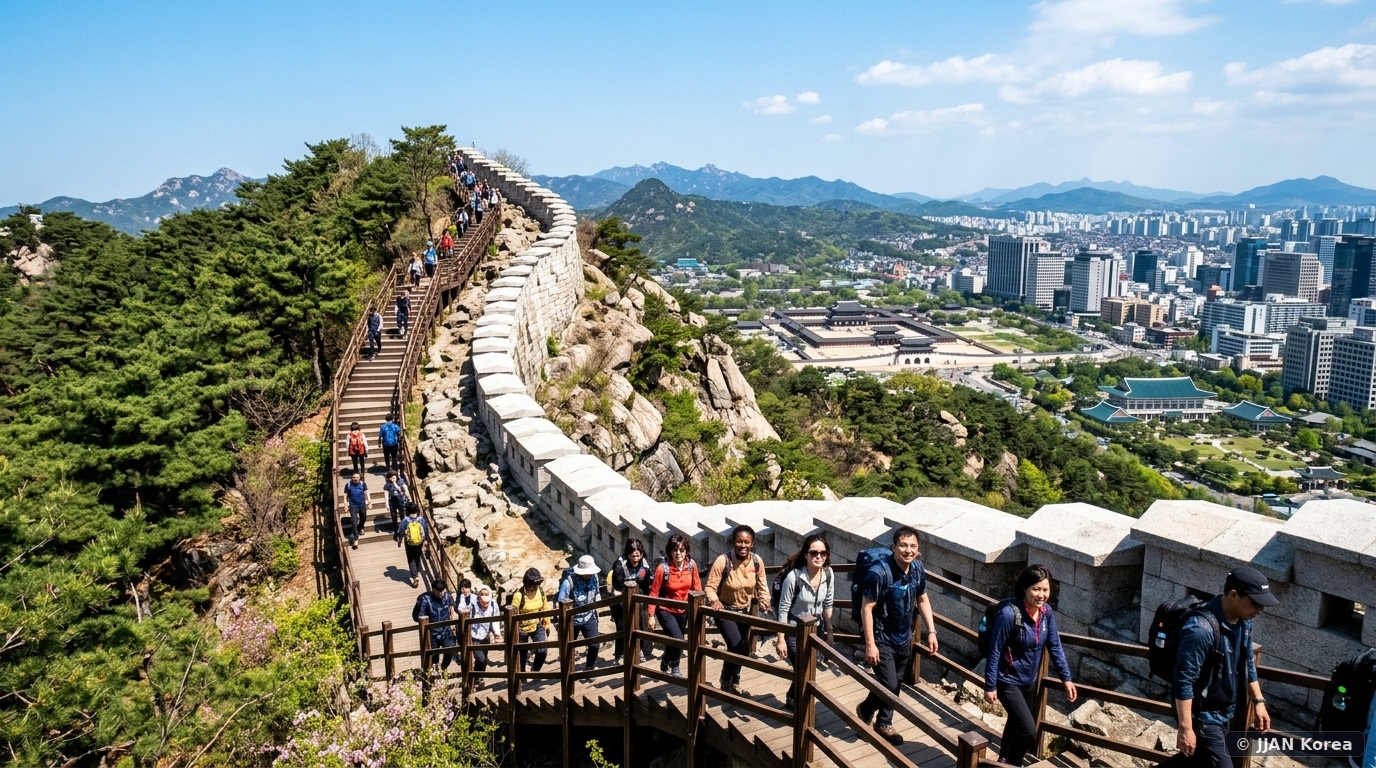

Rising like a dramatic white granite crest directly behind the royal palace of Gyeongbokgung, Inwangsan Mountain (인왕산, 338 meters / 1,109 feet) offers one of the most exhilarating, scenic, and accessible urban alpine adventures in East Asia. Traced along its rocky ridge by the 600-year-old stone ramparts of the Seoul City Wall (Hanyangdoseong / 한양도성), Inwangsan delivers sweeping 360-degree panoramic vistas encompassing the presidential Blue House, the historic palace axis, the futuristic high-rises of Gwanghwamun, and the soaring spire of N Seoul Tower.
Unlike strenuous mountain treks requiring technical crampons or heavy mountaineering equipment, Inwangsan features impeccably maintained wooden staircases, steel safety handrails, and continuous solar LED pathway lighting. This makes it South Korea’s premier destination for illuminated nighttime hiking (야간 등산), where hikers can watch the sunset melt over the city before the metropolis transforms into a glittering sea of neon lights below. This comprehensive trail guide covers trailhead routes, subway access, military photography rules, night-hiking safety, and post-hike dining in 2026.
1. Trailhead Options & Difficulty Comparison
Hikers can ascend Inwangsan via three primary routes, each offering distinct terrain and historical landmarks:
| Trailhead Name | Starting Landmark & Subway Access | Ascent Duration & Distance | Trail Terrain & Recommended Hiker Profile |
|---|---|---|---|
| Gyeongbokgung / Sajik Park Course | Gyeongbokgung Station (Line 3, Exit 1), pass Sajik Park and Hwanghakjeong Pavilion | 1.5 Hours (2.5 km to summit) | #1 Most Popular Classic Trail. Gentle paved incline following the historic Seoul City Wall directly up the southeastern ridge. |
| Muakjae Station Direct Course | Muakjae Station (Line 3, Exit 2), climb residential alleys to wooden skywalk | 1.0 Hour (1.8 km to summit) | Steeper incline with wooden stairs; fastest route to the peak for evening sunset watchers. |
| Changuimun / Buam-dong Traverse | Changuimun Gate (Northwest gate of Seoul City Wall) | 2.0 Hours (Traverse descent) | Spectacular ridge walk descending into the charming hillside art cafes of Buam-dong. |
2. The Magic of Night Hiking (야간 등산) & Twilight Timing
While daytime hiking offers clear vistas of the surrounding Bukhansan mountain range, **Inwangsan at twilight is truly magical**. Following a major municipal restoration project, low-glare LED illumination strips are embedded along the exterior base of the ancient stone fortress wall, casting a warm amber glow that guides hikers along the ridge.
To experience the ultimate golden hour transformation, begin your ascent from Gyeongbokgung Station approximately 45 minutes before official sunset. Reach the summit ridge as the sky shifts through hues of burnt orange, violet, and deep indigo. Within 20 minutes, the sprawling downtown cityscape below illuminates in brilliant LED splendor, showcasing Gyeongbokgung’s glowing courtyards and the illuminated needle of N Seoul Tower, as detailed in our Namsan and N Seoul Tower transit guide.
3. Strict Military Photography Regulations (보안 구역)
Due to its strategic geographic position overlooking the presidential office, Blue House (Cheongwadae), and military command centers, Inwangsan is subject to ongoing national security protocols governed by the Republic of Korea Army:
- Strict Photography Bans Facing North/Northeast: When standing at the summit peak (범바위 / Tiger Rock or the summit marker stone), look for red-bordered signs displaying camera icons with diagonal slashes. Photography facing toward the Blue House, military radar towers, or armed guard sentry posts is strictly prohibited!
- Authorized Photography Angles: You are 100% free to photograph toward the South, East, and West—capturing Gwanghwamun Boulevard, Gyeongbokgung Palace, the Han River, N Seoul Tower, and your fellow hikers. Armed soldiers patrolling the ridge will politely request to inspect your smartphone gallery if they observe lenses aimed toward restricted military installations.
- No Drone Operations: Flying unmanned aerial drones anywhere above Inwangsan or central Seoul is strictly illegal under national aviation security laws, carrying criminal fines up to ₩5,000,000.
4. Recommended Gear & Safety Precautions
While Inwangsan is an accessible city hike, the final 200 meters require scrambling over smooth granite slabs (Beom-bawi / Tiger Rock):
- Footwear Matters: Wear sneakers or trail runners with sticky rubber tread. Avoid smooth-soled lifestyle shoes, leather boots, or sandals, as exposed granite rock faces can become slick when damp from morning dew or light drizzle.
- Headlamp or Charged Smartphone: While the fortress wall itself is gently illuminated, certain wooded sections between Sajik Park and the ridge rely on ambient moonlight. Bring a small headlamp or ensure your smartphone has at least 50% battery to utilize its LED flashlight.
- Hydration & Zero Public Restrooms on Ridge: There are zero vending kiosks or water fountains along the mountain ridge. Purchase a 500ml water bottle at a convenience store near the subway station, and use the public restrooms in Sajik Park before starting your climb!
5. Inwangsan Hiking Checklist
- Started from Gyeongbokgung Station (Line 3, Exit 1) 45 minutes before sunset.
- Wore athletic walking sneakers with good rubber grip for granite sections.
- Packed 500ml water bottle and light windbreaker (summit winds are brisk).
- Fully charged smartphone for night photography and emergency flashlight use.
- Observed military photography bans facing north toward presidential security zones.
- Followed the illuminated Seoul City Wall back down to Seochon for post-hike dining.
6. Frequently Asked Questions (FAQ)
Is Inwangsan Mountain open 24 hours a day?
Yes. Following the historic demilitarization and public opening of mountain patrol paths, Inwangsan is open 24 hours a day, 365 days a year. There are no entrance gates, admission fees, or closing curfews.
Where should I eat after finishing the hike?
Descend back toward the southeastern base into the vibrant foodie enclave of Seochon (서촌). Walk down Jahamun-ro to enjoy bubbling pots of spicy chicken stew (Dak-doritang), crispy potato pancakes (Gamjajeon), and ice-cold craft makgeolli at historic local eateries favored by mountain hikers.
Can beginners and children hike Inwangsan?
Yes, absolutely. The trail consists predominantly of wide wooden boardwalk staircases with steel handrails. Anyone with moderate walking fitness, including energetic children aged 7 and older, can reach the summit in approximately 60 to 75 minutes at a relaxed pace.
What is the cultural history behind the Seoul City Wall?
Constructed in 1396 by King Taejo of the Joseon Dynasty, the 18.6-kilometer fortress wall encircled historic Hanyang (ancient Seoul) along the ridges of four inner mountains: Bugaksan, Naksan, Namsan, and Inwangsan. It protected the capital from foreign invasions and wild Siberian tigers that once roamed the granite peaks!
JJAN Korea Editorial Standards & Fact-Checking Verification
This outdoor mountaineering guide was researched and field-tested across all three summit trails by Travel Editor Do-jun Kim in consultation with the Seoul Metropolitan City Green City Bureau and the Capital Defense Command. Trail regulations and security guidelines reflect 2026 standards.
🛡️ JJAN Korea Editorial Standards & Fact-Checking Verification
This article was independently researched, field-tested, and audited by the JJAN Korea Outdoor Mountaineering & Trail Safety Desk in Seoul. Trail conditions and night illumination safety audited across all three trailheads by our outdoor team in consultation with the Capital Defense Command.
Notice an unlisted policy change, fare update, or revised administrative rule? Help us keep our international community accurately informed: Submit a Correction to our Seoul Newsroom.