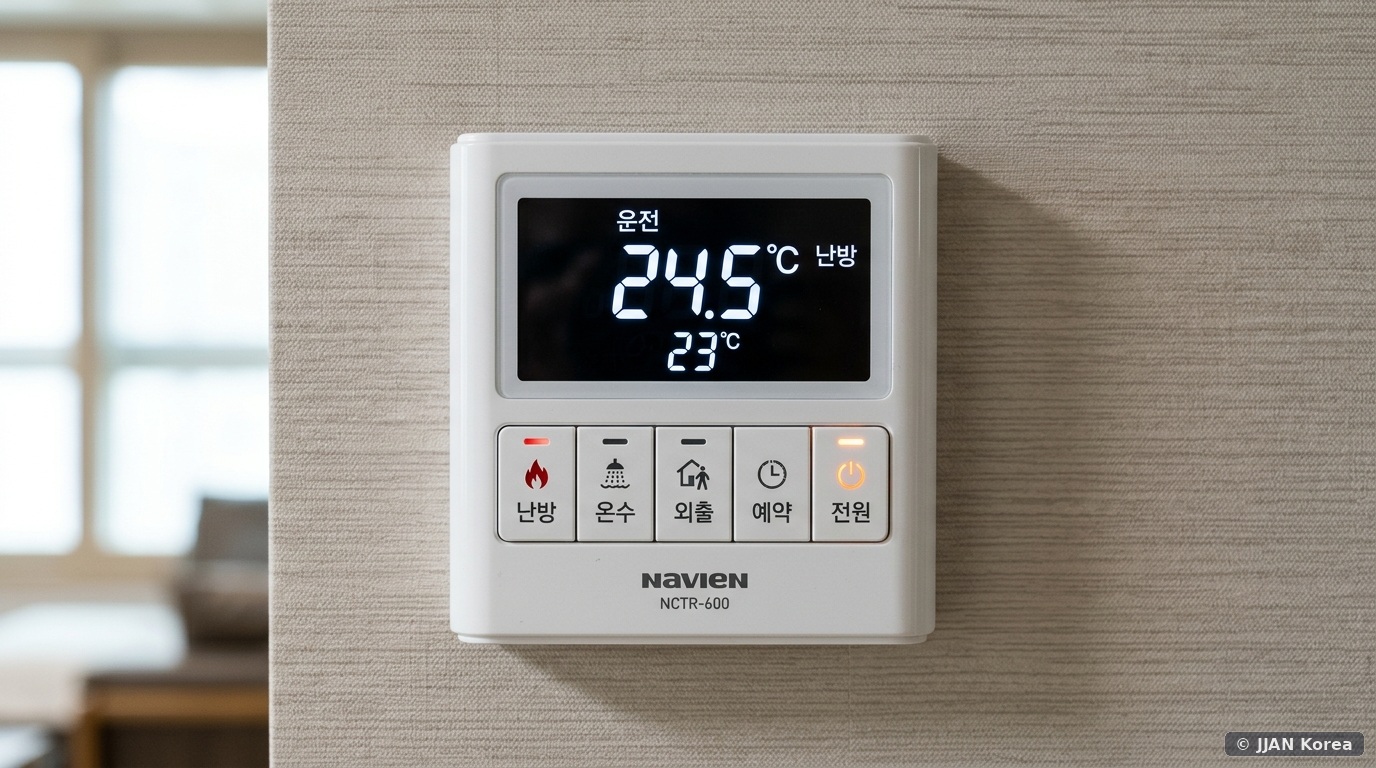

Moving into a Korean studio apartment (one-room), officetel, or high-rise villa during the biting sub-zero depths of winter introduces foreign residents to one of Korea’s most cherished domestic luxuries: Ondol (온돌), the radiant underfloor heating system. Unlike Western convective forced-air furnaces that circulate dry, dusty heat from ceiling vents, Ondol circulates pressurized hot water through embedded subterranean subfloor tubing, warming your living space gently and evenly from the ground up.
However, facing a wall-mounted digital control thermostat completely labeled in cryptic Korean Hangul characters frequently leads to two agonizing extremes: shiver-inducing sleepless nights in freezing rooms, or catastrophic month-end natural gas bills exceeding ₩250,000 to ₩400,000. Mastering the precise terminology, operating modes, and winter energy-saving settings for Korea’s three dominant boiler manufacturers—Navien (경동나비엔), Rinnai (린나이), and Kiturami (귀뚜라미)—is essential for comfortable and cost-effective living in Korea.
1. Universal Korean Boiler Master Glossary & Button Guide
Regardless of whether your rental unit features a modern touchscreen panel or an older analog dial controller, every Korean thermostat utilizes standardized terminology:
| Korean Term | Pronunciation | English Translation | Function & Recommended Setting |
|---|---|---|---|
| 전원 | Jeon-won | Power On / Off | Powers the LCD screen and internal ignition circuits. Never turn off completely in freezing winter weather! |
| 난방 | Nan-bang | Floor Space Heating | Activates hot water circulation through subfloor pipes. Keep set between 20°C and 23°C. |
| 온수 (전용) | On-su (Jeon-yong) | Hot Tap Water (Only) | Heats water exclusively for showers and kitchen sinks without heating the floor. Ideal for summer and warm spring. |
| 외출 | Woe-chul | Away / Anti-Freeze Mode | Maintains a baseline low temperature (8°C–12°C) to prevent water pipe freezing while minimizing gas consumption when leaving home for work. |
| 실온 | Sil-on | Room Air Temperature | Measures ambient air temperature via a built-in thermostat sensor on the wall panel. Range: 10°C–40°C. |
| 온돌 | On-dol | Water Loop Temperature | Measures the exact temperature of water circulating in the subfloor. Range: 40°C–80°C. Best for drafty apartments! |
| 예약 / 반복 | Ye-yak / Ban-bok | Interval Timer | Runs boiler heating for 20 minutes every 2, 3, or 4 hours. Highly effective for energy conservation. |
2. The Critical Setting: Room Air (실온) vs. Water Loop (온돌)
The single most catastrophic mistake foreign tenants make is misunderstanding the fundamental engineering difference between 실온 (Room Air Temperature Mode) and 온돌 (Water Loop Temperature Mode):
Understanding Sil-on (실온 – Room Temperature)
In 실온 mode, the controller measures ambient air temperature around the wall-mounted panel. If you set it to 22°C, the boiler fires continuously until the air in the hallway reaches 22°C. The Trap: If your thermostat is mounted near a drafty front doorway, single-pane window, or entryway where cold air seeps in, the sensor thinks the room is freezing (15°C) and fires the gas burner non-stop 24 hours a day. This single mistake causes ₩300,000 gas bill shocks!
Understanding Ondol (온돌 – Water Temperature)
In 온돌 mode, the system measures the actual circulating water temperature inside the subterranean copper/PEX tubing under your floorboards. Because it measures water rather than air, the target temperature range is much higher: 50°C to 65°C. This mode completely bypasses cold air drafts and ensures consistent, stable radiant heat. If your apartment has drafts or poorly insulated windows, always switch your boiler to 온돌 mode set at 55°C–60°C for optimal warmth and predictable billing.
3. Manufacturer-by-Manufacturer Controls Breakdown
Korea’s major boiler brands utilize distinct interface layouts. Here is how to configure each brand:
1. Navien (경동나비엔 – Navien Smart Controllers)
- Mode Selection (선택 / 난방): Press the circular central button to toggle between 실온 (Room Temp), 온돌 (Water Temp), and 예약 (Interval Timer).
- Hot Tap Water (온수): Dedicated button with low/medium/high (저 / 중 / 고) indicators. For comfortable winter showers, set to 중 (Medium, ~45°C) or 고 (High, ~55°C). Setting it to High during sub-zero cold snaps prevents water from turning lukewarm midway through showers.
- Away Mode (외출): Navien units feature a dedicated 외출 button. Press once when leaving for work; the display will show a house icon or the word 외출.
2. Rinnai (린나이)
- Rotary Dials & Push Buttons: Rinnai controllers often feature a central rotary dial for temperature adjustment alongside physical rocker switches for 난방 (Heating) and 온수 (Hot Water).
- Economy Mode (절약 / 외출): Turn the temperature dial all the way counterclockwise until the LED lands on 외출. In Rinnai systems, this maintains minimal water circulation every few hours to prevent freeze bursts.
- Shower Rapid Boost: Switch the hot water toggle to the double-flame icon for instant high-capacity water flow during winter mornings.
3. Kiturami (귀뚜라미)
- Large Orange Dials: Kiturami units are famous for their prominent analog dials. To run floor heating, ensure the dial is turned to 실내 (Indoor Air) or 온돌 (Floor Water).
- Bath Mode (목욕): Kiturami controllers feature a specialized 목욕 (Bathing) button. Pressing this directs 100% of the boiler’s gas output directly to hot water generation for 2.5 hours, ensuring endless hot shower water. After showering, remember to press it again or it will automatically revert to regular heating.
4. How to Prevent Frozen Water Pipes (동파방지) in Deep Winter
When Siberian polar vortex winds blast Seoul and temperatures plunge below -10°C (14°F), residential boilers and exterior water utility pipes are at extreme risk of Dong-pa (동파 / Pipe Bursting). Under standard rental lease contracts detailed in our Korean housing deposit and lease agreement guide, if tenant negligence leads to frozen or ruptured boiler lines, the tenant is legally liable for repair costs ranging from ₩300,000 to over ₩1,000,000. Follow these three cardinal prevention rules:
- NEVER Turn Off the Master Power Button: Even if traveling abroad for two weeks over winter vacation, leave the boiler Power (전원) ON and set to 외출 (Away Mode). Modern boilers feature automated freeze-protection sensors that pulse hot water for 3 minutes whenever subfloor piping drops near 5°C.
- Let the Bathroom Faucet Drip: During nights when temperatures drop below -10°C, turn your bathroom sink faucet slightly toward the Hot (온수) side and leave it dripping at a pencil-lead thickness. Moving water through the supply pipes prevents freezing solid.
- Insulate Exterior Veranda Boiler Cabinets: If your boiler unit is installed in an unheated utility balcony or outdoor closet, wrap exposed pipes in foam thermal insulation tubes and old blankets. Never obstruct the exhaust flue pipe (연통)!
5. Monthly Natural Gas Billing and Payment Methods
Unlike electricity and water which are often bundled into apartment building management fees (관리비), natural city gas (도시가스 / Dosi Gas) is billed independently by regional utility concessionaires (such as Seoul City Gas, Yesco, or Samchully):
- Physical Bill Arrival: Arrives monthly in your mailbox as an envelope with a bright red or blue tear-off slip.
- Virtual Bank Transfer (가상계좌): Every bill prints unique dedicated virtual account numbers for major banks (KB, Shinhan, Woori). Simply open your banking app and transfer the exact bill amount to your assigned virtual account.
- Convenience Store Cash Payment: Take the physical paper bill to any GS25, CU, or 7-Eleven; the cashier scans the printed barcode and accepts cash or local debit cards. Combine this with regular household tasks outlined in our Korean waste sorting and residential guide.
- Auto-Debit (자동이체): Call the English customer service line printed on the bill to link automated monthly bank withdrawals or foreign registration details registered via your Alien Registration Card (ARC).
6. Winter Ondol Energy Saving Checklist
- Switched boiler control mode from draft-sensitive 실온 (Air) to 온돌 (Floor Water at 55°C–60°C).
- Set baseline indoor living temperature to 20°C–22°C (wear warm fleece slippers and sweaters indoors).
- Left boiler set to 외출 (Away Mode) instead of turning off the main power when going to the office.
- Applied insulating bubble wrap (뽁뽁이 / Bbok-bbok-i) to exterior window glass panes.
- Kept bathroom hot water tap dripping at pencil-lead thickness during -10°C sub-zero cold waves.
- Verified balcony boiler exhaust pipe (연통) is tightly connected and free of obstructions.
7. Frequently Asked Questions (FAQ)
Why is my floor still cold two hours after turning on the boiler?
Ondol heating works via subterranean thermal mass. Unlike air conditioners or convective blowers that change room temperatures within minutes, radiant floor heating requires 2 to 3 hours to heat the thick cement subfloor screed before noticeable warmth radiates upward into the room. Be patient, and avoid cranking the thermostat to 35°C, which will not accelerate heating but will waste enormous amounts of gas once thermal equilibrium is reached.
What is the ideal temperature setting for saving money on gas bills?
The Korean Energy Agency recommends maintaining an indoor living room temperature of 20°C (68°F). Every 1°C reduction in target room temperature reduces total monthly gas consumption by approximately 7%. If using 온돌 (Water Loop) mode, setting circulating water to 50°C to 55°C provides ideal, cozy warmth without excessive boiler firing cycles.
What should I do if my hot water suddenly stops working during a freeze?
If cold water flows from the faucet but no water emerges when turned to Hot, your boiler’s water inlet pipe (직수관) is frozen. Locate the exposed copper pipes running beneath the boiler unit in your veranda. Wrap the pipes with thick towels and gently blow warm air over them using a hair dryer on medium heat, or pour warm (NOT boiling) water over the towels. Never use open flames or boiling water, which can rupture frozen pipes!
Can I turn off the radiator valves in unused rooms?
Yes. Inside your kitchen sink cabinet or utility closet, you will find a brass distribution manifold (분배기 / Bun-bae-gi) with individual valve levers corresponding to each room. Partially closing the levers for storage rooms or unoccupied guest bedrooms directs heated water exclusively to your primary bedroom and living space, saving substantial gas.
JJAN Korea Editorial Standards & Fact-Checking Verification
This technical residential utilities guide was researched and field-verified by Tech Editor Min-jun Kim in consultation with mechanical engineers from the Korea Energy Agency and heating technicians from Navien and Rinnai Korea. Operational standards and municipal freeze prevention statutes reflect official 2026 guidelines.
🛡️ JJAN Korea Editorial Standards & Fact-Checking Verification
This article was independently researched, field-tested, and audited by the JJAN Korea Urban Governance & Residential Utilities Desk in Seoul. Audited with technical guidelines from the Korea Energy Agency and heating system engineers from Navien and Rinnai Korea.
Notice an unlisted policy change, fare update, or revised administrative rule? Help us keep our international community accurately informed: Submit a Correction to our Seoul Newsroom.