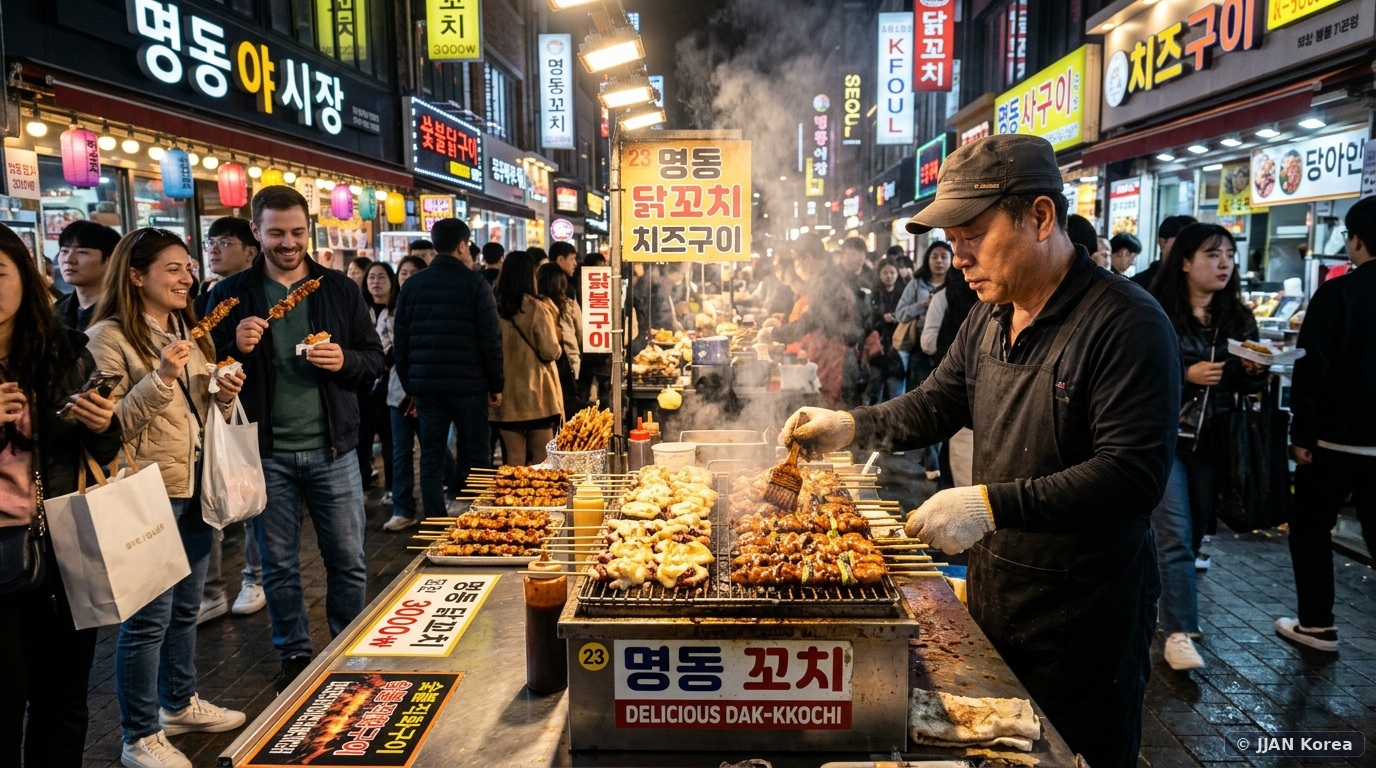
When evening descends upon the bustling commercial heart of central Seoul, the pedestrian boulevards of Myeongdong (명동) undergo a theatrical transformation. At precisely 16:30, a coordinated convoy of over 130 standardized mobile food carts rolls into position along Myeongdong-gil and Jungang-ro. Butane blowtorches roar to life, searing garlic butter over split lobster tails; griddles sizzle with foot-long tornado potatoes; and the warm, heavenly aroma of freshly baked vanilla egg cakes fills the air. The Myeongdong Street Food Night Market (명동 길거리 음식 야시장) is undeniably South Korea’s most famous, visually spectacular, and internationally celebrated street food gauntlet. However, amidst the dazzling neon signs and TikTok viral spectacles, foreign tourists frequently struggle with navigating premium tourist price markups, differentiating gourmet artisan creations from commercial novelties, and knowing their consumer rights.
1. The Culinary Canon: The Top 5 Iconic Treats Reviewed & Ranked
Myeongdong’s street carts are strictly regulated under a municipal lottery system managed by the Jung-gu District Office. Offerings range from traditional heritage street bites to hyper-luxurious modern fusion novelties:
| Signature Street Food | Standard Price Range | Cooking Technique & Ingredients | Honest Flavor & Value Verdict |
|---|---|---|---|
| Torch-Grilled Cheese Lobster (랍스터 구이) | 15,000 ~ 20,000 KRW | Steamed half lobster tail topped with sweet chili sauce, shredded mozzarella, seared with gas blowtorch | High visual drama; premium price; rich, decadent, but tourist-premium heavy |
| Traditional Egg Bread (Gyeran-ppang / 계란빵) | 2,000 ~ 3,000 KRW | Sweet vanilla cornbread batter baked in cast-iron with a whole fresh egg inside | 10/10 Gold Standard: Exceptional budget value; perfect sweet-and-savory harmony |
| Tornado Potato (Hoe-ori Gamja / 회오리감자) | 4,000 ~ 5,000 KRW | Spiral-cut whole potato fried on a wooden skewer, dusted in cheese or onion powder | Fun crunch; beloved by teenagers; nostalgic Korean street food original |
| Grilled Pork Belly Kimchi Rolls (Samgyeopsal Kimchi-mari) | 8,000 ~ 10,000 KRW | Thin pork belly wrapped tightly around aged kimchi and cheese, grilled on flat-top | Outstanding savory flavor; spicy kimchi cuts through the pork fat richness |
| Handmade Strawberry Mochi (Ddalgi Chapssaltteok) | 3,500 ~ 4,500 KRW | Fresh juicy sweet Korean strawberry wrapped in sweet red bean paste and chewy white rice cake | Refreshingly sweet; delicate melt-in-the-mouth fruit perfection |
While exploring the bustling retail shops between food tastings, by visiting the 12-story mega Daiso flagship store right beside Myeongdong Station, shoppers can browse thousands of travel accessories and Korean souvenirs spread across an entire 12-story high-rise tower.
2. Consumer Rights in Myeongdong: The Mandatory Price Tag Rule
Historically, Myeongdong street stalls suffered from negative international publicity due to aggressive overcharging and dynamic pricing where foreign tourists were quoted double the price of local residents. In response, the Seoul Metropolitan Government and Jung-gu District Office enacted strict consumer protection bylaws.
Under current regulations, every registered street food cart is legally mandated to display physical, prominent price tags (Gagyeok Pyosi-je) in Korean, English, and Chinese. Vendors are prohibited from quoting verbal prices differing from their posted signboards. If you encounter a stall without visible price tags or suspect arbitrary overcharging, remember that by reporting street food overcharging and price-tag gouging to Myeongdong Tourist Police, uniformed English-speaking Tourist Police officers stationed at the Myeongdong Center will intervene immediately.
3. Payment Methods: Cash, Foreign Credit Cards & Toss QR
A major improvement in modern Myeongdong is financial accessibility. In the past, vendors demanded cash only. Today, under municipal licensing mandates, over 80% of Myeongdong food carts accept international credit cards (Visa, MasterCard, Amex) via compact mobile terminal readers.
However, during peak weekend rushes, mobile terminals can experience occasional cellular lag. Carrying approximately 20,000 to 30,000 KRW in physical cash banknotes ensures you can pay instantly without waiting for terminal connections. Alternatively, foreign payment apps (such as WeChat Pay and Alipay) and Korean digital wallets (Toss, Kakao Pay, Naver Pay) are universally accepted via counter QR codes.
4. Market Hygiene and Waste Disposal Etiquette
With thousands of people eating skewered meats and seafood on the move, street litter could easily overwhelm the neighborhood. Myeongdong enforces a collaborative waste management protocol:
- The Return-to-Vendor Rule: When you finish your skewer, paper cup, or foil tray, the most polite and standard practice is to return your trash directly to the specific cart where you purchased the item (or to the nearest food cart). Every cart maintains waste bins and wooden skewer collection receptacles.
- Designated Trash Sorting Stations: Municipal recycling stations marked for General Trash (Ilban Sseuregi) and Recyclable Cans/Plastics are stationed at the intersections of Myeongdong Theater and the central UNESCO building.
- Food Safety Standards: Cart operators are subject to regular spot bacteriological inspections by the Jung-gu Health Center; ingredients must be kept in sealed sanitary containers, and cooking surfaces are sanitized daily.
5. Municipal Registered Cart Identification Numbers & Sidewalk Trash Disposal Logistics
Following comprehensive consumer protection reforms enacted by the Jung-gu District Office in downtown Seoul, every street food vendor operating in Myeongdong is strictly regulated under the Myeongdong Real-Name Street Food Cart Certification System (Nojeom Sil-myeong-je – 노점실명제). Look closely at the upper right corner of any authorized food cart along the main pedestrian thoroughfare: you will spot a standardized stainless-steel or laminated municipal license plate displaying the cart’s registered alphanumeric ID and the certified operator’s legal photograph.
This regulatory oversight guarantees rigorous adherence to municipal health and hygiene codes. Inspectors conduct unannounced monthly microbiological swab testing of food-contact surfaces, ensure refrigeration compliance for raw seafood (such as lobster tails and scallops), and verify that all cooking oils are tested daily for total polar compound (TPC) degradation. Furthermore, cart operators are legally prohibited from price gouging; every food item must display an unambiguous price tag in both Korean Won (KRW) and English.
One of the most persistent challenges tourists face while enjoying street delicacies like grilled cheese lobster or twisted spiral potato sticks is finding a place to dispose of sticky bamboo skewers and oily paper trays. Under Seoul Metropolitan Government sidewalk cleanliness ordinances, traditional public waste bins were removed from downtown street corners to deter illegal domestic trash dumping.
To resolve this, every licensed Myeongdong food cart is legally mandated to maintain dedicated waste disposal receptacles attached directly to its side counter. By street custom, you should always return empty skewers and wrappers to the specific cart where you purchased the item. Alternatively, look for clearly marked mobile “Clean Jung-gu Street Sorting Stations” staffed by fluorescent-vested sanitation personnel stationed at the intersections of Myeongdong-gil and Jungang-ro, where you can sort food residue, bamboo sticks, and recyclable drink cups into separate designated recycling bins.
Should any billing dispute or food hygiene concern arise, foreign visitors can visit the multilingual Seoul Tourist Police Center located right at the entrance of Myeongdong walking street (near Euljiro 1-ga Station Exit 6) or dial the Korea Travel Hotline at 1330. Tourist police officers fluent in English, Japanese, and Mandarin inspect cart certification plates on the spot, ensuring immediate mediation and resolution.
Moreover, while physical cash remains popular, an increasing number of modern Myeongdong carts now accept overseas Visa, Mastercard, and Apple Pay contactless NFC payments via compact mobile POS terminals, allowing international travelers to sample mouth-watering Korean street specialties without carrying bulky envelopes of physical Korean Won banknotes.
5. Frequently Asked Questions (FAQ)
Q1: What are the exact operating hours of the Myeongdong Night Market?
Food carts begin rolling onto the streets around 16:00 to 16:30, reaching full bustling operation by 17:30. Stalls continue operating until approximately 22:30 or 23:00 daily, seven days a week, year-round.
Q2: Is Myeongdong street food Halal or vegetarian-friendly?
Numerous stalls cater specifically to Muslim and vegetarian travelers: look for stalls displaying certified “Halal” or “Muslim-Friendly” signs (common for grilled lobster, baked cheese skewers, sweet potatoes, tornado potatoes, and fresh fruit juices). However, traditional dumplings and savory pancakes often contain minced pork; always ask: “Dwaeji-gogi deureo-gannayo?” (Does this contain pork?).
Q3: How much budget should I prepare for a full street food dinner?
If you want to sample 3 to 4 substantial dishes (for example: egg bread, pork belly kimchi roll, grilled skewers, and a fresh pomegranate juice), budget approximately 15,000 to 25,000 KRW per person. If you order premium items like grilled lobster tails, expect to spend closer to 35,000 KRW.
Q4: Where are the nearest clean restrooms in Myeongdong?
Public restrooms inside Myeongdong Subway Station (Line 4) and Euljiro 1-ga Station (Line 2) are clean and free. Alternatively, the upper dining floors of major department stores (Lotte Department Store Main Branch and Shinsegae Main Branch) offer pristine luxury restrooms open until 20:30.
🛡️ JJAN Korea Editorial Standards & Fact-Checking Verification
This Myeongdong night market food and consumer guide has been authored and verified by Culture Editor Min-ah Kim in coordination with commercial oversight standards issued by the Jung-gu District Office of Seoul.
- Mandatory price tag display enforcement verified under Jung-gu Street Vendor Management Bylaws.
- Food safety and mobile food sanitation inspection records audited via the Ministry of Food and Drug Safety.
- Credit card terminal compliance and consumer complaint workflows confirmed with the Seoul Tourist Police.