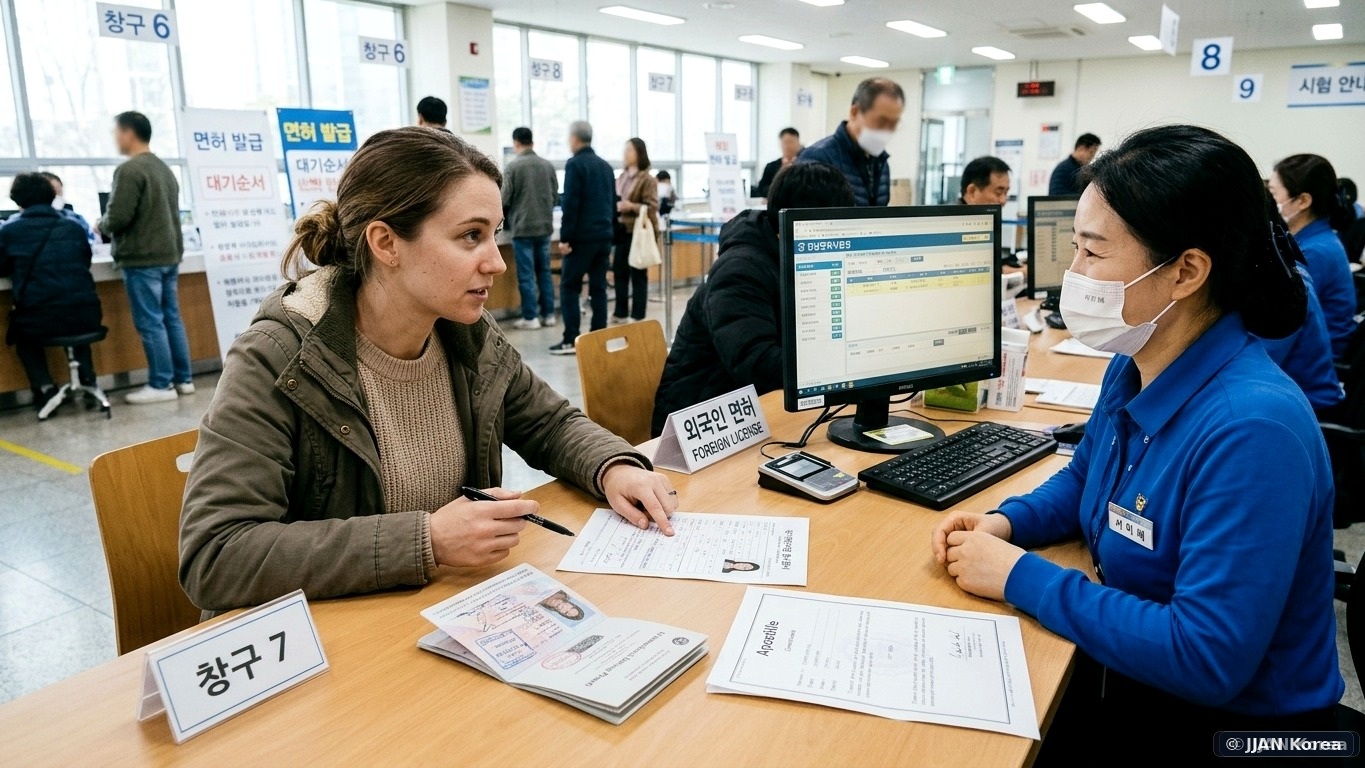
While South Korea possesses one of the world’s most advanced, punctual, and inexpensive public railway and subway networks, certain scenic regional destinations—most notably the volcanic coastlines of Jeju Island, the secluded pine valleys of Gangwon-do, and the tea plantations of Boseong—are best explored from behind the steering wheel. Renting a vehicle in Korea grants international travelers unparalleled flexibility to explore off-the-beaten-path culinary gems and mountain lookouts. However, navigating Korean rental contracts, complex international driver permit conventions, automated electronic toll systems (Hi-Pass), and strict traffic enforcement cameras requires meticulous preparation. Failing to carry the exact treaty-compliant permit booklet will result in rental counter rejection without refund.
1. Legal Prerequisite: The 1949 Geneva Convention IDP
Under South Korean Road Traffic Act statutes (도로교통법), foreign visitors cannot rent or operate a motor vehicle using solely their home domestic driver’s license. You must present an authentic, physical International Driving Permit (IDP):
| Document Requirement | Legal Specification | Critical Pitfalls & Rejection Causes |
|---|---|---|
| 1949 Geneva Convention IDP Booklet | Official grey physical cardboard booklet stamped under the 1949 Convention on Road Traffic | Permits issued strictly under the 1968 Vienna Convention are rejected unless bilateral reciprocity treaties apply |
| Original Home Country Driver’s License | Valid, unexpired plastic license issued by your home state, province, or nation | Must match the exact personal details and vehicle class endorsement on the IDP booklet |
| Valid Passport | Physical passport with valid tourist entry stamp or electronic K-ETA record | Photocopies or digital smartphone screenshots are strictly rejected at rental counters |
| Driver Age & Experience Threshold | Minimum age of 21 years old and at least 1 full year of driving experience since license issue | Certain premium or 9-passenger van models mandate minimum age of 26 and 3 years experience |
If you have transitioned from tourist status to a registered long-term residency visa, operating on an IDP is restricted to your first 12 months; you must formally swap your credentials by exchanging your home country driver’s license for a permanent Korean license at a National Driver’s License Examination Office.
Before committing to a rental car deposit, evaluate your destination geography; as analyzed in our transit breakdown on deciding whether to rent a vehicle or use public transport on Jeju Island, metropolitan cities like Seoul and Busan suffer from severe gridlock and prohibitively expensive parking garages where rail transit is vastly superior.
2. Choosing a Rental Agency: Lotte vs. SK vs. Local Fleets
For international visitors, selecting the right rental car provider determines language support and dispute resolution ease. The two dominant nationwide conglomerates are:
- Lotte Rent-a-Car (롯데렌터카): The largest car rental operator in South Korea with dedicated service desks at Incheon International Airport (Terminals 1 & 2), Gimpo Airport, and Jeju International Airport. Lotte provides a comprehensive English online reservation portal, bilingual rental agreements, and 24/7 English emergency roadside assistance dispatch.
- SK Rent-a-Car (SK렌터카): The primary competitor to Lotte, offering modern fleets featuring electric vehicles (Hyundai Ioniq 5/6, Kia EV6) and streamlined airport shuttle bus connections to their automated rental lots.
- Budget & Third-Party Platforms (Klook / Rentalcars.com): While aggregator platforms often display lower daily rates from smaller regional rental lots, customer service counters may lack English-speaking staff and enforce stricter damage scrutiny upon vehicle return.
3. Insurance Policies: Collision Damage Waiver (CDW) Explained
Under Korean law, all commercial rental vehicles carry mandatory third-party liability insurance covering personal bodily injury and property damage to third parties. However, physical damage to the rental vehicle itself depends entirely upon the level of Collision Damage Waiver (CDW / 자차손해보험) you elect:
- General CDW (일반자차): In the event of an accident, you remain responsible for paying a fixed deductible (면책금), typically ranging between 100,000 and 500,000 KRW, plus loss-of-use compensation (휴차보상료) equal to 50% of the daily rental rate while the vehicle undergoes body repairs.
- Complete / Super CDW (완전자차): Covers 100% of vehicle repair costs with Zero Deductible (면책금 0원) and waives loss-of-use compensation fees entirely. For international visitors unfamiliar with Korean road signs, tight multi-story parking structures, and narrow alleyways, paying an additional 15,000 to 25,000 KRW per day for Complete CDW is an indispensable financial safeguard.
4. Driving Realities: Navigation Apps, Speed Cameras & Hi-Pass
Operating a vehicle on Korean expressways and city streets requires adapting to unique digital and infrastructure systems:
- Google Maps Inefficacy: Due to national security map export restrictions, Google Maps does not offer turn-by-turn driving navigation in South Korea. You must use Naver Map (which features an English voice navigation mode) or KakaoMap, or utilize the English-language dashboard GPS units integrated into rental fleets.
- Automated Speed Enforcement: Korean roads feature the world’s densest concentration of automated speed cameras, sectional speed enforcement zones (구간단속), and bus-only lane enforcement cameras. Your vehicle’s GPS unit will continuously chime and announce speed limits in meters remaining.
- Hi-Pass Electronic Tolls (하이패스): When entering expressway toll plazas, lanes marked in bright blue pavement with overhead “Hi-Pass” gantries are dedicated strictly to vehicles equipped with electronic RFID toll cards. Rental cars from Lotte and SK come pre-equipped with Hi-Pass transponders. You simply drive through the blue lane at 30–50 km/h; accumulated toll fees are settled via your credit card upon returning the vehicle.
- Right Turn on Red Restrictions: Under recent traffic safety law amendments, drivers making a right turn at a red light must come to a complete, momentary stop (일시정지) before the pedestrian crosswalk line if the pedestrian light is green or if any pedestrian is crossing, even if clear. Failure to halt results in a 60,000 KRW fine.
4. Urban Parking Hacks, Speed Camera Penalties & EV Charging Logistics
Driving smoothly throughout South Korea requires mastering municipal parking systems and avoiding automated statutory traffic fines:
| Traffic / Parking Violation | Enforcement Mechanism | Standard Penalty / Fine (KRW) | Practical Prevention Rule |
|---|---|---|---|
| Exceeding Speed Limit by 20 km/h or less | Automated fixed radar & overhead sectional cameras | 40,000 KRW (Settled via rental credit card) | Listen to Naver Map audio chimes; slow down 300m before overhead gantries |
| Illegal Parking in Yellow Double-Line Zones | Mobile municipal camera enforcement vans & citizen reporting apps | 40,000 – 80,000 KRW | Always park in designated public parking lots (공영주차장); avoid street curbs |
| Entering Bus-Only Lane during Peak Hours | Blue-painted central expressway lanes (Gyeongbu Expressway) | 60,000 – 90,000 KRW | Restricted strictly to 9+ passenger vans carrying 6 or more occupants |
| School Zone Violations (어린이 보호구역) | Yellow-painted pavement zones; strict 30 km/h ceiling 24/7 | Double Fine (80,000 to 160,000 KRW) | Maintain strict 25–28 km/h speed; penalties enforced without leniency |
If you rent an electric vehicle (EV) such as a Hyundai Ioniq or Kia EV6, fast DC chargers (급속 충전기) are positioned at virtually all highway expressway rest stops (Hyegeso – 휴게소) and tourist attractions. SK and Lotte provide an integrated EV charging card stored in the sun visor that activates charging kiosks without requiring a domestic credit card.
5. Step-by-Step Walkthrough: Operating Self-Service Gas Stations (셀프 주유소)
Nearly 85% of modern automobile fueling stations in South Korea operate on an automated self-service basis (셀프). While touchscreens prominently display Korean Hangul prompts, navigating them is straightforward once you understand the standard five-step flow:
- Step 1: Language & Fuel Selection: Touch the screen to awaken the system. Look for the English language button (marked ‘English’ or an American/British flag) in the upper right corner. Select your vehicle’s designated fuel type: Gasoline (휘발유 / Hwiball-yu, Yellow icon) or Diesel (경유 / Gyeong-yu, Blue/Black icon). Never select Premium Gasoline (고급휘발유) unless specifically required by your rental contract, as it carries a 20% price premium.
- Step 2: Enter Payment Amount: Choose whether to fill by fixed monetary value (e.g., 30,000 KRW or 50,000 KRW), fixed volume (e.g., 20 Liters), or full tank (가득 / Full). Selecting ‘Full’ will temporarily authorize a pre-authorization hold of 150,000 KRW on your international credit card.
- Step 3: Discharge Static Electricity: Before opening your vehicle’s fuel cap, press your bare hand firmly against the circular orange static electricity touch pad (정전기 패드) located beside the screen to prevent accidental spark ignition.
- Step 4: Dispense Fuel: Insert the matching color-coded fuel nozzle into your tank neck and squeeze the trigger. The pump automatically clicks off once your target volume is reached or the tank becomes full.
- Step 5: Collect Final Receipt: Return the nozzle to the holster and wait for your credit card to be ejected alongside your printed itemized receipt. If you selected ‘Full’, the initial 150,000 KRW pre-authorization is instantly canceled and the exact dispensed amount is billed.
5. Frequently Asked Questions (FAQ)
Q1: Can I drive in Korea using a digital or smartphone app IDP?
A: Absolutely not. South Korean traffic authorities and rental agencies mandate the physical, original cardboard booklet issued by an authorized domestic automobile association (such as AAA in the US or AA in the UK). Digital permits, PDFs, or unlicensed “International Driver’s Licenses” bought on unauthorized websites are legally void and treated as unlicensed driving (무면허 운전), a criminal offense carrying up to one year imprisonment or a 3,000,000 KRW fine.
Q2: On which side of the road do vehicles drive in South Korea?
A: South Korea drives on the right side of the road with the steering wheel situated on the left side of the vehicle, identical to the United States, Canada, and continental Europe.
Q3: How do refueling stations work in Korea?
A: Most modern Korean gas stations are self-service (셀프 주유소). Kiosks feature an English language option on touchscreens. Gasoline is labeled as Hwiball-yu (휘발유, yellow nozzle), while Diesel is labeled as Gyeong-yu (경유, blue or black nozzle). Putting diesel fuel into a gasoline engine results in catastrophic engine damage not covered by insurance.
Q4: What should I do immediately if I get into a traffic accident?
A: Turn on your hazard lights, ensure all passengers are safe, and do not move the vehicle unless obstructing severe highway traffic. Dial 112 for police and 119 for medical emergency. Immediately contact your rental company’s emergency dispatch number (printed on your key tag or contract). Take extensive photographs of both vehicles, tire skid marks, and license plates from multiple angles.
JJAN Korea Editorial Standards & Fact-Checking Verification
Lead Author: Seo-jun Kim, Senior Finance & Legal Editor (Living & Visa Desk)
Statutory permit criteria, liability ceilings, and expressway transit regulations corroborated with the Korea National Police Agency (경찰청), Korea Expressway Corporation (한국도로공사), and official rental agency underwriting guidelines.