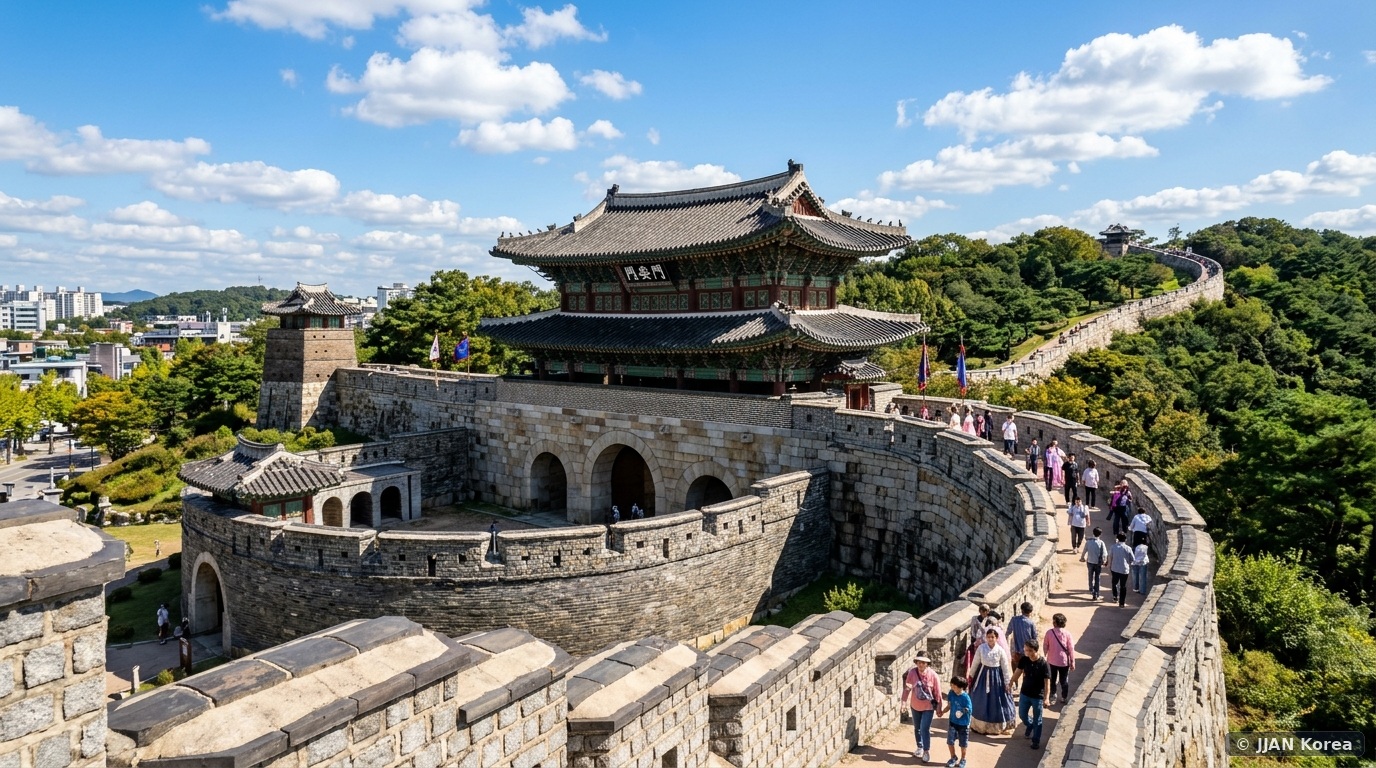

Located just 30 kilometers south of Seoul in Gyeonggi Province, the historic walled city of Suwon (수원) offers one of South Korea’s most rewarding, historically rich, and visually spectacular day trips. At its cultural heart stands Suwon Hwaseong Fortress (수원 화성)—a monumental military architectural masterpiece completed in 1796 by Joseon King Jeongjo to honor his father, Prince Sado, and protect the southern approaches to the royal capital.
Enscribed as a prestigious UNESCO World Heritage Site in 1997, Hwaseong Fortress represents the pinnacle of 18th-century scientific engineering—synthesizing traditional Korean stone ramparts with advanced European defensive bastions designed by legendary scholar Jeong Yak-yong using revolutionary pulley lifting cranes (Geojunggi). From walking along the 5.74-kilometer continuous stone battlements and riding the giant tethered “Flying Suwon” helium balloon, to savoring world-famous charcoal-grilled Suwon Galbi and freshly fried whole chicken along Chicken Street, this comprehensive day trip guide covers subway routes, KTX connections, highlights, and culinary itineraries for 2026.
1. Transit Logistics: Getting from Seoul to Suwon via Subway, KTX & Bus
Traveling from central Seoul to Suwon is remarkably fast, affordable, and flexible across three distinct transit options:
| Transit Mode | Departure Point in Seoul | Travel Duration | One-Way Fare (KRW) |
|---|---|---|---|
| Seoul Subway Line 1 (Local / Express) | Seoul Station, Yongsan, City Hall, or Sindorim | 45 – 55 Minutes (Express Train) / 65 Mins (Local) | ₩2,000 (T-Money card) |
| KTX / ITX-Saemaeul High-Speed Rail | Seoul Station or Yongsan Station | 25 – 30 Minutes (Lightning fast!) | ₩4,800 (ITX) / ₩8,400 (KTX reserved seat) |
| Red Express Bus (광역버스 3000-series) | Gangnam Station (Line 2, Exit 5) or Yangjae | 45 Minutes (Direct highway coach) | ₩3,000 (T-Money) |
From Suwon Station to the Fortress:
Upon arriving at Suwon Station, exit via Exit 4 or the main bus rotary. Board city bus No. 11, 13, or 35; within 10 minutes (4 stops), alight at Paldalmun Gate (팔달문) or Hwaseong Haenggung Palace (화성행궁). Alternatively, a taxi ride costs approximately ₩6,000 to ₩8,000. Review bus transfer discount rules in our Seoul public bus riding guide.
2. The 5.74km Fortress Perimeter Walk & Must-See Sights
The entire perimeter of Suwon Hwaseong is fully walkable along pristine stone battlements, taking roughly 2.5 to 3 hours at a leisurely photography pace:
1. Janganmun Gate (장안문) & Hwaseomun (화서문)
Janganmun is the grand northern gate of Hwaseong and the largest palace gate in South Korea (surpassing even Seoul’s Sungnyemun / Namdaemun). It features a massive semi-circular outer brick defensive wall known as an Ongseong (옹성 / Jar Wall) designed to trap attacking enemy troops in an enclosed crossfire kill zone.
2. Banghwasuryujeong Pavilion (방화수류정) & Yongyeon Pond
Perched high on a rocky cliff overlooking the willow-fringed Dragon Pond (Yongyeon), this exquisite wooden pavilion served as King Jeongjo’s military observation post and poetic retreat. Today, it is Korea’s premier picnic spot: local cafes rent vintage picnic wicker baskets, mats, and battery lanterns. Relaxing on the grassy pond banks while watching the stone pavilion reflect in the water at sunset is unmissable!
3. Hwaseong Haenggung Temporary Palace (화성행궁)
The largest secondary royal palace in Joseon history, featuring over 600 rooms where King Jeongjo stayed during royal ancestral tomb visitations. Featured in iconic K-Dramas like Jewel in the Palace (Dae Jang Geum) and Love in the Moonlight. Explore historical palaces further in our Gyeongbokgung Palace Hanbok guide.
4. The Flying Suwon Tethered Helium Balloon (플라잉 수원)
A colossal, tethered helium passenger balloon moored near Changnyongmun Gate. The balloon ascends smoothly 150 meters (500 feet) into the sky, granting passengers unobstructed 360-degree aerial views of the entire fortress wall curving through the modern urban cityscape. Night flights (19:00–21:30) showcase the illuminated stone walls curving like a golden ribbon of light! (Tickets: ₩20,000 per adult; operations depend on wind speeds).
3. Traditional Archery at Changnyongmun (국궁체험)
Beside the open grassy fields of Changnyongmun Gate, visitors can participate in authentic Traditional Korean Archery (Gukgung / 국궁). For just ₩2,000 for 10 arrows, certified archery instructors teach you traditional Joseon archery stances, thumb-ring grips, and aiming techniques using authentic composite recurve bows targeting wooden targets 30 meters away. It is an exhilarating, interactive historical activity suitable for all ages!
4. Suwon’s Legendary Gastronomy: King Ribs & Fried Chicken Street
No trip to Suwon is complete without indulging in the city’s two world-famous culinary exports:
1. Suwon Wang-Galbi (수원 왕갈비 / King Beef Short Ribs)
Historically home to one of Korea’s largest cattle markets during the Joseon Dynasty, Suwon developed an internationally celebrated barbecue tradition. Unlike Seoul galbi which relies heavily on dark soy sauce, authentic Suwon Wang-Galbi is cut into colossal 15cm diamond-scored bone-in slabs seasoned with a delicate dry rub of toasted sea salt, garlic, sesame oil, and Korean pear juice, grilled over hardwood charcoal. Iconic institutions include Gabojeong (가보정) and Bonsuwon Galbi.
2. Suwon Fried Chicken Street (수원 통닭거리 / Tongdak Golmok)
Located near Paldalmun Gate along the Suwoncheon Stream, this aromatic alleyway houses a dozen legendary fried chicken establishments operating since the 1970s (such as Jinmi Tongdak and Yongseong Tongdak). Whole chickens are chopped and deep-fried in giant, bubbling cast-iron cauldrons (Gamasot), emerging blisteringly crispy and juicy. Order the viral Suwon Galbi Chicken (왕갈비통닭)—crispy fried chicken tossed in sweet, smoky barbecue rib glaze made famous by the blockbuster Korean movie Extreme Job!
5. Suwon Day Trip Itinerary Checklist
- Boarded Seoul Subway Line 1 Express train or booked 25-minute KTX ticket from Seoul Station.
- Arrived at Paldalmun Gate or Hwaseong Haenggung Palace via city bus No. 11/13.
- Walked the fortress ramparts between Janganmun Gate and Banghwasuryujeong Pavilion.
- Shot 10 traditional arrows at the Changnyongmun Archery Range (₩2,000).
- Ascended 150 meters on the Flying Suwon helium balloon for panoramic aerial photos.
- Feasted on cast-iron cauldron chicken at Suwon Fried Chicken Street or charcoal King Galbi.
6. Frequently Asked Questions (FAQ)
Is there an admission fee to walk along Suwon Hwaseong Fortress?
Walking along the exterior battlements, perimeter walls, and viewing gates is 100% free of charge (₩0) and open 24 hours a day. Modest admission fees apply only if entering the enclosed courtyards of Hwaseong Haenggung Palace (₩1,500 for adults).
What is the Hwaseong Fortress Tourist Tram (Hwaseong E-Train)?
If you prefer not to walk the full 5.7km distance, you can ride the charming Hwaseong E-Train (화성어차), an electric road train styled after King Sunjong’s imperial limousine and royal sedan chairs. The tram departs from Yeonmudae and Hwaseong Haenggung every 30 minutes, carrying passengers along the fortress walls for ₩4,000 per adult.
How does the Flying Suwon helium balloon operate in bad weather?
Because the balloon is tethered by heavy-duty steel cables, flights are strictly governed by wind safety regulations. If ground winds exceed 13 meters per second (approx. 25 knots) or during heavy rainfall, operations are temporarily suspended. Check flight status on the official website or Naver Map before making the trek to Changnyongmun.
Can I take the KTX high-speed train to Suwon?
Yes. Select KTX trains running along the Gyeongbu Line stop at Suwon Station. The journey from Seoul Station to Suwon Station takes just 25 to 28 minutes! You can book seats in advance via the KorailTalk mobile app, as detailed in our Korea KTX booking and travel guide.
JJAN Korea Editorial Standards & Fact-Checking Verification
This regional heritage day-trip dossier was compiled and field-tested across all fortress sectors by Travel Editor Do-jun Kim in coordination with the Suwon Cultural Foundation and the UNESCO World Heritage Hwaseong Management Office. Transit schedules and admission rates reflect official 2026 standards.
🛡️ JJAN Korea Editorial Standards & Fact-Checking Verification
This article was independently researched, field-tested, and audited by the JJAN Korea Regional Heritage & Transit Tourism Desk in Seoul. Fortress walking trails and transit connections audited by our travel desk in coordination with the Suwon Cultural Foundation and UNESCO World Heritage Management Office.
Notice an unlisted policy change, fare update, or revised administrative rule? Help us keep our international community accurately informed: Submit a Correction to our Seoul Newsroom.