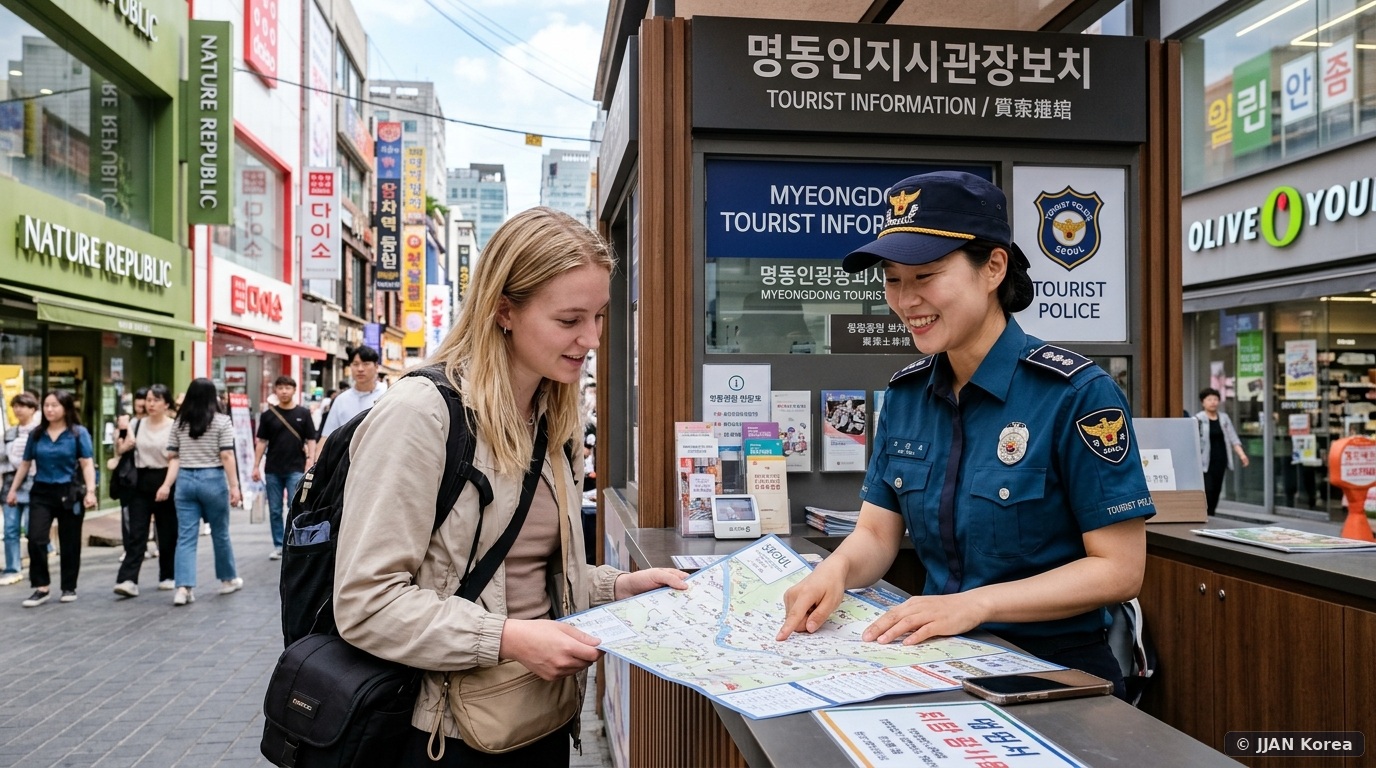

While South Korea consistently ranks among the safest travel destinations in the world with virtually negligible rates of violent street crime, international visitors occasionally encounter frustrating commercial pitfalls. These range from unscrupulous late-night taxi drivers refusing meters in bustling nightlife zones and street food carts withholding statutory price tags in Myeongdong, to aggressive cosmetics touts and unauthorized private luggage storage kiosks. To protect visiting travelers and safeguard Korea’s global tourism reputation, the Korean National Police Agency operates an elite specialized unit: the Korea Tourist Police (관광경찰 / Tourist Police).
Stationed prominently across Seoul, Busan, and Incheon, Tourist Police officers are easily distinguished by their sharp dark navy uniforms, berets, and bilingual country-flag sleeve patches indicating fluency in English, Japanese, and Mandarin Chinese. Whether you are facing a belligerent taxi driver demanding a ₩50,000 cash surcharge, dealing with an unauthorized accommodation cancellation, or navigating an aggressive vendor dispute, understanding how to summon on-the-spot police intervention and leverage the 24/7 1330 Korea Travel Hotline ensures you never become a target of commercial exploitation.
1. Primary Responsibilities and Statutory Authority of Tourist Police
Unlike standard municipal patrol officers who primarily handle general domestic crime, traffic collisions, and civic disputes, the Korea Tourist Police possess specialized jurisdiction governed by the Tourism Promotion Act (관광진흥법). Their key operational mandates include:
- Enforcing Transparent Pricing Statutes: Inspecting shopping stalls, clothing boutiques, and cosmetics outlets in designated special tourism zones (Myeongdong, Dongdaemun, Hongdae, Insadong, and Itaewon) to enforce mandatory open-price display laws (가격표시제). Vendors concealing price tags or charging foreign surcharges face immediate administrative citations and escalating municipal fines.
- Intercepting Illegal & Unmetered Taxis: Conducting covert and uniformed checkpoints outside major international hotels, Incheon/Gimpo airport terminals, and late-night entertainment corridors to catch drivers tampering with meters, operating unauthorized “Call Vans” disguised as metered cabs, or demanding unlawful flat-rate fees.
- Mediating Commercial & Hospitality Disputes: Resolving real-time retail conflicts regarding immediate VAT tax refunds, merchant refusal of foreign credit cards, defective item returns, or unlicensed Airbnb/guesthouse operations failing fire and safety regulations.
- Lost Property & Emergency Translation Dispatch: Coordinating recovery operations for smartphones, passports, and purses left in subway cars or public buses, alongside providing real-time on-scene interpretation during emergency medical situations covered in our Korea 119 emergency room medical guide.
2. Permanent Tourist Police Centers in Seoul & Operating Hours
If you encounter an issue within Seoul’s central tourist districts, you can walk directly into a dedicated Tourist Police Center or flag down patrolling officers:
| Center Location | Exact Landmark & Address | Operating Hours | Special Patrol Focus |
|---|---|---|---|
| Myeongdong Center | Near Myeongdong Art Theater, 66 Eulji-ro 2-ga, Jung-gu | 09:00 – 23:00 (Daily) | Street food price gouging, tax refund disputes, cosmetics touts |
| Dongdaemun Center | Opposite Doota Mall / DDP Fashion Mall, Jongno-gu | 10:00 – 01:00 (Night Patrol) | Late-night wholesale taxi refusals, counterfeit luxury goods |
| Hongdae Center | Hongik University Station Exit 9 Pedestrian Plaza, Mapo-gu | 13:00 – 22:00 (Patrols extend to 02:00 Fri/Sat) | Club entry discrimination, late-night taxi price fixing |
| Insadong Patrol Booth | Near Ssamziegil Cultural Complex, Jongno-gu | 10:00 – 19:00 (Daily) | Antique authenticity certification, walking street bicycle control |
| Itaewon Center | Itaewon Subway Station Exit 1 Plaza, Yongsan-gu | 14:00 – 23:00 (Fri/Sat until 03:00) | Multi-language dispute mediation, nightlife safety patrols |
3. The Most Common Tourist Scams in Korea & Practical Defense Tactics
While outright robbery or violent crime is practically non-existent, unscrupulous operators rely on subtle psychological pressure, language barriers, and tourist unfamiliarity. Here are the five primary scams encountered by international visitors and how to defeat them:
Scam 1: The “Black Taxi / Call Van” Airport & Nightlife Trap
The Tactic: Solitary drivers linger inside airport arrival terminals or outside clubs in Hongdae and Gangnam, approaching weary travelers with phrases like “Official Taxi Seoul ₩100,000 flat deal” or ushering groups into large 6-seater vans without starting the meter. Upon arrival, they demand ₩150,000 to ₩300,000, claiming the vehicle is a luxury limousine or heavy cargo van.
Defense: Never accept rides from individuals soliciting inside terminals or on sidewalks. Always wait in the official designated taxi queue outside the airport doors or hail metered orange/silver/white sedans. For absolute price transparency, use official metered hailing or review our transit alternatives in the Korean ATM and foreign card payment guide to ensure you always pay with a trackable corporate credit card.
Scam 2: Street Food “Unpriced Menu” Overcharging
The Tactic: Street food stalls in tourist-dense pockets of Myeongdong display mouth-watering grilled lobster tails, fruit tanghulu, and skewered meats without visible price tags. After handing you the food, the vendor demands ₩20,000 to ₩25,000 per portion, claiming premium ingredients or specialty sauces.
Defense: Under Korean law, all open-air street stalls in designated tourist zones are strictly required to display written prices in Korean won. If a stall has no visible prices, ask firmly: “Olmayeyo? (얼마예요? / How much is this?)” before the food is prepared. If they overcharge or refuse to provide change, locate a nearby Tourist Police officer or dial 1330 on your phone immediately; vendors quickly capitulate when police inspect their pricing licenses.
Scam 3: Aggressive Cosmetics Samples & Bait-and-Switch
The Tactic: Promoters stand outside shopping street beauty stores thrusting free face masks into tourists’ hands, ushering them inside under the pretense of a “free gift.” Once inside, aggressive sales staff block exits, apply expensive ampoules onto customers’ hands, and pressure them into multi-pack sets costing hundreds of dollars while refusing single-item purchases.
Defense: Do not accept free promotional items if you do not intend to enter. If pressured, simply leave the item on a counter and walk out. For legitimate, government-certified skincare shopping with guaranteed fixed retail pricing and automated VAT refunds, visit corporate flagship stores detailed in our Olive Young instant tax refund guide.
Scam 4: The “Pseudo-Religious Cultural Tea Ceremony” Approach
The Tactic: Friendly, neatly dressed young Koreans approach foreign tourists near Anguk, Gyeongbokgung, or Hongdae speaking conversational English. They ask for directions or claim they are university students practicing English, quickly pivoting to: “Would you like to experience a traditional Korean ancestral tea ceremony (Darye / 다례) to bring you good fortune?” Victims are led to a private residential apartment or basement, made to wear hanbok, and coerced into donating ₩50,000 to ₩200,000 in cash to “purify their ancestral spirits.”
Defense: This is an infamous pseudo-religious cult recruitment tactic (frequently associated with Daesun Jinrihoe). Legitimate Korean cultural centers never recruit random foreign travelers on street corners. If approached by pairs of overly friendly strangers offering traditional rituals or home visits, politely say “No thank you” and keep walking.
4. Step-by-Step Protocol: How to Report an Incident
If you experience price gouging, taxi meter refusal, or aggressive commercial coercion, follow this four-step reporting protocol:
- Preserve Essential Digital Evidence: For taxi disputes, snap a clear photo of the taxi’s rear license plate (must begin with commercial yellow plates displaying ‘아, 바, 사, 자’) and the driver’s credential card mounted on the dashboard. Request a printed payment receipt (영수증 / Yeongsujeung), which records the vehicle registration number, driver license number, exact boarding/alighting timestamps, and distance traveled.
- Dial the 1330 Korea Travel Hotline: Dial 1330 from any Korean mobile or local phone (or +82-2-1330 from foreign SIMs). Press 2 for English. The bilingual concierge operator can mediate directly with the vendor or taxi driver over speakerphone. The mere sound of an official government translation hotline often resolves disputes instantly.
- Summon Official Police Response: For active hostility, fraud exceeding ₩100,000, or criminal behavior, dial 112 (Police Emergency). The 112 dispatch center immediately connects a three-way translation interpreter and routes GPS coordinates to the nearest patrol cruiser.
- File a Formal Investigation Request: If the incident occurred earlier, visit a Tourist Police Center with your receipts, photos, and credit card statement. Officers will review CCTV footage, issue official administrative penalty summonses to the offending merchant, and coordinate financial restitution directly to your bank account.
5. Tourist Scam Defense Checklist
- Saved the 1330 Korea Travel Hotline (+82-2-1330) and 112 Police Emergency in phone contacts.
- Always verify that the taxi driver presses the physical meter button (starts at ₩4,800 in Seoul) before departing.
- Always request and retain printed physical receipts for all taxi rides, dining bills, and retail purchases.
- Confirmed street food item prices verbally before allowing vendors to grill or prepare orders.
- Strictly decline street invitations from strangers offering “ancestral ceremonies,” “tea culture experiences,” or private residential visits.
- Kept photos of passport information page and foreign credit cards stored securely in cloud storage.
6. Frequently Asked Questions (FAQ)
Do Tourist Police officers speak fluent English?
Yes. Every officer assigned to the Korea Tourist Police is specially vetted and selected for advanced linguistic proficiency in English, Japanese, or Mandarin. They wear identifying language flag badges above their chest nameplates and are trained specifically to handle foreign traveler legal and consumer protection inquiries.
What should I do if a Seoul taxi driver refuses to use the meter?
Under Korean law, refusing to operate the taximeter (미터기 미사용) or demanding flat cash fares is strictly illegal. Calmly point to the meter and say “Meter-gi kyeo-juseyo (미터기 켜주세요 / Please turn on the meter).” If the driver refuses, take a photo of the dashboard license plate, exit the vehicle immediately, and report the license number to 1330 or 120 (Dasan Seoul Call Center). Penalties for drivers include severe administrative fines and commercial license suspension.
Is it safe to walk around Seoul at 3:00 AM?
Yes. Seoul is renowned as one of the safest global metropolises at night, supported by extensive municipal CCTV networks, well-lit pedestrian corridors, 24-hour convenience stores, and regular police patrols. However, general street awareness is still advised in rowdy late-night clubbing clusters such as Hongdae and Itaewon to avoid intoxicated bar brawls.
Can the Tourist Police assist if I lose my passport or phone?
Yes. Tourist Police Centers maintain direct database access to the National Police Agency’s nationwide lost-and-found portal (LOST112 / lost112.go.kr). If you misplaced an item on the subway, bus, or in a park, officers can register your missing property, track reported items across transit depots, and contact you immediately upon recovery.
JJAN Korea Editorial Standards & Fact-Checking Verification
This investigative consumer guide was compiled and verified by Senior Columnist Dong-hwan Kim in coordination with operational data from the Korean National Police Agency (KNPA), Seoul Metropolitan Government Tourism Division, and Korea Tourism Organization (KTO) 1330 Advisory Council. Consumer regulations and taxi statutes reflect official 2026 enforcement standards.
🛡️ JJAN Korea Editorial Standards & Fact-Checking Verification
This article was independently researched, field-tested, and audited by the JJAN Korea Emergency Safety & Consumer Rights Desk in Seoul. Audited in coordination with the Korean National Police Agency (KNPA) Tourist Police Division and 1330 Korea Travel Advisory Center.
Notice an unlisted policy change, fare update, or revised administrative rule? Help us keep our international community accurately informed: Submit a Correction to our Seoul Newsroom.