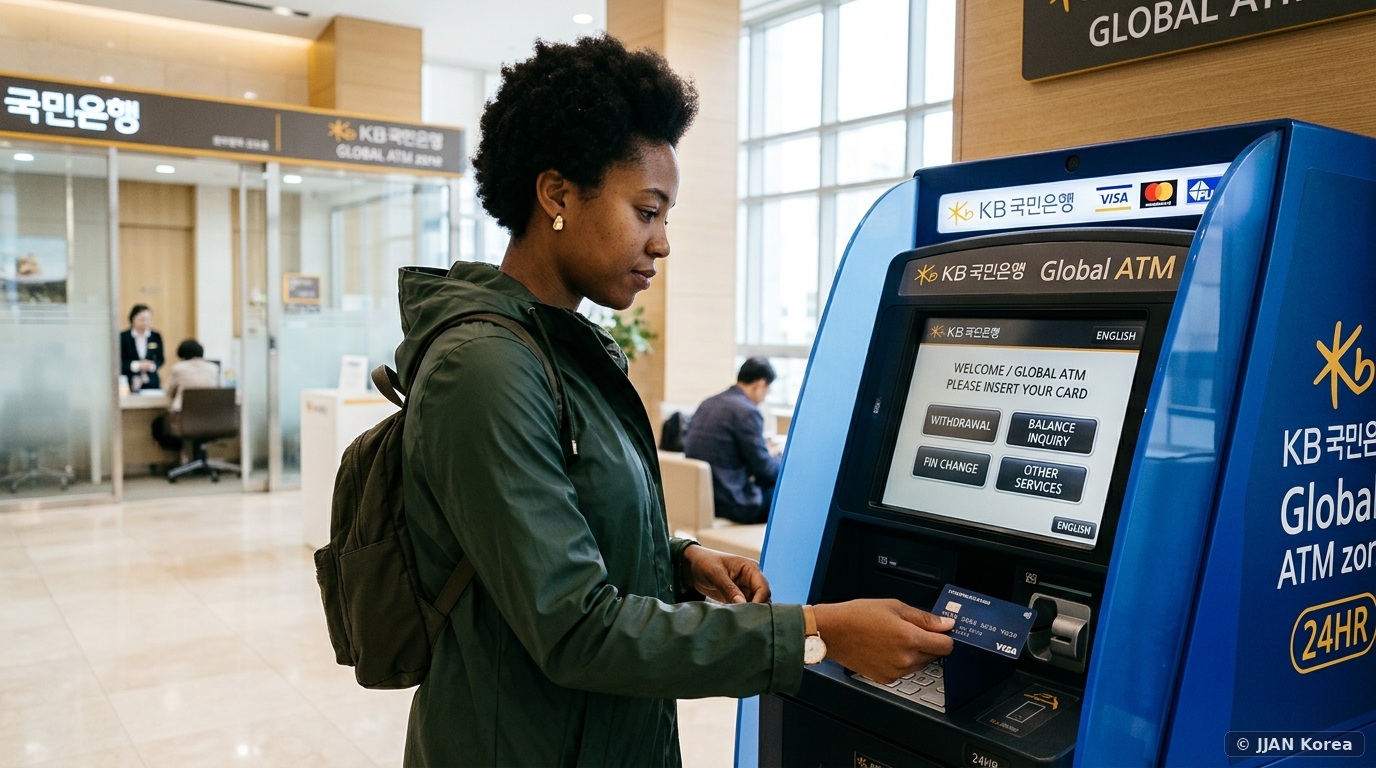
While South Korea is celebrated as one of the most technologically advanced, virtually cashless societies in the world—where locals purchase everything from convenience store chewing gum to luxury designer handbags with a flick of their smartphone—international travelers quickly discover that cash remains an unavoidable operational necessity. From purchasing and recharging physical public transit cards (T-Money and the Seoul Climate Card) to navigating street food stalls at Gwangjang Market or paying apartment move-in key deposits, you will need physical Korean Won (KRW) banknotes.
However, sliding an overseas credit or debit card into a random Korean cash machine can be fraught with unexpected errors. Half of the nation’s automated teller machines physically reject foreign magnetic stripe cards, hidden Dynamic Currency Conversion (DCC) traps inflate withdrawal exchange rates by 5% to 8%, and daily cash withdrawal ceilings can trigger anti-fraud security freezes on your home bank account. This field-tested financial guide breaks down how to identify certified Global ATMs, bypass DCC currency traps, compare local operator surcharges, and avoid ATM card swallowing in 2026.
1. Standard Domestic ATMs vs. Global ATMs: The Fatal Distinction
The single most common mistake foreign travelers make is approaching an automated cash dispenser inside a random subway station or convenience store and receiving an immediate “Transaction Denied / Invalid Card” error message. Understanding why this happens requires decoding Korea’s banking terminal landscape:
| Machine Type | Visual Exterior Signage | Supported Card Networks | Foreign Card Acceptance |
|---|---|---|---|
| Global ATM (글로벌 ATM) | Prominent “GLOBAL ATM” lettering, Visa/Plus, Mastercard/Cirrus, JCB, UnionPay logos | Worldwide interbank networks (Cirrus, Plus, Star, Maestro) | 100% Guaranteed Acceptance for foreign-issued credit and debit cards |
| Domestic-Only ATM (국내전용 ATM) | Korean bank logos only (KB, Shinhan, Woori) with no international network emblems | Domestic Korean clearing house (KFTC) and local bank cash cards | Strictly Rejected; will spit your foreign card out immediately |
| Convenience Store Kiosks (CD Machines) | Standalone unbranded terminals (NICE, HanNet, Lotte ATM) inside GS25, CU, 7-Eleven | Mixed (Select terminals feature Global software; others reject foreign cards) | Selective acceptance; higher third-party operator convenience surcharges (₩3,500 – ₩5,000) |
2. Where to Find Reliable Global ATMs in South Korea
To avoid roaming street corners with a declined card, direct your footsteps toward these proven withdrawal locations:
- Major Tier-1 Bank Branch Foyers: Physical branch lobbies of Hana Bank, Shinhan Bank, Woori Bank, and KB Kookmin Bank almost universally dedicate at least one or two terminals labeled “Global ATM” within their 24-hour ATM glass vestibules.
- International Airport Terminals: Incheon Airport (T1/T2) and Gimpo Airport arrivals halls are densely packed with certified Global ATMs operated by major commercial lenders. Withdraw initial cash here before entering downtown transit lines. For ground rail transit into the city, review our Incheon Airport to Seoul transit guide.
- Major Subway Hubs: Major transit interchanges (Seoul Station, Hongik University, Gangnam, Myeongdong, Dongdaemun History & Culture Park) house bank-operated Global ATMs near station ticket barrier concourses.
- 7-Eleven & GS25 Convenience Store Terminals: 7-Eleven stores featuring Lotte ATM machines and GS25 stores featuring NICE terminals frequently support foreign Visa and Mastercard withdrawals, displaying multi-language English touchscreens.
3. The DCC Deception: How to Avoid the 8% Conversion Trap
The single most expensive pitfall during foreign ATM withdrawals is Dynamic Currency Conversion (DCC). During your transaction, the ATM screen will detect that your card was issued in the United States, United Kingdom, Australia, or Europe, and present a seemingly helpful prompt:
⚠️ Deceptive ATM Screen Prompt:
“Would you like to be billed in your home currency ($228.50 USD) with guaranteed locked exchange rate, or in local currency (₩300,000 KRW)?”
ALWAYS CHOOSE LOCAL CURRENCY (KRW / 원화)!
If you select your home currency (USD, EUR, GBP), you grant the local Korean ATM operator permission to calculate the exchange rate using their own arbitrary, predatory markup—typically 5% to 8% worse than the interbank spot rate. If you select KRW (Korean Won), the transaction routes directly to your home bank or credit card company (e.g., Chase, Schwab, Wise, Revolut), which converts the currency at the official wholesale mid-market rate with minimal or zero spread. Always hit “Decline Conversion” or “Continue in Local Currency”.
4. Step-by-Step Global ATM Withdrawal Walkthrough
Execute your cash withdrawal smoothly following this standardized interface sequence:
00 (e.g., 123400).5. Withdrawal Limits, Bank Surcharges & Security Freezes
To avoid having your card declined or captured by the machine, review these regulatory ceilings:
- Single Transaction Machine Limit: Most Korean Global ATMs enforce a physical cash dispensing limit of ₩1,000,000 per single withdrawal transaction (equivalent to twenty ₩50,000 bills). If you need ₩2,000,000, you must execute two consecutive withdrawals.
- Daily Home Bank Limits: Your domestic home bank enforces its own daily international cash withdrawal cap (typically $500 to $1,000 USD per 24 hours). Ensure you increase your daily ATM withdrawal limit inside your mobile banking app before departing for Seoul.
- Bank Operator Surcharges: Expect a local terminal operator fee of ₩3,500 to ₩4,000 per transaction at bank branches, and up to ₩5,000 at convenience store CD kiosks. Using travel-specialized debit cards (like Charles Schwab or Wise) refunds these local terminal fees automatically. When setting up long-term financial foundations, see our guide on how to open a Korean bank account as an expat.
6. Frequently Asked Questions (FAQ)
What should I do if a Korean ATM swallows my bank card?
If the ATM retains your card due to three consecutive incorrect PIN entries or a hardware mechanism jam, do not leave the machine. If the ATM is located inside an open bank branch during business hours (9:00 AM – 4:00 PM), alert the security guard or teller immediately with your passport; they can retrieve your card in minutes. If the branch is closed or standalone, pick up the integrated telephone handset attached to the ATM casing to speak with the 24-hour security dispatch operator.
Can I exchange foreign physical cash (USD, EUR, JPY) at a Korean ATM?
Most standard ATMs cannot accept or exchange foreign paper currency. To exchange physical banknotes into Korean Won, visit an in-person foreign exchange bank counter, an authorized airport money exchange kiosk, or use automated currency exchange machines (such as WOWPASS kiosks located across major subway stations) which accept USD, EUR, JPY, and SGD banknotes directly.
Why did my ATM transaction fail with a “PIN Error” when my PIN was correct?
Some international banks require a 6-digit PIN for international point-of-sale and ATM clearing networks. If your domestic bank card utilizes a 4-digit PIN and the Korean ATM rejects it, attempt entering your 4-digit code followed by two zeroes (e.g., PIN + 00). If the error persists, your home bank has likely triggered an anti-fraud security hold requiring app authorization.
Do Korean retail shops accept cash payments?
Under Bank of Korea legal tender laws, all physical brick-and-mortar merchants are legally required to accept Korean Won cash. However, select modern automated cafes, unmanned convenience stores, and fast-food kiosks operate under “Cashless Store” (현금 없는 매장) policies and only accept credit cards or mobile pay. Always carry both a card and emergency cash.
🛡️ JJAN Korea Editorial Standards & Fact-Checking Verification
This article was independently researched, field-tested, and audited by the JJAN Korea Banking & Financial Compliance Desk in Seoul. Audited across Global ATMs at Shinhan, Woori, and KB Kookmin Bank; international interchange fee schedules cross-checked with Visa, Mastercard, and Cirrus.
Notice an unlisted policy change, fare update, or revised administrative rule? Help us keep our international community accurately informed: Submit a Correction to our Seoul Newsroom.