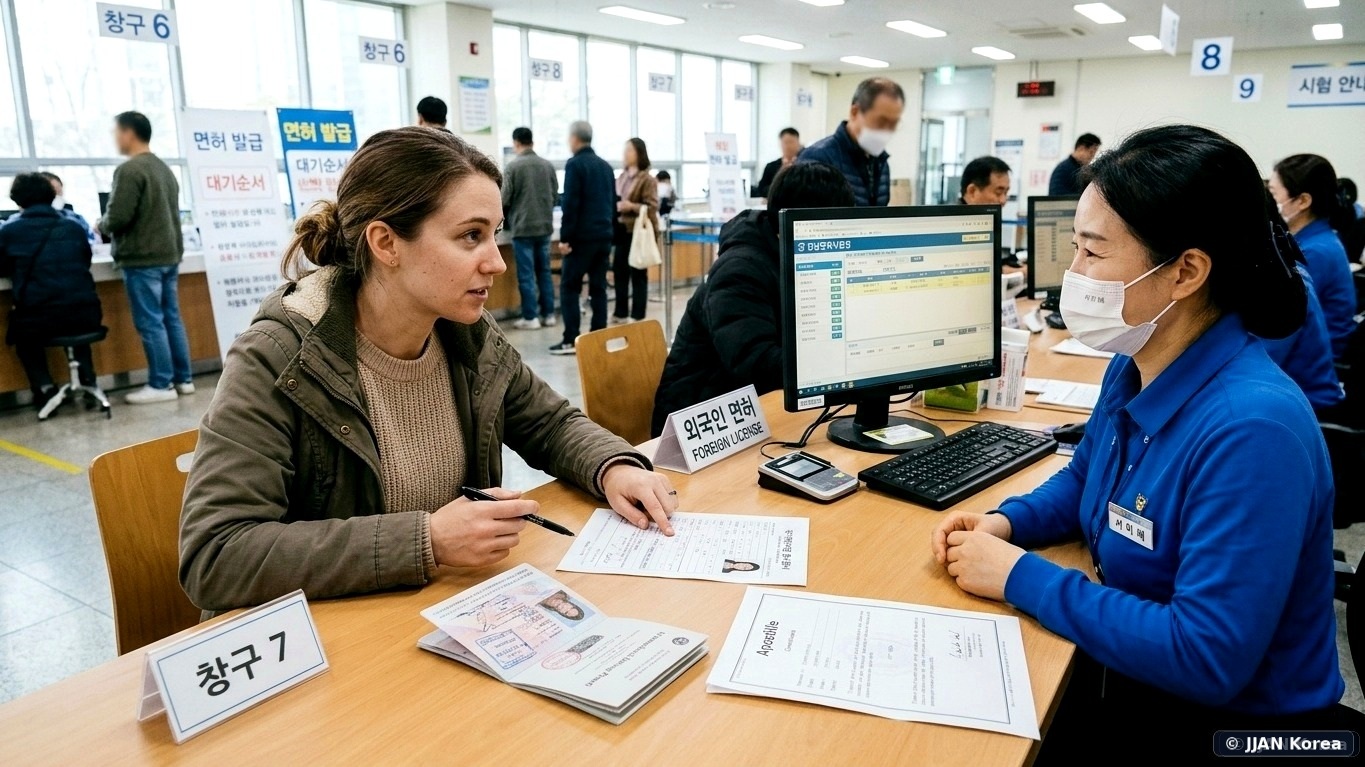
For international foreign residents living in South Korea, acquiring a local driver’s license (Unjeon Myeonheojeung – 운전면허증) unlocks complete autonomy to explore stunning national parks, coastal driving highways, and remote provincial villages beyond the reach of high-speed railways. While foreign nationals from treaty-recognized jurisdictions can often convert their home country license through a direct paperwork exchange, thousands of expats—including those from non-reciprocal jurisdictions, international university students who never drove in their home countries, or those whose foreign licenses expired—must navigate South Korea’s official licensing examination from the ground up. Fortunately, the Korea Road Traffic Authority (KoROAD – 도로교통공단) provides comprehensive English-language examination tracks, modern computerized testing kiosks, and nationwide driver examination centers that make obtaining a license remarkably fast, affordable, and transparent.
1. The 4-Stage Licensing Examination Architecture
In South Korea, passenger vehicles and light SUVs are categorized under the Class 2 Ordinary License (2종 보통 / 2-Jong Botong), which can be taken as an Automatic transmission (Jadong – 자동) or Manual transmission (Sudong – 수동) track. Over 90% of applicants choose Class 2 Automatic. Obtaining this license requires passing four sequential statutory stages governed by the Road Traffic Act.
| Examination Stage | Testing Format & Language | Passing Score Threshold | Standard State Statutory Fee |
|---|---|---|---|
| Stage 1: Traffic Safety Education & Physical Check | 1-Hour video lecture + Vision / hearing test | Mandatory completion (Pass/Fail) | Lecture: Free / Physical: 6,000 KRW |
| Stage 2: Written Academic Exam (Pilgi) | 40 Computer-based multiple choice questions (English) | 60 Points out of 100 (Class 2) | 10,000 KRW |
| Stage 3: Closed-Course Functional Driving (Jangnae Gineung) | Computerized automated sensor course (300m track) | 80 Points out of 100 | 25,000 KRW |
| Stage 4: On-Road Driving Test (Doro Juhaeng) | 5km real-world municipal road route with live examiner | 70 Points out of 100 | 30,000 KRW |
Before committing to the testing process, foreign residents should first verify whether their home nation maintains an automated reciprocity agreement. By checking if your country’s license qualifies for direct exchange without testing, you may be able to bypass the testing entirely by submitting an Apostilled translation of your existing foreign permit.
2. Stages 1 & 2: Traffic Safety Education and the English Written Exam (Pilgi)
To begin, create a profile on the official KoROAD Safe Driving civil portal (www.safedriving.or.kr) or walk into any of the 27 nationwide Driver’s License Examination Centers (such as Gangnam, Dobong, Gangseo, or Western Seoul Centers) with your Alien Registration Card (ARC), passport, and three color passport-sized photos (3.5cm x 4.5cm).
- Mandatory Traffic Safety Video (1 Hour): All first-time applicants must sit through a 60-minute video presentation covering basic road signs, DUI penalties, school zone regulations, and pedestrian safety laws. English subtitles are provided in designated international lecture rooms.
- Physical Health Assessment: Next, proceed to the on-site clinic for a quick 5-minute health check. Staff will test your uncorrected or corrected vision (must meet 0.5 or higher in both eyes for Class 2) and verify hearing and color blindness.
- The 40-Question English Computer Exam: The written academic test (학과시험 / Hakgwa Siheom) is administered entirely via touch-screen PC kiosks. You can select “English” from the initial language selection screen (options also include Chinese, Vietnamese, and Korean). The 40 questions are pulled randomly from KoROAD’s public question bank of 1,000 questions, covering traffic sign identification, safe following distances, right-of-way rules at uncontrolled intersections, and scenario video analysis.
- How to Ace the Written Exam in 48 Hours: Do not waste money on physical textbooks. Download the free Korean app Unjeon Myeonheo PLUS (운전면허 PLUS) on iOS or Android. Select English mode and take 5 practice mock exams. The official exam questions, diagrams, and answer choices are 100% identical word-for-word to the real KoROAD test. Scoring above 75 points on the app guarantees an effortless first-time pass.
3. Stage 3: Closed-Course Functional Driving Test (Jangnae Gineung)
Once you pass the written exam, you are immediately eligible to attempt the Closed-Course Functional Test (장내기능시험). This test takes place inside a specialized paved driving facility equipped with automated electronic sensors, radio telemetry, and onboard computerized scoring computers. There is no human instructor in the vehicle with you; the onboard computer monitors your steering, pedals, and timing with microsecond precision, deducting points automatically for errors.
The test evaluates basic mechanical operations and navigation of a standardized course:
- Stationary Mechanical Checks (5 Points Each): Before moving, the computer instructs you via voice prompts to operate turn signals, cycle headlights from low to high beams, toggle windshield wipers, and shift transmission gears between Drive (D) and Park (P).
- Starting & Emergency Stop (Dolbal – 돌발): You must release the parking brake, engage the left turn signal, and accelerate. At a completely randomized moment on the track, a loud siren will scream “DOLBAL! DOLBAL!” accompanied by flashing red dashboard lights. You must slam on the brakes to come to a complete stop within 2 seconds and engage your hazard warning flashers within 3 seconds.
- The Infamous T-Parking Test (Jik-gak Joo-cha): The most dreaded component of the functional exam is perpendicular reverse parking (T-Course) into a narrow concrete bay bordered by yellow pressure sensor lines within a 2-minute time limit. Touching a black curb or pressure line deducts 10 points. Veteran academy instructors teach a mechanical geometry trick: align the vehicle’s interior door handle with the concrete curb line, turn the steering wheel 1.5 full rotations right, reverse slowly until straight, and touch the white confirmation sensor strip.
- Uphill Slope & Railway Crossings: Stop the car on an elevated uphill incline, hold the brake for 3 seconds without rolling backward more than 50cm, and smoothly accelerate over the crest.
4. Stage 4: On-Road Driving Test & Private Academy (Hagwon) Economics
Passing the functional course earns you a Temporary Practice Driving Permit (Yeonseup Myeonheo – 연습면허) valid for one year. This permit allows you to practice driving on public roads provided you are accompanied in the front passenger seat by an individual who has held a full Korean driver’s license for at least two years.
The final hurdle is the On-Road Driving Test (도로주행시험). You will drive a 5-kilometer designated municipal road course selected at random (from Routes A, B, C, or D) with a human KoROAD examiner sitting in the passenger seat holding a synchronized tablet PC. The examiner grades lane positioning, smooth merging, yielding to pedestrians at crosswalks, maintaining proper following distances, and smooth braking.
Foreign applicants typically choose between two preparation pathways: the Independent Government Center Route (paying only statutory state fees totaling roughly 75,000 KRW, booking slots individually), or enrolling in a certified Private Driving Academy (Unjeon Myeonheo Hagwon – 운전면허학원). Private driving academies provide 13 hours of mandatory structured practice (3 hours classroom theory, 4 hours functional track, 6 hours public road practice). While academies charge between 750,000 and 950,000 KRW, they offer massive advantages: English-speaking instructors, shuttle bus pickups, and the ability to take the functional and road exams directly on the familiar academy track using the exact vehicle you trained in.
Once you acquire your physical Korean license, you can legally navigate nationwide toll expressways, rent shared green vehicles via apps like Socar or GreenCar, and master the rules for understanding Korean traffic laws, speed cameras, and insurance coverage across Jeju Island and the East Coast.
5. Frequently Asked Questions (FAQ)
Q1: What happens if I fail the functional course or road exam?
Under KoROAD regulations, there is zero lifetime limit on re-attempts. However, a mandatory cooling-off period applies: you must wait three full calendar days before you can retake a failed functional course or on-road exam. You simply pay the exam re-test fee (25,000 or 30,000 KRW) and re-book the next available slot.
Q2: Can I get an International Driving Permit (IDP) issued on my new Korean license?
Yes! As soon as your physical Korean driver’s license is printed at the examination counter, you can step over to the adjacent civil window and request an English Driver’s License (Yeong-mun Unjeon Myeonheojeung) printed with your photo and legal details in English on the reverse side. This English license is legally recognized in over 60 countries (including Australia, the UK, Singapore, and Canada) without needing a separate IDP booklet.
Q3: Is the voice navigation on the road exam available in English?
Yes. In the official on-road test vehicle, the automated GPS navigation system (which issues audible turn-by-turn commands such as “In 300 meters, make a left turn at the intersection”) can be set to English audio mode upon request to the testing supervisor before departing.
Q4: Can I take the road test in my own private vehicle?
No. All functional and road examinations must be executed exclusively in state-certified dual-control examination vehicles equipped with an emergency passenger-side brake pedal for examiner intervention and synchronized telemetry sensors.
🛡️ JJAN Korea Editorial Standards & Fact-Checking Verification
This driver licensing walkthrough has been authored and verified by Tech & Systems Editor Min-jun Kim following statutory regulations published by the Korea Road Traffic Authority (KoROAD) and the Korean National Police Agency (KNPA).
- Exam scoring thresholds and fee structures cross-checked with the 2026 KoROAD Official Driver Examination Tariff.
- T-Parking course dimensions and electronic sensor criteria verified under Road Traffic Act Enforcement Rules.
- English language testing availability confirmed across all 27 nationwide KoROAD Driver’s License Examination Centers.