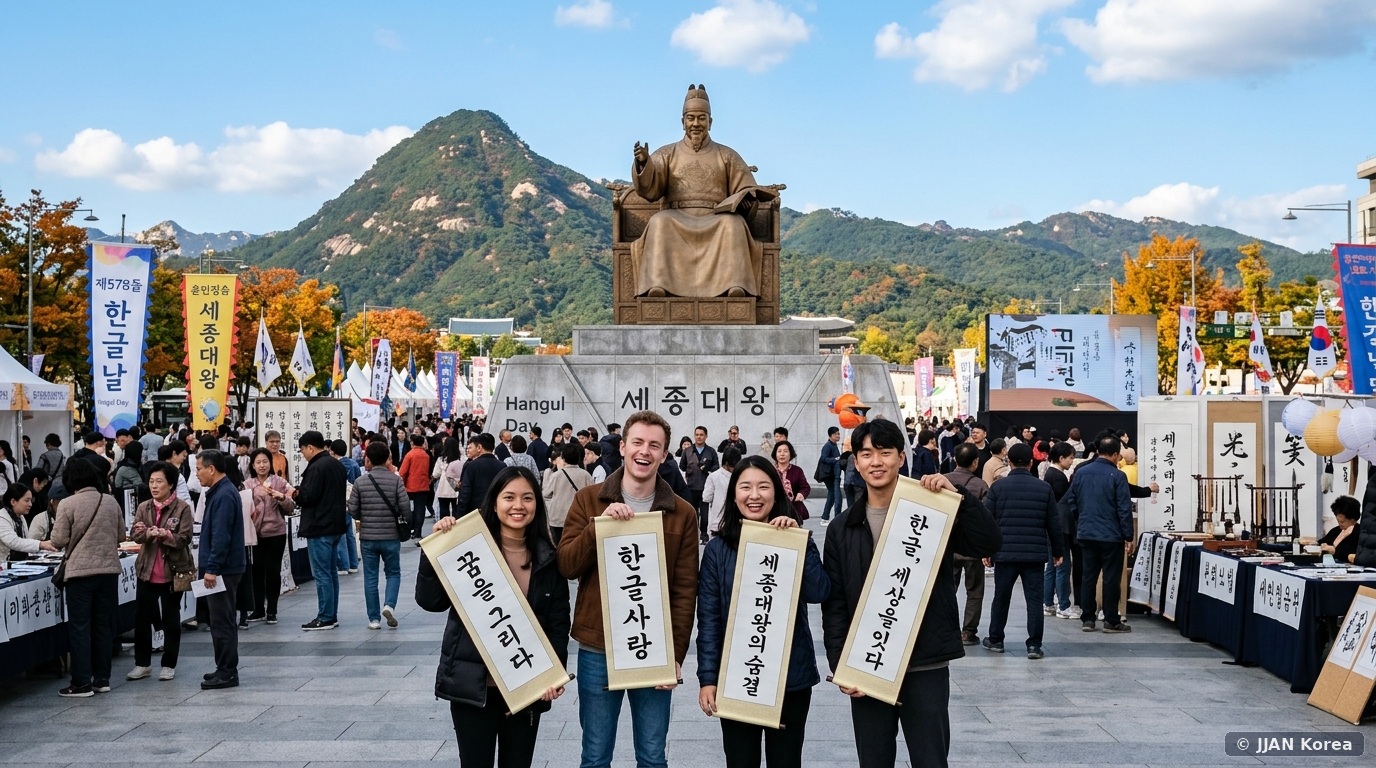
Every October 9th, the Republic of Korea observes one of the most culturally unique statutory national holidays in human civilization: Hangul Day (한글날 / Hangul-nal). While nations worldwide celebrate military victories, royal coronations, or declarations of political independence, South Korea is the only sovereign country on earth that observes an official national public holiday dedicated to the invention and celebration of its written alphabet. Created in 1443 and promulgated in 1446 by King Sejong the Great (세종대왕), Hangul represents an unparalleled linguistic masterwork—hailed by linguists worldwide as the most scientifically engineered, phonetically elegant feat of writing technology ever devised. For international foreign residents and travelers in Seoul, joining the vibrant commemorative festivities at Gwanghwamun Square offers a profound, joyous immersion into the intellectual soul of the Korean nation.
1. The Linguistic Breakthrough: Hunminjeongeum and Featural Geometry
Prior to the 15th century, the Korean language had no native alphabet. Educated aristocrats (Yangban) recorded thoughts using Classical Chinese characters (Hanja – 漢字). Because Hanja required memorizing thousands of complex pictographic ideograms entirely disconnected from spoken Korean grammar, the vast majority of ordinary commoners, agrarian farmers, and women were functionally illiterate—unable to appeal unjust legal convictions, read farming manuals, or record personal debts.
Deeply moved by compassion for his people, King Sejong gathered the elite scholars of the royal research academy (Jiphyeonjeon – Hall of Worthies) to design an egalitarian writing system. In the historic preface of the royal manuscript Hunminjeongeum (훈민정음 – “The Correct Sounds for the Instruction of the People”), King Sejong wrote words that remain immortal in Korean hearts: “Because the spoken sounds of our country differ from those of China, they cannot be communicated by Chinese characters. Therefore, even if an illiterate commoner has something to say, they cannot express their feelings. Being troubled by this, I have newly created twenty-eight letters so that every person can easily learn them and use them daily.”
| Basic Hangul Consonant | Phonetic Sound | Anatomical Mouth & Throat Shape Represented | Derived Letters with Strokes |
|---|---|---|---|
| ㄱ (Giyeok) | G / K | Root of the tongue blocking the throat pharynx | ㅋ (aspirated K) |
| ㄴ (Nieun) | N | Tip of the tongue touching the upper alveolar gum ridge | ㄷ (D), ㅌ (T), ㄹ (R/L) |
| ㅁ (Mieum) | M | Outline of closed lips meeting together | ㅂ (B), ㅍ (P) |
| ㅅ (Siot) | S | Profile outline of incisor front teeth | ㅈ (J), ㅊ (CH) |
| ㅇ (Ieung) | Silent / NG | Circular cross-section shape of the open throat larynx | ㅎ (H) |
Hangul is scientifically categorized as a featural alphabet: the physical graphic shapes of the consonant letters directly mimic the anatomical positions of the tongue, teeth, lips, and throat during speech articulation! Furthermore, vowels are composed of three philosophical elements representing the universe: • (Heaven / Sun), ㅡ (Flat Earth), and ㅣ (Upright Human Being). A famous historical quote by Sejong’s scholars noted: “A wise person can master them in one morning; even a simpleton can learn them in ten days.”
2. Hangul Day Celebrations at Gwanghwamun Square: Key Zones & Activities
On October 9th, the grand central pedestrian boulevard of Gwanghwamun Square (광화문광장)—anchored by the colossal bronze statue of King Sejong seated upon his throne—becomes the epicenter of national festivities. The entire granite plaza is cordoned off for pedestrian-only cultural interactive zones:
- The Underground King Sejong Story Museum (세종이야기): Located directly beneath the bronze King Sejong statue (accessible via elevators behind the monument or from inside Gwanghwamun Subway Station Exit 9), this expansive subterranean museum showcases King Sejong’s scientific innovations: rain gauges (Cheugugi), celestial globes (Honcheonui), sundials (Angbuilgu), and interactive touchscreens explaining Hangul principles. Admission is 100% free.
- Royal Traditional Calligraphy Tents (Seoye): Master Korean calligraphers set up open-air pavilions where international visitors can sit across from an artist. The calligrapher will ask for your native name, transliterate it into poetic Hangul characters, and brush it onto handmade mulberry paper (Hanji) using black ink stone brushes as a personalized souvenir.
- Hangul Typography Art Exhibitions: Contemporary Korean graphic designers and typography artists display monumental wooden and neon sculptural installations representing geometric Hangul characters along the grassy promenades of the square.
- K-Pop Lyric Transcription Competitions: University exchange students and foreign residents participate in friendly handwriting and spelling competitions, writing out lyrics to popular K-Pop ballads with fountain pens to win commemorative cultural book vouchers.
While taking part in Gwanghwamun festivities, remember that by entering neighboring royal palaces for free during major cultural holidays, visitors can stroll right across the pedestrian crossing into Gyeongbokgung Palace without paying admission fees.
3. Exploring Cultural Alleys: Insadong Hanji & Traditional Seal Carving
After immersing yourself in Gwanghwamun Square, take a leisurely 10-minute walk eastward along Yulgok-ro into the historic arts district of Insadong (인사동). By exploring traditional artisanal craft and paper shops in Insadong, travelers can commission an authentic hand-carved stone name seal (Dojang – 도장).
Master seal-carving craftsmen (Injang-jang) will engrave your customized Korean Hangul name into colored jade, soapstone, or wood. Dipped into crimson vermilion cinnabar ink paste (In-ju), your personal Hangul seal can be used on legal Korean bank documents, art prints, or as a timeless personal keepsake of your journey.
5. King Sejong Underground Exhibition Chambers & Mastering Hangul Input Keyboards
Directly beneath the imposing 9.5-meter golden bronze statue of King Sejong the Great at Gwanghwamun Square lies one of Seoul’s most impressive underground cultural complexes: The Story of King Sejong (Sejong Iyagi – 세종이야기). Accessible via sunken staircases behind the statue or directly through the underground concourse of Gwanghwamun Station (Exit 9), this expansive subterranean museum spans six dedicated exhibition zones detailing the historical, scientific, and humanist genius behind the creation of Hangul in 1443.
Visitors can marvel at authentic high-definition facsimile reproductions of the Hunminjeongeum Haeryebon (designated National Treasure No. 70 and registered on UNESCO’s Memory of the World register), which explicitly details how King Sejong designed phonetic vowel characters based on the tripartite cosmic philosophy of Cheon-Ji-In (Heaven, Earth, and Man) and consonant characters mimicking the physical shapes of human vocal organs during speech. Interactive bilingual touchscreens allow foreign guests to test their pronunciation accuracy against Joseon court phonetics.
Beyond historical appreciation, celebrating Hangul Day offers the perfect opportunity to transition your digital workflow to Korean text input. Modern smartphones feature two primary Korean keyboard layouts: the traditional 2-Set (Dubeolsik) layout and the ingenious Cheonjiin (천지인) layout. While Dubeolsik maps every consonant and vowel directly across a standard QWERTY layout, the Cheonjiin layout utilizes just three vowel keys—a vertical line (| representing Man), a horizontal line (ㅡ representing Earth), and a dot (• representing Heaven)—to construct all 21 complex Korean vowels through sequential taps.
Practicing Korean typing using Cheonjiin on mobile screens dramatically accelerates texting speed and intuitive comprehension of Hangul letter assembly. By combining strokes into syllable blocks (Choseong initial consonant, Jungseong medial vowel, and Jongseong final consonant batchim), learners experience firsthand the mathematical elegance that linguists worldwide acclaim as humanity’s most perfect writing system.
Foreign visitors attending the Hangul Day festival at Gwanghwamun Square can also participate in complimentary experiential booths offering personalized calligraphy scrolls (Seo-ye). Master Korean calligraphers transcribe your Romanized name into poetic phonetic Hangul using traditional goat-hair brushes and aromatic pine soot ink on handmade Mulberry Hanji paper, providing an authentic cultural keepsake certified with King Sejong’s royal vermilion seal.
4. Frequently Asked Questions (FAQ)
Q1: Was Hangul always a national holiday in South Korea?
Hangul Day was originally designated a national holiday in 1949. However, in 1991, under heavy lobbying from corporate manufacturing conglomerates wishing to increase annual factory working days, the holiday was demoted to a non-holiday commemoration day. Following fierce public campaigns by academic linguistic societies, citizen petitions, and historians, the Korean National Assembly officially restored Hangul Day as a full statutory paid public holiday in 2013.
Q2: Why is Hangul celebrated on October 9th in South Korea but January 15th in North Korea?
South Korea celebrates on October 9th based on historical records in the Veritable Records of the Joseon Dynasty (Sejong Sillok), which dates the official publication and release of the Hunminjeongeum Haeryebon to the ninth month of the lunar calendar in 1446 (calculated to October 9 on the Gregorian calendar). North Korea, by contrast, observes “Choson-gul Day” on January 15th, marking the earlier date in 1443 when King Sejong first completed drafting the alphabet letters.
Q3: How many letters are in modern Hangul?
Modern Hangul consists of 24 basic letters: 14 basic consonants (ㄱ, ㄴ, ㄷ, ㄹ, ㅁ, ㅂ, ㅅ, ㅇ, ㅈ, ㅊ, ㅋ, ㅌ, ㅍ, ㅎ) and 10 basic vowels (ㅏ, ㅑ, ㅓ, ㅕ, ㅗ, ㅛ, ㅜ, ㅠ, ㅡ, ㅣ). These combine with 5 double consonants (ㄲ, ㄸ, ㅃ, ㅆ, ㅉ) and 11 complex diphthong vowels to form syllables stacked neatly into square blocks.
Q4: Can complete beginners really learn to read Hangul in one day?
Yes, absolutely! Because Hangul letters represent phonetic sounds without silent letters or arbitrary historical spelling traps found in English or French, foreign visitors using interactive mobile apps (such as Duolingo, Lingodeer, or Sejong Institute apps) can reliably learn to read street signs, subway station names, and restaurant menus within 4 to 6 hours of focused practice.
🛡️ JJAN Korea Editorial Standards & Fact-Checking Verification
This cultural guide to Hangul Day has been authored and verified by Tech & Systems Editor Min-jun Kim in coordination with archival materials preserved by the National Hangeul Museum and the King Sejong Institute Foundation (KSIF).
- Historical linguistic timelines verified against UNESCO Memory of the World Hunminjeongeum inscription records.
- Statutory holiday compensation guidelines audited under the Regulations on Holidays of Public Agencies.
- Public museum operating schedules confirmed with the National Museum of Korean Contemporary History and Seoul City Tourism Bureau.