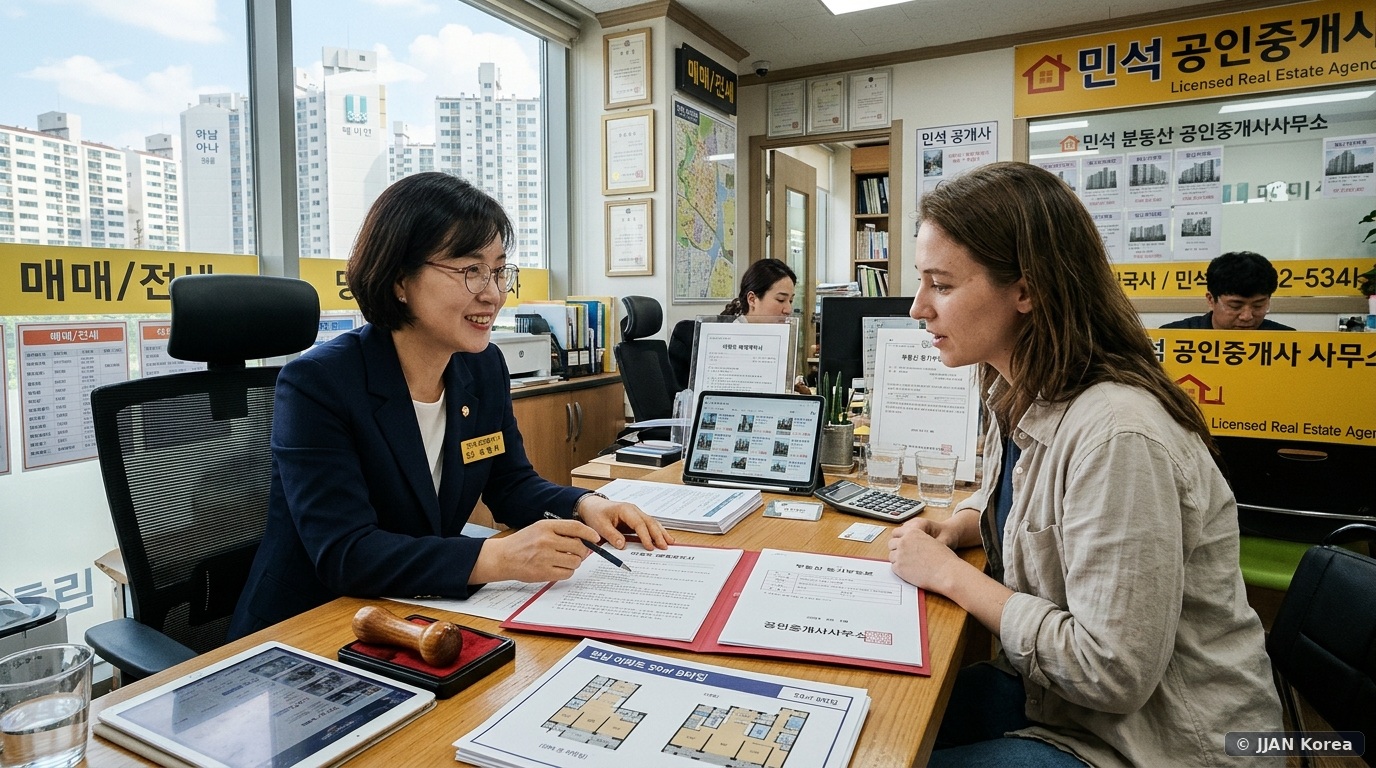
For international foreign residents, expatriate executives, and cross-border investors, one of the most persistent financial myths in East Asia is that non-citizens cannot legally own private property in South Korea. The reality, codified in the Act on Report on Real Estate Transactions (Real Estate Foreigner Acquisition Act), is astonishingly liberal: South Korea is one of the few developed nations in Asia that imposes virtually zero statutory restrictions on foreign property ownership. Non-citizens—regardless of whether they hold long-term visas or are non-resident foreign nationals living overseas—can purchase freehold high-rise apartment units (Apateu), commercial office buildings, luxury villas, and residential land plots with identical legal title protections granted to Korean citizens. However, navigating the strict banking foreign exchange reporting frameworks, acquisition deed taxes, and loan-to-value (LTV) mortgage regulations requires rigorous financial planning.
1. Legal Classification: Foreign Resident (Geoju-ja) vs. Non-Resident Buyers
While the right to purchase real estate is universal, South Korean law segregates foreign purchasers into two distinct categories that govern foreign exchange filings and banking procedures:
| Legal Classification | Residency & Visa Status | Governing Legislation | Mandatory Real Estate Reporting Procedure |
|---|---|---|---|
| Foreign Resident (Geoju-ja / 거주자) | Holds active ARC; resided in Korea for 6+ months (E-7, F-2, F-5, F-6) | Act on Report on Real Estate Transactions | Standard real estate transaction report filed at District Office (Si/Gun/Gu) within 30 days of signing |
| Non-Resident Foreigner (Bi-geoju-ja / 비거주자) | Tourists (B-1/B-2), short-term visa holders, or overseas investors | Foreign Exchange Transactions Act (FETA) | Must file Real Estate Acquisition Declaration with a Foreign Exchange Bank (Bank of Korea) prior to fund transfer |
| Designated Military / Heritage Zones | Properties located near military bases, DMZ zones, or cultural heritage sites | Article 9 of Real Estate Transaction Act | Pre-Approval Permit Required from local district mayor prior to executing purchase contract |
Before transferring any earnest money deposits, by verifying building registry documents (등기부등본) before signing contracts, prospective buyers must examine the certified title register at the Supreme Court Registry Office to confirm zero hidden liens, senior collateral mortgages, or tax foreclosures on the property.
2. Financing the Purchase: Mortgages, LTV Caps & DSR Thresholds
The single greatest hurdle foreign buyers face in the Korean market is securing a commercial mortgage (Jutaek Dambo Dae-chul). The Financial Services Commission (FSC) enforces aggressive anti-speculation lending limits designed to curb skyrocketing housing prices across the Seoul Metropolitan Area:
- Loan-to-Value (LTV) Ceilings: In regulated speculative areas (such as Gangnam, Seocho, Songpa, and Yongsan districts), commercial banks restrict mortgage lending to a maximum 50% LTV for first-time home buyers. Non-regulated metropolitan districts permit up to 70% LTV. This means buyers must have at least 30% to 50% of the entire purchase price in liquid, unencumbered cash.
- Debt Service Ratio (DSR 40% Cap): Under statutory DSR regulations, your total annual principal and interest debt repayments across all loans cannot exceed 40% of your verified annual taxable income reported on your National Tax Service Certificate of Income Amount (Sodeuk Geumaek Jeungmyeongwon). Foreigners without domestic Korean taxable income cannot qualify for domestic commercial mortgages.
- Bringing Funds from Abroad (Foreign Capital Declaration): If wire-transferring funds from your home country to finance the purchase, you must designate a primary “Foreign Exchange Bank” (such as Shinhan, KEB Hana, or Woori Bank). By navigating international wire declarations and foreign capital certificates, you obtain an official “Confirmation of Remittance of Foreign Funds” (Oeguk Hwanjeon Jeungmyeongseo), which guarantees the legal right to repatriate all sale proceeds and capital gains back to your home country upon selling the property in the future.
3. Closing Costs: Acquisition Tax, Brokerage Fees & Bond Stamps
Purchasing Korean real estate entails mandatory closing costs that must be paid in cash at settlement:
| Expense Category | Standard Statutory Rate | Calculation Baseline & Timing |
|---|---|---|
| Acquisition Tax (Chwi-deuk-se – 1 Home) | 1.0% ~ 3.0% (depending on purchase price) | 600M KRW or less: 1% / 600M~900M: 1~3% / 900M+: 3% |
| Local Education Tax & Rural Special Tax | 0.1% ~ 0.5% | Surcharge levied on top of base acquisition tax |
| Multi-Homeowner Surcharge Tax | 8.0% to 12.0% (PUNITIVE) | Applies if purchasing a 2nd or 3rd residential home in regulated zones |
| Licensed Real Estate Broker Fee (Bokbi) | 0.4% ~ 0.7% (Statutory maximum cap) | Negotiable sliding scale paid upon final contract closing |
| Judicial Scrivener (Beopmusa) Title Fee | approx. 500,000 ~ 1,200,000 KRW | Handles deed registration at District Court Registry Office |
| National Housing Bonds (Gungmin Jutaek Chaekwon) | approx. 1.5% ~ 2.5% of official assessed value | Government bonds purchased and immediately discounted at market rate |
4. Foreign Exchange Transactions Act Reporting & Certified Judicial Scrivener Closing
One of the most complex procedural hurdles foreign nationals face when purchasing residential property in South Korea is strict compliance with the Foreign Exchange Transactions Act (FETA – 외국환거래법). If you are financing a property transaction utilizing offshore capital, every overseas bank wire remittance must be declared in advance to a designated primary foreign exchange bank (such as Shinhan, Woori, Hana, or KB Kookmin) before the funds touch Korean escrow accounts.
Non-resident buyers must file a formal Real Estate Acquisition Notification for Foreigners (Oegukin Budongsan Chwideuk Singo) with the foreign exchange branch of the Bank of Korea or an authorized Tier-1 commercial bank. Attempting to transfer hundreds of millions of KRW across borders without formal FETA clearance constitutes a felony violation of foreign exchange laws, resulting in harsh criminal penalties and forfeiture of your legal right to register title ownership at the local District Court Registry Office (Deung-gi-so).
On closing day (Jan-geum-il), both buyer and seller convene at the licensed real estate agency office alongside a licensed Judicial Scrivener (Beop-mu-sa – 법무사). The Beopmusa serves as an impartial legal officer responsible for inspecting real-time certified copies of the Property Title Register (Deunggibudeungbon) to ensure zero undisclosed mortgages (Geunjeodang), provisional attachments (Aamnyu), or tax liens were placed on the apartment between contract signing and final settlement.
Once the final balance is electronically wired, the Beopmusa immediately collects the seller’s original deed stamp certificate (In-gam Jeung-myeong-seo) and physically delivers the deed transfer dossier to the competent registry court. Within 3 to 5 business days, the official Certificate of Real Estate Title Ownership (Deunggi Piljeung – 등기필증) is issued in the foreign buyer’s legal Romanized passport name and ARC number, providing absolute, incontestable fee-simple ownership rights recognized under South Korean civil law.
Post-acquisition annual taxation involves two recurring municipal and national taxes: Property Tax (Jae-san-se – 재산세) assessed every July and September, and the Comprehensive Real Estate Holding Tax (Jong-hab Bu-dong-san-se – 종부세) assessed every December. Foreign homeowners residing in Korea enjoy identical tax deductions and valuation thresholds as Korean nationals, including generous senior citizen tax deferrals and primary residence homestead exemptions on properties valued under 1.2 billion KRW.
4. Frequently Asked Questions (FAQ)
Q1: Does buying real estate in South Korea automatically grant me a residency visa?
No, purchasing standard residential apartments in Seoul does not automatically grant residency rights. However, South Korea operates a specialized Real Estate Investment Immigration System (REIIS): purchasing designated government-approved luxury resort properties or condo units in special tourist zones (such as Jeju Island, Incheon Songdo, or Yeosu) valued at 1,000,000,000 KRW (approx. 750,000 USD) or higher grants an F-2 Long-Term Residency Visa, which converts to unconditional F-5 Permanent Residency after 5 years of ownership.
Q2: Can foreign buyers rent out their property through the “Jeonse” system?
Yes! Foreign property owners enjoy the exact same rights as domestic landlords, including renting out apartments under monthly lease (Wolse) or lump-sum deposit lease (Jeonse – 전세). However, landlords are legally required to register their lease contracts with the local district office within 30 days under the Mandatory Lease Reporting System.
Q3: How is property title deed ownership proven in South Korea?
South Korea does not use physical paper deeds to prove ultimate ownership. Ultimate legal ownership is recorded electronically in the centralized Supreme Court Real Estate Registry (Deung-gibu Deung-bon). Once your judicial scrivener (Beopmusa) completes registration, you receive a security document called the Deed Certificate of Title (Deung-gi Pil-jeung / Deung-gi Gwon-ri-jeung) containing encrypted security pin codes used for future sales.
Q4: Do foreigners pay higher capital gains tax when selling real estate?
If you are a tax resident of South Korea (residing 183+ days per year), foreign homeowners are taxed at the exact same progressive capital gains tax rates (Yangdo Sodeukse – 6% to 45%) as Korean citizens. Furthermore, if you own only one residential home continuously for more than two years, you can qualify for the massive 1-House Tax Exemption (Il-jutaek Bi-gwase), exempting capital gains on sales up to 1.2 billion KRW from all income taxes.
🛡️ JJAN Korea Editorial Standards & Fact-Checking Verification
This legal and financial property acquisition guide has been authored and verified by Finance Editor Seo-jun Kim following statutory regulations published by the Ministry of Land, Infrastructure and Transport (MOLIT) and the Bank of Korea (BOK).
- Foreigner acquisition reporting frameworks verified under Article 8 of the Act on Report on Real Estate Transactions.
- Cross-border foreign currency declaration rules audited in accordance with the Foreign Exchange Transactions Act (FETA).
- Acquisition and capital gains tax brackets cross-referenced with National Tax Service (Hometax) Real Estate Tax Schedules.