South Korea’s public transit infrastructure—centered around the seamless contact-free RFID payment ecosystem of T-Money, Cashbee, and the revolutionary Seoul Climate Card—is universally recognized as the fastest, cleanest, and most technologically advanced transit network in the world. However, every month, thousands of foreign residents and tourists face an unexpected crisis: dropping their card down a train track gap, sitting on a wallet and cracking the internal copper RFID antenna, or tapping a reader only to hear the dreaded electronic error screech: “Ka-deu-reul da-si daejuseyo” (Please tap card again). What happens to the 40,000 won in prepaid balance loaded onto a malfunctioning card? Can a foreigner recover lost card funds? Navigating South Korea’s transit card warranty networks, station master offices (Yeokmu-sil), and automated refund envelopes ensures you never forfeit your hard-earned money.
1. The Two Scenarios: Physically Malfunctioning vs. Lost/Stolen Cards
Your legal right to recover funds loaded onto a Korean transit card depends fundamentally on whether you hold the physical plastic in your hand:
| Transit Card Scenario | Physical Card Present? | Refund Possibility | Official Settlement Channel & Process |
|---|---|---|---|
| Defective / Broken Card (Go-jang Ka-deu) | YES (Cracked, bent, unreadable RFID chip) | 100% Full Balance Refunded | Subway Station Master Office ➔ Mail Malfunction Envelope to T-Money |
| Unregistered Anonymous Plastic Card (Lost) | NO (Dropped, misplaced on train) | 0% (Cannot be refunded) | Treated as lost physical cash banknotes under Korean commercial law |
| Registered T-Money Card (Lost/Stolen) | NO (Card registered on T-Money website) | Remaining Balance Refunded | Log into T-Money portal ➔ Report Lost Card (Bunshil Singo) ➔ Balance frozen |
| Seoul Climate Card (Digital Mobile Version) | N/A (Stored in Android Google/Samsung Wallet) | 100% Protected | Re-log into Mobile T-Money app on new phone; active period restored |
By comparing replacement policies between digital phone cards and physical plastic passes, foreign residents utilizing Android smartphones enjoy maximum security because digital Climate Cards and mobile T-Money passes are bound to your verified telecom mobile identity rather than a vulnerable piece of plastic.
2. Step-by-Step Walkthrough: The Malfunction Envelope (Gojang Hwanbul Bongtu)
If your physical plastic transit card suddenly stops scanning at turnstiles and displays “Card Not Recognized”, follow this exact protocol to claim every single won:
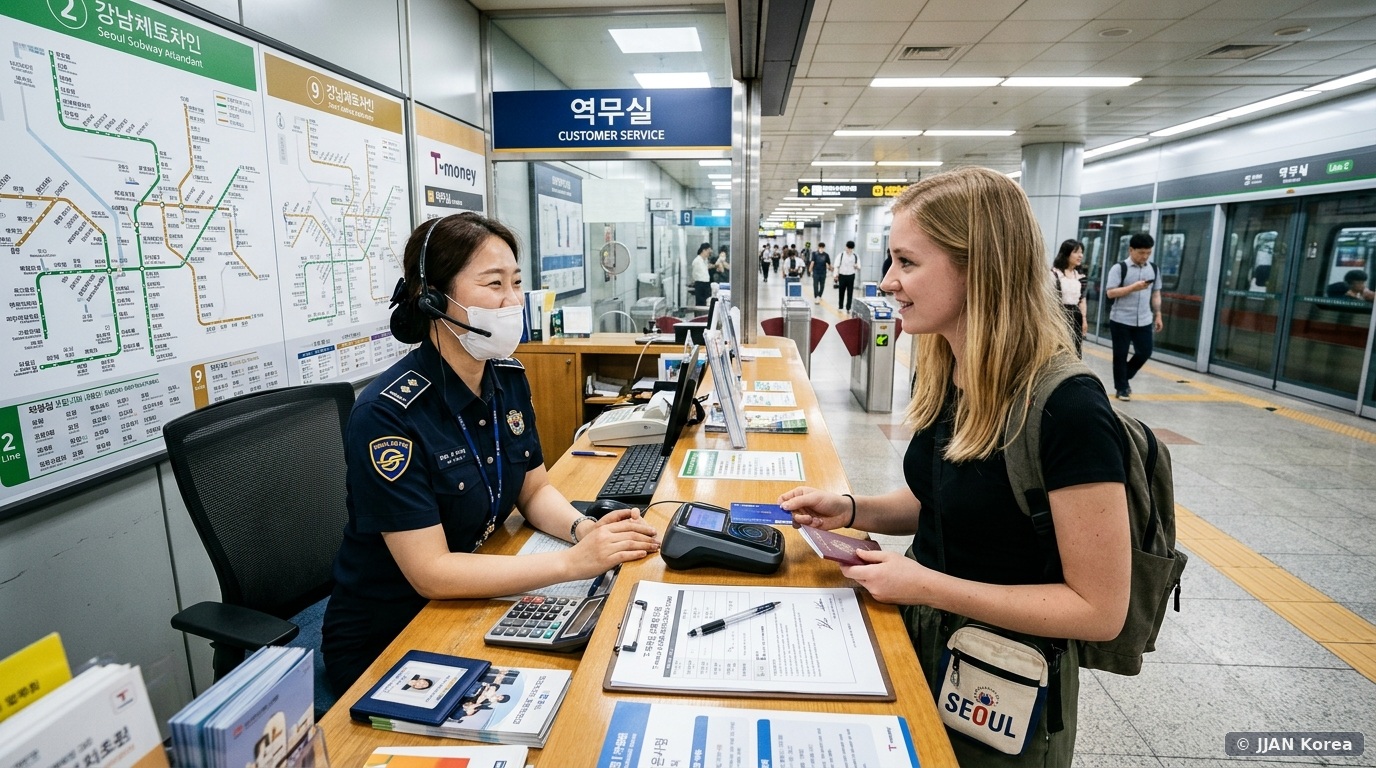
- Step 1: Locate the Station Master’s Office (Yeok-mu-sil – 역무실): In any Seoul subway station, locate the station office (usually located beside the ticket turnstiles or customer service gate). Press the call button beside the disabled gate and say: “Ka-deu-ga in-sik-i an dwae-yo” (The card is not recognized).
- Step 2: Request a Malfunction Refund Envelope: The station attendant will place your card on an official diagnostic reader. If the reader cannot read the internal chip, they will hand you an official postage-paid T-Money Malfunction Refund Envelope (고장카드 환불봉투).
- Step 3: Fill Out the Form in English: Fill out the form printed on the back of the envelope: enter your name, Korean mobile phone number, and your domestic Korean bank account number (or your friend’s Korean bank account if you don’t have one).
- Step 4: Drop into Any Red Postal Mailbox: Insert your defective plastic card into the envelope, seal it, and drop it into any red Korea Post mailbox on the street or hand it to a postal clerk. Postage is 100% pre-paid by T-Money Corporation.
- Step 5: Direct Bank Deposit: T-Money’s forensic engineering lab retrieves the encrypted balance data directly from the physical silicon chip. Within 5 to 7 business days, the entire remaining balance—plus a 2,500 KRW cash refund for the original card purchase price if the card broke within its 2-year warranty period without external physical damage—is wired directly into your bank account!
3. Lost on a Train? Recovering Physical Cards via Lost112
If you dropped your card or left your wallet inside a subway train car, do not assume it is gone forever. South Korea’s integrated lost property network recovers thousands of wallets and transit cards daily.
By tracking misplaced transit cards through national subway lost and found centers, remember your train car details: note the exact subway station you exited, the exact time, the direction of the train (e.g., Line 2 toward City Hall), and the four-digit car number printed above the carriage doors. Inform station staff immediately; they will telephone the terminal depot to have cleaning crews search your exact row of seats.
4. Moving Out of Korea? How to Cash Out Remaining Balances
If you are permanently leaving South Korea and have a functional plastic T-Money card loaded with excess money, you can cash out your balance instantly:
- Balances Under 20,000 KRW (Instant Convenience Store Cashout): Walk into any GS25, CU, 7-Eleven, or Emart24. Hand your card to the clerk and say: “Hwan-bul hae-ju-se-yo” (Please refund this). The cashier taps the card, deducts a nominal statutory 500 KRW processing fee, and hands you the entire remaining balance in crisp physical cash banknotes.
- Balances Under 50,000 KRW: Can be refunded in cash at designated Seoul Metro Station Customer Service Centers.
- Balances Exceeding 50,000 KRW: Must be processed at the T-Money Headquarters Customer Lounge (located near Seoul Station Exit 10) or through the mail refund envelope process.
5. Pre-Emptive Online Card Registration & International Resident Balance Recovery
The single greatest operational vulnerability with physical rechargeable transit cards in South Korea—including standard T-Money, Cashbee, and Rail+ cards—is that anonymous, unregistered cards function exactly like physical cash banknotes. If an unregistered physical card slips out of your pocket or wallet onto a train seat, whoever finds it can spend its pre-loaded balance at convenience stores or subway turnstiles with zero security verification, leaving the original owner with zero legal claim or recovery mechanism.
To eliminate this financial risk, every foreign resident holding an Alien Registration Card (ARC) or domestic mobile phone identity (PASS/Kakao certification) should immediately register their card on the official T-Money Website (pay.tmoney.co.kr). By logging into the portal and pairing your 16-digit card number with your legal domestic identity, you activate comprehensive theft and loss protection under the “Safe Transit Card” program.
Once registered, if your physical card is lost or stolen, you can immediately log into the mobile app or call the T-Money Customer Center (1644-0088) and report a “Suspension of Stolen/Lost Transit Card” (Bunshil/Donaan Singo). T-Money electronically freezes the transit balance within 24 to 48 hours across the national transportation clearinghouse, locking out unauthorized use. The remaining balance (minus a minor 500-won electronic administrative processing fee) is then directly wired to your Korean bank checking account.
For international tourists traveling on short-term 90-day tourist visas without local bank accounts or domestic mobile authentication, online balance recovery is not supported. In such cases, if you lose an anonymous card, your sole recourse is visiting the nearest Seoul Metro Subway Station Customer Service Center (Gogaek An-nae Center) and filing an on-site lost property report through the police-integrated Lost112 System, specifying the unique 16-digit card number printed on your purchase receipt.
5. Frequently Asked Questions (FAQ)
Q1: Can I register an anonymous physical T-Money card online to protect my balance?
Yes! Anyone holding an Alien Registration Card (ARC) can create an account on the official T-Money website (www.t-money.co.kr) and register the 16-digit card number printed on the back. Registering your card provides two major benefits: (1) You earn automatic 30% public transit income tax deductions (So-deuk Gong-je) on your year-end taxes, and (2) If the card is lost, you can report it to freeze the remaining balance.
Q2: What happens if my Seoul Climate Card cracks halfway through its 30-day period?
If a physical Climate Card is physically defective, take it to a subway station master’s office. Staff will calculate your pro-rated unused days (deducting the days already used and a 500 KRW fee) and issue an official refund slip to return funds to your bank account, while transferring your remaining validity to a new card.
Q3: Can a convenience store clerk refund a cracked card?
No. Convenience store point-of-sale registers can only process refunds if the card’s RFID chip scans successfully on their contactless pad. If the chip is dead or cracked, convenience stores cannot help; you must use the postal Malfunction Refund Envelope provided at subway station offices.
Q4: Why does my transit card say “Insufficient Balance” when transferring to a bus?
Under Korean transit transfer discount rules (Hwan-seung), you must maintain a minimum threshold balance of at least 250 KRW on your card when tagging out of a bus or subway; otherwise, the automated transfer discount terminates and the reader blocks the exit turnstile.
🛡️ JJAN Korea Editorial Standards & Fact-Checking Verification
This public transit card balance recovery and refund guide has been authored and verified by Tech & Systems Editor Min-jun Kim following statutory regulations published by T-Money Corporation and the Seoul Metropolitan City Transportation Operations Department.
- Malfunction refund policies and consumer warranty durations cross-checked with T-Money Card Terms of Use.
- Subway lost and found dispatch procedures verified via Seoul Metro Customer Service Center.
- Electronic financial transaction protections audited under the Electronic Financial Transactions Act.