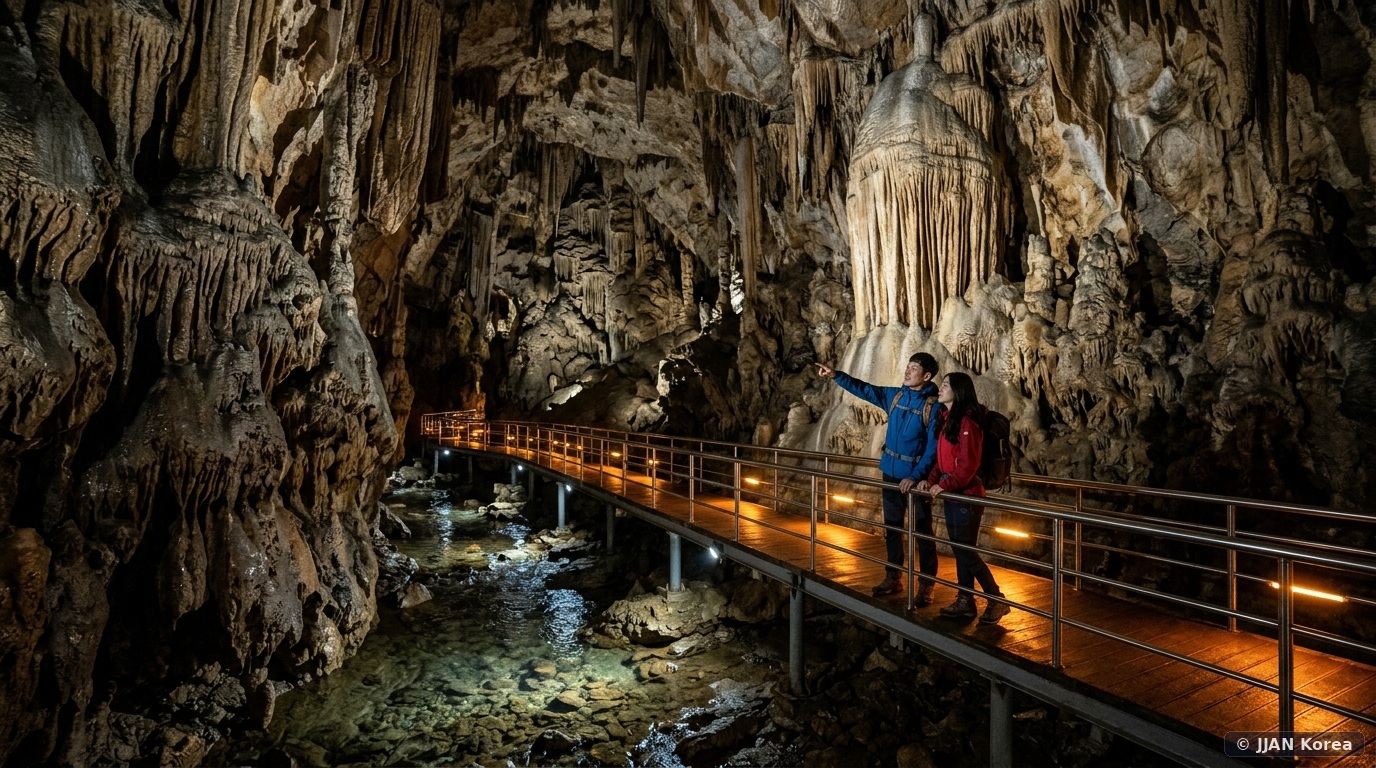
Tucked deep within the dramatic limestone karst peaks of the Taebaek Mountain Range in southern Gangwon Province lies one of South Korea’s most awe-inspiring subterranean geological wonders: Hwanseongul Cave (환선굴) in Samcheok. Formed more than 530 million years ago during the early Paleozoic Era, this colossal limestone cavern is officially recognized as the largest natural limestone cave in South Korea and one of the most voluminous subterranean cave chambers in all of Asia. While the subterranean labyrinth extends for over 6.2 kilometers into the mountain bedrock, a meticulously engineered 1.6-kilometer elevated steel pathway allows visitors to venture deep into a subterranean cathedral of thundering underground waterfalls, ancient calcified stalactites, monumental flowstone draperies, and mystical subterranean rimstone pools. For travelers seeking an adventure beyond Seoul, visiting Hwanseongul combined with coastal Samcheok provides an unforgettable off-the-beaten-path escape.
1. The Ancient Karst Geology: 530 Million Years of Stalactites and Flowstone
Designated as South Korea’s Natural Monument No. 178, Hwanseongul is a living geological classroom. The cave was hollowed out by ancient subterranean rivers dissolving massive beds of marine limestone over hundreds of millions of years. Inside, the cavern dimensions are monumental: main chambers soar up to 100 meters high and span over 40 meters wide, creating a sense of subterranean scale that dwarfs human visitors.
| Geological Feature | Dimensions / Description | Notable Cave Formations |
|---|---|---|
| Main Cathedral Chamber | Height: up to 100m / Width: up to 40m | Monumental open cavern with natural acoustics |
| Subterranean Waterfalls | Cascades dropping 5m to 10m through bedrock | Thunderous rushing underground mountain rivers |
| Giant Flowstone Draperies | Curving calcite sheets spanning 20+ meters | “Maria Statue” stalagmite, “Lion Rock”, “Dream Palace” |
| Internal Atmospheric Climate | Year-round temperature: 10°C ~ 14°C | Cool refreshing sanctuary in summer; warm refuge in autumn |
Local folklore adds an aura of Taoist mysticism to the cavern. According to local legend, a beautiful Taoist hermit entered the deep cavern hundreds of years ago to practice meditation and spiritual cultivation, eventually transforming into an immortal fairy (Hwanseon – 환선) and vanishing into the rock. The cave’s name translates literally to “Cave of the Reincarnated Immortal.”
2. The Ascent: Riding the Steep Scenic Karst Monorail
The entrance to Hwanseongul is perched high on a sheer limestone cliff at an altitude of 500 meters above sea level. Visitors have two choices to reach the mouth of the cave: a strenuous 45-minute uphill mountain stair trek, or riding the Hwanseongul Scenic Monorail (환선굴 모노레일).
The bright yellow panoramic glass monorail car glides up a 400-meter track pitched at an astonishing 30-degree vertical incline through the forested mountain canyon. The 6-minute ride offers breathtaking panoramic views of jagged limestone karst peaks framed by blazing red and golden autumn foliage, delivering riders smoothly to the massive gaping stone portal of the cave.
3. Navigating the Subterranean Circuit: Suspension Bridges & Rimstone Pools
Inside the cave, a 1.6-kilometer loop trail is constructed from non-slip galvanized steel grating with solid safety railings, illuminated by subtle eco-friendly LED trail lights that protect delicate cave mosses. The tour takes approximately 1 hour to 1 hour and 15 minutes to complete.
- The Bridge of Hell (Ji-ok-gyo): A dramatic steel suspension bridge crossing over a churning, roaring subterranean abyss where an underground river plunges into darkness below your boots.
- The Maria Statue Stalagmite: A delicate, translucent white stalagmite formation that has grown over millennia into the uncanny, elegant silhouette of the Virgin Mary holding an infant child, illuminated by a dedicated spotlight.
- Terraced Rimstone Pools (Gurok-pot): Stepped pools of crystal-clear turquoise mineral water resembling miniature underground rice paddies, formed by calcium carbonate precipitating along pool edges over tens of thousands of years.
- Rare Subterranean Fauna: Hwanseongul is an ecologically protected biosphere home to over 47 species of specialized troglobitic cave creatures, including blind cave spiders, transparent cave crickets, and colonies of eastern bent-wing bats roosting in high ceiling crevices.
4. Samcheok Coastal Gastronomy & Transportation Options
After emerging from the cavern, take time to explore the stunning coastal scenery and culinary treasures of Samcheok. By combining Gangneung coastal coffee tours with Samcheok cave explorations, you can travel down the scenic coastal rail line between Gangneung and Samcheok.
Head to Samcheok Port (Jeongra-jin) to savor Gomchiguk (곰치국 – Moray Eel Soup), a legendary local maritime delicacy featuring velvety, melt-in-your-mouth eel simmered in a spicy, sour aged kimchi broth that warms your entire body after exploring the chilly cave. Furthermore, by renting a rental car to easily explore Gangwon-do’s mountainous coast, you can smoothly connect Hwanseongul with Samcheok’s famous Marine Cable Car and scenic ocean rail bikes.
5. Subterranean Microclimates, Photography Protocol & Coastal Ocean Railbike Connections
Venturing inside Hwanseongul Cave transports visitors into a prehistoric geological sanctuary characterized by a constant subterranean microclimate. Regardless of exterior weather fluctuations—whether the autumn sun warms the Taebaek valley to 22°C or an early mountain frost sets in—the interior cavern maintains an unvarying temperature between 10°C and 14°C (50°F–57°F) with relative humidity hovering near 95% year-round. This constant cool dampness causes rapid condensation on camera lenses and skin.
To ensure comfortable exploration across the 1.6-kilometer elevated steel pathway, dress in layered thermal athletic wear topped with a water-resistant shell. Water droplets impregnated with dissolved calcium bicarbonate constantly drip from soaring limestone stalactite ceilings, earning these formations their poetic Korean moniker: “Cave Tears” (Donggul-ui Nunmul). Wear non-slip rubber-soled trail shoes; the galvanized steel mesh walkways can be slick from continuous subterranean seepage.
From a photography perspective, Hwanseongul strictly prohibits the use of professional heavy tripods and external lighting rigs along the narrow metal catwalks to prevent pedestrian congestion. To capture the monumental scale of the cave’s cathedral-like chambers—some soaring over 100 meters high—rely on modern camera sensor image stabilization (IBIS) and fast prime lenses with wide apertures of f/1.8 to f/2.8. Adjust white balance manually to 4,200K to preserve the natural golden and turquoise glow of the cave’s installed ambient LED uplighting.
After completing your 90-minute underground circuit, descend via the monorail and catch local Samcheok City Bus 60 or a 30-minute taxi down to Gungchon Station to ride the famous Samcheok Ocean Railbike (삼척 해양레일바이크). This 5.4-kilometer twin-track pedaling course traces the coastal pine forests and crashing emerald surf of the East Sea, weaving through multi-colored laser illumination tunnels that celebrate Gangwon-do’s maritime culture, providing an exhilarating contrast to the subterranean depths of the karst cavern.
For an authentic coastal culinary conclusion, head to nearby Samcheok Port (Samcheok-hang) where local seafood markets serve freshly steamed East Sea Snow Crab (Daege) and spicy-sour chilled raw fish soup (Mulhoe). Savoring fresh maritime delicacies while watching fishing trawlers unload their daily catch provides the ultimate seasonal reward after an exhilarating day of mountain cavern exploration.
If time permits before catching the evening KTX from Donghae Station, venture 15 minutes south to Jangho Port (장호항), celebrated by Korean travelers as the “Naples of Korea.” Sheltered by dramatic sea stacks and pine-topped islets, the crystalline turquoise cove offers transparent sea kayaking and a coastal marine cable car soaring high above the crashing East Sea surf. Walking along the dramatic wooden boardwalk over crashing turquoise waves provides breathtaking coastal panoramic views, sealing an extraordinary Gangwon autumn adventure. Booking roundtrip train tickets in advance through the official Korail Talk mobile app guarantees reserved window seats facing the sparkling East Sea coastline.
5. Frequently Asked Questions (FAQ)
Q1: What should I wear inside Hwanseongul Cave?
Because the cave interior remains at a constant 10°C to 14°C (50°F to 57°F) year-round with high humidity and water dripping from the ceiling, wear a windproof light jacket or fleece sweater. Sturdy walking sneakers or hiking shoes with non-slip rubber soles are mandatory; steel grating walkways can be damp and slippery.
Q2: Is the cave accessible for strollers or wheelchairs?
No. The interior walking circuit consists of approximately 400 steel steps, narrow bridges, and varying elevations. Strollers and wheelchairs cannot navigate the course and must be left at the ticket office.
Q3: How much do tickets cost for Hwanseongul Cave and the Monorail?
Cave admission is 4,500 KRW for adults. The scenic monorail is operated independently and costs 7,000 KRW for a round-trip adult ticket (or 4,000 KRW one-way). Combined adult cost is approximately 11,500 KRW.
Q4: Can I visit neighboring Dae-geum-gul Cave on the same day?
Daegeumgul Cave is located in the same valley just 1 kilometer away. However, unlike Hwanseongul (which permits walk-in ticketing), Daegeumgul requires advance online reservations via the Samcheok Tourism website due to strict daily visitor caps to preserve fragile crystal cave formations.
🛡️ JJAN Korea Editorial Standards & Fact-Checking Verification
This Samcheok Hwanseongul geological travel guide has been researched and verified by Travel Editor Do-jun Kim following documentation provided by the Samcheok City Tourism Division and the Korea Institute of Geoscience and Mineral Resources (KIGAM).
- Cave monument conservation status verified under Natural Monument No. 178 protective guidelines.
- Monorail operating hours and safety inspection certificates confirmed with Samcheok Urban Corporation.
- Subterranean biodiversity records cross-checked with the National Institute of Biological Resources (NIBR).