
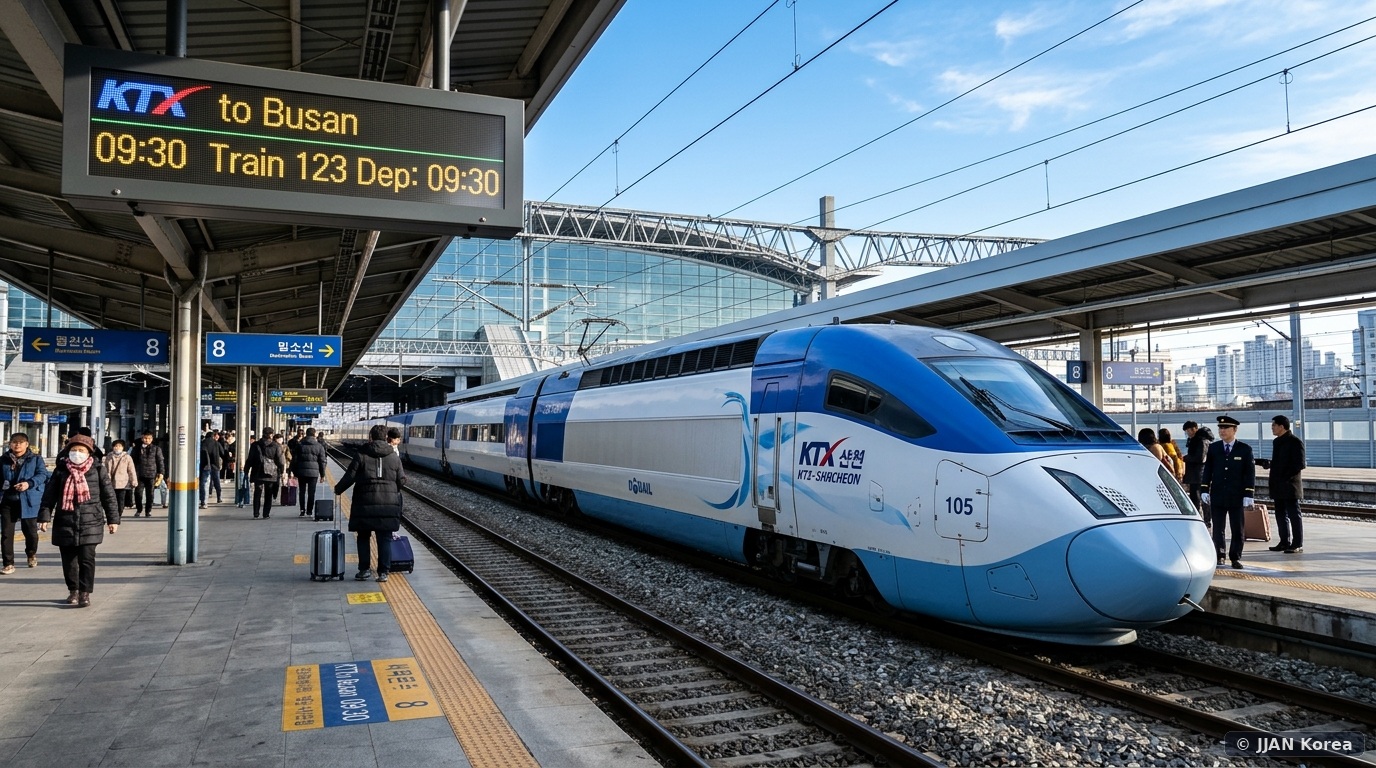

Gliding through the picturesque South Korean countryside at blistering speeds of 305 kilometers per hour, the KTX (Korea Train eXpress) is the undisputed jewel of the country’s national intercity transportation network. Operated by the state rail authority Korail (한국철도공사), high-speed rail links downtown Seoul to the southern port metropolis of Busan in just 2 hours and 15 minutes, turning multi-day journeys into effortless day trips.
However, for international travelers planning expeditions across the peninsula, booking train tickets can quickly become an exercise in frustration. Third-party travel agencies frequently charge inflated 20% to 30% commission surcharges, high-demand weekend holiday trains sell out weeks ahead, and confusion between the Korail-operated KTX and the private SRT (Super Rapid Train) leads travelers to the wrong departure terminal. This comprehensive, field-tested guide provides step-by-step instructions for booking official zero-commission tickets, evaluating the Korail Pass, and mastering standing ticket hacks in 2026.
1. KTX vs. SRT: Understanding Korea’s High-Speed Rail Operators
Before purchasing your ticket, you must confirm which high-speed rail line and terminal matches your hotel location in Seoul:
| Parameter | KTX (Korea Train eXpress / 코레일) | SRT (Super Rapid Train / 에스알티) |
|---|---|---|
| Primary Seoul Terminals | Seoul Station (서울역) & Yongsan Station (용산역) | Suseo Station (수서역) in southeastern Gangnam |
| Operating Entity | Korail (State-owned national enterprise) | SR Corporation (Private-public joint venture) |
| Seoul to Busan Fare | Standard: ₩59,800 | First Class: ₩83,700 | Standard: ₩52,600 | First Class: ₩76,300 (Approx. 10% cheaper) |
| Foreigner Booking Platform | LetsKorail.com & KorailTalk App (Full English / Global cards) | SRT Official App (Limited English, domestic card bias) |
| Multi-Day Tourist Rail Pass | KORAIL Pass accepted across all KTX lines | Not valid! SRT tickets must be bought individually |
| Best Destination Routing | Tourists staying in Myeongdong, Hongdae, Jongno, Yongsan | Expats & travelers based in Gangnam, Jamsil, or Bundang |
2. Step-by-Step Official Zero-Fee Booking on LetsKorail
Never pay third-party agency booking surcharges. The official Korail booking portal (LetsKorail.com) and the KorailTalk mobile app accept international Visa, Mastercard, JCB, and Amex credit cards with zero booking fees:
3. The Korail Pass: Mathematical Cost-Benefit Analysis
The KORAIL Pass is a dedicated unlimited rail pass sold exclusively to non-Korean foreign tourists and registered international students. It provides unlimited standard-class seating across all KTX and conventional commuter trains (ITX-Saemaeul, Mugunghwa) for a designated period:
2026 KORAIL Pass Price Matrix
- Consecutive 3-Day Pass: Adult (₩138,000) | Youth 12–25 (₩110,000)
- Consecutive 5-Day Pass: Adult (₩210,000) | Youth 12–25 (₩168,000)
- Select 2-Day Flexible Pass (Within 10 Days): Adult (₩121,000) | Youth (₩97,000)
- Select 4-Day Flexible Pass (Within 10 Days): Adult (₩193,000) | Youth (₩154,000)
The Golden Math Rule: A standard round-trip ticket between Seoul and Busan costs ₩119,600 (₩59,800 each way). If you are only traveling from Seoul to Busan and back, the Select 2-Day Pass (₩121,000) or Consecutive 3-Day Pass (₩138,000) is more expensive than purchasing individual tickets!
When Does the Pass Win? The Korail Pass delivers massive financial savings if your itinerary connects three or more distant cities within the pass window: for example, Seoul ➔ Jeonju ➔ Gyeongju ➔ Busan ➔ Seoul. In this multi-leg scenario, individual tickets exceed ₩190,000, saving you over ₩50,000. While visiting Seoul between train legs, navigate the city with our Seoul Climate Card vs. T-Money comparison.
4. Sold-Out Trains: Standing Ticket Hacks & Waiting Lists
During peak holiday periods (Chuseok, Lunar New Year, summer beach weekends), KTX trains sell out weeks in advance. If your screen shows “Sold Out (매진)” across all departures, deploy these three counter-measures:
5. Onboard Experience: Amenities, Wi-Fi & Luggage Storage
The modern KTX fleet features top-tier passenger conveniences:
- Luggage Storage Strategy: Large 28-to-30-inch hard-shell suitcases will not fit in the overhead luggage racks above your seat. When boarding, place oversized bags in the heavy luggage racks located at the end of every passenger carriage. Backpacks and carry-on bags fit easily overhead.
- Electrical Outlets & USB Ports: In modern KTX-Sancheon and KTX-Eum trains, every seat features dedicated 220V power outlets and USB ports positioned between seat backs or beneath the center console. Older classic KTX-1 trains feature outlets only along window pillars.
- Complimentary High-Speed Wi-Fi: Connect to the open “Korail Wi-Fi” network. The connection requires one-click authentication and refreshes every 30 to 60 minutes with unlimited re-connections.
6. Frequently Asked Questions (FAQ)
What happens if I miss my scheduled KTX departure?
Under Korail refund regulations, if you miss your train, you can present your mobile ticket to an official station ticket counter within 20 minutes of departure to receive a 70% refund of your ticket fare. Alternatively, counter staff can rebook you onto the next available departing train for a nominal exchange fee.
Can I eat and drink food inside the KTX train?
Yes. Eating and drinking beverages are fully permitted inside KTX train carriages. Travelers frequently purchase boxed meal sets (Dosirak), gimbap, and coffee at station concourse bakeries to enjoy at their pull-down seat tables. However, consuming strongly odorous foods (such as open cup ramen or pungent grilled fish) is considered bad passenger etiquette.
Can I bring my pet on the KTX high-speed train?
Small household pets (dogs, cats, small birds) weighing under 10kg are permitted inside passenger cars, provided they remain completely enclosed inside an approved pet travel carrier placed at your feet. Pets are not permitted to occupy adjacent passenger seats unless a separate child ticket is purchased for the carrier.
Is smoking or e-cigarettes permitted on board?
No. Smoking traditional tobacco or electronic vape pens is strictly prohibited throughout all train cars and restrooms under the Railroad Safety Act. Restroom smoke detectors trigger emergency braking systems, and violators face criminal fines up to ₩1,000,000.
🛡️ JJAN Korea Editorial Standards & Fact-Checking Verification
This article was independently researched, field-tested, and audited by the JJAN Korea Global Transit & Rail Desk in Seoul. Audited against official Korail ticketing terms, refund algorithms, and verified foreign payment gateways across KorailTalk and LetsKorail.
Notice an unlisted policy change, fare update, or revised administrative rule? Help us keep our international community accurately informed: Submit a Correction to our Seoul Newsroom.