
South Korea’s Labor Standards Act (Geunro Gijunbeop – 근로기준법) is one of the most strictly enforced labor frameworks in Asia, granting comprehensive statutory protections to all employees working within the country’s borders. Crucially for foreign residents, expatriates, and international students working part-time, the Labor Standards Act applies equally to foreign nationals regardless of citizenship, nationality, or visa type. Despite these statutory safeguards, foreign workers frequently encounter wage underpayment, improper withholding of overtime premiums, and the denial of mandatory Korean labor benefits such as the Weekly Holiday Allowance (Juhyu Sudang – 주휴수당). Knowing your precise legal entitlements, how to calculate complex statutory allowances, and the procedure for filing an official grievance with the Ministry of Employment and Labor (MOEL – 고용노동부) ensures you receive every won you have earned.
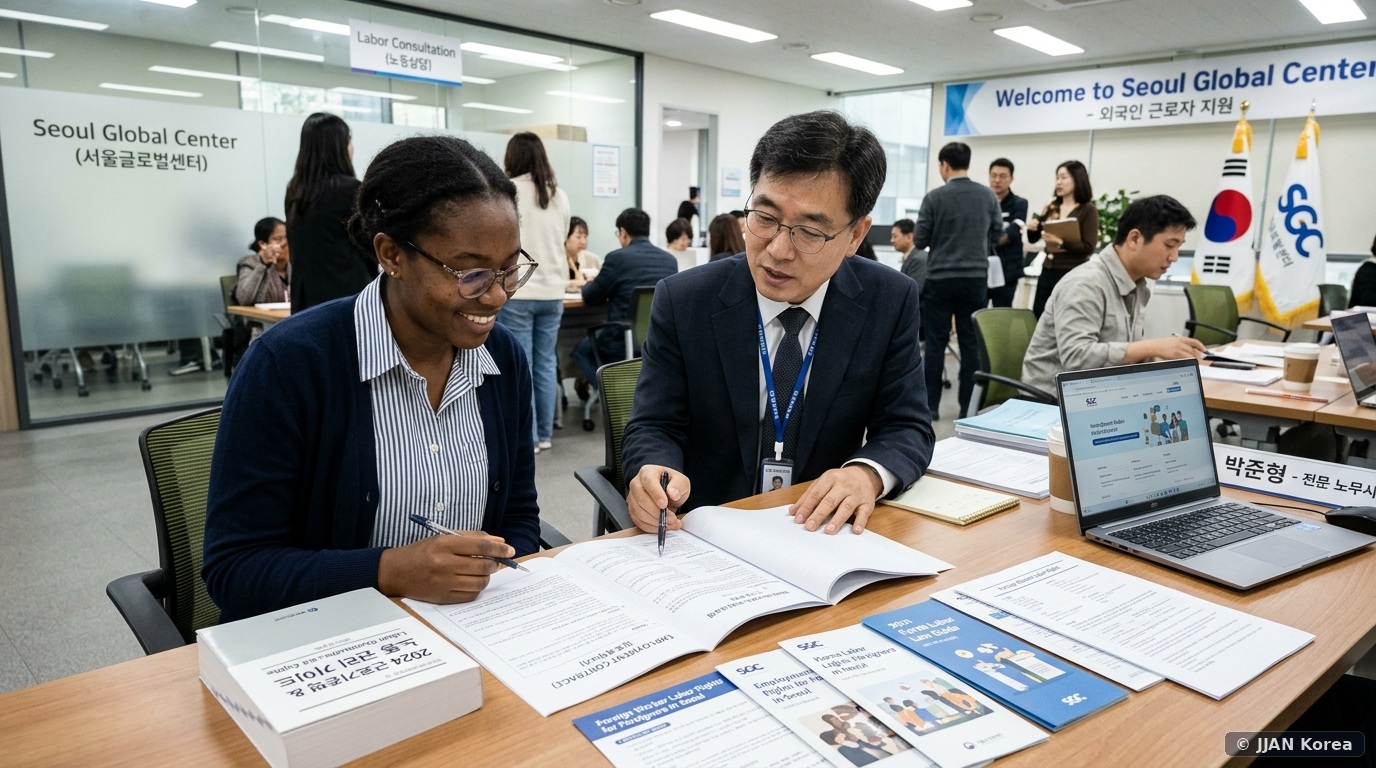
1. Weekly Holiday Allowance (주휴수당): The Mandatory Extra Day of Pay
One of the most unique aspects of South Korean labor law is the Weekly Holiday Allowance established under Article 55 of the Labor Standards Act. Under this statutory rule, any employee who meets two straightforward conditions is legally entitled to one paid rest day per week:
- Weekly Work Hours: You must be contracted to work a minimum of 15 hours or more per week.
- Perfect Contractual Attendance: You must fulfill all scheduled working days in that workweek without unexcused absences (Gongeun – 결근). Authorized sick leave or public holidays do not break perfect attendance.
If you work 40 hours per week (standard 8 hours/day, 5 days/week), your employer must pay you for 48 hours of wages. For part-time workers, the formula is calculated proportionally:
Weekly Holiday Allowance Formula:
(Total Weekly Contracted Hours / 40 Hours) x 8 Hours x Base Hourly Wage
For example, if you work 20 hours per week at the 2026 minimum wage of 10,030 KRW per hour, your weekly holiday allowance is: (20 / 40) x 8 x 10,030 = 40,120 KRW. Over a month, this adds approximately 160,000 to 180,000 KRW in extra wages that dishonest employers sometimes unlawfully omit from foreign worker payrolls.
2. Overtime, Night Work & Holiday Premium Pay Calculations
For workplaces employing 5 or more regular workers (5-in Isang Sa-eopjang – 5인 이상 사업장), the Labor Standards Act mandates strict overtime premium multipliers above your base hourly wage rate:
| Labor Category | Statutory Definition | Statutory Wage Multiplier | Effective Hourly Rate (At 10,030 KRW Min) |
|---|---|---|---|
| Standard Labor | Up to 8 hours/day or 40 hours/week | 100% (Base Rate) | 10,030 KRW / hr |
| Overtime Labor (Yeonjang Geunro) | Hours worked beyond 8h/day or 40h/week | 150% (Base x 1.5) | 15,045 KRW / hr |
| Night Labor (Yagan Geunro) | Hours worked between 10:00 PM and 06:00 AM | +50% Additional (Base x 0.5) | 15,045 KRW / hr (or 20,060 if overtime) |
| Holiday Labor (Hyu-il Geunro) | First 8 hours worked on statutory rest days | 150% (Base x 1.5) | 15,045 KRW / hr |
| Overtime on Holiday | Hours worked beyond 8 hours on a holiday | 200% (Base x 2.0) | 20,060 KRW / hr |
Crucially, these multipliers compound. If your employer schedules you to work overtime from 10:00 PM to midnight on a public holiday, your wage rate is: Base (100%) + Holiday (50%) + Overtime (50%) + Night (50%) = 250% of your hourly wage.
3. Employment Contracts & Mandatory Pay Slips (Geup-yeo Myeongsaeseo)
Under Article 17 of the Labor Standards Act, your employer must deliver a physical or electronic written employment contract (Pyojun Geunro Gyeyakseo – 표준근로계약서) upon hire detailing wage calculation methods, working hours, designated rest days, and annual leave allocations. As explained in our guide to E-7 visa sponsor employment contracts and minimum wage standards, signing a vague or unwritten agreement leaves you vulnerable to wage theft.
Furthermore, since November 2021, Korean law mandates that employers issue an itemized pay stub (Geup-yeo Myeongsaeseo – 급여명세서) every pay period. The pay slip must explicitly break down base pay, overtime allowances, weekly holiday pay, and mandatory 4-Major Insurance deductions (National Pension, Health Insurance, Employment Insurance, Industrial Accident Compensation). Employers who fail to issue itemized pay stubs face administrative fines up to 5,000,000 KRW per violation.
Remember that upon completing 12 consecutive months of employment, you also trigger an automatic statutory entitlement to mandatory severance pay (퇴직금) calculation after one year of work, amounting to at least 30 days of average daily wages for every year served.
4. How to File an Unpaid Wage Petition with MOEL (Step-by-Step)
If your employer refuses to pay proper overtime, withholds weekly holiday allowance, or delays your final paycheck past the statutory 14-day settlement deadline upon departure, you can file a formal labor petition (Jinjoseo – 진정서) with the Ministry of Employment and Labor:
- Step 1: Gather Evidentiary Documentation: Collect your written employment contract, monthly itemized pay stubs, bank statements proving actual wage transfers, transit card logs proving arrival times, kakao message records from managers assigning overtime, and GPS time-card logs.
- Step 2: Submit Petition Online or in Person:
- Online: Visit the MOEL Minwon Civil Service Portal (minwon.moel.go.kr) using a verified ARC or digital certificate.
- In Person: Visit the regional MOEL labor office (Jibang Goyong Nodong Cheong – 지방고용노동청) overseeing your company’s physical address. English translation assistance is available by calling the MOEL helpline at 1350.
- Step 3: Labor Inspector Tri-Party Summon (Samja Daemyeon): Within 2 to 3 weeks of filing, an assigned Labor Inspector (Geunro Gamdogwan) will summon both you and your employer to the regional labor office. The inspector cross-examines work records, calculates exact owed amounts, and issues a formal rectification order (Shijeong Jishi).
- Step 4: Criminal Referral & Wage Guarantee Fund: Employers who defy the inspector’s rectification order face criminal prosecution under labor law. If the company becomes bankrupt or insolvent, foreign workers can claim unpaid wages directly from the government through the Simple Substituted Wage Payment System (Ganyi Daedeupgeum – 간이대지급금).
5. Frequently Asked Questions (FAQ)
Q1: Does filing a labor petition against my employer jeopardize my visa status?
No. The Ministry of Justice maintains a strict policy protecting foreign workers asserting basic statutory wage rights. In fact, if your employer retaliates by firing you or canceling E-7/E-9 sponsorship, you are eligible to transfer to a G-1 temporary lawsuit/dispute visa while your labor case is adjudicated.
Q2: My contract says my salary is ‘inclusive’ of all overtime (Po-hwal Imgeum-je). Is that legal?
Comprehensive inclusive wage agreements (Pohwal Imgeumje – 포괄임금제) are heavily restricted by Korean courts. Even if your contract includes an estimated overtime clause, if your actual hours worked exceed the contractually stipulated overtime allowance, your employer is legally obligated to pay the difference based on actual time-card logs.
Q3: What is the statute of limitations for recovering unpaid wages in Korea?
Under Article 49 of the Labor Standards Act, the statute of limitations for claiming unpaid wages, overtime premiums, and weekly holiday allowances is three (3) years from the date the payment was originally due.
Q4: Can international students on D-2 visas claim weekly holiday allowance?
Yes! Part-time student workers holding legal immigration permission for extra-curricular activities (S-3 permit) are 100% covered by the Labor Standards Act. If you work 16 hours per week at a restaurant or convenience store, you are legally entitled to the weekly holiday allowance.
🛡️ JJAN Korea Editorial Standards & Fact-Checking Verification
This article was independently researched, field-tested, and audited by the JJAN Korea Finance & Labor Desk in Seoul led by Finance Editor Seo-jun Kim. Statutory overtime multipliers and weekly holiday formulas cross-referenced with Ministry of Employment and Labor (MOEL) Labor Standards Act enforcement decrees and National Labor Relations Commission precedents.
Notice an unlisted labor regulation revision or wage calculation update? Help us keep our international community accurately informed: Submit an Editorial Correction to our Seoul Newsroom.