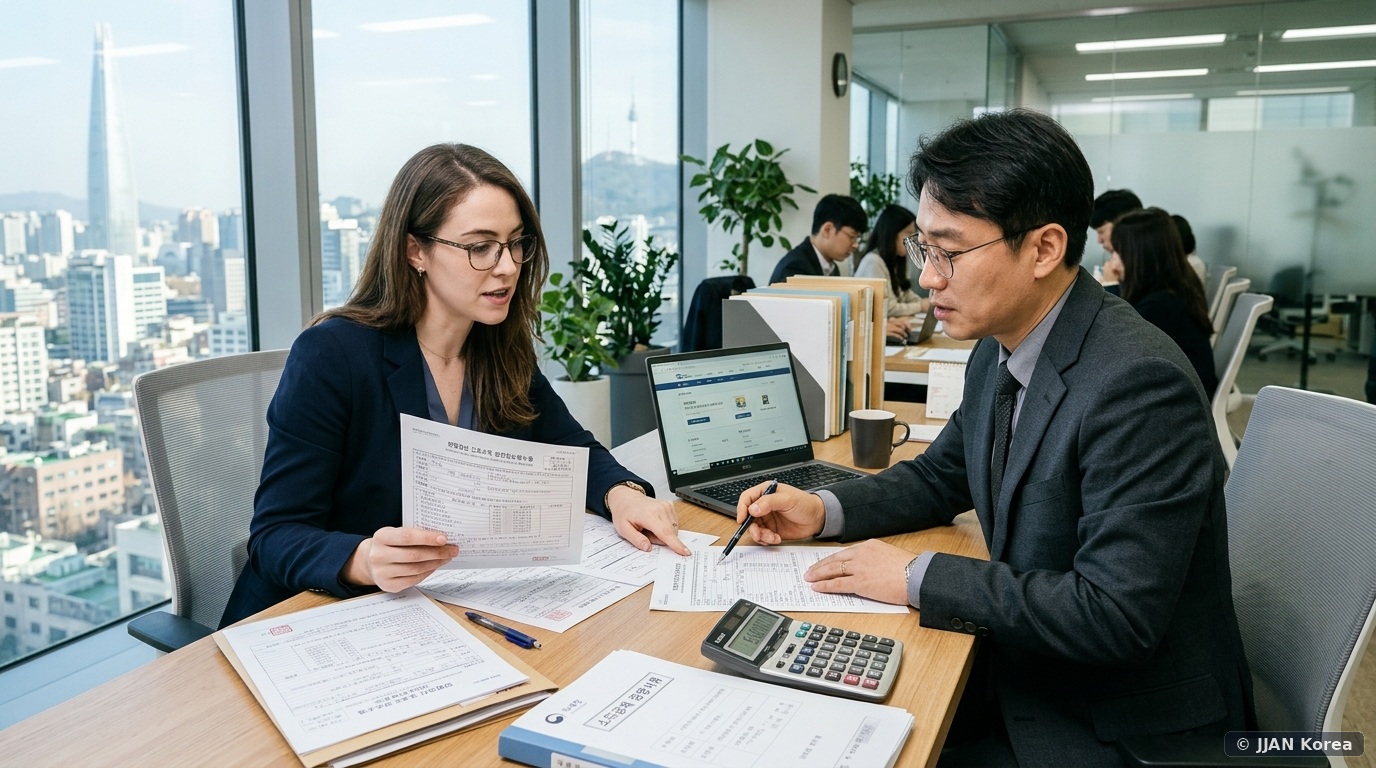
Every February across the Republic of Korea, millions of salaried employees embark on the annual administrative reconciliation known as Yeonmal Jeongsan (연말정산 / Year-End Tax Settlement). For foreign residents working at domestic manufacturing conglomerates, IT startups, public institutions, international academies, or foreign-invested enterprises, this annual tax filing determines whether you receive a substantial cash refund deposited directly into your Korean bank account or face an unexpected supplemental tax assessment on your February paycheck.
Under Article 18-2 of the Restriction of Special Taxation Act (조세특례제한법), foreign workers enjoy a unique statutory tax privilege not available to Korean citizens: the legal choice to calculate tax liability under a 19% Flat Tax Rate (단일세율 19%) rather than standard progressive income tax brackets ranging from 6% to 45%. However, making the wrong election can result in millions of won in forfeited deductions or unnecessary tax withholding. Below is the comprehensive, field-tested legal guide to calculating your optimal tax strategy, navigating the National Tax Service (국세청 NTS) Hometax portal, claiming qualified personal deductions, utilizing the 5-year retroactive rectification refund (경정청구), and understanding your statutory tax rights in South Korea.
1. The Strategic Choice: 19% Flat Tax vs. Progressive Tax Brackets
Unlike Korean nationals who must calculate tax liability strictly through standard progressive brackets, foreign employees in South Korea can elect between two completely different statutory methodologies under the Restriction of Special Taxation Act:
A. Standard Progressive Income Tax Method (일반 종합소득세율)
Under the standard progressive method, your annual earned income is taxed at graduated rates from 6% to 45% based on tax brackets. You are entitled to all general personal tax deductions, including basic personal deductions (1,500,000 KRW per person), National Health Insurance and pension deductions, credit and debit card spending deductions, medical expense credits, education credits, and donation credits. For workers earning moderate salaries (under 75,000,000 KRW annually), the standard progressive method almost always results in a significantly larger cash refund.
B. The 19% Flat Tax Rate Method (외국인 단일세율 19%)
Foreign executives, specialized technicians (such as E-7 visa holders), researchers, and corporate professionals can elect to apply a flat 19% income tax rate on their entire gross earned income (excluding non-taxable meal allowances up to 200,000 KRW monthly). The statutory catch: If you choose the 19% flat tax, you forfeit ALL tax deductions, tax credits, and exemptions. You cannot deduct insurance, medical costs, card spending, or dependent allowances. The calculation is strictly: Gross Annual Taxable Income × 19% = Base Tax Liability.
| Annual Earned Income (Gross) | Progressive Rate Bracket | Standard Method Effective Tax | 19% Flat Tax Base | Recommended Tax Strategy |
|---|---|---|---|---|
| 35,000,000 KRW (Entry Level / E-9) | 15% | Approx. 1,800,000 KRW (after credits) | 6,650,000 KRW | Standard Progressive (Save 4.8M won) |
| 60,000,000 KRW (Mid-Career / E-7) | 24% | Approx. 5,400,000 KRW (after credits) | 11,400,000 KRW | Standard Progressive (Save 6.0M won) |
| 100,000,000 KRW (Senior Specialist) | 35% | Approx. 18,200,000 KRW | 19,000,000 KRW | Near Breakeven (Simulate on Hometax) |
| 150,000,000+ KRW (Executive / Tech Lead) | 38% – 45% | 35,000,000+ KRW | 28,500,000 KRW | 19% Flat Tax (Save 6.5M+ won) |
The Financial Tipping Point: According to empirical tax simulations by certified Korean tax accountants, the 19% flat tax rate becomes decisively advantageous when your annual gross salary exceeds 85,000,000 to 100,000,000 KRW, or when you have minimal domestic deductible expenditures in South Korea. If your earnings fall below this threshold, filing under progressive rates ensures you retain essential tax deductions.
2. Real-World Case Studies: Comparing Three Career Profiles
To understand how this statutory choice functions in practical payroll management, consider three typical expatriate profiles operating under South Korean labor contracts:
Case Study 1: Sarah, English Instructor (E-2 Visa, Annual Gross: 34,000,000 KRW)
Sarah earned 34,000,000 KRW during the calendar year. Under the 19% flat tax, her liability would be 34,000,000 × 19% = 6,460,000 KRW. However, by electing the standard progressive method, Sarah deducts her mandatory social insurances (approx. 3,100,000 KRW), personal exemption (1,500,000 KRW), and earned income deduction (approx. 10,250,000 KRW), reducing her taxable base (과세표준) to approximately 19,150,000 KRW. At the 15% tax bracket with basic tax credits, her final tax is only 1,650,000 KRW. Because her school withheld 2,400,000 KRW during the year, Sarah receives a cash refund of 750,000 KRW. Choosing the flat tax would have resulted in an enormous, unnecessary tax penalty of over 4,000,000 KRW!
Case Study 2: Kenji, Senior Software Architect (E-7 Visa, Annual Gross: 95,000,000 KRW)
Kenji is an unmarried tech specialist living in Pangyo. Under the progressive system, his high income places him in the 35% marginal tax bracket. After applying standard deductions and card spending credits, his final calculated tax liability is approximately 17,900,000 KRW. Under the 19% flat tax option, his liability is 95,000,000 × 19% = 18,050,000 KRW. In Kenji’s case, the two methods are separated by less than 150,000 KRW. If Kenji increases his domestic credit card spending and health checkup expenses, the standard method wins; if he spends minimally in Korea, the flat tax provides administrative simplicity.
Case Study 3: Marcus, Regional Managing Director (D-8 Visa, Annual Gross: 190,000,000 KRW)
Marcus heads a European automotive subsidiary in Seoul. Under progressive brackets reaching 38% and 40%, his standard tax liability exceeds 52,000,000 KRW even after factoring in all maximum personal deductions. By submitting the Application for Single Tax Rate for Foreign Workers, his tax liability is capped at 190,000,000 × 19% = 36,100,000 KRW. Marcus saves an astonishing 15,900,000 KRW (approx. $12,000 USD) in net personal income tax through this statutory foreign worker incentive.
3. Key Deductions Available under the Standard Progressive Method
If you determine that the standard progressive method maximizes your refund, ensure you capture every eligible statutory deduction under the Income Tax Act:
1. Social Insurance Full Deductions (100% Tax Deductible)
All mandatory statutory insurance contributions deducted from your monthly paychecks are 100% deductible from your gross income: National Pension (국민연금), Employment Insurance (고용보험), and National Health Insurance as explained in our Guide to Korea NHIS Health Coverage.
2. Credit, Debit Card & Cash Receipt Deductions (신용·체크카드 소득공제)
Spending through Korean bank credit cards (15% deduction rate), debit cards (30% deduction rate), and cash receipts tied to your phone number or ARC (30% deduction rate) is deductible once total annual spending exceeds 25% of your gross annual salary. Spending at traditional markets and public transit earns a premium 40% deduction rate.
3. Medical Expense Tax Credit (의료비 세액공제)
Out-of-pocket medical expenses (including clinic visits, dental scaling, prescription pharmacy drugs, and eye glasses up to 500,000 KRW per person) exceeding 3% of your total salary qualify for a 15% direct tax credit.
4. Critical Housing Deduction Exclusion for Foreigners
Foreign workers must be aware of an important statutory limitation: under Korean tax law, certain housing deductions—specifically, the Monthly Rent Tax Credit (월세 세액공제) and Housing Purchase Savings deduction (청약저축공제)—historically require the applicant to be the registered “Head of Household” (세대주) under the Resident Registration Act (주민등록법). While foreign spouses of Korean citizens can qualify, solo foreign residents often face hurdles claiming monthly rent credits on the automated Hometax PDF. However, you can convert monthly rent payments into Cash Receipts (현금영수증) through the NTS website to claim them under the debit card / cash receipt spending deduction tier.
4. Step-by-Step Procedure: Using NTS Hometax & Submitting to HR
The National Tax Service operates the world-renowned Hometax (홈택스) Simplified Tax Service (연말정산 간소화 서비스), which automatically compiles all your domestic spending records:
Step 1: Access NTS Hometax (Mid-January)
Visit hometax.go.kr starting January 15. Click on the Year-End Tax Simplified Service (연말정산 간소화) banner. You must authenticate your identity using a Korean financial certificate, Toss, Kakao, or mobile joint verification as described in our Banking & Digital Identity Guide.
Step 2: Download Consolidated PDF Report
Click on each expenditure category button (Health Insurance, National Pension, Medical Expenses, Education, Card Spending, Donations). The system will reveal your annual qualified totals. Click “Download PDF in Batch (한번에 내려받기)” and save the password-free electronic report to your computer.
Step 3: Complete the Foreign Worker Application Form
If you intend to elect the 19% Flat Tax Rate, download the official Application for Single Tax Rate for Foreign Workers (외국인근로자 단일세율적용신청서). If applying standard progressive deductions, submit the standard income deduction declaration (소득·세액공제신고서).
Step 4: Submit to Employer HR & Receive Refund
Submit your Hometax PDF report and deduction forms to your corporate HR department before the designated company deadline (typically late January to early February). Your HR team calculates final tax liabilities on your official Withholding Tax Receipt (근로소득원천징수영수증). Overpaid taxes are refunded directly into your February or March salary payment.
5. The 5-Year Retroactive Rectification Refund (경정청구)
Did you fail to claim eligible deductions in previous years because you did not understand Korean tax forms? Under Article 45-2 of the Framework Act on National Taxes (국세기본법), taxpayers have the legal right to file a Request for Rectification (경정청구 / Gyeongjeong Cheong-gu) for up to 5 previous tax years.
If you worked in Korea in 2021, 2022, 2023, 2024, or 2025 and did not submit your medical expenses, foreign insurance records, or cash receipts, you can log in to Hometax during May, submit retroactive proof, and receive past overpaid taxes deposited straight into your bank account. Many foreign professionals recover between 500,000 KRW and 3,000,000 KRW through this retroactive audit.
6. Bilingual Glossary of Essential Korean Tax Terms
- 원천징수 (Wontcheon Jingsoo): Tax Withholding. The monthly estimated tax deducted by your employer.
- 과세표준 (Gwase Pyo-joon): Taxable Income Base. Gross income minus all allowable deductions.
- 결정세액 (Gyeoljeong Se-aek): Determined Final Tax. Your actual statutory tax liability for the year.
- 차감징수세액 (Chagam Jingsoo Se-aek): Final Balance. A negative number (e.g., -500,000 KRW) means a cash refund; a positive number means taxes owed.
- 근로소득원천징수영수증: Withholding Tax Receipt. The official NTS document proving your annual salary and tax payments.
7. Frequently Asked Questions (FAQ)
Q1. How many years can a foreign worker utilize the 19% Flat Tax Rate?
Under Article 18-2 of the Restriction of Special Taxation Act, eligible foreign employees can utilize the 19% flat tax rate for up to 20 consecutive years starting from the date they first provide labor in South Korea. Once this 20-year period expires, you must file under the standard progressive tax rates.
Q2. Can I claim tax deductions for my family members living overseas?
Generally, no. Basic personal deductions (1,500,000 KRW) for dependents require that family members share your registered household in South Korea and possess active Alien Registration Cards, with annual earned income under 1,000,000 KRW. Dependents residing permanently abroad cannot be verified through standard civil registries and are excluded from automatic Hometax data.
Q3. What happens if I miss the February company deadline?
If you fail to submit your documentation to your employer during the February corporate cycle, do not panic. You can personally file a Comprehensive Income Tax Return (종합소득세 신고) directly through Hometax during the statutory national tax reconciliation month of May. The National Tax Service will process your refund directly to your personal bank account by late June.
Q4. Which English helpline assists foreigners with tax settlement questions?
The National Tax Service operates a dedicated Foreigner Tax Consultation Hotline at 1588-0560. Specialized English-speaking tax agents provide real-time assistance regarding flat tax eligibility, deduction qualifications, and Hometax navigation.
JJAN Korea Policy & Legal Verification Desk
Regulatory Reference: Restriction of Special Taxation Act (조세특례제한법) Article 18-2 (Special Taxation for Foreign Workers), Framework Act on National Taxes (국세기본법) Article 45-2, and Income Tax Act (소득세법) Articles 50, 52 & 59.
Verification Authority: Republic of Korea National Tax Service (국세청 NTS) & Ministry of Economy and Finance. This guide reflects verified statutory schedules and deduction guidelines for the 2026 tax year.