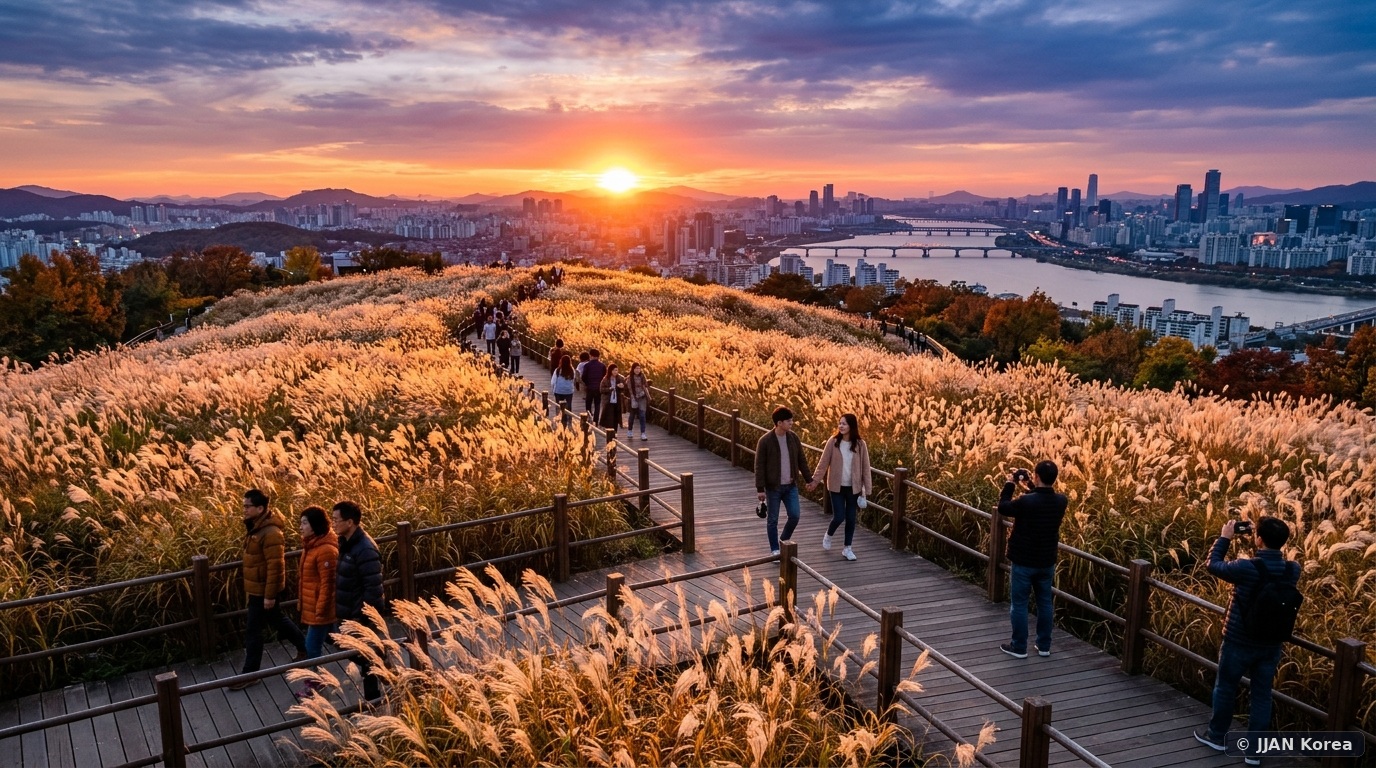
Perched 98 meters above western Seoul on an ecological plateau that was once a municipal landfill, Haneul Park (하늘공원 / Sky Park) undergoes a breathtaking seasonal metamorphosis every autumn. From mid-October through early November, over 190,000 square meters of golden silver grass (eoksae / 억새) blossom into dense, feathery plumes that ripple like an ocean in the afternoon breeze. As the golden hour approaches, photographers, local picnickers, and international travelers gather along the park’s wooden observation decks to watch the sun melt beneath the horizon, casting amber reflections across the Han River and silhouetting the red steel arches of the World Cup and Seongsan Bridges.
Yet for first-time international visitors, navigating this vast ecological sanctuary can present unexpected logistical friction. Deciding between climbing the notorious 291-step zigzag wooden staircase versus waiting in lengthy queues for the electric “Maengkkongi” Frog Tram, figuring out the ticketing kiosk interface, and timing your descent before the park security gates lock at dusk require field-tested planning. If you are traveling across Seoul on the subway, check our Seoul Climate Card vs. T-Money Transit Pass comparison guide to confirm whether your unlimited transit card covers Subway Line 6 all the way to World Cup Stadium Station.
Below is your definitive, field-verified guide to experiencing Haneul Park’s autumn spectacle without stress, wasted transit time, or missing the peak golden hour light.
From Landfill to Ecological Sanctuary: The Miracle of Nanjido
To truly appreciate the scenery at Haneul Park, understanding its historical background provides profound context. Between 1978 and 1993, this area—originally an alluvial island named Nanjido (난지도 / Orchid Island)—served as Seoul’s primary official waste disposal facility. Over 15 years of rapid industrialization and urban expansion, more than 92 million tons of garbage accumulated into two mammoth trash mountains reaching nearly 100 meters in height.
In 1996, the Seoul Metropolitan Government launched an ambitious, 30-year ecological restoration megaproject. Engineers capped the mountain with impermeable liners, constructed underground containment walls, installed methane gas extraction wells that now supply district heating to the surrounding Sangam digital media city, and laid a deep topsoil layer. Today, Nanjido has been reborn as the World Cup Park complex, comprising five interconnected public reserves: Peace Park, Nanjicheon Park, Nanji Han River Park, Sunset Park (Noeul Park), and the crown jewel atop the plateau, Haneul Park. Rather than manicured artificial lawns, the city deliberately planted silver grass, reeds, and native wild flora to restore biological diversity, creating an unpretentious sanctuary where wild pheasants, kestrels, and butterflies thrive directly above the capital.
How to Reach Haneul Park: Subway Line 6 Transit Walkthrough
Reaching the park via public transit is straightforward, but requires walking through the adjacent Peace Park grounds before reaching the base of the hill. Follow this precise navigational sequence:
- Subway Line 6 Arrival: Ride Seoul Subway Line 6 to World Cup Stadium Station (월드컵경기장역). Note that if you are transferring from Subway Line 2 at Hapjeong Station, the transfer corridor is exceptionally brief and efficient.
- Use Exit 1: Take Exit 1. As you emerge onto street level, the massive curved facade of Seoul World Cup Stadium will be on your right.
- Traverse Peace Park (Pyeonghwa Park): Walk straight ahead across the broad public plaza. Cross through the landscaped grounds of Peace Park, walking westward toward the Peace Bell and the Nanji Lake reflecting pond. This pleasant 10-minute stroll covers approximately 700 meters.
- Cross the Rainbow Footbridge: Follow the bilingual blue-and-white signs toward “Haneul Park (Sky Park)”. You will cross a sweeping pedestrian overpass spanning the multi-lane World Cup-ro expressway. Once across, you have arrived at the base entrance where the trail splits into two routes: the Haneul Staircase on the right, and the Maengkkongi Tram Ticket Booth on the left.
Ascending the Plateau: The 291 Wooden Steps vs. Maengkkongi Tram
Once at the base, you must decide how to tackle the 98-meter elevation gain to the plateau summit. Depending on your physical mobility, footwear, and the time of day, each method has distinct trade-offs.
Option A: The 291-Step Wooden Zigzag Staircase (하늘계단)
The wooden staircase is the choice of fitness enthusiasts and those eager to avoid tram queues during peak weekend afternoons. The staircase consists of 291 numbered steps configured in a scenic zigzag layout ascending the eastern slope. Each landing features wooden safety railings and small rest platforms offering increasingly expansive aerial vistas of the World Cup Stadium, the surrounding Bukhansan mountain ridge to the north, and the Han River to the south.
A moderately fit adult can complete the climb in 10 to 15 minutes. It is well-lit until park closing and offers an immediate, invigorating experience. However, it is not wheelchair- or stroller-accessible, and can feel arduous if you are carrying heavy photographic gear or visiting with elderly family members.
Option B: The Maengkkongi Electric Frog Tram (맹꽁이 전기차)
Named after the narrow-mouthed toad (maengkkongi) that inhabits the restored wetlands, these open-air, low-emission electric shuttles run continuously between the base parking plaza (Nanji Stream Park) and the Haneul Park summit entrance. The scenic ride takes roughly 6 to 8 minutes, winding gently up the asphalt vehicular access road through lush forest groves.
Ticketing & Fares: You can purchase tickets from automated touch-screen kiosks located beside the tram boarding pavilion. The kiosks support English, Korean, Japanese, and Chinese, and accept standard international credit cards (Visa, Mastercard) as well as domestic cards and Samsung Pay.
| Transport Method | Cost (Adult) | Travel Time | Physical Effort | Best Suited For |
|---|---|---|---|---|
| Haneul Stairs (하늘계단) | Free | 10 – 15 mins | Moderate (291 steps) | Solo travelers, photographers avoiding tram queues, brisk walkers |
| Maengkkongi Tram (One-Way) | 2,000 KRW | 7 mins (+ queue) | Zero Effort | Climbing up without sweating, then walking down the stairs at sunset |
| Maengkkongi Tram (Round-Trip) | 3,000 KRW | 15 mins total | Zero Effort | Families with strollers, seniors, rainy or chilly weather |
| Paved Service Road (Walking) | Free | 25 – 30 mins | Low / Gentle Incline | Those with wheelchairs or strollers who prefer not to ride the shuttle |
Pro-Tip from Our Travel Desk: If you visit on a sunny October Saturday or Sunday between 2:00 PM and 5:00 PM, the ticket queue and boarding line for the Maengkkongi Tram frequently exceeds 40 to 50 minutes. We strongly advise purchasing a one-way uphill ticket only, or bypassing the queue entirely to walk up the 291 stairs. Riding up and walking down the stairs as twilight settles allows you to admire Seoul’s sparkling stadium lights without standing in the post-sunset tram line at the summit.
Botanical Identification: Silver Grass (억새) vs. Reeds (갈대) vs. Pink Muhly
Visitors frequently confuse the plant varieties scattered across Haneul Park. Korean botanists emphasize key distinctions that will enhance your visit and social media captions:
- Silver Grass (Eoksae / 억새): The undisputed protagonist of Haneul Park. Silver grass grows exclusively on dry, sun-drenched mountain slopes and highlands. Its stems are slender, reaching 1.5 to 2 meters, and produce shimmering silver-white, silken plumes with fine serrated leaf edges that gleam like spun gold under late afternoon backlighting.
- Common Reeds (Galdae / 갈대): Reeds grow exclusively in damp wetlands, riverbanks, and marshy lowlands (such as Suncheon Bay or the base lakes of Nanji Park). Reeds are brown, purple-tinted, or dull beige, with thicker, bamboo-like hollow stems and heavier, drooping tufts.
- Pink Muhly (분홍쥐꼬리새): Located in designated garden parcels near the southern viewing edge of Haneul Park. This ornamental perennial grass blooms in vibrant, cloud-like candy-pink clouds between late September and late October, creating dreamlike portrait backdrops that contrast sharply with the towering tawny silver grass fields.
Top Photography Vantage Points: Golden Hour & Sunset Deck
To capture award-winning autumn photographs, navigate directly toward these three designated vantage points within the plateau:
1. The Central Eoksae Boardwalk & Windmill Intersections
Five massive wind turbines tower over the silver grass field, generating clean wind electricity for the park’s night lighting. Standing at the intersection of trails 2 and 4 allows you to frame the towering white wind turbines rising from a sea of golden, wind-whipped plumes. Shoot with a telephoto or portrait lens (50mm to 85mm equivalent) at an aperture of f/2.8 to compress the golden stalks around your subject with silky bokeh.
2. The Southern River Overlook (Han River Panoramic Deck)
Along the southern perimeter fence, wooden cantilevered decks project outward over the expressway. From here, you have an unobstructed 180-degree vista of the Han River. Directly below you sits the newly constructed World Cup Bridge (월드컵대교) with its asymmetric cable-stayed towers, flanked by the vintage red steel arches of Seongsan Bridge to the east and Gayang Bridge to the west. On clear autumn evenings, the orange sun sets directly downriver behind the distant hills of Gimpo and Ganghwa Island.
3. The “Bowl of Sky” (하늘을 담는 그릇 / Sky Observation Vessel)
Near the southern center of the park stands an artistic, circular, three-tier bowl-shaped observation structure crafted from woven steel latticework and timber steps. Climbing to the top circular platform provides a 360-degree aerial panorama looking down across the undulating silver grass field while offering panoramic vistas of the Yeouido financial skyline and Bukhansan’s jagged peaks.
Essential Park Etiquette, Evening Chill & Safety Protocols
Because Haneul Park sits atop an exposed, elevated bluff directly adjacent to the Han River, evening meteorological conditions can catch unprepared travelers off-guard. Keep these essential operational facts in mind:
Because of rapid temperature swings, evening wind chill can cause temperatures to plunge by 8°C to 12°C within thirty minutes after sunset. Review our Korean autumn weather, layering and temperature swings guide before heading out in light autumn knitwear.
- Strict Park Closing Hours: Unlike Hangang riverside parks which remain open 24/7, Haneul Park locks its perimeter security gates precisely at dusk (usually between 7:30 PM and 8:30 PM depending on sunset time, and 7:00 PM in November) to safeguard nocturnal wildlife and prevent accidents. Security staff actively clear the plateau with megaphones starting 30 minutes before gate closure.
- Zero Trash Can Policy (Bring Your Waste Home): In accordance with strict ecological preservation rules, there are virtually no trash cans on the summit plateau. Carry a small plastic bag in your backpack to pack out beverage bottles, snack wrappers, and tissues.
- Strict Drone Prohibition: Flying civilian drones at Haneul Park is strictly illegal without prior military and Ministry of Land, Infrastructure and Transport clearance due to its direct proximity to Gimpo International Airport flight corridors and military air defense perimeters. Unapproved drone flights result in fines up to 3 million won under the Aviation Safety Act.
- Comfortable Walking Footwear: The plateau paths consist of dirt trails, decomposed granite gravel, and raised wooden boardwalks. High heels and slippery dress shoes are strongly discouraged.
After descending the park staircase around dusk, you can take Subway Line 6 just three stops directly to Mangwon or Hapjeong Station to warm up with seasonal roasted chestnuts, hot soup, and street snacks as detailed in our Korean autumn street foods and bungeoppang guide.
Autumn Haneul Park Traveler’s Checklist
Before leaving your hotel or apartment, ensure you have packed these vital items:
- [ ] T-Money card or Climate Card with sufficient transit balance for Line 6 subway and Maengkkongi Tram.
- [ ] Light windbreaker, padded vest, or fleece jacket for post-sunset Han River wind chill.
- [ ] Fully charged smartphone or portable power bank (cold evening winds drain lithium batteries rapidly).
- [ ] Comfortable walking sneakers or cushioned running shoes suitable for 291 wooden steps.
- [ ] Bottled water or warm thermos (there are only limited vending machines at the summit).
- [ ] Small personal plastic trash pouch for packing out your own garbage.
Frequently Asked Questions (FAQ)
Is admission to Haneul Park free of charge?
Yes. Entry to Haneul Park and the entire World Cup Park complex is 100% free for all domestic and international visitors year-round. The only optional expense is the Maengkkongi electric shuttle tram (2,000 KRW one-way, 3,000 KRW round-trip for adults) if you choose not to walk up the 291-step staircase.
What is the absolute best time of day to visit?
The optimal arrival window is between 3:30 PM and 4:30 PM in late October. This allows you 45 minutes to stroll through the silver grass and pink muhly fields under soft late-afternoon sunlight, followed by 30 to 40 minutes to position yourself at the southern Han River deck for peak sunset (usually between 5:35 PM and 5:45 PM KST). Arriving after 5:30 PM means missing the golden hour reflection across the grass.
Can I bring pets or ride a bicycle on the plateau?
Dogs on leashes (under 2 meters) with waste bags are permitted on the walking trails, but pets are not allowed to ride the open Maengkkongi electric trams unless held in an approved enclosed pet carrier. Bicycles, electric kickboards, and motorized personal mobility devices are strictly prohibited on the Haneul plateau to protect pedestrian safety.
Are restrooms and dining facilities available at the summit?
There are clean, heated public restrooms located near the summit tram turnaround terminal and beside the central park management office. However, food options atop the plateau are extremely limited to a small automated convenience kiosk selling bottled water, coffee, and packaged snacks. For substantial meals, descend to the World Cup Stadium Mall (home to a massive Homeplus hypermarket and food court) or ride Line 6 to Mangwon Market.
JJAN Korea Editorial Standards & Fact-Checking Verification
This seasonal travel guide has been field-verified on-site at Haneul Park (Mapo-gu, Seoul) by JJAN Korea’s Travel Desk. Operational hours, Maengkkongi tram fares, and transit routes are verified in accordance with official guidelines published by the Seoul Metropolitan Government Parks & Landscape Management Bureau (Western Parks Center), Seoul Transportation Corporation (Subway Line 6), and the Mapo-gu Office Culture & Tourism Division.