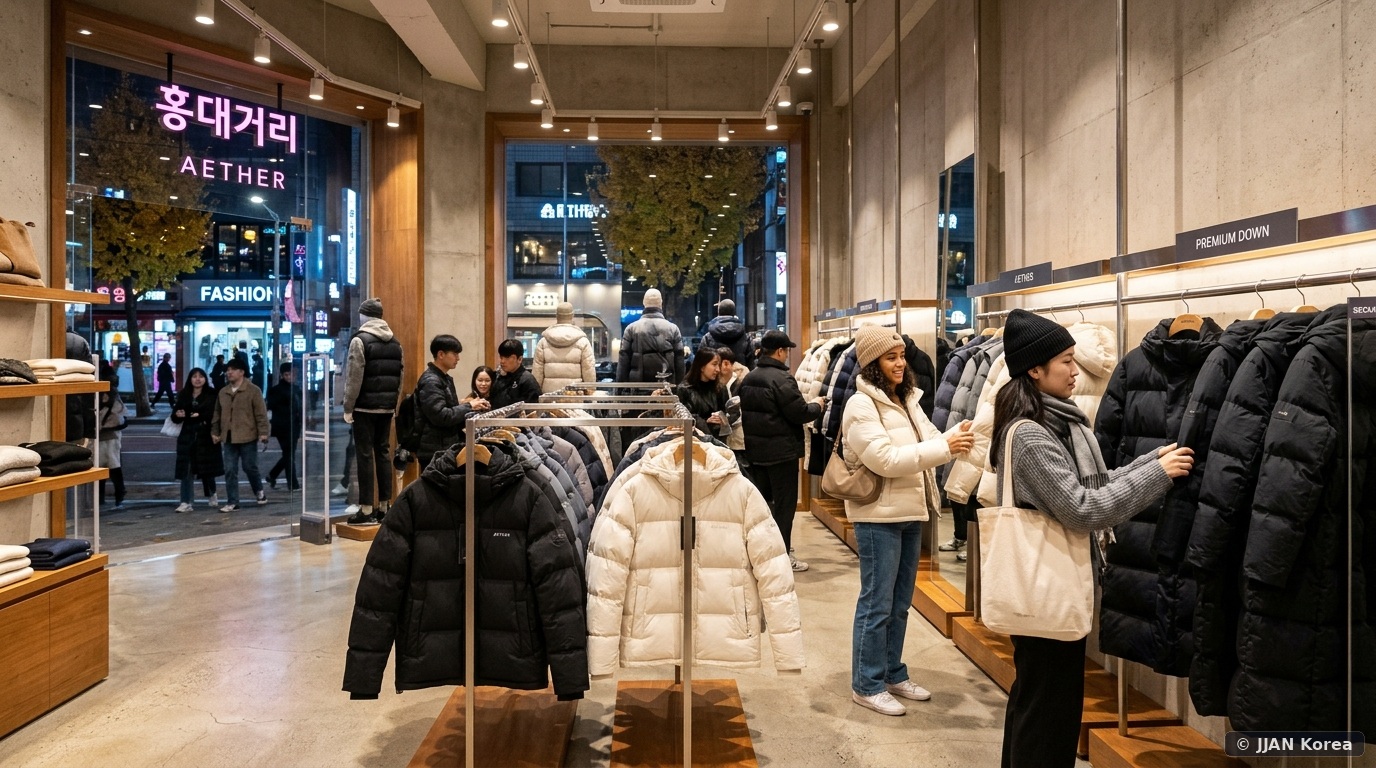
As late October transitions toward November, an unmistakable shift ripples across the streets of Seoul. Storefront mannequins in Myeongdong, Hongdae, and Seongsu-dong swap light trench coats for voluminous, insulated down jackets, and local commuters begin discussing their annual winter armor. In South Korea, these quilted, down-filled outerwear garments are universally referred to by a distinct Konglish term: “Padding” (패딩). When Siberian cold snaps (bukseo-poong / 북서풍) plunge temperatures below -15°C with howling wind chills, a quality padding jacket ceases to be a mere fashion choice—it becomes an indispensable survival tool for daily life.
Yet for international visitors, exchange students, and newly relocated expatriates, navigating Korea’s winter outerwear market can feel overwhelming. Should you invest in an ankle-length “sleeping bag” Long Padding (롱패딩) or a boxy, cropped Short Puffer (숏패딩)? What down-to-feather ratio (우모량) is actually required to withstand a Seoul January? Which homegrown brands—from affordable staples like SPAO and Musinsa Standard to high-demand collector labels like The North Face White Label—offer the best value? If you are just starting to adapt to late-autumn weather, review our Korean autumn weather, layering and temperature swings guide to plan your wardrobe progression before sub-zero chills arrive.
Here is your comprehensive, field-tested guide to choosing, shopping for, and caring for Korean winter padding, complete with store breakdowns, technical down specs, instant VAT refund procedures, and laundering rules.
The Evolution of K-Padding: Long Padding (롱패딩) vs. Short Puffer (숏패딩)
Korea’s relationship with winter outerwear is legendary. Around 2017, the country experienced the “PyeongChang Olympic Long Padding Frenzy,” where midnight queues formed outside department stores for 300-meter-long lines to purchase duck-down bench coats that draped all the way to the shins. Over the past several seasons, silhouette trends have diversified into two primary camps:
1. The Utilitarian Heavyweight: Long Padding (롱패딩)
Long padding coats typically measure 105cm to 125cm in total length, terminating between mid-calf and just above the ankle. They are engineered with dual two-way heavy-duty zippers, snap-button side vents (allowing comfortable strides and sitting on subway seats), and thermal storm cuffs.
- Pros: Unrivaled thermal protection. Because it completely covers your thighs and calves, you can walk through frigid wind tunnels between subway exits without wearing bulky thermal long johns underneath your trousers.
- Cons: Bulk and weight. Navigating crowded subway cars during rush hour can feel cumbersome, and carrying a 1.5kg long coat around heated indoor shopping malls requires patience.
- Best For: Daily subway commuters who walk more than 15 minutes outdoors, university students walking across breezy hill campuses, and anyone planning outdoor winter travel to Gangwon-do or ski resorts.
2. The Modern Streetwear Staple: Short Puffer (숏패딩)
Short puffers end sharply at the waist or high hip, emphasizing a boxy, oversized, cloud-like silhouette inspired by Korean streetwear aesthetics. Many contemporary Korean designs feature stand-up chimney collars, dropped shoulders, and subtle matte finishes in muted earth tones, charcoal, and ivory.
- Pros: High mobility, youthful styling, and lightweight comfort. It pairs effortlessly with wide-leg denim, pleated trousers, and chunky sneakers without engulfing your entire body frame.
- Cons: Exposed lower body. Once the thermometer dips below -5°C, freezing wind will pierce through regular denim and chinos, making thermal heat-tech base layers mandatory for your legs.
- Best For: Fashion-conscious travelers exploring cafe-dense districts like Seongsu and Hannam-dong, indoor shoppers, and days when temperatures stay above -3°C.
Technical Specs Explained: Down-to-Feather Ratios & Fill Power
When inspecting the interior tags of padding jackets in Korean retail stores, foreign shoppers often encounter unfamiliar Korean textile terminology. Knowing how to read these specifications guarantees you won’t overpay for low-insulation synthetic polyester masquerading as premium down.
1. Duck Down (오리털) vs. Goose Down (거위털)
Goose down (거위털) clusters are larger, lighter, and trap more air pockets than duck down, providing superior insulation per gram. However, high-quality duck down (오리털) provides more than enough thermal insulation for typical Seoul city winters at roughly 40% to 60% lower retail prices.
2. The Down vs. Feather Ratio (솜털 대 깃털 비율)
The label will always state a ratio, such as 80:20 or 90:10:
- Down Cluster (솜털 / Somteol): The fluffy, quill-less plumage from the bird’s chest. This traps body heat and creates loft.
- Feather (깃털 / Gitteol): The structural feathers with stiff quills. They provide shape and bounce, but minimal warmth.
- The Golden Rule: Never purchase winter padding with less than an 80:20 ratio (80% down cluster, 20% feather). Premium performance jackets boast a 90:10 ratio, which feels feather-light while trapping maximum thermal air. Avoid cheap budget coats that use 50:50 ratios or 100% polyester “Wellon” fill if you plan to spend hours outdoors in mid-winter.
3. Fill Power (필파워 / FP)
Fill power measures the volume in cubic inches that one ounce of down occupies. For South Korea’s continental winter climate:
- FP 550 – 600: Standard baseline insulation suitable for late autumn and mild winter days (-3°C to 5°C).
- FP 650 – 700: The ideal sweet spot for metropolitan Seoul city life, balancing warmth, packability, and price.
- FP 800+: Expedition-grade warmth designed for sub-zero alpine hiking or sub -15°C blizzards.
Where to Shop in Seoul by Budget Category
Seoul offers an extraordinary spectrum of retail environments for winter outerwear. Below are the most reputable brands and shopping hubs categorized by price tier:
| Brand / Retailer | Typical Price Range | Insulation Fill | Key Strengths | Recommended Store Location |
|---|---|---|---|---|
| SPAO (스파오) | 69,000 – 129,000 KRW | Duck Down (80:20) / Wellon | Extreme budget value, lightweight pastel short puffers | Myeongdong Central Flagship, Hongdae |
| TopTen (탑텐) | 79,000 – 149,000 KRW | Duck Down (80:20) | Frequent 1+1 autumn sales, minimalist office basics | Gangnam Station, Insadong, Dongdaemun |
| Musinsa Standard (무신사) | 139,000 – 249,000 KRW | RDS Duck/Goose (80:20) | Contemporary clean fit, matte shell fabrics, waterproof zips | Hongdae Flagship, Seongsu, Gangnam |
| The North Face White Label | 289,000 – 499,000 KRW | RDS Goose Down (80:20) | Korea-exclusive line, high streetwear resale value, iconic Nuptse cuts | Myeongdong Flagship, Lotte Dept Store Main |
| Discovery Expedition / NatGeo | 250,000 – 450,000 KRW | Goose Down (80:20) | The quintessential Korean “Gorpcore” university student aesthetic | The Hyundai Seoul (Yeouido), COEX Mall |
Insider Shopping Tip: If you are exploring Seongsu-dong’s cafe streets, check our Seongsu-dong autumn cafe hopping and design pop-ups guide. Many domestic designer labels (such as Matin Kim, Stand Oil, and Marithé François Girbaud) host limited-run winter outerwear pop-up showrooms in converted industrial warehouses throughout November.
Foreigner Tax Refund Procedures for Outerwear Shopping
Because winter padding represents a substantial retail purchase (often 100,000 to 500,000 KRW), claiming Value Added Tax (VAT) refunds can save you between 5% and 8% of the total purchase price.
- Instant In-Store Tax Refund (현장 즉시 환급): Available at major flagship locations including Musinsa Standard, SPAO Myeongdong, and The North Face White Label. Present your physical passport at the cash register before paying. If your single-receipt total is between 15,000 KRW and 1,000,000 KRW (with a cumulative trip limit of 5,000,000 KRW), the cashier will deduct the VAT immediately, allowing you to pay the discounted net amount on the spot. For similar instant tax refund procedures, see our Olive Young tax refund and shopping walkthrough.
- Airport Customs Tax Refund: If shopping at department store boutiques that issue a paper Tax Refund Slip (Global Blue or Tax Free Korea), keep the printed receipt and unopened tags intact. At Incheon International Airport (Terminal 1 or 2), scan your passport and receipts at the automated tax refund kiosks located in the departures hall before luggage check-in.
How to Wash & Maintain Down Padding Without Ruining Loft
One of the most catastrophic mistakes foreign residents make is sending their down padding to a neighborhood dry cleaner (setakso / 세탁소). Natural down feathers contain protective natural oils (keratin) that trap air. Chemical dry-cleaning solvents strip these organic oils, causing the feathers to become brittle, clump together, and permanently lose up to 50% of their thermal loft!
Follow this professional Korean coin-laundromat (koin-setakso / 코인세탁소) washing method instead:
- Pre-Treat Collar & Cuffs: Smudge liquid detergent or dish soap directly onto makeup or food grease stains along the inner collar and cuffs using a soft toothbrush.
- Gentle Machine Wash: Zip up all zippers and turn the jacket inside out. Place it in the washing machine on a delicate or wool cycle using lukewarm water (30°C) and a specialized neutral down wash (중성세제 / jungseong-seje). Never use fabric softener or bleach.
- Low-Heat Tumble Dry with Tennis Balls: Transfer the damp jacket to a commercial gas dryer. Toss in 3 to 4 clean tennis balls or wool dryer balls. As the dryer rotates on low heat (40°C to 50°C), the bouncing balls continuously pound the damp down clusters, breaking up damp clumps and restoring full, fluffy factory loft.
Autumn Winter Outerwear Checklist
Before heading out to Seoul’s shopping districts, verify these preparation points:
- [ ] Physical passport carried for instant in-store tax refunds at the cash register.
- [ ] Wearing a medium-weight sweater or hoodie to test sleeve fit and shoulder mobility when trying on coats.
- [ ] Checked the garment interior label for a minimum 80:20 down-to-feather ratio.
- [ ] Verified two-way zipper functionality (essential for sitting comfortably on the subway in long coats).
- [ ] Confirmed whether the outer shell fabric features water-repellent (DWR) treatment for wet Seoul snow.
Frequently Asked Questions (FAQ)
Is Long Padding out of fashion in Korea?
No. While short puffers currently dominate youth fashion and streetwear editorials, long padding remains the undisputed king of practical cold-weather commuting. When Seoul experiences prolonged sub-zero cold waves in December and January, millions of Koreans across all age groups rely on black long padding coats for daily survival.
What is “The North Face White Label” and why is it famous?
The North Face White Label is an exclusive lifestyle and streetwear line designed and sold exclusively within South Korea by Youngone Outdoor. It blends high-performance outdoor materials with tailored streetwear cuts that are not available in North American or European retail markets, making it one of the most coveted shopping items for international visitors.
Can I wear an ankle-length long coat on public buses and subways?
Yes, but always unzip the bottom zipper halfway up before boarding crowded buses or sitting down on subway benches. This prevents strain on the zipper teeth and keeps the coat fabric from dragging across damp floorboards.
What does RDS certified mean on Korean coat tags?
RDS stands for Responsible Down Standard. It guarantees that the duck or goose down was sourced humanely from animals that were not subjected to live-plucking or force-feeding. Most reputable Korean brands (including Musinsa Standard and The North Face) prominently display RDS certification hangtags.
JJAN Korea Editorial Standards & Fact-Checking Verification
This Korean fashion guide has been fact-checked and compiled by JJAN Korea’s Culture & Lifestyle Desk in Seoul. Retail pricing, textile down ratios, and store availability were verified through direct on-site inspections at flagship retail stores in Hongdae, Seongsu, and Myeongdong. Instant tax refund regulations align with official procedures verified by the National Tax Service (NTS / 국세청) and Korea Customs Service (관세청).