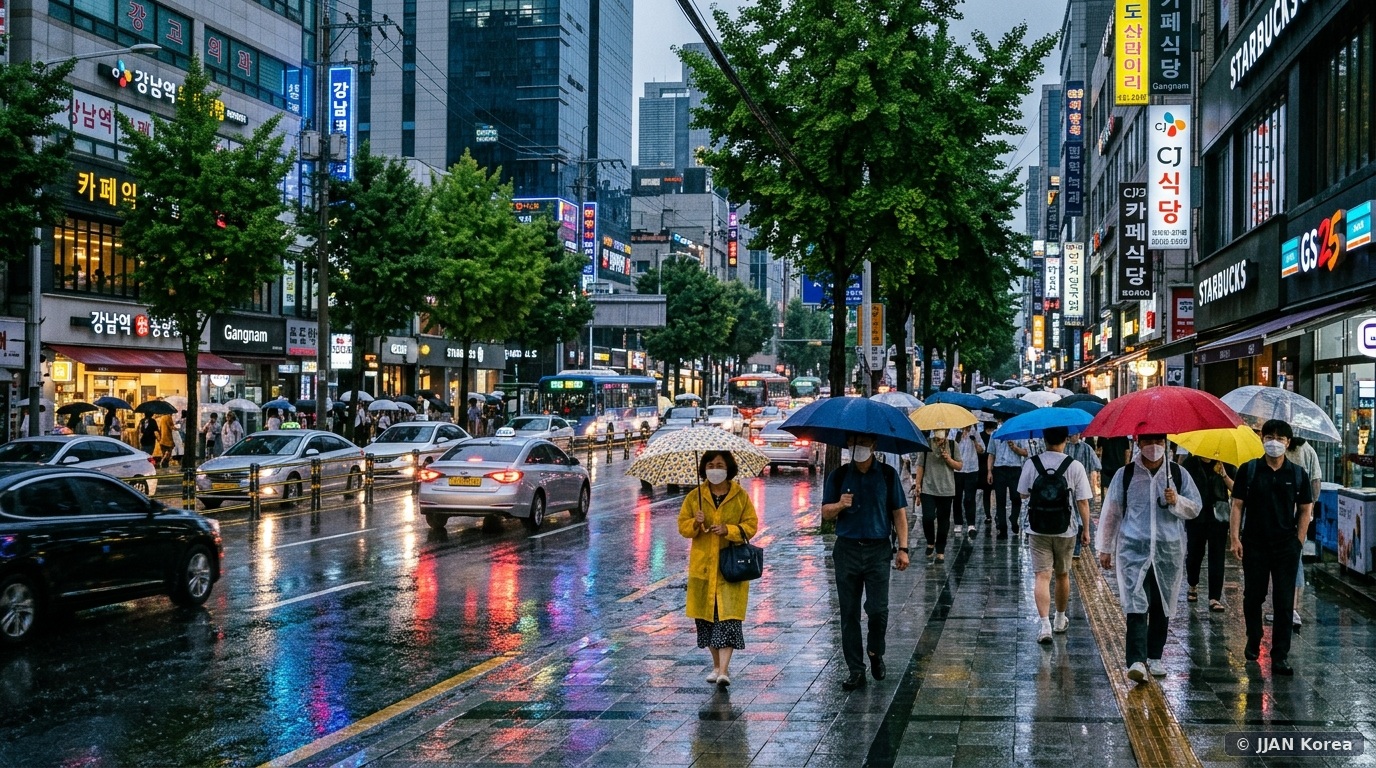
South Korea’s summer season transforms dramatically between late June and late July as the East Asian monsoon front, known locally as Jangma (장마), stalls over the Korean Peninsula. Unlike brief tropical showers or predictable European drizzle, Jangma delivers weeks of relentless, heavy downpours accompanied by sustained indoor relative humidity levels exceeding 85% to 95%. For foreign residents and expatriates living in modern Korean studio apartments (officetels), multi-family villas, or high-rise complexes, this prolonged dampness poses severe challenges: black toxic mold flourishing inside built-in closets, ruined leather footwear, musty laundry that refuses to dry, and sudden indoor condensation. Understanding how to manage indoor air quality, select appropriate appliances, and utilize traditional Korean climate management techniques is essential for surviving the summer without property damage or health complications.
1. The Meteorology of Jangma: Timeline, Rainfall & Humidity Patterns
The Korean Meteorological Administration (KMA – 기상청) officially tracks the movement of the seasonal rain front (Jangmajeonseon – 장마전선), which forms along the boundary where cold, moist Okhotsk Sea air masses clash with warm, humid North Pacific subtropical air. The timeline varies slightly across geographic regions:
- Jeju Island: Typically commences between June 19 and June 23, lasting approximately 32 days.
- Southern Regions (Busan, Gwangju, Daegu): Commences between June 23 and June 25, lasting approximately 31 days.
- Central Region & Seoul Metropolitan Area: Commences between June 25 and June 28, terminating around July 24 to July 26.
During peak Jangma, South Korea receives nearly 30% to 40% of its entire annual precipitation within a single four-week window. More critically, the outdoor dew point frequently hovers around 24°C to 26°C. When ambient outdoor air enters an air-conditioned room or unventilated closet, the water vapor rapidly condenses on cooler surfaces, providing an ideal breeding ground for Aspergillus and Cladosporium mold spores within 48 hours.
2. Choosing the Right Dehumidifier (제습기): Compressor vs. Desiccant
While standard split-unit air conditioners in Korea feature a dehumidification mode marked as Jeseub (제습), relying exclusively on your AC unit is often insufficient and energetically inefficient. In small officetels, running an AC continuously can chill the room excessively while failing to dry closed wardrobe cabinets, corner shoe racks, and bathroom entryways. Investing in a dedicated standalone dehumidifier (제습기) is widely considered mandatory by veteran expats.
| Appliance Type | Daily Extraction Capacity | Average Price (KRW) | Best Suited Living Space | Noise & Heat Profile |
|---|---|---|---|---|
| Winix / LG Compressor (16L–20L) | 16 – 20 Liters / 24h | 320,000 – 480,000 KRW | Two-room villas, 20–30 pyeong apartments | Moderate hum (38–42dB); emits warm dry exhaust |
| Compact Compressor (10L–12L) | 10 – 12 Liters / 24h | 190,000 – 260,000 KRW | Single studio (One-room), Officetel (6–10 pyeong) | Low hum (36–39dB); lightweight with caster wheels |
| Semiconductor / Peltier (1L–2L) | 0.5 – 1.2 Liters / 24h | 45,000 – 75,000 KRW | Walk-in closet or enclosed shoe cabinet only | Near silent; completely ineffective for entire rooms |
| Split AC ‘Jeseub’ (제습) Mode | Varies by cooling coil load | Included with AC lease | Immediate ambient cooling + humidity reduction | Chills room; shuts off compressor once target temp reached |
When shopping on Korean e-commerce platforms like Coupang or visiting electronics outlets such as Himart (하이마트), look for models with an Energy Rating Label (에너지소비효율등급) of Grade 1. Grade 1 compressor units draw roughly 200W to 280W of power, resulting in an estimated monthly electricity increase of less than 15,000 to 22,000 KRW even when operating 8 to 10 hours daily.
3. Closet, Shoe Rack & Bathroom Mold Defense Protocols
Korean villas and multi-family structures often utilize external insulation walls that suffer from thermal bridging. During prolonged downpours, corner walls behind wardrobes and bed frames trap moisture. To protect your clothing, electronics, and health, implement the following four-tier defense protocol:
- Chemical Moisture Absorbers (Mulgmeokneun Hama – 물먹는 하마): Place calcium chloride tubs inside every wardrobe compartment, under the bed, and on each shelf of your shoe rack. Inspect them weekly; once the white beads dissolve into liquid reaching the fill line, peel off the protective membrane and pour the brine down the toilet before recycling the plastic container. Remember our guide on disposing of moisture-absorbing packets in volume-rate garbage bags to prevent municipal fines.
- The 30-Minute Ondol Dry-Out Technique: Even in mid-summer, veteran Korean homeowners occasionally activate floor heating. By running the Ondol boiler on mild heat for 30 minutes with windows slightly cracked, the heated subfloors rapidly bake out trapped moisture beneath the linoleum or laminate flooring, eradicating hidden mildew colonies before they spread.
- Air Circulation Clearance: Maintain at least a 10cm (4-inch) gap between all large furniture pieces and exterior-facing walls. Never push fabric sofas or hanging clothes directly flush against cold corner drywall.
- Anti-Fungal Disinfection Sprays: If dark spotting appears on silicone caulking around bathroom tiles or window frames, apply specialized Korean mold remover gel (Gompang-i Jegeojae – 곰팡이 제거제). Leave the gel undisturbed for 3 to 4 hours to dissolve the root fungal hyphae before rinsing with cold water.
4. Essential Monsoon Gear: Waterproof Footwear & Inverted Umbrellas
Navigating Seoul during an intense downpour requires specialized equipment. Standard canvas sneakers will soak through in seconds due to sidewalk puddle splash-back, while cheap convenience store plastic umbrellas frequently buckle under sudden wind gusts along wide boulevards like Teheran-ro or Gwanghwamun.
- Waterproof Rain Boots (Janghwa – 장화): Brands like Rockfish Weatherwear, Hunter, and Barbour dominate Korean city streets during June and July. Mid-calf or ankle Chelsea boot silhouettes allow you to wade across submerged crosswalk gutters while maintaining professional office attire.
- Fiberglass-Ribbed Windproof Umbrellas: Invest in a double-canopy umbrella featuring flexible fiberglass structural ribs. Korean subway station entrances are notorious wind tunnels; steel-wire umbrellas snap instantly when encountering these localized updrafts.
- Shoe Dryer Inserts (Sinbal Geonjogi – 신발건조기): If your leather dress shoes or running sneakers get drenched, avoid direct hair-dryer heat, which warps glues and stiffens leather. Instead, insert dual-prong low-heat ceramic shoe dryers available on Coupang for under 20,000 KRW.
- Waterproof Backpack Rain Covers: Foreign university students and tech commuters carrying expensive laptops should carry an ultralight silicone pack cover stowed inside an exterior pouch pocket.
5. Indoor Laundry Drying Hacks Without a Gas Dryer
Most Korean rental apartments are equipped with an integrated washing machine (드럼세탁기) beneath the kitchen counter or on a small utility veranda, but lack a dedicated vented heat tumble dryer. Drying wet clothes indoors at 90% humidity causes bacterial propagation (Moraxella), producing a pungent, sour smell (Kkungkkeunghan Naemsae – 끙끙한 냄새).
To eliminate laundry odor during Jangma, replace conventional fabric softener with 1 to 2 tablespoons of white vinegar or specialized indoor drying liquid detergent (Silnae Geonjo Seyeje – 실내건조 세제, such as Tech or Persil Indoor Care). Position your portable dehumidifier directly beneath your collapsible drying rack (Geonjodae – 건조대), set the appliance to continuous ‘Turbo’ mode, and drape a clean lightweight bedsheet over the entire rack to create an accelerated hot-air drying chamber. Average wash loads dry crisp and odor-free within 3.5 hours.
6. Frequently Asked Questions (FAQ)
Q1: Will my landlord pay for mold damage remediation on wallpaper?
Under South Korean civil lease precedents, landlords are obligated to repair structural defects (such as external rainwater leaks or roof seepage). However, if mold develops solely due to tenant negligence—such as never opening windows, drying excessive laundry without ventilation, or failing to run dehumidification—the tenant may be held legally responsible for wallpaper restoration costs (Dobaebiyong – 도배비용) upon vacating. Always document pre-existing wall conditions and report water leaks in writing immediately.
Q2: Is it safe to walk along the Cheonggyecheon Stream or Han River during Jangma?
No. Seoul Metropolitan Government strictly enforces automatic gate closures across Cheonggyecheon, Dorimcheon, and Han River floodplains during torrential rain advisories (Hobuuibo – 호우경보). Flash flooding can submerge pedestrian pathways within 10 to 15 minutes due to sudden storm-water overflow discharge from upstream gates. Obey all municipal siren broadcasts and emergency mobile alerts.
Q3: How do I read Korean Emergency Alert texts (Jaenan Munja – 재난문자)?
Emergency alert alerts flashing across your smartphone are issued by the Ministry of the Interior and Safety (MOIS). Look for the words 호우경보 (Heavy Rain Warning), 산사태주의보 (Landslide Advisory), and 침수위험 (Flooding Hazard). Download the official ‘Emergency Ready App’ (긴급재난문자 앱) provided by the National Disaster Management Research Institute for real-time English translations.
Q4: Can I leave my apartment windows cracked open during rain?
Only if your unit features deep exterior storm verandas (Balcony/Veranda windows). Standard one-room studio tilt-windows allow horizontal wind-driven rain to enter, ruining expensive composite laminate flooring within hours. Always verify that sliding storm windows are fully latched before leaving for work.
🛡️ JJAN Korea Editorial Standards & Fact-Checking Verification
This article was independently researched, field-tested, and audited by the JJAN Korea Policy & Safety Desk in Seoul led by Senior Columnist Dong-hwan Kim. Meteorological timelines cross-referenced with Korea Meteorological Administration (KMA) historical climatological data and Seoul Metropolitan Disaster Prevention headquarters manuals.
Notice an unlisted regional weather safety update or property maintenance standard? Help us keep our international community accurately informed: Submit an Editorial Correction to our Seoul Newsroom.