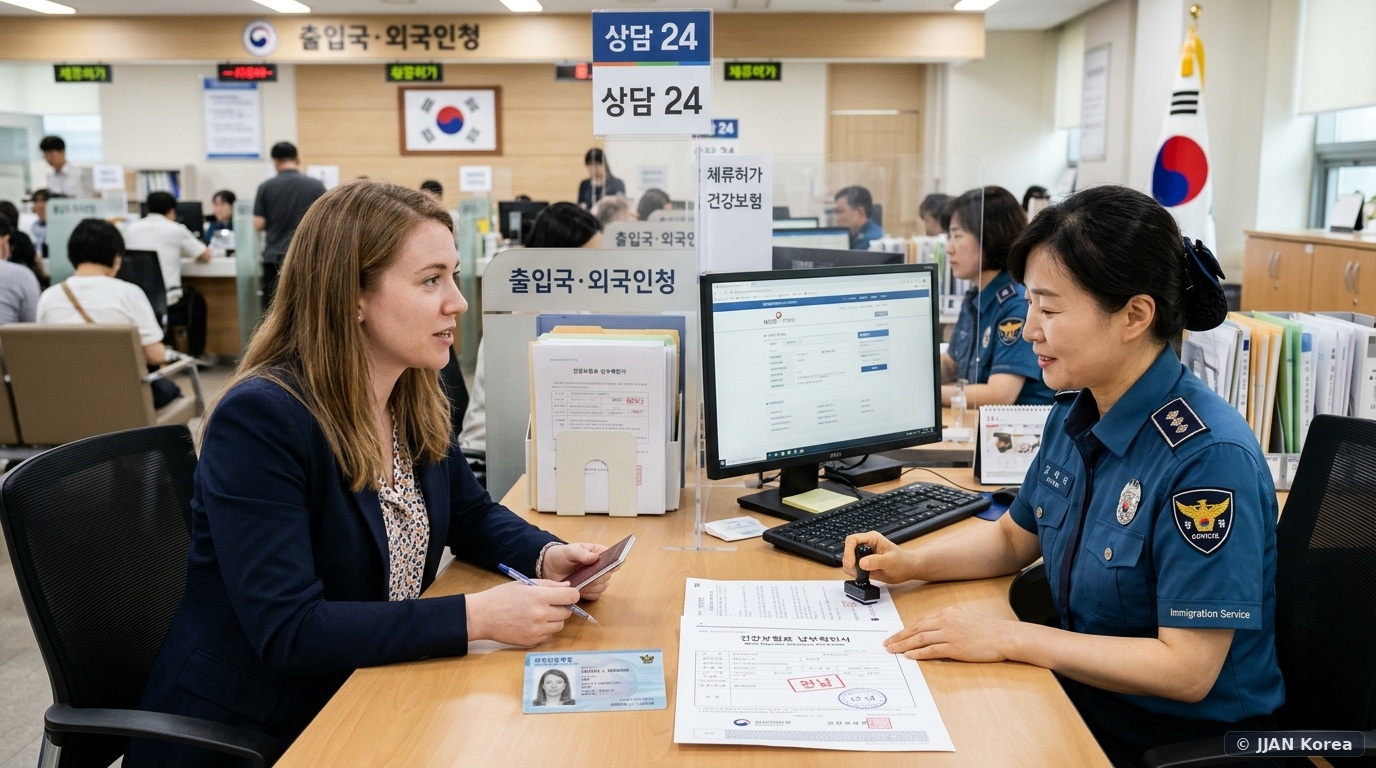
For foreign residents living in South Korea, maintaining an active, compliant visa status is closely tied to another vital administrative pillar: the National Health Insurance Service (NHIS / 국민건강보험). Under statutory data-sharing protocols established between the Ministry of Health and Welfare (MOHW) and the Ministry of Justice (MOJ) Korea Immigration Service, an expat’s immigration record is digitally linked to their health insurance contribution history.
Under Article 109 of the National Health Insurance Act and Article 9-2 of the Enforcement Regulations of the Immigration Act, registered foreigners who accrue health insurance premium arrears face automatic, non-negotiable administrative penalties. When delinquent foreign residents apply for a visa extension (체류기간 연장허가) or a change of status, immigration officers will reject the application or grant only a severely shortened temporary extension (under 6 months) until the entire debt is settled. Below is the comprehensive legal guide to understanding health insurance debt thresholds, preventing address-related delinquency, setting up installment payment plans (분할납부), and obtaining official clearance certificates to secure your visa renewal.
1. The Automated Immigration Lock: Arrears Thresholds & Sanctions
Immigration desk officers do not manually investigate health insurance records during visa appointments; the immigration screening terminal automatically executes an instantaneous database query against the NHIS central server. The statutory sanctions apply according to a progressive tier system:
| Arrears Status & Debt Amount | Immigration Visa Extension Sanction | Medical Facility Consequences |
|---|---|---|
| 1 to 2 Months Delinquency (Under 500,000 KRW) | Official warning; standard extension may be approved once | Full medical insurance coverage remains active. |
| 3+ Months Delinquency or 500,000+ KRW Debt | Shortened extension (strictly under 6 months) | Insurance benefits suspended; pay 100% full hospital costs. |
| Prolonged Delinquency / Repeated Non-Payment | Complete Visa Extension Denial & Departure Order | Asset seizure (bank accounts, wages, deposits frozen). |
| Installment Agreement Approved (분할납부) | Full Standard Visa Extension Approved (1 to 2 Years) | Immediate restoration of 100% health insurance benefits. |
Immediate Medical Suspension: When health insurance contributions are overdue for three or more billing cycles, NHIS automatically freezes your coverage. If you visit a Korean clinic, hospital, or pharmacy, you must pay 100% of non-subsidized medical expenses out of pocket—meaning an MRI or standard appendectomy that would normally cost 150,000 KRW can suddenly cost over 3,000,000 KRW.
2. How Foreigners Accidentally Accrue NHIS Arrears
Over 70% of foreign residents who discover insurance debt at immigration did not intentionally evade payment. In most cases, delinquency is caused by systemic administrative disconnects:
1. Moving Residence Without Updating NHIS
While foreigners are legally obligated under our analyzed 15-Day Residence Change Mandate to report new addresses to immigration, the National Health Insurance Service does not always immediately synchronize regional subscriber billing addresses. Paper billing statements continue to be mailed to your old studio or goshiwon, where new tenants discard them. Months later, accumulated bills and late surcharges (연체금) trigger an automated immigration hold.
2. Transitioning from Workplace to Regional Subscriber
When you leave a company (e.g., resigning from an E-7 tech job or changing language institutes on an E-2 visa), your employer cancels your Workplace Subscriber (직장가입자) status. The NHIS system automatically converts you into a Regional Subscriber (지역가입자). Regional health insurance premiums are billed separately to your home address, starting at approximately 150,000 KRW monthly. If you are unaware of this automatic conversion, arrears accumulate silently.
3. International Students Post-Graduation
International students on D-2 visas receive a statutory 50% discount on health insurance. Upon graduation or transitioning to a D-10 job seeker visa, the student discount terminates, and the standard regional premium applies. Unpaid balances quickly surpass the 500,000 KRW threshold.
3. Step-by-Step Procedure: Resolving Arrears & Restoring Visa Eligibility
If you discover that your visa extension is blocked due to health insurance arrears, take the following steps immediately to clear the hold before your visa expires:
Step 1: Check Exact Debt Balance via NHIS Center
Call the dedicated NHIS Foreigner Consultation Desk at 033-811-2000 (English, Chinese, Vietnamese, and Uzbek support available). Inquire about your total overdue balance, late surcharges, and the specific billing months involved. Alternatively, visit your regional NHIS branch office (국민건강보험공단 지사) in person with your Alien Registration Card.
Step 2: Choose Payment Method (Full Settlement vs. Installment Agreement)
Depending on your current financial liquidity, you have two statutory options under NHIS regulations:
- Full Immediate Settlement (완납): Pay the entire delinquent sum via virtual bank account transfer or credit card at the NHIS counter. The clearance is digitally transmitted to immigration servers within 2 to 4 hours.
- Installment Payment Agreement (분할납부 신청): If the total balance is large (e.g., exceeding 1,500,000 KRW), you can formally apply to pay the debt in monthly installments (ranging from 2 to 24 months). You must pay the first installment (typically 10% to 20% of the total balance) upfront. Upon approval, NHIS issues an official Installment Approval Notice (분납승인서).
Step 3: Obtain Official Clearance Certificates
Request that the NHIS officer issue a printed Certificate of Health Insurance Payment (건강보험료 납부확인서) or Certificate of Full Payment / Installment Approval (완납증명서 / 분납승인서). Verify that the document bears the official NHIS red circular seal.
Step 4: Present Clearance Document at Immigration
Take the original NHIS payment certificate to your scheduled immigration visa appointment. The immigration officer verifies the document against the internal database and lifts the extension hold, granting your full statutory visa extension (typically 1 to 2 years).
4. Employer Default Immunity: What If Your Boss Failed to Pay?
A critical legal distinction exists between Regional Subscriber (지역가입자) delinquency and Workplace Subscriber (직장가입자) delinquency under Article 109 of the National Health Insurance Act:
- Employer Responsibility: Under South Korean labor law, your employer is legally obligated to withhold your 50% health insurance contribution from your monthly paycheck and match it with a 50% employer contribution. If the employer fails to transfer these funds to NHIS, the legal delinquency belongs to the employer, NOT the foreign employee.
- Protecting Your Visa from Employer Delinquency: If an immigration officer flags an insurance hold caused by a delinquent employer, present your official monthly Pay Slips (급여명세서) or Withholding Tax Receipts proving that health insurance contributions were deducted from your earnings. Under Ministry of Justice administrative relief guidelines, a worker who proves paycheck deduction is granted full visa extension rights while NHIS pursues criminal distraint against the corporate owner.
5. Real-World Case Study: Resolving a 1.4 Million Won Delinquency in 48 Hours
Consider the case of Priya, an Indian IT marketing specialist residing in Mapo-gu. After resigning from an agency in January, Priya spent four months seeking a new position before securing an E-7 visa sponsorship in August. During her visa extension appointment, the immigration officer informed her that her application was blocked due to 1,420,000 KRW in accumulated regional health insurance premiums and late penalties.
Faced with an expiring ARC, Priya took immediate action:
- She visited the Mapo NHIS branch office the same morning.
- Because she could not pay the full lump sum immediately, she submitted an Application for Installment Payment (분할납부 신청서). NHIS approved a 6-month installment plan of 236,000 KRW per month, requiring an initial deposit of 250,000 KRW.
- Upon paying the first installment, NHIS issued an official Certificate of Installment Approval (체납보험료 분납승인서) bearing the official seal.
- Priya returned to the immigration office the following day. The officer entered the approval code into the immigration terminal and granted her a full 2-year E-7 visa extension without delay.
6. Crucial Checklist: Maintaining Clean NHIS Standing
- Set Up Automated Bank Debits (자동이체): Log in to your banking app or call NHIS to set up automatic monthly bank deductions on the 10th or 25th of each month, eliminating missed bills.
- Enroll in Electronic Billing (이메일·모바일 고지서): Switch from paper mail to mobile SMS or KakaoTalk billing to ensure you receive statements regardless of physical moves.
- Verify Coverage After Workplace Resignation: Check your NHIS status within 14 days of leaving a job to confirm whether you need to file as a regional subscriber or enroll under a family member’s policy as a dependent (피부양자).
- Update Domicile Simultaneously: Whenever moving apartments, notify NHIS directly by phone (033-811-2000) on the same day you register your move at the local Community Center.
5. Frequently Asked Questions (FAQ)
Q1. Can I be enrolled as a dependent (피부양자) under my spouse’s workplace health insurance?
Yes. If your spouse or immediate family member is employed full-time at a Korean company with workplace insurance, foreign spouses and children holding valid Alien Registration Cards can be registered as dependents (피부양자) free of charge. You must submit your official marriage certificate (apostilled or consular legalized) and family relation proof to NHIS.
Q2. If I leave South Korea permanently, will my health insurance be cancelled automatically?
Under NHIS regulations, once immigration registers your departure through Incheon Airport customs, your health insurance coverage is suspended. However, if you possess outstanding arrears from prior months, the debt remains logged on your ARC record. If you attempt to re-enter South Korea on a new visa years later, immigration will demand full repayment of past arrears before granting entry.
Q3. Can NHIS seize my personal bank account if I do not pay?
Yes. Under Article 81 of the National Health Insurance Act, NHIS possesses statutory authority to initiate administrative tax distraint (체납처분). If insurance premiums remain unpaid following formal demand notices, NHIS will freeze your Korean commercial bank accounts and seize funds up to the delinquent amount.
Q4. Which English hotline assists foreign residents with insurance billing questions?
Contact the National Health Insurance Service Foreigner Dedicated Line at 033-811-2000 (press extension 1 for English) Monday through Friday from 09:00 to 18:00 KST.
JJAN Korea Policy & Legal Verification Desk
Regulatory Reference: National Health Insurance Act (국민건강보험법) Articles 81 & 109, Enforcement Regulations of the Immigration Act Article 9-2, and Ministry of Justice Stay Management Guidelines.
Verification Authority: Republic of Korea National Health Insurance Service (국민건강보험공단) & Korea Immigration Service (출입국·외국인정책본부).